DIFFERENCE BETWEEN
JUDICIAL SEPARATION
AND DIVORCE
FAMILY LAW - 1
SEM - V
INTRODUCTION
• In Indian Society, marriage is considered as a
sacrament. It is an irrevocable relationship between
husband and wife established through rituals and
customs. Before 1955, there was no relief available to
either party in case of a failed marriage.
• After the passage of Hindu Marriage Act, 1955 things
changed in favor of both parties to the marriage. Now,
in case of a failed marriage, the parties do not need to
suffer in the marriage and can easily break their
matrimonial alliance through Judicial Separation or by a
decree of Divorce.
• Either party to the marriage, whether solemnized
before or after commencement of the Hindu Marriage
Act, 1955 can under Section 10 of the Act file a
petition for judicial separation.
• After a decree is passed in favor of the parties, they
are not bound to cohabit with each other.
• Some matrimonial rights and obligation, however,
continue to subsist.
WHAT IS A JUDICIAL SEPARATION?
• Under Section 13(1), judicial separation may be sought on the following grounds:
1. Adultery
2. Cruelty
3. Desertion
4. Conversion
5. Insanity
6. Leprosy
7. Venereal disease
8. Renounced the world
9. Has not been heard alive for seven years.
WHAT IS A JUDICIAL SEPARATION?
• Judicial Separation is a step prior to a divorce. The
purpose of judicial separation is to provide an
opportunity to the parties to reconcile their difference.
WHAT IS THE PURPOSE OF A JUDICIAL
SEPARATION?
• In case of divorce, parties cease to be husband and
wife. Divorce puts an end to the marriage and all
mutual rights, and obligations stand terminated. The
parties are free to marry again.
WHAT IS A DIVORCE?
• The grounds for divorce is mentioned under Section
13(1). The grounds of divorce and judicial separation
are the same. Apart from these grounds, the wife may
seek divorce on additional grounds
• The parties are also free to present a petition in case
there is no resumption of cohabitation between the
parties to the marriage for a period of one year or
more after the passing of judicial separation by the
court.
GROUNDS FOR DIVORCE?
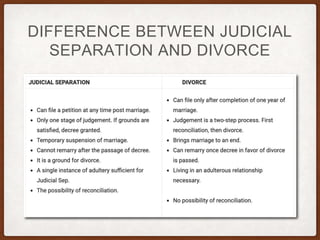
DIFFERENCE BETWEEN JUDICIAL
SEPARATION AND DIVORCE
CONCLUSION
• Before 1955, there was no provision for separation or
divorce. Reforms introduced in the Hindu Law by way
of legislation and amendments is a welcome step by
the government.
• The two relieves granted by the HMA,1955 have
proven to be effective in resolving disputes between
parties by giving them an opportunity to reconcile their
difference or by releasing them from marital ties.
THANK YOU