Javascript basic course

 Values and practices change
everyday, but principle does not.
What we're learning today?

● Javascript introduction (5 mins)
● Basic concepts (20 mins)
● OOP in Javascript (20 mins)
Introduction

● Original created and used in Netscape.
● A prototype based scripting language.
● Was formalized in the ECMAScript
  language standard.
● Using commonly in web, and also for
  other server side/desktop applications.
● JavaScript™ is a registered trademark of
  Oracle corporation.
Basic concepts of Javascript

 ● Variable scope
 ● What is this?
 ● Closure
 ● Prototype
Variable scope
  Global                            Local

    ● Declared outside functions.     ● Declared inside function
    ● Can be accessed everywhere.     ● Can be accessed only inside the
                                        function.
What is this?

All javascript code is executed in an execution context.
 ● Global code runs in Global execution context.
 ● Invocation of a function runs in a associated execution
    context.

this = object for getting the current execution context.
Closure
When you return a function => you're creating a closure.


A closure is a special object that combines two things:
 ● Function
 ● Binding local variables at the time that the function was
   created.
Closure example-1
 function add(x) {
    return function(y) {
        return x + y;
    };
 }
 var add5 = add(5);
 var result = add5(3);
 console.log(result);

 Guess the result?
Closure example-2 (Infamous loop)
 function addLinks() {
    for(var i=0, link; i< 5; i++) {
       link = document.createElement("a");
       link.innerHTML = "Link " + i;
       link.onclick = function() {
            alert(i);
       };
    }
 }
 window.onload = addLinks();
Closure example-2 (Infamous loop-fixed)
function addLinks() {
   for(var i=0, link; i< 5; i++) {
      link = document.createElement("a");
      link.innerHTML = "Link " + i;
      link.onclick = function(num) {
            return function() {
               alert(num);
            };
      } (i);
   }
}
window.onload = addLinks();
Prototype
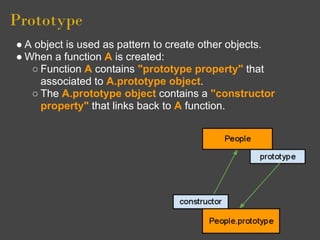
● A object is used as pattern to create other objects.
● When a function A is created:
   ○ Function A contains "prototype property" that
     associated to A.prototype object.
   ○ The A.prototype object contains a "constructor
     property" that links back to A function.
Prototype 

function People() {

}
Prototype 

function People() {

}

var steve = new People()

People.prototype object is
used as reference for
method look up and
construct the new object.
OOP in Javascript
● Private, public, privilege
● Inheritance
● Modularization with namespace
Private

Private variable      Private function

function People() {   function People() {
  var name;             //declaration-w1
                        var sayHello = function()
}                       {
                        ...
                        }
                        //declaration-w2
                        function sayHello() {
                         ...
                        }
                      }
                      Private function can access to private
                      variable or global variable only
Public

Public variable       Public function

function People() {   function People() {
  this.name = null;
                      }
}
                      People.prototype.sayHi = function() {
                      ...
                      }

                      Public functions cannot access to
                      private variables/functions.
Privilege functions

Declaration                Usage

function People() {         ● To introduce private
 this.sayHi = function()      variable/functions to public function.
 {
 ...
 }

}
Private-public-privilege access matrix


                    Private func   Privilege func   Public func


 Private var/func   YES            YES              NO


 Public var/func    NO             YES              YES


 Privilege func     NO             YES              YES
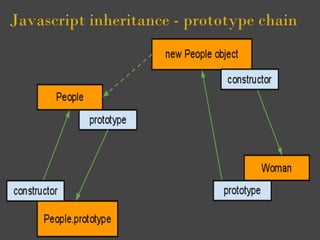
Javascript inheritance

function People() {

}

function Woman() {

}

//Make Woman inherits from People
Woman.prototype = new People();
Woman.prototype.constructor = Woman;
Javascript inheritance - prototype chain
Javascript inheritance - call super method

function People() {
}
People.prototype.sayHi = function() {
...
}

function Woman() {

}

Woman.prototype = new People();
Woman.prototype.constructor = Woman;
Woman.prototype.sayHi = function() {
  People.prototype.sayHi.call(this);
  ...
}
Methods look up in the prototype chain

1. An object's methods (like all properties) are found by
   walking up the object's prototype chain.
2. The entries in the prototype chain are references to ordinary
   objects.
3. Object.create() or the new operator creates objects with
   a prototype chain.
Modularization with namespace

Namespace helps you organize your code better and limits bugs
caused by "name violation".

pyco = pyco || {};
pyco.app = pyco.app || {}

=> you have namespace: pyco.app
Now add functions to your pyco.app namespace:

pyco.app.Menu = new function() {
...
}
...
References:

● https://developer.mozilla.org/en/JavaScript/Guide/Closures
● https://developer.mozilla.
  org/en/JavaScript/Guide/Inheritance_constructor_prototype
● http://robertnyman.com/2008/10/09/explaining-javascript-
  scope-and-closures/
● http://javascript.crockford.com/prototypal.html
● http://www.crockford.com/javascript/private.html
● High performance Javascript book - Nicholas.C.Zakas.
Question?