



Java Modules
(why your stuff stopped working)
@bbdsoftware
@rorypreddy
Meet Rory
• Developer in R&D team at BBD
• Organizer for the Java and AWS User groups
• Not related to Tyrion Lannister
• Don’t do kids parties
@rorypreddy
Agenda
• Introduction
• Modules 101
• Jlink
• Demo
• Migrating to Java 9+
common/hadoop-common-3.0.0-SNAPSHOT.jar:common/hadoop-nfs-3.0.0-SNAPSHOT.jar:common/lib/activation-1.1.jar:common/lib/apacheds-i
18n-2.0.0-M15.jar:common/lib/apacheds-kerberos-codec-2.0.0-M15.jar:common/lib/api-asn1-api-1.0.0-M20.jar:common/lib/api-util-1.0
.0-M20.jar:common/lib/asm-3.2.jar:common/lib/avro-1.7.4.jar:common/lib/commons-beanutils-1.7.0.jar:common/lib/commons-beanutils-
core-1.8.0.jar:common/lib/commons-cli-1.2.jar:common/lib/commons-codec-1.4.jar:common/lib/commons-collections-3.2.1.jar:common/l
ib/commons-compress-1.4.1.jar:common/lib/commons-configuration-1.6.jar:common/lib/commons-digester-1.8.jar:common/lib/commons-ht
tpclient-3.1.jar:common/lib/commons-io-2.4.jar:common/lib/commons-lang-2.6.jar:common/lib/commons-logging-1.1.3.jar:common/lib/c
ommons-math3-3.1.1.jar:common/lib/commons-net-3.1.jar:common/lib/curator-client-2.7.1.jar:common/lib/curator-framework-2.7.1.jar
:common/lib/curator-recipes-2.7.1.jar:common/lib/gson-2.2.4.jar:common/lib/guava-11.0.2.jar:common/lib/hadoop-annotations-3.0.0-
SNAPSHOT.jar:common/lib/hadoop-auth-3.0.0-SNAPSHOT.jar:common/lib/hamcrest-core-1.3.jar:common/lib/htrace-core4-4.0.1-incubating
.jar:common/lib/httpclient-4.2.5.jar:common/lib/httpcore-4.2.5.jar:common/lib/jackson-core-asl-1.9.13.jar:common/lib/jackson-jax
rs-1.9.13.jar:common/lib/jackson-mapper-asl-1.9.13.jar:common/lib/jackson-xc-1.9.13.jar:common/lib/java-xmlbuilder-0.4.jar:commo
n/lib/jaxb-api-2.2.2.jar:common/lib/jaxb-impl-2.2.3-1.jar:common/lib/jcip-annotations-1.0.jar:common/lib/jersey-core-1.9.jar:com
mon/lib/jersey-json-1.9.jar:common/lib/jersey-server-1.9.jar:common/lib/jets3t-0.9.0.jar:common/lib/jettison-1.1.jar:common/lib/
jetty-6.1.26.jar:common/lib/jetty-util-6.1.26.jar:common/lib/jsch-0.1.51.jar:common/lib/json-smart-1.1.1.jar:common/lib/jsp-api-
2.1.jar:common/lib/jsr305-3.0.0.jar:common/lib/junit-4.11.jar:common/lib/log4j-1.2.17.jar:common/lib/mockito-all-1.8.5.jar:commo
n/lib/netty-3.6.2.Final.jar:common/lib/nimbus-jose-jwt-3.9.jar:common/lib/paranamer-2.3.jar:common/lib/protobuf-java-2.5.0.jar:c
ommon/lib/servlet-api-2.5.jar:common/lib/slf4j-api-1.7.10.jar:common/lib/slf4j-log4j12-1.7.10.jar:common/lib/snappy-java-1.0.4.1
.jar:common/lib/stax-api-1.0-2.jar:common/lib/xmlenc-0.52.jar:common/lib/xz-1.0.jar:common/lib/zookeeper-3.4.6.jar:hdfs/hadoop-h
dfs-3.0.0-SNAPSHOT.jar:hdfs/hadoop-hdfs-nfs-3.0.0-SNAPSHOT.jar:hdfs/lib/commons-daemon-1.0.13.jar:hdfs/lib/hadoop-hdfs-client-3.
0.0-SNAPSHOT.jar:hdfs/lib/hpack-0.11.0.jar:hdfs/lib/leveldbjni-all-1.8.jar:hdfs/lib/netty-all-4.1.0.Beta5.jar:hdfs/lib/okhttp-2.
4.0.jar:hdfs/lib/okio-1.4.0.jar:hdfs/lib/xercesImpl-2.9.1.jar:mapreduce/hadoop-mapreduce-client-app-3.0.0-SNAPSHOT.jar:mapreduce
/hadoop-mapreduce-client-common-3.0.0-SNAPSHOT.jar:mapreduce/hadoop-mapreduce-client-core-3.0.0-SNAPSHOT.jar:mapreduce/hadoop-ma
preduce-client-hs-3.0.0-SNAPSHOT.jar:mapreduce/hadoop-mapreduce-client-hs-plugins-3.0.0-SNAPSHOT.jar:mapreduce/hadoop-mapreduce-
client-jobclient-3.0.0-SNAPSHOT.jar:mapreduce/hadoop-mapreduce-client-nativetask-3.0.0-SNAPSHOT.jar:mapreduce/hadoop-mapreduce-c
lient-shuffle-3.0.0-SNAPSHOT.jar:mapreduce/hadoop-mapreduce-examples-3.0.0-SNAPSHOT.jar:yarn/hadoop-yarn-api-3.0.0-SNAPSHOT.jar:
yarn/hadoop-yarn-applications-distributedshell-3.0.0-SNAPSHOT.jar:yarn/hadoop-yarn-applications-unmanaged-am-launcher-3.0.0-SNAP
SHOT.jar:yarn/hadoop-yarn-client-3.0.0-SNAPSHOT.jar:yarn/hadoop-yarn-common-3.0.0-SNAPSHOT.jar:yarn/hadoop-yarn-registry-3.0.0-S
NAPSHOT.jar:yarn/hadoop-yarn-server-applicationhistoryservice-3.0.0-SNAPSHOT.jar:yarn/hadoop-yarn-server-common-3.0.0-SNAPSHOT.j
ar:yarn/hadoop-yarn-server-nodemanager-3.0.0-SNAPSHOT.jar:yarn/hadoop-yarn-server-resourcemanager-3.0.0-SNAPSHOT.jar:yarn/hadoop
-yarn-server-sharedcachemanager-3.0.0-SNAPSHOT.jar:yarn/hadoop-yarn-server-web-proxy-3.0.0-SNAPSHOT.jar:yarn/lib/aopalliance-1.0
.jar:yarn/lib/commons-math-2.2.jar:yarn/lib/curator-test-2.7.1.jar:yarn/lib/fst-2.24.jar:yarn/lib/guice-3.0.jar:yarn/lib/guice-s
ervlet-3.0.jar:yarn/lib/javassist-3.18.1-GA.jar:yarn/lib/javax.inject-1.jar:yarn/lib/jersey-client-1.9.jar:yarn/lib/jersey-guice
-1.9.jar:yarn/lib/objenesis-2.1.jar
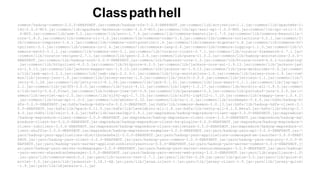
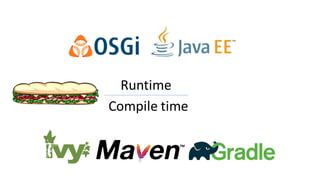
Classpathhell
Runtime
Compile time
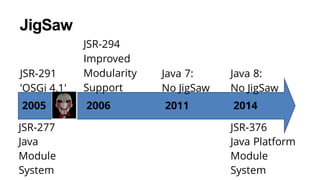
JigSaw
2011
JSR-294
Improved
Modularity
Support
2006
Java 7:
No JigSaw
Java 8:
No JigSaw
JSR-376
Java Platform
Module
System
JSR-277
Java
Module
System
2005
JSR-291
'OSGi 4.1'
2014
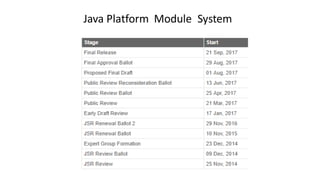
Java Platform Module System
Why Modules?
• Reliable configuration
+
• Strong encapsulation
• Leads to:
• Scalable Java platform
• Greater platform integrity
• Improved performance
-Compile + Runtime
-Cleaner, more logical designs
-95 Modules
-sun.misc.Unsafe
-Lazy loading
Modules 101
“Programming is breaking of one big
impossible task into several very small
possible tasks”.
-Jazzwant
Define a Module
- Its name
- The packages it makes available publicly
- The modules it depends on
module name
exports
requires
module-info.java
Some Rules
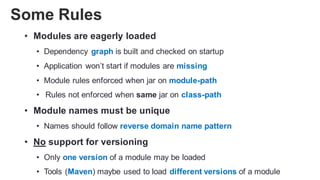
• Modules are eagerly loaded
• Dependency graph is built and checked on startup
• Application won’t start if modules are missing
• Module rules enforced when jar on module-path
• Rules not enforced when same jar on class-path
• Module names must be unique
• Names should follow reverse domain name pattern
• No support for versioning
• Only one version of a module may be loaded
• Tools (Maven) maybe used to load different versions of a module
Example – com.coffee
com.coffee
|
---com
---coffee
| Coffee.class
| CoffeeMaker.class
|
---types
Arabica.class
Robusta.class
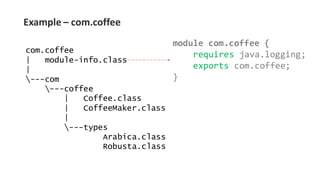
Example – com.coffee
com.coffee
| module-info.class
|
---com
---coffee
| Coffee.class
| CoffeeMaker.class
|
---types
Arabica.class
Robusta.class
module com.coffee {
requires java.logging;
exports com.coffee;
}
Example – com.app
com.app
|
---com
---app
CoffeeApp.class
TeaApp.class
Example – com.app
com.app
| module-info.class
|
---com
---app
CoffeeApp.class
TeaApp.class
module com.app {
requires com.coffee;
requires com.tea;
requires java.sql;
requires java.logging;
}
Readability And Accessibility
Write code that is easy to delete, not easy
to extend.
- Tef, Programming is Terrible
Readability - Direct Readability
com.app
com.coffee
com.tea
java.logging
java.base
java.sql
java.xml
Readability - Implied Readability
module java.sql {
requires transitive java.logging;
requires transitive java.xml;
exports java.sql;
exports javax.sql;
exports javax.transaction.xa;
}
String url = ...;
Properties props = ...;
Driver d = DriverManager.getDriver(url);
Connection c = d.connect(url, props);
d.getParentLogger().info("Connection acquired");
com.app
com.coffee
com.tea
java.logging
java.base
java.sql
java.xml
Accessibility
• Other modules can only see and use code if:
1. public
2. package is exported by target module
3. package is readable from this module
• Combination referred to as "accessibility"
Accessibility
package com.app;
import com.coffee.Coffee;
import com.coffee.CoffeeMaker;
import com.coffee.types.Arabica;
import …
public class CoffeeApp {…
The type com.coffee.types.Arabica is not
accessible
module com.app {
requires com.coffee;
requires com.tea;
requires com.coffee.types;
}
com.coffee.types cannot be resolved to a module
Accessibility
Unnamed And Automatic Modules
“Programs must be written for people to
read, and only incidentally for machines
to execute”.
-Harold Abelson
Unnamed Module
-Used for
-Java 8 and older versions
-Small or temporary applications
- Added via the class path
- The unnamed module reads code in any other module
- The unnamed module exports all of its packages.
>jdeps minecraft1.12.jar
Warning: split package: javax.annotationjrt:/java.xml.ws.annotation server.jar
com.google.gson-> java.sql
<unnamed> -> com.google.common.base
….
Automatic Modules
• JAR from the class path that has been put in the module path.
• Don’t wait for third party libraries to become modularized.
• Becomes a named module with
• Automatic-Module-Name in Manifest.mf
• Otherwise, a name is derived from the JAR filename
• Reads every other named module.
• Exports all of its packages.
• It guarantees direct and implied readability to all other modules.
Summary of Readability
Module Type Origin Export
Packages
Read Modules
Named Platform Provided by platform Explicitly
NamedApplication All JARS containing
module-info on the
module path
Explicitly • Platform
• Application
• Automatic
• Unnamed
Automatic All JARs without
module-info but on
module path
All • Platform
• Application
• Automatic
• Unnamed
Unnamed Classpath All • Platform
• Automatic
• Application
Cloud-native is an approachto building and running
applicationsthat exploits the advantages of the
cloud computing delivery model.
Source: https://pivotal.io/cloud-native
jlink
jlink
jlink
java.sql
java.xml
java.base
java.logging
com.app
Modular run-time
image
…confbin jmods
jlink
$ jlink --module-path $JDKMODS:$MYMODS 
--add-modules com.app 
–-output myimage
$ myimage/bin/java –-list-modules
com.app
com.coffee@1.0
com.tea@1.0
java.base@10
java.sql@10
java.logging@10
27 MBs vs 226 MBs
Demo
http://github.com/roryp/spring-maven-modules
Migrating to Java 9
Migrating to Java 9+
module
java.base
module
java.sql
module
java.logging
module
java.xml
myapp.jar mylib.jar
lib1.jar otherapp.jar lib2.jar
Bottom Up
Library Migration
Top Down
App MigrationYour app
Libraries and
Third party apps
JDK
module
java.base
module
java.sql
module
java.logging
module
java.xml
module
myapp
module
mylib
lib1.jar otherapp.jar lib2.jar
Top Down
App MigrationYour app
Libraries and
Third party apps
JDK
AUTOMATIC MODULE
Migrating to Java 9+
(Migrating your application and using “not migrated” libraries that are still residing on the classpath)
Bottom Up
Library Migration
module
java.base
module
java.sql
module
java.logging
module
java.xml
myapp.jar mylib.jar
module
lib1
module
otherapp
module
lib2
Your app
Libraries and
Third party apps
JDK
UNNAMED MODULE
Migrating to Java 9+
(Migrating the libraries first and using migrated modularized libraries while your app is still on the class path)
HOW TO MODULARIZE
• Introduce a module-info.java file for each module
• A module-info.java file can be:
• Created manually by the developers
• Automatically generated using the JDeps tool
with the option --generate-module-info
MODULARIZE - Issues
1) Encapsulated JDK internal APIs
2) Not resolved modules
3) Cyclic dependencies
4) Split packages
ENCAPSULATED JDK INTERNAL API
• Most of the internal JDK APIs are inaccessible in Java 9
• Trying to access them causes a compilation error
• Internal APIs are in the sun.* package are part of the
jdk.unsupported module . Not java.base
• The module jdk.unsupported provides:
• sun.misc.Unsafe,
• sun.reflect.Reflection,
• …
batik-codec.jar -> JDK removed internal API
JDK Internal API Suggested Replacement
---------------- ---------------------
com.sun.image.codec.jpeg.JPEGCodec Use javax.imageio @since 1.4
com.sun.image.codec.jpeg.JPEGDecodeParam Use javax.imageio @since 1.4
ENCAPSULATED JDK INTERNAL APIS
• JDeps can report internal dependencies
$ jdeps --jdk-internals 'lib/batik/batik-codec.jar'
Solve the problem of JDK internal APIs:
• Replace each of your JDK internal APIs calls with
supported APIs.
OR
• Break the encapsulation with --add-exports
--add-exports java.base/sun.net=ALL-UNNAMED
NOT RESOLVED PLATFORM MODULES
• From jdk-9+118 running code on the class path , these types will not be visible by
default:
• java.activation
• java.annotations.common
• java.corba
• java.transaction
• java.xml.bind
• java.xml.ws
NOT RESOLVED PLATFORM MODULES
• Make that module available for compilationwith --add-modules:
>Javac --add-modules java.xml.bind
• And again for execution:
>java --add-modules java.xml.bind
CYCLIC DEPENDENCIES
• Forbidden at compile-time (between modules)
• JPMS does not allow cycles in the “requires” clauses
• JPMS allows cycles in the “reads” relation of run-time modules
module A {
requires B;
}
module B {
requires A;
}
• One solution is to merge the JARs into a single module
SPLIT PACKAGES
• Modules that contain packages having the same name must not
interfere with each other
• Solution for JAR files:
1. Create a single JAR file out of the two JAR files
2. Rename one of the package
• Solution for modules:
1. Create a single module out of two or more modules
2. Create a third module
3. Remove the package dependencies
Looking Ahead
Do not add a module-info.java module declaration until:
1. All of your runtime dependencies have been modularised
• (either as a full module or with a MANIFEST.MF entry)
2. All those modularised dependencies have been released to Maven Central
3. Your library depends on the updated versions
If you can't meet these 3 criteria
• Add a MANIFEST.MF entry following the agreed module naming conventions
Module Hell
If everyone does this
we stand a reasonable chance of avoiding Module Hell
Questions?
• http://github.com/roryp/javamodules
• http://github.com/roryp/spring-maven-modules @bbdsoftware
@rorypreddy