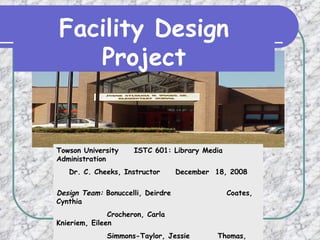
Facility Design Project Towson University  ISTC 601: Library Media Administration Dr. C. Cheeks, Instructor  December  18, 2008 Design Team:  Bonuccelli, Deirdre  Coates, Cynthia    Crocheron, Carla  Knieriem, Eileen   Simmons-Taylor, Jessie  Thomas, Pamela
Samples of Programs Justification Beautiful facility Opened for 1999-2000 school year Lacks functionality Meets standards?
Facility  Guidelines : Areas of LMC PGCPS Process Guide   Main Class  Conference  Listening and Viewing Media Production/Studio Storage Office and/or Work  Professional Reading Stack Standards for SLM Programs in Md and Facilities Guidelines for LM Programs Study and Research Area Informal Reading Area Instructional Area Production and Group Project Administrative
Floor Plan Considerations   Access points Technology connectivity Stationary/ wireless access Visual supervision Technical integration Small group areas Instructional area
Sample Programs Flexibility  in Design
Sample Programs School Example Wisconsin :  Standards Layout Reference Story telling Instructional Reading Production Storage  Conference  Office Maine :  Considerations   Single story, ground  Accessibility to all points of school  ADA regulations Acoustics Flexibility Population growth Community access
Sample Programs Texas Six Standards: Learner Centered…. Teaching and Learning Program Leadership and Management Technology and Information Access Library Environment Connections to Community Information Science and Librarianship
Sample Programs Georgia-  Carroll County, Central High School Fast-growing school district about 50 miles west of Atlanta.  Charrette indicated architects did not meet educational requirements Purpose of Library
Sample Programs An Architect needs to….. listen carefully visit other libraries with a LMS understand LMS is the expert on library programs and functions understand program is driving force of facility layout be flexible
Floor Plan Design Before Actual Blueprint
Floor Plan: Before
Floor Plan Design Before Welcome to Judge Sylvania W. Woods, Sr. Elementary Library Media Center
Floor Plan Design Before At Entrance: Circulation Desk and Instructional Area
Floor Plan Design Before Left of Entrance
Floor Plan Design Before Circulation Desk, Instructional Area, Other teaching areas not related to Media Center
Floor Plan Design Before Left of entrance, behind circulation desk
Floor Plan Design Before Shelving to right of entrance
Floor Plan Design Before Shelving and doors to office, crisis center, storage area, head room
Floor Plan Design Before Office windows, shelving
Floor Plan Design Before Looking across Media Center from office hallway. Door on right goes to two “classrooms”. Door on left goes to the listening area.
Floor Plan Design Before Outside view of the Storytelling Area
Floor Plan Design Before Inside view of the Storytelling Area
Floor Plan Design Before Shelving along the section next to Storytelling Area
Floor Plan Design Before View of the ceiling: 100% skylight
School Profile History Opened doors fall 1999 Dodge Park students merged there Dodge Park closed, then renovated Judge Woods students moved back
School Profile Demographics Enrollment  592 students  Grades HS - 6 th CSEP program with enrollment of 51 students in grades K -6 MEANS program in 2nd and 3rd grade with an enrollment of 29 students.  An America’s Choice school
Educational Specifications Space Standards Safety Measures  Flooring Power requirements Wall paint Flexible shelving
Furniture:  Teen Reading Area Lunar Lounger   Lunar Lounger Black With Silver Frame   Funky Camo© Carpets
Furniture:   Pre-K Room Royal Seating™ Prima Stack Chairs   Royal Seating Prima Color-banded Tables   Animal Friends Seating
Furniture:  Storytelling Area Glider Rocker
Furniture:   Main Area Community Edwards Library Tables   Community 2-position and 3-position Chairs
Furniture:   Main Area MODULAR CIRCULATION DESKS Some modular units are wheelchair accessible . Eurotech Executive Chairs
Furniture:   Career Room Plus Sofas   Plus Chairs   Fabric Selection:  Slideshow Blueprint
Furniture for Technology Ergonomically Correct Chairs
Furniture for Technology Ergonomically Correct Workstation
iMacs
Aesthetics
Wireless LAN
Laptop Tray and Footrest
Environmental Design Elements Thermal Lighting Natural light is prominent  Electrical Determining power capabilities Step1:how many amps you will be running Step 2: calculate total number of amps per powered series Step 3: divide by 16 Step 4: this equals number of circuits you require Step 5: Repeat steps 1-4 for each powered series Acoustics Color
Environmental Design Acoustics Color What mood do you want to create?  Which colors will help you achieve that  mood? http://freshome.com/2007/04/17/room-color-and-how-it-affects-your-mood/
Environmental Design GREEN   Mid to light  - relaxing and peaceful.  BLUE Mid to deep -  instills feelings of trust, expansiveness and confidence brings down blood pressure and slows respiration and heart rate.   RED   invokes feelings of power, fire, alarm, danger and emergency.  raises a room’s energy level.  http://jrscience.wcp.muohio.edu/nsfall99/ProposalArticles/Draft1Howcoloreffectsyour.html
GOING GREEN
Going Green Going green has become very popular in public and private schools. So far at least 50 schools have gone green from the state of Maine to the state of California.
Why Go Green? A Healthy Environment Teacher Retention Financial Gains Hands-on-learning
Going Green Examples Some examples of going green is as follows: Using less energy Using less water Using paint that does not have lead
USGBC According to the U.S. Green Building Council (USGBC) green schools use 33 percent less energy  32 percent less water. Savings  $60,000 in energy bills 360,000 gallons (43%)of water a year.
What We Would Save If every new school or every renovated school were totally green, in just energy savings alone, the school would save approximately $20 billion dollars over a 10 year time frame. Although money is a driving force, there is more to going green than money.
A 2006 report by the American Federation of Teachers called “Building Minds, Minding Buildings” made some astounding discoveries. 14 million students attend schools dangerous to their health and considered substandard.
What Studies Show Studies show the physical condition of a school building impacts student learning. Primary causes effecting student performance.  lighting  air quality Three elementary schools  were examined in California, Washington, and Colorado.
It was found that classrooms with abundant light had students with higher learning rates, and better test scores than students in classrooms that did not have the same amount of natural light. A report by the U.S. Green Building Council showed test scores went up dramatically in Charles Young Elementary School after the school was renovated in Washington, D.C. in 1997.
Over half of our nations schools, approximately 115,000 schools, are linked to poor indoor air quality Teachers and students spend most of their time indoors during the school day. This leads to asthma attacks and respiratory infections which lead to more sick days.
Accommodations for Special Learners Aspects of ADA standards Access to resources Electronic catalogs Stacks Fixed seating Check out area Wheelchair access Door opening/closing Floor skid resistant Heavy traffic area Floor textures Signage
Accessibility for Students with Disabilities
Guidelines Public schools have guidelines that they must adhere to for students with disabilities. These standards apply to new construction or a school undergoing renovations.
Guidelines When the guidelines were developed, they were developed with adults in mind. The guidelines are adjusted when necessary when it comes to children. These guidelines were developed by the U.S. Architectural and Transportation Barriers Compliance Board in January of 1998.
Guidelines These guidelines are federal guidelines and were to be incorporated into the Americans Disabilities Act Accessibility Guidelines in 1998. Schools, Staff, parents and designers have access to these guidelines.
Guidelines One set of standards that apply to school libraries in the ADAAG guidelines is: Standard 4.0: Accessible Elements and Spaces: Scope & Technical Requirements
ADAAG Standards 4.1   Minimum Requirements 4.2   Space Allowance and Reach Ranges 4.3   Accessible Route 4.4  Protruding Objects 4.5   Ground and Floor Surfaces
ADAAG Standards 4.13  Doors 4.25  Storage 4.27  Controls and Operating Mechanisms 4.28  Alarms 4.30  Storage 4.31  Telephones 4.32  Fixed or Built-in Seating and Tables 4.32.5  Children’s Fixed or Built in Seating and Tables
ADA Guidelines The other set of standards that apply to school libraries is: 8.0: Libraries 8.1  General 8.2  Reading and Study Areas 8.3  Checkout Areas 8.4  Card Catalogs and Magazine Displays 8.5  Stacks Appendix A.4.2.5  Reach – Children’s Reach Ranges
COMAR Another set of guidelines that should be looked at is the Maryland Accessibility Code (COMAR .05.02.02). These accessibility codes apply to new construction and facilities that are undergoing renovations as well.
Relocation  and  Moving Plans Introduction: Ideal & Real World Timeline Shift Maps of Paths & Areas Revision of the Plan Throughout the Process & Explain the Different Phases
Relocation  and  Moving Plans Public Info: Up-To-Date & Frequent  Recommendations for Closure Comparisons Between Current Collection Holdings & New Collection Capacity  Explain the Growth Spaces & Even Distribution Throughout the Collection
Outcomes and Recommendations After the remodeling, this elementary school will contain the following areas: Conference Room Computer Lab and Multimedia Production Room (Listening and Viewing Area) Informal Reading Area 2 Instructional Areas (one for primary and one for intermediate) Story area for the younger students Office Communications Distribution Room Workroom and Career Office Equipment Storage Room
Floor Plan: After
Bibliography See Binder