The web framework for perfectionists with deadlines


James Casey
2nd October 2009
What’s Django?
“Django is a high-level Python Web framework that
encourages rapid development and clean, pragmatic
design.”


from http://djangoproject.org/
Whence Django ?
‣ Internal project of newspaper in 2003
  ‣ Lawrence Journal-World
‣ Should help journalist meet faster deadlines
‣ Should not stand in the way of journalists
‣ Named after the famous guitarist Django
  Reinhardt
Django in the news

     ‣ http://mps-expenses.guardian.co.uk/
     ‣ MP expense scandal
        ‣ crowdsourcing the review of 500K
          documents
        ‣ 7 days from proof-of-concept to launch


http://simonwillison.net/2009/talks/europython-crowdsourcing/
Django won a pulitzer

     ‣ http://polifact.com/
        ‣ Fact checking in 2008 US presidental
          election
     ‣ Lead developer was former journalist
        ‣ It was his first django application


http://www.mattwaite.com/posts/2007/aug/22/announcing-politifact/
Overview
Principles
‣ DRY (Don’t Repeat Yourself)
‣ Write less code
‣ Make CRUD easy
‣ DB neutral
 ‣ Oracle, MySQL, PostgreSQL, SQLlite
‣ Deployment platform neutral
 ‣ mod_python, WSGI, ...
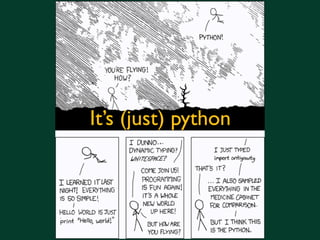
It’s (just) python
Features
‣ Object-relational mapping (ORM)
‣ Automatic admin interface
‣ Elegant URL design
‣ Template system
‣ Caching
‣ i18n
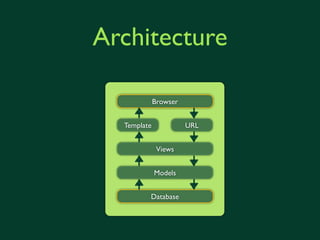
Architecture

             Browser


  Template             URL


              Views


             Models


         Database
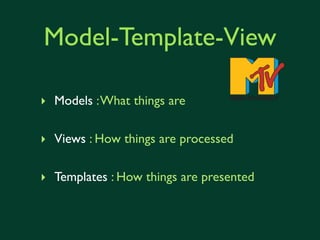
Model-Template-View

‣ Models : What things are

‣ Views : How things are processed

‣ Templates : How things are presented
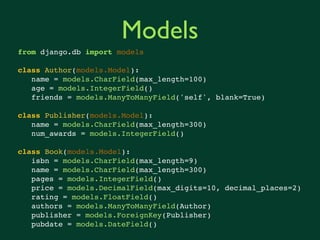
Models
from django.db import models

class Author(models.Model):
   name = models.CharField(max_length=100)
   age = models.IntegerField()
   friends = models.ManyToManyField('self', blank=True)

class Publisher(models.Model):
   name = models.CharField(max_length=300)
   num_awards = models.IntegerField()

class Book(models.Model):
   isbn = models.CharField(max_length=9)
   name = models.CharField(max_length=300)
   pages = models.IntegerField()
   price = models.DecimalField(max_digits=10, decimal_places=2)
   rating = models.FloatField()
   authors = models.ManyToManyField(Author)
   publisher = models.ForeignKey(Publisher)
   pubdate = models.DateField()
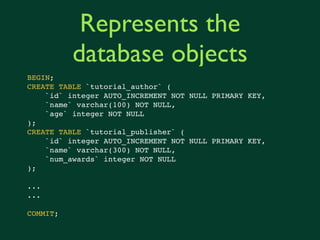
Represents the
          database objects
BEGIN;
CREATE TABLE `tutorial_author` (
    `id` integer AUTO_INCREMENT NOT NULL PRIMARY KEY,
    `name` varchar(100) NOT NULL,
    `age` integer NOT NULL
);
CREATE TABLE `tutorial_publisher` (
    `id` integer AUTO_INCREMENT NOT NULL PRIMARY KEY,
    `name` varchar(300) NOT NULL,
    `num_awards` integer NOT NULL
);

...
...

COMMIT;
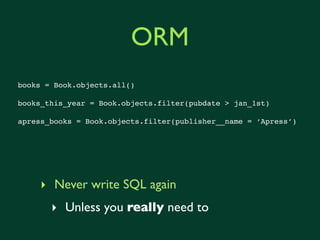
ORM
books = Book.objects.all()

books_this_year = Book.objects.filter(pubdate__gt = jan_1st)

apress_books = Book.objects.filter(publisher__name = ‘Apress’)


     ‣ Never write SQL again
       ‣ Unless you really need to
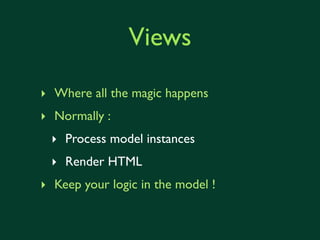
Views
‣ Where all the magic happens
‣ Normally :
 ‣ Process model instances
 ‣ Render HTML
‣ Keep your logic in the model !
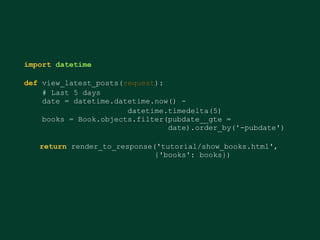
import datetime

def view_latest_books(request):
    # Last 5 days
    date = datetime.datetime.now() -
                       datetime.timedelta(5)
    books = Book.objects.filter(pubdate__gte =
                                date).order_by('-pubdate')

   return render_to_response('tutorial/show_books.html',
                             {'books': books})
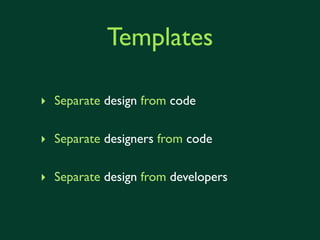
Templates

‣ Separate design from code

‣ Separate designers from code

‣ Separate design from developers
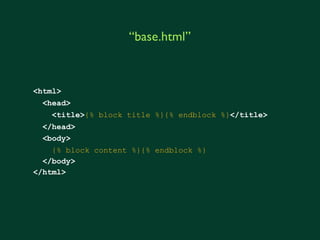
“base.html”


<html>
  <head>
    <title>{% block title %}{% endblock %}</title>
  </head>
  <body>
    {% block content %}{% endblock %}
  </body>
</html>
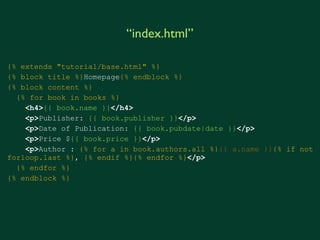
“index.html”

{% extends "tutorial/base.html" %}
{% block title %}Homepage{% endblock %}
{% block content %}
  {% for book in books %}
    <h4>{{ book.name }}</h4>
    <p>Publisher: {{ book.publisher }}</p>
    <p>Date of Publication: {{ book.pubdate|date }}</p>
    <p>Price ${{ book.price }}</p>
    <p>Author : {% for a in book.authors.all %}{{ a.name }}{% if not
forloop.last %}, {% endif %}{% endfor %}</p>
  {% endfor %}
{% endblock %}
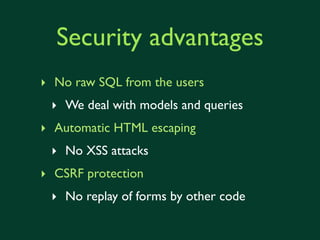
Security advantages
‣ No raw SQL from the users
 ‣ We deal with models and queries
‣ Automatic HTML escaping
 ‣ No XSS attacks
‣ CSRF protection
 ‣ No replay of forms by other code
This cannot happen !
URLs

urlpatterns = patterns('apps.tutorial.views',
    (r'^$', 'index'),

    (r’^book/<?P<id>d+)/$’, ‘show_book’),
    (r'^latest/(?P<num_days>d+)/$', 'view_latest_books'),
    (r'^create/$', 'create'),
)


       ‣ URLs map to views (via regular expressions)
http://example.com/tutorial/

http://example/com/tutorial/books/

http://example.com/tutorial/create/

http://example.com/tutorial/latest/5/
Views are just python
          functions
import datetime

def view_latest_books(request, num_days):
    date = datetime.datetime.now() -
                       datetime.timedelta(int(num_days))
    books = Book.objects.filter(pubdate__gte =
                                date).order_by('-pubdate')

   return render_to_response('books/show_books.html',
                             {'books': books})
Aggregation
      ‣ When you need to summarise a collection
        of objects
         ‣ Leveraging the DB where possible

  > q = Book.objects.annotate(num_authors=Count('authors'))
  > [b.num_authors for b in q]
  [2, 3, 1]
  > Store.objects.aggregate(min_price=Min('books__price'),
                            max_price=Max('books__price'))
  {‘min_price’ : 2.99, ‘max_price’ : 29.99}


http://docs.djangoproject.com/en/dev/topics/db/aggregation/
Other features
‣ Forms
‣ Generic Views
 ‣ Makes CRUD simple
‣ User management
‣ i18n
My first django project
Projects contain Applications
                       Project


                  my
                                  myapp
               other_app

                      reuseable
                         app


‣ Application : self-contained set of functions
‣ Project : collection of applications, installed
  into same database
  ‣ roughly project == a web application - has a
    settings file
Getting started
‣ Install Django 1.1
 > easy_install django

‣ Create a project
 > django-admin.py startproject new_django_project

   new_django_project/
       __init__.py
       manage.py
       settings.py
       urls.py
> ./manage.py startapp tutorial


 new_django_project/
     __init__.py
     manage.py
     settings.py
     tutorial/
         __init__.py
         models.py
         tests.py
         views.py
     urls.py
> ./manage.py runserver
Validating models...
0 errors found

Django version 1.1, using settings 'new_django_project.settings'
Development server is running at http://127.0.0.1:8000/
Quit the server with CONTROL-C.
...


‣ Now you write your code ...
> ./manage.py syncdb
Creating table django_content_type
Creating table django_session
Creating table django_site
Creating table tutorial_author
Creating table tutorial_publisher
Creating table tutorial_book
Creating table tutorial_store
Installing index for tutorial.Book model
automatic admin interface


   http://localhost:8000/admin/tutorial/
manage.py
‣ syncdb : create SQL for your models
‣ shell : start up a python shell with your
  django project loaded
‣ test : run your unit tests
    ‣ you did write some, didn’t you ?
‣ inspectdb : reverse engineer models for
  existing DB
‣ loaddata / dumpdata : load/dump your
  fixtures from a DB
Tools to make you
 more productive
   all just an easy_install away
distutils
‣ ‘standard’ python packaging
  ‣ ./setup.py sdist : source packages
  ‣ /.setup.py bdist : binary packages
‣ Nice to integrate with other tools
  ‣ pip, unittest, ...
‣ ./setup.py bdist_rpm : Can produce rpm
Virtualenv
‣ Run separate python environments
 ‣ With different sets of packages
 ‣ And even different interpreters
‣ Easily switch between then
 ‣ virtualenv_wrapper gives nice bash
   functions for it all

   http://pypi.python.org/pypi/virtualenv
ipython
‣ python with CLI hotness
 ‣ TAB autocomplete
 ‣ code coloring
 ‣ nicer pdb integration
 ‣ ...


         http://ipython.scipy.org/moin/
PIP
‣ Better installation manager
  ‣ ‘easy_install’ with dependency ordering
  ‣ Integrated with virtualenv
  ‣ Allow to ‘freeze’ a set of packages
    ‣ and re-install to the same level


       http://pypi.python.org/pypi/pip
django-debug-toolbar


  http://localhost:8000/tutorial/
django-command-extensions

 ‣ Extra manage.py commands
  ‣ shell_plus : a better python shell
  ‣ runserver_plus : a better debugging
    server (werkzeug)
  ‣ show_urls : dump the url map of your
    site
Werkzeug


http://localhost:8000/tutorial/latest/5
and of course, unittest
‣ Django supports :
 ‣ doctest : useful for simple model validation
 ‣ unittest : you did write some, didn’t you ?
 ‣ test client : acts a dummy web browser
   ‣ Test your views
 ‣ fixture loading : have a set of complex test data
   ‣ generated from your production database
reusable apps
if it’s useful, it’s probably been done before...
south

‣ Schema migration
 ‣ Change models over time
 ‣ Write upgrade routines
   ‣ just python functions with access
     to .objects and .old_objects
A platform for rapidly developing (social) websites
code.google.com

‣ just search for django-<WHATEVER> :)
‣ It’s probably there...
  ‣ If it’s not there, write it and put it there
Future
beyond django 1.1
Multi-DB

‣ Allows your models to be in multiple DBs
 ‣ Different applications in different DBs
 ‣ ‘sharding’ of objects across DBs
 ‣ using slaves for read-only operations
Other
‣ Admin UI enhancements
 ‣ autocompletion
 ‣ better inline handling
‣ Non-relational database support
   ‣ CouchDB, MongoDB, tokyo Tyrant,
     Google Bigtable, SimpleDB
want more ?
‣ http://docs.djangoproject.com/
‣ Django community RSS feed
  ‣ http://www.djangoproject.com/community/
‣ Mailing lists
  ‣ django-dev to understand how the developers
    think
  ‣ django-users to ask for help
‣ DjangoCon presentations
  ‣ http://www.djangocon.org/
Books
django-users@cern.ch
Thank you
Credits
‣ XKCD for cartoons
‣ Amazon.com for book pictures
‣ Initial inspiration for slides and examples
  from Joaquim Rocha, Abe Estrada
  ‣   http://www.slideshare.net/j_rocha/django-intro

  ‣   http://www.slideshare.net/AbeEstrada/django-web-framework-presentation-822177


‣ http://www.djangoproject.com/