INTRODUCTION
TO DATABASE
University of Northern Philippines. College of Business Administration and Accountancy. Computer Education
ARPEE M. CALLEJO, MIT
Instructor
LEARNING OBJECTIVES
āˆŽLearn database, its purpose, kinds and types
āˆŽLearn the structured database models and Relational Database
Management System
āˆŽIdentify the relationship and their types
DATABASEāˆŽ collection of organized data, information and records
āˆŽ creating/making a list of classmates, list of relatives, list of friends, telephone directory
and so on; you’re actually generating a database
āˆŽ Structural model defines how data is organized in a database and also determine the
set of operations that can be performed on a data (e.g. relational model)
āˆŽ Computer database are those data/information stored in the computer
āˆŽ Database software allows the user to collect, edit, delete and organize information for
easy manage, update and access of the user
āˆŽ Microsoft Access is an example of database software
PURPOSE OF
DATABASE
• Database is important document
• Database is information that a person needs
ā€œuse it but do not abuse itā€
datasets that grow so large that
they become awkward to work
with using on-hand database
management tools
āˆŽ GOOGLE
DATAWAREHOUSE
āˆŽ FACEBOOK
DATAWAREHOUSE
ENTITY
āˆŽ is the term given to the category of information in database
ā–«A car dealer would be interested in entities such as clients, cars and salesmen.
ā–«A school would be interested in students, faculty and classes
ā–«A bookstore would be interested in customers, stores, branches and contractors
Examples
TYPES OF
DATABASEOPERATIONAL DATABASE
āˆŽDynamic database that is used by any
organization in its day to day operation
āˆŽUse to collect, maintain, modify and delete
data
āˆŽe.g. inventory database
ANALYTICAL DATABASE
āˆŽStatic database, wherein data is rarely modified
āˆŽUse to store and track historical data to make long term
projections and analysis
āˆŽe.g. data on global temperature to determine the effects off
global warming in a certain areas for a period of time
Is the color of blood, and because of this it has historically
been associated with sacrifice, danger and courage.
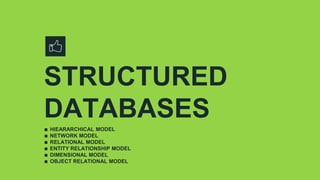
STRUCTURED
DATABASES
āˆŽ HIEARARCHICAL MODEL
āˆŽ NETWORK MODEL
āˆŽ RELATIONAL MODEL
āˆŽ ENTITY RELATIONSHIP MODEL
āˆŽ DIMENSIONAL MODEL
āˆŽ OBJECT RELATIONAL MODEL
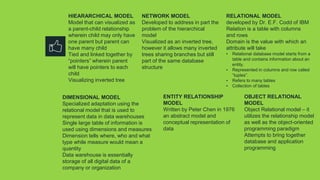
HIEARARCHICAL MODEL
Model that can visualized as
a parent-child relationship
wherein child may only have
one parent but parent can
have many child
Tied and linked together by
ā€œpointersā€ wherein parent
will have pointers to each
child
Visualizing inverted tree
NETWORK MODEL
Developed to address in part the
problem of the hierarchical
model
Visualized as an inverted tree,
however it allows many inverted
trees sharing branches but still
part of the same database
structure
RELATIONAL MODEL
developed by Dr. E.F. Codd of IBM
Relation is a table with columns
and rows
Domain is the value with which an
attribute will take
ā–Ŗ Relational database model starts from a
table and contains information about an
entity.
ā–Ŗ Represented in columns and row called
ā€œtuplesā€.
ā–Ŗ Refers to many tables
ā–Ŗ Collection of tables
ENTITY RELATIONSHIP
MODEL
Written by Peter Chen in 1976
an abstract model and
conceptual representation of
data
DIMENSIONAL MODEL
Specialized adaptation using the
relational model that is used to
represent data in data warehouses
Single large table of information is
used using dimensions and measures
Dimension tells where, who and what
type while measure would mean a
quantity
Data warehouse is essentially
storage of all digital data of a
company or organization
OBJECT RELATIONAL
MODEL
Object Relational model – it
utilizes the relationship model
as well as the object-oriented
programming paradigm
Attempts to bring together
database and application
programming
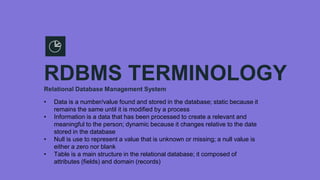
RDBMS TERMINOLOGY
Relational Database Management System
• Data is a number/value found and stored in the database; static because it
remains the same until it is modified by a process
• Information is a data that has been processed to create a relevant and
meaningful to the person; dynamic because it changes relative to the date
stored in the database
• Null is use to represent a value that is unknown or missing; a null value is
either a zero nor blank
• Table is a main structure in the relational database; it composed of
attributes (fields) and domain (records)
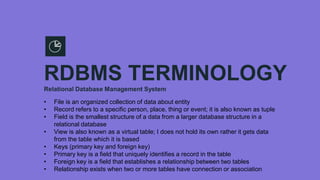
RDBMS TERMINOLOGY
Relational Database Management System
• File is an organized collection of data about entity
• Record refers to a specific person, place, thing or event; it is also known as tuple
• Field is the smallest structure of a data from a larger database structure in a
relational database
• View is also known as a virtual table; I does not hold its own rather it gets data
from the table which it is based
• Keys (primary key and foreign key)
• Primary key is a field that uniquely identifies a record in the table
• Foreign key is a field that establishes a relationship between two tables
• Relationship exists when two or more tables have connection or association
things we can do with RDBMS
Information
management
Information
analysis
Print and share
information
Create a database
Information
storage
Information
retrieval
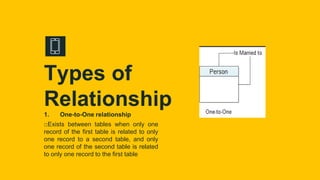
1. One-to-One relationship
ā–”Exists between tables when only one
record of the first table is related to only
one record to a second table, and only
one record of the second table is related
to only one record to the first table
Place your screenshot here
Types of
Relationship
Place your screenshot
here
2. One-to-Many relationships
ā–”Exists between tables when one record
of the first table can be related to one or
more records to a second table, but only
one record from the second table can be
related to a single record in the first table
ā–”Most common relationship used to
avoid or eliminate duplicate and
redundant data
Place your screenshot
here
2.Many-to-one relationships
ā–”Exists between tables when more than
one record of the first table can be
related to one record to a second table,
but only one record from the second
table can be related to a single record in
the first table
Place your screenshot here
3. Many-to-Many relationship
ā–”Exists between tables when one record
of the first table can be related to one or
more records to a second table, and one
or more records of the second table is
related to one or more record s to the first
table
1. Databases are used for:
A. To entertain your friends
B. To store infomation
C. To create a presentation
2. Within a Database, infomation is stored in a:
A. Record
B. Cabinet
C. Field
3. The software to create a database is:
A. Google
B. Microsoft Word
C. Microsoft Access
QUIZ
4. Within a Record there are multiple:
A.
Fields
B.
Cabinets
C.
Databases
5. A place where are Database is used are:
A. Your House
B. Restaurant
C. Hospital
THANKS!Any questions?