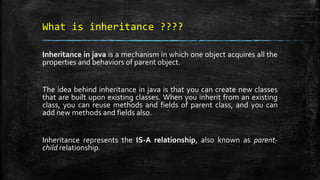
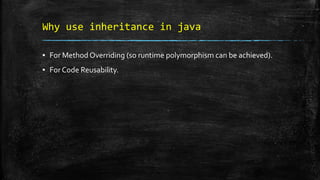
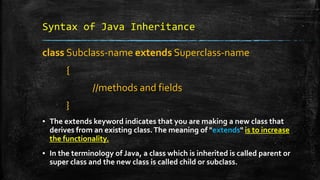
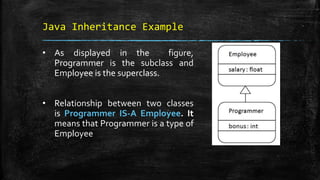
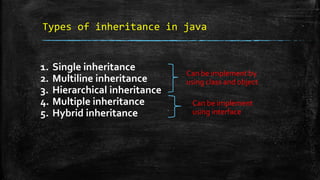
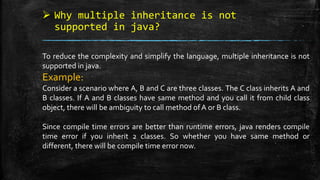
The document discusses inheritance in Java, describing it as a mechanism where one object inherits properties and behaviors from a parent object, allowing for code reusability and method overriding. It outlines the syntax, types of inheritance (single, multilevel, hierarchical, and hybrid), and provides examples for each type, while explaining why multiple inheritance is not supported in Java due to potential ambiguity. The document concludes by summarizing the benefits of using inheritance in programming.
![Example of simple inheritance
class Employee
{
float salary=40000;
}
class Programmer extends Employee
{
int bonus=10000;
public static void main(String args[]){
Programmer p=new Programmer();
System.out.println("Programmer salary is:"+p.salary);
System.out.println("Bonus of Programmer is:"+p.bonus);
}
}](https://image.slidesharecdn.com/inheritance-170724125656/85/Inheritance-in-java-6-320.jpg)
![Single inheritance
class Animal
{
void eat(){System.out.println("eating...");}
}
class Dog extendsAnimal{
void bark()
{
System.out.println("barking...");
}
}
classTestInheritance
{
public static void main(String args[]){
Dog d=new Dog();
d.bark();
d.eat();
}
}](https://image.slidesharecdn.com/inheritance-170724125656/85/Inheritance-in-java-8-320.jpg)
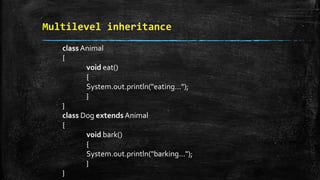
![class BabyDog extends Dog
{
void weep()
{
System.out.println("weeping...");
}
}
classTestInheritance2
{
public static void main(String args[]){
BabyDog d=new BabyDog();
d.weep();
d.bark();
d.eat();
}}](https://image.slidesharecdn.com/inheritance-170724125656/85/Inheritance-in-java-10-320.jpg)
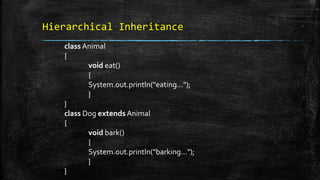
![class Cat extendsAnimal
{
void meow()
{
System.out.println("meowing...");
}
}
classTestInheritance3
{
public static void main(String args[])
{
Cat c=new Cat();
c.meow();
c.eat();
//c.bark();
//C.T.Error
}
}](https://image.slidesharecdn.com/inheritance-170724125656/85/Inheritance-in-java-12-320.jpg)
![class A
{
void msg(){System.out.println("Hello");}
}
class B
{
void msg(){System.out.println("Welcome");}
}
class C extends A,B
{//suppose if it were
Public Static void main(String args[])
{
C obj=new C();
obj.msg();//Now which msg() method would be invoked?
}
}](https://image.slidesharecdn.com/inheritance-170724125656/85/Inheritance-in-java-14-320.jpg)


![Example of simple inheritance
class Employee
{
float salary=40000;
}
class Programmer extends Employee
{
int bonus=10000;
public static void main(String args[]){
Programmer p=new Programmer();
System.out.println("Programmer salary is:"+p.salary);
System.out.println("Bonus of Programmer is:"+p.bonus);
}
}](/p?url=https%3A%2F%2Fimage.slidesharecdn.com%2Finheritance-170724125656%2F85%2FInheritance-in-java-6-320.jpg&__src=https%3A%2F%2Fwww.slideshare.net%2Fslideshow%2Finheritance-in-java-78194424%2F78194424&__type=image)

![Single inheritance
class Animal
{
void eat(){System.out.println("eating...");}
}
class Dog extendsAnimal{
void bark()
{
System.out.println("barking...");
}
}
classTestInheritance
{
public static void main(String args[]){
Dog d=new Dog();
d.bark();
d.eat();
}
}](/p?url=https%3A%2F%2Fimage.slidesharecdn.com%2Finheritance-170724125656%2F85%2FInheritance-in-java-8-320.jpg&__src=https%3A%2F%2Fwww.slideshare.net%2Fslideshow%2Finheritance-in-java-78194424%2F78194424&__type=image)

![class BabyDog extends Dog
{
void weep()
{
System.out.println("weeping...");
}
}
classTestInheritance2
{
public static void main(String args[]){
BabyDog d=new BabyDog();
d.weep();
d.bark();
d.eat();
}}](/p?url=https%3A%2F%2Fimage.slidesharecdn.com%2Finheritance-170724125656%2F85%2FInheritance-in-java-10-320.jpg&__src=https%3A%2F%2Fwww.slideshare.net%2Fslideshow%2Finheritance-in-java-78194424%2F78194424&__type=image)

![class Cat extendsAnimal
{
void meow()
{
System.out.println("meowing...");
}
}
classTestInheritance3
{
public static void main(String args[])
{
Cat c=new Cat();
c.meow();
c.eat();
//c.bark();
//C.T.Error
}
}](/p?url=https%3A%2F%2Fimage.slidesharecdn.com%2Finheritance-170724125656%2F85%2FInheritance-in-java-12-320.jpg&__src=https%3A%2F%2Fwww.slideshare.net%2Fslideshow%2Finheritance-in-java-78194424%2F78194424&__type=image)

![class A
{
void msg(){System.out.println("Hello");}
}
class B
{
void msg(){System.out.println("Welcome");}
}
class C extends A,B
{//suppose if it were
Public Static void main(String args[])
{
C obj=new C();
obj.msg();//Now which msg() method would be invoked?
}
}](/p?url=https%3A%2F%2Fimage.slidesharecdn.com%2Finheritance-170724125656%2F85%2FInheritance-in-java-14-320.jpg&__src=https%3A%2F%2Fwww.slideshare.net%2Fslideshow%2Finheritance-in-java-78194424%2F78194424&__type=image)


