Presented by :
Rishi Ram Khanal
108
Bim 6th (TU)
11/27/20201
Implementation issues
Content
11/27/20202
 Introduction
 Reuse
 Configuration management
 Host-target development
 Reuse levels
 Configuration management tool interaction
 Development platform tools
Introduction
11/27/20203
 Focus here is not on programming, although this
is obviously important, but on other
implementation issues that are often not covered
in programming texts
 Reuse
Most modern software is constructed by reusing
existing components or systems.
When you are developing software, you should
make as much use as possible of existing code.
11/27/20204
 Configuration management
During the development process, you have to
keep track of the many different versions of each
software component in a configuration
management system.
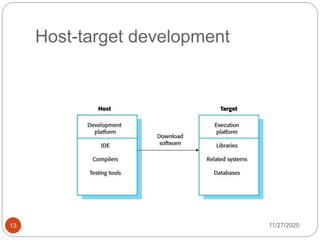
 Host-target development
Production software does not usually execute on
the same computer as the software development
environment.
Rather, you develop it on one computer (the host
system) and execute it on a separate computer
(the target system).
Reuse
11/27/20205
 From the 1960s to the 1990s, most new software
was developed from scratch, by writing all code in
a high- level programming language.
The only significant reuse or software was
the reuse of functions and objects in
programming language libraries.
 Costs and schedule pressure mean that this
approach became increasingly unviable,
especially for commercial and Internet-based
systems.
 An approach to development based around the
reuse of existing software emerged and is now
generally used for business and scientific
software.
Reuse levels
11/27/20206
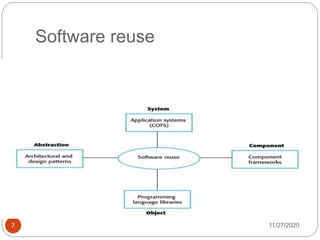
 The abstraction level
At this level, you don’t reuse software directly but
use knowledge of successful abstractions in the
design of your software.
 The object level
At this level, you directly reuse objects from a library
rather than writing the code yourself.
 The component level
Components are collections of objects and object
classes that you reuse in application systems.
 The system level
At this level, you reuse entire application systems.
Software reuse
11/27/20207
Reuse costs
11/27/20208
 The costs of the time spent in looking for software
to reuse and assessing whether or not it meets
your needs.
 Where applicable, the costs of buying the
reusable software. For large off-the-shelf
systems, these costs can be very high.
 The costs of adapting and configuring the
reusable software components or systems to
reflect the requirements of the system that you
are developing.
 The costs of integrating reusable software
elements with each other (if you are using
software from different sources) and with the new
Configuration management
11/27/20209
 Configuration management is the name given to
the general process of managing a changing
software system.
 The aim of configuration management is to
support the system integration process
 So that all developers can access the project
code
 Also documents in a controlled way, find out what
changes have been made, and compile and link
components to create a system.
Configuration management activities
11/27/202010
 Version management = where support is provided
to keep track of the different versions of software
components.
 System integration = where support is provided to
help developers define what versions of
components are used to create each version of a
system.
 Problem tracking = where support is provided to
allow users to report bugs and other problems,
and to allow all developers to see who is working
on these problems and when they are fixed.
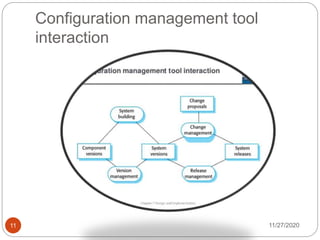
Configuration management tool
interaction
11/27/202011
Host-target development
11/27/202012
 Most software is developed on one computer (the
host), but runs on a separate machine (the
target).
 More generally, we can talk about a development
platform and an execution platform.
 A platform is more than just hardware.
 It includes the installed operating system plus
other supporting software such as a database
management system.
 Development platform usually has different
installed software than execution platform , these
platforms may have different architectures.
Host-target development
11/27/202013
Development platform tools
11/27/202014
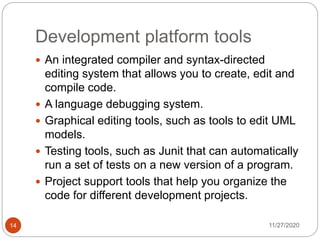
 An integrated compiler and syntax-directed
editing system that allows you to create, edit and
compile code.
 A language debugging system.
 Graphical editing tools, such as tools to edit UML
models.
 Testing tools, such as Junit that can automatically
run a set of tests on a new version of a program.
 Project support tools that help you organize the
code for different development projects.
Reference
11/27/202015
 https://www.safaribooksonline.com/library/view/so
ftware-engineering
 https://search.yahoo.com/yhs/search;_ylt
 https://www.slideshare.net
11/27/202016
 Thank you
 Any question