IIMA
Consult Prep Book
2021-22
1
Prepbook,Consult Club,IIM-A,8/e
© 2021,ConsultClub,IIM-A. All rights reserved.
Notice
No part of this publication may be reproduced or transmitted in any form or by any means – electronic or mechanical,including photocopy,
recording or any information storage and retrieval system – without permission in writing from the Consult Club,IIMAhmedabad.
First edition:
Second edition:
Third edition:
Fourth edition:
Fifth edition:
Sixth edition:
Seventh edition:
Eighth edition:
J
uly 2014
August 2015
September 2016
September 2017
September 2018
August 2019
September 2020
September 2021
Issue details and copyright
(C) Consult Club, IIM Ahmedabad 2021-22 Page 2
This year the Consult Club,IIMAhmedabad is proud to present the Consult Prep Book,an all-in-one document that bundles all key resources
required to ace consulting interviews as one ready-to-use document.
The IIMA Case Book, now in its 8th edition,aims to give the reader a comprehensive view of the type of cases that form a significant part of
consulting interviews.The document is a careful curation of real interview experiences of candidates with leading consulting firms.These
interview experiences are collected,analyzed,sanitized,and then bolstered using relevant frameworks.By relying on this book,thousands of
students,across numerous institutes,have been able to achieve success in their case interviews over the past six years.
Similar to last year
,this year too we have added Panorama Reports, a collection of analyses of 17 industries highly relevant for consulting
interviews. Even though these interviews test first-principled thinking which is industry-agnostic,aspirants are often concerned about grasping
the nuances of cases across multiple sectors and testing their understanding across them.This year we have tweaked the industry primers to
give a more in-depth analysis of various industries so that the reader can supplement their case preparation with industry-specific learning.
As part of the appendices,we have included our Consulting Primer & a concise compendium of tips and tools useful for your preparation
and to StrengthenYourToolkit.This is to complement your main consulting interviews’ preparation and we hope that this adds to your
perspective about consulting.
We’re making this document available in the public domain with a goal to aid consulting aspirants,irrespective of campuses and levels of
information access,step closer to their professional goals. We hope that we’ve been able to help you in doing so. Wishing you the best!
SrishtiJain
Coordinator
,Consult Club,2021-22
Introducing the IIMA Consult Prep Book
(C) Consult Club, IIM Ahmedabad 2021-22 Page 3
Acknowledgements
IIMA Casebook
We are grateful to all the people that have helped by sharing their cases and interview experiences, which has enabled us to put together a
comprehensive preparation resource for the future batches.
We would like to thank Avantika Mathur
, K R Ramakrishnan, Shivli Agrawal, Shubham Goyal, and T
anay Banerjee (PGP 2020-22) for leading the
Case Book initiative and putting together this edition of the IIMA Case Book. We would also like to acknowledge the efforts of Nikita
Kishore, Mitesh Mishra, and Mohak Ghelani(PGP 2021-23) for helping the club put together this case book. They have ensured breadth and
depth in the cases to give the reader a comprehensive view of the kind of cases they may be administered.
Panorama Reports
We would like to thank Akhil Varma, Anoushka Pal, K R Ramakrishnan, and Simran Kanodia (PGP 2020-22) for leading the Panorama Reports
initiative and putting together this revamped edition. We would also like to acknowledge the efforts of Anandh Natarajan, Richa Bhatia,
Sonam Tshering, and Tina Jain (PGP 2021-23) for helping the club put this together
. They have ensured that the analysis of all major industries
relevant for consulting preparation are presented in a thorough,yet easy-to-understand manner
.
We would like to thank Shivli Agrawal, Head, Publications, Consult Club (PGP 2020-22) for leading all these initiatives with thorough
professionalism and delivering this integrated output.
We would also like to extend a special acknowledgement to the contributors of the previous editions of the IIMA Case Book as well as
numerous Consult Club alumni whose feedback, over the years, has shaped this document. We would also like to thank students of the PGP
2020-22 and 2021-23 batches,many of whose submissions have added unmatched richness to the Prep book.
(C) Consult Club, IIM Ahmedabad 2021-22 Page 4
IIM A
Case Book
2021-2022
While reading this Case Book,we would suggest the reader should use the interview transcripts to set up a case between 2 people (or
groups),and after solving the case,the solution process sheet should be looked into to gain a broader understanding of the approach and
areas of improvement.
The frameworks are there to give a direction initially to new case-solvers and should not be treated as a fixed boundary but could be
utilized by the reader to cover any case which comes up their way according to their own logical structure.Also,the reader should
leverage the recommendations,tips,and suggestions to apply learnings from one case to another
.
Remember
,the journey is as important as the destination.Case preparation is a group exercise with individual self-preparation as well.
Also, all cases are linked to the Panorama report of the industry they are concerned with.It is advisable to go through the reports to get
a better understanding of the industry.The first page for each industry is meant to narrate a story to aid understanding while the two
following pages will give a deep-dive into the industry
We wish you the best of luck in your case preparation journey!
How to use this book?
(C) Consult Club, IIM Ahmedabad 2021-22 Page 6
Table of contents (1/3)
Particulars Sector Rigor Page Particular Sector Rigor Page
Structure of case interview, approach 10 22. Banking (Profitability) BFSI Moderate 61
23. Restaurant (Revenue Decline) F&B Challenging 63
A. Profitability
24. Seat Manufacturing (Cost Reduction) Manufacturing Easy/Mod
e rate
65
Overview / Framework 14
1. Airline Operator (Profitability) Aviation Moderate 16
25. Kiosk at Stadium (Profitability) FMCG Moderate 67
2. Beer manufacturer (Cost reduction) Distillers Easy 19
26. Battery Manufacturer (Profitability) Consumer
Durables
Moderate 69
3. Retail bank (Cost reduction) BFSI Moderate 21
4. Lease fee (Cost reduction) Leasing Moderate 23 27. Zoomcar (Revenue Decline) Services Moderate 71
5. Auto insurance (Cost reduction) BFSI Moderate 25 28. Pharma (Cost Reduction) Pharma Challenging 73
6. Banking (Cost reduction) BFSI Challenging 27 29. Grocery Retail Store (Profitability) Retail Challenging 75
7. Telecom billing process (Cost reduction) Telecom Challenging 28 B. Market entry
8. Oncology firm (Revenue decline) Pharma Easy 31 Overview / Framework 79
9. Oil distributor (Revenue decline) Oil and Gas Moderate 33 30. Insurance BFSI Moderate 82
10. Washing machinefirm (Revenue decline) Consumer
Durables
Moderate 35 31. HBS Satellite campus EdTech Easy 85
32. Insurance Company BFSI Moderate 87
11. Tractor company (Revenue decline) Heavy Industry Moderate 37
34. Electric buses Transport Moderate 89
12. Fishing company (Revenue decline) Fishing Moderate 39
35. Retirement benefits policy BFSI Challenging 91
13. Banking (Revenue decline) BFSI Moderate 41
36. Anti-smoking pills Pharma Challenging 93
14. Alcohol company (Revenue decline) Distillers Challenging 43
37. Fintech in UAE market Fintech Challenging 95
15. Spicejet vs Indigo (Profitability) Aviation Challenging 45
38. European Airline (Growth Objective) Aviation Challenging 98
16. Fast Food Industry (Cost Reduction) F&B Challenging 47
39. Covaccine Manufacturer Pharma Moderate 100
17. Textile (Retail) (IncreasingReturn on Capital
Employed)
Textile Challenging 50
40. Petrochemical Company Petrochemical Challenging 103
18. Beverage Manufacturer (Cost Reduction) F&B Challenging 52 C. Pricing
Overview / Framework 105
19. Meal Coupon Company (Shift in
Business Model)
Services Moderate 55
41. Helicopter Service Transport Moderate 107
20. Steel Industry (Cost Reduction) Steel Challenging 57 42. Light Bulb Electrical Moderate 109
21. Client Card Company (Profitability) Payment Moderate 60 43. Residential Complex Housing Moderate 111
(C) Consult Club, IIM Ahmedabad 2021-22 Page 7
Table of contents (2/3)
Particulars Sector Rigor Page Particulars Sector Rigor Page
44. Cow Feed Animal
Husbandr
y
Moderate 113 63. Threat of new entrant Retail Challenging 157
64. Drug pricing Pharma Challenging 159
D. Growth strategy
65. Declining response in a competition Education Challenging 161
Overview / Framework 116
66. Strategic fit / Merger feasibility Payment Cards Challenging 162
45. Cab Driver (Revenue maximisation) Services Moderate 118
67. Oil and gas (Project management) Oil & Gas Challenging 163
46. Apparel manufacturer Textile Moderate 121
68. FMCG- Supply chain (Supply
chain optimization)
FMCG Challenging 165
47. Elevator manufacturer Manufacturing Moderate 123
48. E-commerce E-commerce Challenging 125 69. Karate the next cricket (Brand building) Sports Challenging 167
49. Software product company Technology Challenging 127 70. Covid Vaccination Strategy Pharm
a,
logistic
s
Challenging 169
50. Midstream oil & gas company Oil & Gas Challenging 129
71. Pharma company (Digital Transformation) Pharma Challenging 172
51. Pump manufacturer Manufacturing Challenging 131
72. TT Association of India Sports Easy 174
52. Wool yarn manufacturer Manufacturing Challenging 133
73. Children in School Education Moderate 176
53. Indian PSU Transport/ Rail Challenging 135
74. Interplanetary payments Moderate 178
E. Unconventional cases
75. FMCG Acquisition (M&A) FMCG Challenging 180
Overview / Framework 138
54. Bid Strategy for GOT Season 8 Entertainment Challenging 139
55. Senior Associate at BCG Moderate 141
56. Increased Processing Time Packaging Moderate 143
57. “Go Green” Strategy Aviation Moderate 145
58. Operations strategy (FMCG) FMCG Moderate 147
59. Declining website traffic Media Moderate 149
60. Risks of oil transportation company Oil Moderate 151
61, Variable pay structure Preciou
s
Stones
Moderate 153
62. Horizontal integration in e-commerce E-commerce Challenging 155
(C) Consult Club, IIM Ahmedabad 2021-22 Page 8
Table of contents (3/3)
Particulars Sector Page
F. Guesstimates
Tips and Tricks 183
1. Gold Flakes cigarettes Tobacco 184
2. Dairy cows in Maharashtra General 185
3. Revenue of a multiplex Entertainment 186
4. Revenue of a coffin maker General 187
5. Electricity consumption Electricity 188
6. Market size of 2-wheeler taxis Automobile 189
7. Spend on bedsheets General 190
8. BigBasket Instant Vending machine E-Commerce 191
9. IPL team Sports 192
10. Zoom minutes of PGP1 Internet 193
11. Barbed wire General 194
12. Tata Sky Delhi subscribers Media 195
13. Post office revenue Courier 196
14. Golf balls in the air Sports 197
15. X-ray machines in India X-ray 198
16. Cabs at Taj hotel Hospitality 199
17. Heaters Durables 200
18. Sanitary pads Hygiene 201
19. Usage of shampoo Personal Care 202
20. Credit cards Payment Cards 203
21. Revenue of Maggi in Lockdown F&B 204
22. Ads streamed in YouTube Internet 205
23. Cycles in West Bengal Cycles 206
Sector Page
G. Panorama Reports
Overview 208
1 Airlines 209
2 Asset Management 212
3 Automobile 215
4 Banking 218
5 Cement 221
6 E-Commerce 224
7 FMCG 227
8 Healthcare 230
9 Hospitality 233
10 Iron & Steel 236
11 IT & IteS 239
12 Logistics 242
13 Oil & Gas 245
14 Pharmaceuticals 248
15 Power 251
16 Retail 254
17 Telecom 257
(C) Consult Club, IIM Ahmedabad 2021-22 Page 9
Structure of a consulting case interview
Interviews usually test the candidates on both or any of the following criteria:
• Personality/behavioural questions (through HRQ)
• Problem solving (through cases and/or guesstimates)
Personality / behavioural (through HRQs)
Candidates are strongly advised to be prepared for any kind of question that may pop-up from the information mentioned in their CVs,
particularly past work experience,internships or projects,besides the most famous questions like what are your strengths and weaknesses,why
consulting,why this particular firm.
Problem solving (Case interviews)
• Expectations
Case interviews are used to measure candidates’ability to assess an unfamiliar situation,uncover relevant and minute details while applying
their thought process to come up with one or more possible solutions to the problem,and finally communicating their recommendations in a
structured manner
.
• Approach
The basic approach to solving a case interview is:First,understanding the problem and requirements,then identifying a structure that would
help one solve the problem,then analysing the information available and finally
,reaching a conclusion & giving recommendations
Clarify Structure Analyse Conclude
(C) Consult Club, IIM Ahmedabad 2021-22 Page 10
How to approach a case interview
Understand & clarify the problem statement
• Candidates must be absolutely sure that they have clearly understood the problem statement, a mistake committed here has the biggest potential to ruin the
entire interview.
• Ask clarifying questions in the beginning; someone who asks the right questions is better able to understand the complete problem and has a higher chance to
come up with an accuratesolution.
• It is not unusual for the interviewer to not divulge all the relevant information at once because they also try to test the candidates on their ability to extract
information; the obvious purpose is to see how well the candidate may be able to do the same while interactingwith clients.
• Do not make any assumptions unless necessary; if a candidate wishes to do, then its always better to communicatewith the interviewer to get them validated
Structure the problem
• This involves putting all the data received together and making a sense out of it. The A4 sheet technique is very helpful for this, however, candidates may use
their own methods according to comfortlevel.
• Candidates should try to keep their structure as simple as possible because in some cases, the interviewer may ask for the working sheet, and accordingly should
be able to understand the approach followed by just glancing at the sheet at once.
• Frameworks canbe used for in structuring of data;however, do not try to force fitany framework justfor the sake of using it. Also, whenever a framework is
used, the candidatesshould communicate their approach of reaching the solution to the interviewer rather than sayingthat “I’m using market entry framework”.
Analyse the case
• This is the main stage of the problem-solving process wherein the candidates are required to draw inferences from the gathered information. The process is
aided by the structure they decide to follow using the chosen framework, if any.
• Candidates should ask two questions to themselves: a) How did this data point look like earlier for us?, and b) How does this data point look like for the
competitors?
• It is suggested that candidates develop a hypothesis consisting of various possible solutions, ask leading questions to validate their hypothesis, and keep on
narrowing their set based on the discussion. The candidate should continuously communicate with the interviewer to let them know of one’s thought process.
More often than not, the interviewers will help the candidate get back on track if they see that the person is thinking in the wrong direction.
• In case the candidate realizes that some data is still missing, do not hesitate to ask questions to extract it from the interviewer. No one will provide the
information on their own but will surely help if well-directed questions are asked.
Arrive at a conclusion
• This is the laststage of problem-solving and perhaps the determinant of acandidate’ssuccess in gettingthrough the interview. All efforts put in thus far are of
little use if the candidate is unable to come up with a proper conclusionbacked by a logicalimplementationplan.
• Try to ensure that the recommendations are close to reality since it increases their chances of being implementable in real life scenarios. Remember, concrete
solutions fetch more marks than broad vague answers.
• Before finally communicating the solution, do a quick “sanity check”, that is, evaluate if the proposed solution, particularly if its quantitative in nature, makes
sense or not. This can be done by using bottom-up strategy if the original answer was derived following top-down approach or vice-a-versa.
(C) Consult Club, IIM Ahmedabad 2021-22 Page 11
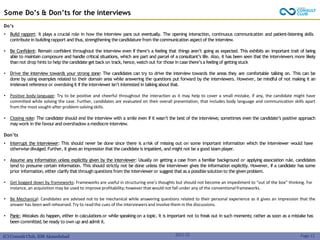
Some Do’s & Don’ts for the interviews
Do’s
• Build rapport: It plays a crucial role in how the interview pans out eventually. The opening interaction, continuous communication and patient-listening skills
contributein building rapport and thus, strengthening the candidature from the communication aspectof the interview.
• Be Confident: Remain confident throughout the interview even if there’s a feeling that things aren’t going as expected. This exhibits an important trait of being
able to maintain composure and handle critical situations, which are part and parcel of a consultant’s life. Also, it has been seen that the interviewers more likely
than not drop hints to help the candidate get back on track, hence, watch out for those in case there’s a feeling of getting stuck
• Drive the interview towards your strong zone: The candidates can try to drive the interview towards the areas they are comfortable talking on. This can be
done by using examples related to their domain area while answering the questions put forward by the interviewers. However, be mindful of not making it an
irrelevant reference or overdoing it if the interviewer isn’tinterested in talking about that.
• Positive body-language: Try to be positive and cheerful throughout the interaction as it may help to cover a small mistake, if any, the candidate might have
committed while solving the case. Further, candidates are evaluated on their overall presentation, that includes body language and communication skills apart
from the most sought-after problem-solvingskills.
• Closing note: The candidate should end the interview with a smile even if it wasn’t the best of the interviews; sometimes even the candidate’s positive approach
may work in the favour and overshadow a mediocre interview.
Don’ts
• Interrupt the interviewer: This should never be done since there is arisk of missing out on some important information which the interviewer would have
otherwise divulged.Further, it gives an impression that the candidate is impatient, and might not be a good team player.
• Assume any information unless explicitly given by the interviewer: Usually on getting a case from a familiar background or applying association rule, candidates
tend to presume certain information. This should strictly not be done unless the interviewer gives the information explicitly. However, if a candidate has some
prior information,either clarify that through questions from the interviewer or suggest that as a possiblesolutionto the given problem.
• Get bogged down by frameworks: Frameworks are useful in structuring one’s thoughts but should not become an impediment to “out of the box” thinking. For
instance, an acquisition may be used to improve profitability; however that would not fall under any of the conventionalframeworks.
• Be Mechanical: Candidates are advised not to be mechanical while answering questions related to their personal experience as it gives an impression that the
answer has been well rehearsed. Try to read the cues of the interviewers and involve them in the discussions.
• Panic: Mistakes do happen, either in calculations or while speaking on a topic. It is important not to freak out in such moments; rather as soon as a mistake has
been committed,be ready to own up and admit it.
(C) Consult Club, IIM Ahmedabad 2021-22 Page 12
Profitability
A profitability case could deal with revenue-side issues, cost-side issues or both.The candidate is expected to identify the key revenue and cost
heads,and isolate the‘problem areas
Approach/ Framework
Important notes: Initial question
• Get primitive understanding of company:
What product/services does it offer?
What geography does it cater to?
• Understand whether this is acompany
specific problem or an industry-wide
phenomenon
• Keep in the mind the quantum of
profit/losses and the time period
Important notes: Profit vs
Profitability
• Profits are merely a difference of
Revenues and Cost,while Profitability
refers to profit as a proportion of sales
Important notes: Value ChainAnalysis
• Clearly lay out the value chain to cover
all costs and ask interviewer where to
focus
• Similarly look at customer journey while
analysing decrease quantity sold
Profit
Revenue Cost
Units sold
Price
Profitability– Overview
Pre-
Transaction
During
Transaction
Post
Transaction
R&D Processing
Storage &
Transportation
Sales &
Marketing
Raw Material
Need Accessibility Affordability
Customer
Experience
Awareness
AlternateApproaches
• Cost: While segregating cost,we can break down cost as fixed and variable
• Revenue:
• Problem with units sold can be looked at from the demand and supply side lens
• Factors affecting revenue can be bucketed as internal and external factors
• Internal Factors include Production (R&D issues,manufacturing issues- Labour
,
machinery,packaging), Distribution/Push factors (Distribution channels,no.of
distributors, margins offered) or Consumer/ Pull factors (Product,Promotion)
• External factors can be examined by conducting a PESTEL analysis
Customer
Servicing
(C) Consult Club, IIM Ahmedabad 2021-22 Page 14
Cost Reduction – Overview (subset of profitability cases)
In a cost reduction case, a company is likely to aim for becoming more profitable by reducing their bottom line. An interviewee is expected to
first identify various cost component, followed by validating them, identify major cost drivers along with levers affecting their values, and finally
recommend how the company can change it’s ways to become more cost efficient.
A pproach / Framework Overview
Framework Summary
A company can reduce cost and become more efficient across its components. The best way is the look at the journey of a product/service right from the time its raw materials are bought to
the time it is delivered to the customer and he is happy after the post sale support etc. This is called a value chain analysis as each step of the process adds some value to the initial raw material
and accelerates its journey towards the final product. At each of these stages, we expect to find some levers which can be tweaked to make the process more efficient.
Tips
• Clarify objective, especially the cost buckets the interviewer wants you to delve into
• Cost cases are generally very streamlined till the time you are identifying places where cost can be reduced. Creativity comes into play when recommendations are asked by the interviewer.
Key Questions
• Is this particular company facing the problem of high costs or is it something that the industry is facing as a whole?
• Chalk the value chain and then ask if it is the correct way to do it? Or should it be done by splitting fixed and variable costs?
• What are the last 3 year trends in growth for the organization?
• Any major shifts in cost over time?
• Does any of these cost seem out of line?
(C) Consult Club, IIM Ahmedabad 2021-22 Page 15
Your client is alow-cost airline operator in Europe. Over the past 2 to 3 years, it has been
burning cash. Diagnose and recommend solutions.
I would like to ask a few clarifying questions before I begin to analyse the case. I would want to
understandthe client’s business. What kind of flights does the company run?
The company operates short flights across Europe. We have direct as well as connecting flights.
How manycompetitors do we have and are they facingsimilar problems?
We do have 2 major competitors but unfortunatelynone of them arefacingthis kind of a
problem. You can go ahead and work out the revenue streamsfor our client.
Ok. So I believe that the major revenue streams would be hospitality, revenue generated from
tickets and cargo. I wanted to confirm once that have the revenues gone down and has there
been any significant changesin cost?
Yes therevenues have gone down and the costs have increased. Let us focus now on the
revenue generatedfrom sale of tickets.
That’s very helpful. I would want to analyse this problem by looking at various components of the
revenue. I would break them down into price per ticket, occupancy rate, number of seats/flight
and number of flights?Do we have any informationon any of these parameters?
Yes. So, the number of direct flights have gone up and the occupancy rate in both direct and
indirectflights have gone down.
Okay. So I understand that the drop in revenue is mainly due to the drop in occupancy rate. Do
we have any data regarding the same? Also to further understand why we are burning cashes, I
would like to look into the costs side.
Sure. Go ahead and tell me what are the major cost components?
Ok. I would break down my costs into fixed Costs and variable Costs. The fixed costs would
comprise of lease, hangar costs, salaries and marketing. The variable costs would be fuel,
maintenance and operations etc. Do we know how these cost heads have changed over the last 3
years?
Yes, the hangar costs have gone up.
I amtrying to understand why the costs have gone up and whether this has gone up for the
entire industry or only specifically for us.
It has been such that the hangar costs have gone up only for us. This is because we have started
owning airports. The speciality is that people need to reach our airport only half an hour prior to
flight.
Okay. That helps a lot. So what I understand is that we have started owning airports and this has
led to large investment cost hence leading to burning of cashes. Further I would like to
understandwhy the occupancy rate has gone down.
Please go ahead.
So, I would break the entire value chain into the components. Those are procedure for flight
booking, Reaching airport, Procedure at the airport, taking the flight, taking the luggage at
destination airport. I would now furtherlike to understand each of the mentioned processes.
Okay. Lets focus on reaching the airport segment. I would further like to tell you that though the
airport is in the outskirts, the time cost of reaching the airport is same.
I would break down the cost into time cost and effort cost. Now, since the time cost is same, I
assume that the effort cost has gone up. Is that a fair assumption?
Quite right. I have few numbers. Can you work with them and let me know your suggestions. At
earlier airports mode of transport was: Public 30%, Own 20% and Taxis 50%. Now in this airport it
is Public 50%, Own 40% and taxis 10%.
That’s interesting. So, the availability of taxis in this airport location has gone down. This is primarily
because the airport is situated in the outskirts. So the taxis do not get any passengers while
returning. Hence the number of taxis in this area have gone down. Now the taxis being less in
number, it has become difficult for passengers to reach the airport. Hence that explains the reason
why the occupancy rate has gone down.
Yes. You are correct. Can you summarise the case and suggest a few recommendations?
As per my understanding, the company has burned cash because of huge investments in building
airports. Now the airport, being located in the outskirts has very less availability of taxis which are
the most preferred mode of transport to an airport. Hence the passengers preferring this airlines
have gone down leading to decrease in occupancy rate. I would now state my recommendations.
Yes. Please go on.
So I would suggest that the client should start its own shuttle service or collaborate with taxis
providing them added incentives. Further, the client can also include transportation cost from
airport to desired locationas part of the ticketprice.
Profitability |Moderate |Aviation
Airline operator – Interview Transcript
(C) Consult Club, IIM Ahmedabad 2021-22 Page 16
Your client is a low-cost airline operator in Europe.Over the past 2 to 3 years,it has been burning cash.Diagnose and recommend solutions.
Interviewee Notes
• Revenue –cost analysis
• Client currently in
airlines industry
• Ask about the current
status of the industry and
competitive scenario
• Look into the
customer journey
Case Facts
• Client operating both direct
and connecting flights across
Europe
• Is a low cost online operator
• Problem exists only for client
• Revenues have gone down and
the costs have increased
• Number of fights have gone up
while
occupancy has gone down
• Hangar costs have gone up
• The client have started owning
own airports – arrival only 30
mins prior to departure
• Airports located in outskirts, but
time cost of reaching airport
remains same
Approach/ Framework
Revenue
Price/tick Total
et
customer
s
No of No of
flights seats/flight
Occupanc
y Rate
Profit
Marketing Salary
Variable
Costs
Hanga
r
Costs
Costs
Fixedcosts
Lease
Airline operator
Profitability |Moderate
Recommendations
• Should start its own shuttleservice
• Should collaborate with cab aggregators by providing added incentives and ensure taxis stay outside the airport
• Can bundle two services together – Air ticket price and transportationprice and ensure passengersare picked up /dropped from respective locations
Observations / Suggestions
• The candidate did a good job in figuringout the fundamentals in why the revenue has gone down. Also after the cost analysis, the candidate was able to furtherelaborate on the reasons why the revenue has gone
down
• Need to understand the customer journeyto figureout the reason behind lower occupancy rates
• Do not directly suggest to undo an action the client has taken, unless there is sufficient evidence to suggest the same
(C) Consult Club, IIM Ahmedabad 2021-22 Page 17
(C) Consult Club, IIM Ahmedabad
Your client is a low-cost airline operator in Europe.Over the past 2 to 3 years,it has been burning cash.Diagnose and recommend solutions.
A lternate A pproach
The candidate could have used the value chain approach to
assess the cost side of the problem instead of suing the fixed
and variable cost approach.
It is not always possible to be exhaustive while using fixed and
variable cost approach.
What could have been done better
The candidate skipped to the cost side
without deep diving into the revenue side
problem.In this case, as there was a linkage
between the two, it was easy to come back
to the revenue side again, otherwise it
could have been a problem.
After diagnosis of the problem, the
candidate should have explored the client’s
strategy of owning airports and its viability
in the long run. This could have earned
brownie points
What was done well
The candidate tried to start with an
exhaustive list of revenue streams- tickets,
cargo and hospitality. Usually, in such cases,
candidates straight away start with revenue
from tickets.
To understand the reason behind the low
occupancy rate, the candidate successfully
understood the customer journey. Further,
reaching the airport was seen from both
the time and cost perspective.
In each step, the candidate tried comparing
the conditions with those of competitors.
This helped in diagnosing the problem
effectively.
Key learnings
Page 18
2021-22
Cost
Procurement
Inbound
logistics
Operations
O utbound
logistics
Sales and
Marketing
Customer
Care
Your client is a beer manufacturing company that operates in India. The cost structure for the
company is poor compared to the international benchmarks, and you have been asked by the
client to find out why.
Is the problem only on the cost side, or should I also analyse the revenues of the company to look
for a problem there?
No, the problem is only on the cost side.
Alright. Is the problem with only one specific beer product, or is the problem spread out across
different products? Additionally, is this an industry wide problem, or specific to our client?
The problem is not limited to one product. In fact,the client is facing the problem across many
beer products. There is no relevance to the problem being limitedto our client or the industry.
Okay. I think it would make sense to break the costs down into the value chain to see where the
cost issue lies. Should I go ahead with the same?
Sure, you can do that.
I would start by looking at the raw material costs. Are they largerthan the industry average?
No, our raw material costs are in line with the industry.
Okay. Next, I would look at the processing costs. Have there been any issues out there?
Yes, as a matterof fact, our processing costs are higherthan the benchmarks.
Okay, in that case, I would like to delve deeper into processing costs. However, before I proceed
with the same,I would like to see if this is the only cost head that has an issue.
You may proceed with processing costs. There are no other cost heads where the clientis facing
a problem.
Okay. Is the client facing labour or rent issues, or is having underutilisation of capacity?
Yes. The client is indeed facinga problem in the utilizationof capacity
How many plants/machines does the client own? What is the capacity of each plant/machine? Are
we utilizing 100% of the production capacity?
The client owns 3 plants with 3 machines each. The capacity of each plant is 30,000 bottles. Yes,
we are able to utilize 100% of the capacity.
Okay. So this would mean 10,000 bottles per machine. Are the competitors also producing 30,000
bottlesper plant .
No, the competitors are able to produce 50,000 – 80,000 bottles per plant.
Is it because of better machines or more number of machines?
Competitors are using advanced machines which are able to produce more number of bottles per
machine
How expensive are advanced machines?Would the labour need special trainingto operate the
same?
These machines cost 1.5 times(1.5 crores) the normal machine and produces twice the amount
produced by normal machine.There are no special trainingrequirements to operatethe machine
Okay. So now I would want to figureout the reason for not buyinghigh capacity machines
Sure, Go ahead.
I could think of the following reasons :
1. The client can’tinvest an amountof 1.5 crores at this point of time
2. There are some logisticsissues associated with installing the machine
The client can invest 1.5 crores so lets explore the second option
It can be because of the size of machineor different raw material requirements
Okay, so the advance high capacity machine requires larger ground area which is not possible in the
current plant size. What would you recommend in such a case?
So I have a few questions before I give the recommendations. How many shifts are we operating in
and what is the duration of each shift?
We are currently operating in 2 shifts of 8 hours each.
So, In the short term, we can increase the shifts from 2 to 3 to increase the capacity of the plant.
And in the longer run we can aim to buy plants which are larger as compared to the existing plant to
accommodate highcapacity machines.
Profitability |Cost reduction |Easy |Distillers
Beer manufacturer – Interview Transcript
(C) Consult Club, IIM Ahmedabad Page 19
2021-22
Your client is a beer manufacturing company that operates in India.The cost structure for the company is poor compared to the international
benchmarks,and you have been asked by the client to find out why.
Interviewee Notes
• Qualitative case,
no numbers
provided
• A single cost head
case where one
issue needs to be
identified
• The cost problem
is identified to be
in processing
• Either the client
cannot invest
capital or there are
logistical issue in
relation to getting
advanced machines
Case Facts
• Client is a beer
manufacturing
company with
multiple products
• It is facing cost issues
with more than one
beer
product
• Thus is not a
industry wide
problem
• Client has 3 plants
with 30000 bottles
capacity working at
100% utilization
• Advanced machines cost
1.5 times the normal
ones and produce
twice as much
Approach/ Framework
R & D Raw
Material
Advanced
machines
Shortage
of
capital
Costs
Processing
Machinery Labor
Capacity
Utilization
Increasingcount
of machines
Logistic
al
Issues
Storage &
Transportatio
n
Distribution
- Sale
force
Marketing
Beer manufacturer
Profitability |Cost reduction |Easy
Recommendations
• Candidate should give a combinationof short term and long-termrecommendations
• In the short term, the shifts can be increased from 2 to 3 to increase the capacity of the plant.
• In the longer run, the client should aim to buy plants which are largeras compared to the existing plant to accommodate high capacity machines.
Observations / Suggestions
• This is a cost reduction case where the interviewee should quickly establish the major cost buckets after discussing with the interviewer. The candidate can either probe each bucket along the value chain,or ask
the interview which buckets to look into
• Each cost component should be broken down into multiple cost levers to ensure that nothingis being missed out
• When analysing a specific cost bucket, look into its components in decreasing order of their magnitude
(C) Consult Club, IIM Ahmedabad Page 20
2021-22
Profitability |Cost reduction |Moderate |BFSI
Retail bank – Interview Transcript
Our clientis amajor retailbank facingdecliningprofits and is unable to compete.You have been
approached to find the problem and suggestchanges.
Sure, sir. So the key problem I need to focus on is finding the issue with decliningprofits of our
client which is a major retailbank. Is there anyother objectiveI need to keep in mind?
No, please go ahead.
I’ll start with a few clarifying questions.Is the problem plaguing most of the client’s branches or is
specific to a particularcategory(metro, urban, rural) of branches?
The problem is being faced by a specific branch located in a metropolitanregion.
Given the problem is specific to a particular branch, it is fair to assume that the problem is not
faced by the banking industry in general? Are the competitors located in that region also facing
similar issues?
No, the problem is only being faced by our client.
How much have the profits declined by? And for how long has the clientbeen experiencingthis
decline?
There has been a decline of 20% in profits. The issue has been around for 3 Quarters now.
Alright.Since the issue is that of profitability, could you help me with the trend in revenueand cost
of that particularbranch over the last three quarters?
Revenue has grown at a steady rate, but the costs have increased at a much higherrate.
Alright.In that case, I’d like to delve into the cost structure of a typical retail bank branch. All the
costs of a retail bank can be mostly divided into three heads: Interest, Provisioning and Operating
expense.Do we have knowledge as to which of above were not in line with the expectations of
the client?
The interest expense is similar to comparable branches and the bad debt levels are also at par with
the region.
Okay, so the issue is with the operatingcosts of the branch. The major operatingexpenses of the
branch would include employee/agentssalary, rent, utilities, stationery& postage, maintenance and
depreciation expense. So, do we have any informationof where the costs have been increasing
specifically vis-à-vis our competitorsor in comparison to prior periods?
The rent per square foot is similar to other banks in the area and has remained unchanged for the
past year, maintenance,depreciation and utilityexpenses have also roughly been the same.
Okay, so that leavesus with employee and sales agentssalary (i.e.customer acquisition and
customer handlingcosts), stationery & postage expense. Addressing the issue of employee and
sales agentssalaries first, are salaries of branch employees and sales agentshigherthan industry
standards?
The salary structure of employees for various positions is similar to that of comparable branches.
Alright.Can you give me some insight on the customer base of the branch? As in was the
demographic similar to that of other competing branches? Also, ifyou can helpme with afew
metricssuch as no. of customers served, ratio of low-valueto high-valuecustomers etc.
The branch is similarto competingbranches in allof theabove terms.The number of customers
served by the branch is also roughly the same.
Alright,so prima facie,the issue seems to be that of overstaffing. Alternatively,given that
increased employee expense has not resulted in aproportional increase in revenue for the
branch, the issue can also be seen as that of inefficiency.
Can you elaborate on how you’ll define employee efficiency?
Employeeefficiency will comprise number of customers served per employee which will depend
on the time taken by the employee per customer and the total non-workinghours.
Yes correct. So it has been observed that the time taken by the employee per customer is high.
Can you think of possible reasons for the same?
1.The employees may be lackingcompetency or training, thereby being unable to resolve the
issue of the customers in their first visit.
2.Due to improper segmentation, the customer may have to visit multiple counters for
performing a a single task.
So, how do you suggest we overcome this?
I can think of the following few steps:
1. Encouragingthe branch customers to use bank’s mobileapp and website for availingbasic
services such as transferringmoney and balance inquiry.Demonstrate the services if required.
2.Set up aself-operating kiosk inside or outside thebank for deposit of cash and updatingof
passbook.
3.Train the employees so as to enable them better understandthe needs of the customer and
thereby assist them efficiently.
4. Have single window clearance for as manyservices as possible.
Thank you. These are reasonablerecommendations.
(C) Consult Club, IIM Ahmedabad Page 21
2021-22
Our client is a major retail bank facing declining profits and is unable to compete.You have been approached to find the problem and suggest
changes.
Interviewee notes Case Facts
• Client is a major retail bank
• Problem of increasing costs
• Problem specific to a
particular branch
• Interest expense and bad debt
level at par with
other branches
• Fixed cost of employee
salary similar to
competitors
Approach/ Framework
Revenue
Rent
Mainten
ance
costs
Total
working
hours
Cost
Provisioning
Costs (NPAs)
Variabl
e
Costs
Interest
on
deposits
• Issue with costs
• Low efficiency of
Profits
employees
• Lack of training to provide
solution to customers in
one go
• Multiple visits by customer
for any service
Fixe
d
Costs
Employe
e
Salaries
Custome
r
Handling
Costs
Employe
e
Efficiency
Time taken
by
employee
per
customer
Retail bank
Profitability |Cost reduction |Moderate
Recommendations
• Improve the systems in place to ensure customer service is improved and time devoted by an employee decreased- introduce single window clearances and self-operating kiosks
• Give proper trainings to employeesto help them better assist the customers
• Aggressive use and promotion of technologyto avoid redundanttasks performed by the employees
Observations / Suggestions
• Declining costs are majorlydue to higheremployee salaries. This can also be figuredthrough higher customer handlingcharges
• Once the problem is identified, it is importantto figureout the reasons for the same- this can be done through industry specific metrics which measureefficiency/ productivity
• Candidate needs to develop understanding of the cost structure in the bankingindustry
(C) Consult Club, IIM Ahmedabad Page 22
2021-22
Profitability |Cost reduction |Moderate |Leasing
Lease fee – Interview Transcript
Your client is a private company in the United states that leases a jet. The lease contract is soon
expiring and the company want to renew the contract. The client now contacted you and asked
you to find ways to reduce the lease amount. The current amount is $1 million, how can the
company lower it?
That is an interesting case.. As I understand, client needs to find ways to reduce current amount of
leasing the jet. Do I need to look into other options of buying the jet or booking of private jet
during the time of use? Or should I just focus on lease contract
So, client needs to lease the jet as per his requirement. You should look into how to lower the
cost of leasing
I would like to know whether the jet should be exactly the same as the jet leased under the past
lease contract?Also, what is the duration of the lease contract?
Excellent question.The jetleased under the new contract does not necessarily have to be the
same. The current contract was for 1 year
I would like to look at 2 factors affecting the leasing cost. First would be our client’s requirement
for the jet and second would be the lessor and its leasing contract
Ok. Go ahead
I would like to deep dive into requirements of our client. I would like to analyse the seating
capacity required by the client as well as the # of times jet is used. What is the general occupancy
of the plane over the last few years and what is the seating capacity of the leased plane?
The seatingcapacity of the plane is 40 and the occupancy has ranged between 8 to 10
Great, so one way the firm could reduce its cost is by leasing a plane with a lower seating capacity.
Considering that the occupancy rate was around 10, I believe that a plane with 15 seats should be
sufficient. Assuming that the occupancy rate follows a normal distribution it is very unlikely that
there will be more than 15 people in the plane at the same time. However, if this is the case it is
always possible for the plane to fly multiple trips.
I agree, that is a great suggestion.
Now I would like to analyzethe usage of jet.I would like to know how often the leased plane is
used per year?
The company uses the plane 3-4 times per year.
Ok, as we know that company uses jet only 3-4 times a year, do we know which months
specifically the company uses the jet? I am coming from the point that if we know the specific
months, we can lease the jet for those months only
Fair suggestion, but generally industry has minimum of 1 year of leasing contracts and client doesn’t
have fixed months when jet is required
Ok, another suggestion because of low usage can be that the company could possibly share the
plane with anotherfirm. The sharingof cost would then result in substantialcost savings.
This mightresult in complications in case both companies require the plane at the same time.
That is true,the companies would hence have to establishstringent contracts regarding the
usage of the plane.
Good point.
Now I would like to analyze the lessor and the contract. I would like to look into different
lessors available to our client and how the length of leasing contract will affect the cost. What is
the our current relationship with the lessor and are there other lessor who have better pricing
with similar services?
Client has been leasing the jet from the same lessor for past 7 years and trust him with quality.
He doesn’t want to look for other lessors
Ok. So, as the current leasing contract is just for 1 year, the company could hence opt for a
contract with a longer period. This should provide the firm with a discount.
Good suggestion. As you can see in the graph the leasing price per year in the initial contract is 1
million per year. The total price for a contract with a duration of 5 years is 4.2 million. What
would be the cost savings for the firm if they switch to a contractwith a longer leasingperiod?
The cost savings would be $160000.
Excellent suggestions. It was nice interacting with you.
(C) Consult Club, IIM Ahmedabad Page 23
2021-22
Your client is a private company in the United states that leases a jet.The lease contract is soon expiring and the company want to renew the
contract.The client now contacted you and asked you to find ways to reduce the lease amount.
Interviewee Notes
• The jet need not be the exact
same as leased under the
present contract
• Assume occupancy follows a
normal distribution and will rarely
exceed 15 passengers
• Look into the requirement of
the jet
• Duration of lease agreement
can be modified to reduce
costs
Case Facts
• The current lease fee is 1
million Dollar
• The contract duration is 1 year
• Seating capacity of the plane is 40
• The occupancy has ranged around 8-
10
• The company uses the leased jet 3-
4
times per month
• The contract has been renewed
for the last 7 years
Approach/ Framework
Lower Leasing fee
Client Requirements
Lessor and
leasing
contract
Seating Frequency of use New lessor with Increasing
contract Requirement lower rate duration
Type of contract Short (1year) Long (5 years)
Total cost 1 million 4.2 million
Cost per year 1 million 0.84 million
Cost savings per year 160000
Recommendations
• Lease plane with lower seatingcapacity.Since the plane hardly ever is used at max capacity,a smaller plane can be leased
• Share the lease contractwith another party. Stringentcontracts need to be established regardingusage
• Increase contractduration. A longer contractduration should result in discounts
Observations / Suggestions
• Conduct a feasibility analysis of the options recommended, wherever possible
• If a feasibility analysis is not possible, mention the caveats associated with your recommendations
• Structure the recommendationand do not give a laundrylist of suggestions
Lease fee
Profitability |Cost reduction |Moderate
(C) Consult Club, IIM Ahmedabad Page 24
2021-22
Your client (IA) is an auto insurance company operating in India and has been facing reducing
profitability in the last 2 years. They have come to you for help to identify the reasons and explore
possible solutions.You can ignore reinsurancefor the purpose of the analysis.
Can you tell me alittle bit more about the industry,and the position of IA? The kind of
competition,the growth?
Sure. IA is one of the 5-6 major players who dominate the industry and hold around 95% of the
market. The market has been growing steadily at around 10% p.a.
Okay. And how is the company growing? Is it in line with the industry?
The market is growing at around 10% p.a, and the company's market share is growing in almost the
same proportion.
Alright,is this reduction in profitabilityonly being faced by the companyor by competitors as well?
We do not have very accurate data of competitors, however, reliable estimates indicate that most
of them have maintained profitability levels and some have even increased profitability. What do
you think are the possible causes for this?
It can either be due to higher revenues, or due to lower costs.
The industry is fairly competitive, and none of the players can get away with charging higher prices
without losing out on market share. And as for number of customers, there has not been any major
change as such. So you can move on from revenue.
Okay. Then I will move on to the costs side. There will be fixed costs, and variable costs. Fixed
costs in such a company would generally include salaries, administrative expenses, etc., and the main
variable costs would be the claim costs. Am I missinganythinghere?
No, go on.
Do we have any data about these costs? Any increase in a particular cost head?
Umm, fixed costs have been growing as per normal trends.
And what about claim costs?
IA has been seeing a rise in the claim costs over the past few years, fasterthan revenue growth.
Right, so would it be fair to say that it may be a majorreason for the decline in profitability.
Probably yes.
Okay, then I would like to understand the possible causes of the rising costs, and why competitors
are not incurring this cost. But before I go into a deeper analysis, I would just like to ask, is it
possible that competitors have implemented stringent policies for claim approvals, or somehow
provide lesser cover using fine print in the policiesdue to which the costs are lower for them?
I do not think that is the case. This would result in unnecessary loss of goodwill for the company.
Further, the industry is highly regulated and all players have similar policy terms and claim
processes. Hence, this is not practical.
Alright, then I would like to look atthe claimcosts in greater detail. Before I do that,is there
anything other significant cost item I am missing?
No, you can focus on claim costs
Okay. So with claim costs, it is possible that the difference may be arising out of the difference in
the customer portfolios of the company as compared to competition?
Okay, that may be a possible reason.But how will you analyse the portfolio?
We can segment customers into buckets based on
a.Age group
b.Income bracket
c.Geography and terrain
d.Traffic in the area.
That would give us an idea of the risk, based on the general profile of the customers. So do we
have any data regarding this?
Yes, so although there is a fair mix in all the buckets, the portfolio is generally dominated by
people of relatively younger age groups (less than 25 years). In terms of income, IA has a large
base of lower and middle level income groups. It has its operations in all major cities –Delhi,
Bangalore,Mumbai,etc.
That explains a lot. You mentioned that the company has more number of customers who are
young. They can be considered more risky, as they tend to be more rash while driving, increasing
risk of accidents, when compared with middle aged people having families. Further, you
mentioned that they do not have too many customers in the higher income brackets. Higher
income groups can be considered less risky as they use expensive cars, usually have professional
chauffeurs who are generally more careful. Also, it has a lot of clients in cities with extremely
highand aggressive traffic like Delhi, which have higherincidents of accidents
Thus, the company should either focus on improving the portfolio mix, or should adjust
premiumsmore appropriately to factor in the risks.
That sounds good to me. Thank you.
Profitability |Cost reduction |Moderate |BFSI
Auto Insurance – Interview Transcript
(C) Consult Club, IIM Ahmedabad Page 25
2021-22
To increase profitability of an auto insurance provider
Interviewee Notes Case Facts
• Client is a top 6 player in
a concentrated auto
insurance industry in
India
• Client has experienced
falling profitability but
competitors
haven’t
• Revenues have been
growing in line with
industry
• Industry is competitive
with little scope to
charge higher than
competitors
• Fixed cost growing as
per market trends
Approach/ Framework
Revenue
Administrative
Licenses
Expenses
Cost
Customer
Service
Costs
• Profitability changes can be
due to both revenue and costs
Profits
• Since revenues have been
growing in line with industry,
declining profitability must be
due to rising costs
• Problem is also specific to the
client (not an industry-issue)
• Analyse variable and fixed
costs of the client
• Claim cost has increased
at a faster rate than
revenue
Fixe
d
Costs
Variabl
e
Costs
• Understand the customer
segment behind the rising
claim costs Employe
e
Salaries
Claim Costs
Auto Insurance
Profitability |Cost reduction |Moderate
Recommendations
• The problem arises due to high claim costs. High claim costs arise due to an unfavourablecustomer profile mix.
• Thus, the company should either focus on improvingthe portfolio mix, or should adjust premiumsmore appropriately to factor in the risks.
Observations / Suggestions
• Have a clear approach. In this interview,the candidate took many questions before being able to pin down claim costs as the root cause. Nonetheless, it is clear that the candidate had a very clear framework in
mind (Profitability> Revenues/Costs > Industry-Wide/Firm-Wide Issue > Fixed/Variable > Claim Costs).
• Furthermore,the candidate also asked if there were cost componentshe was missing.This shows that the candidate tried to have a MECE approach, which is what interviewersare looking for.
• It is important to have an understanding of the nuances of the insurance industry to come up with the cost structure
(C) Consult Club, IIM Ahmedabad Page 26
2021-22
Your client is a Leading Public Sector Bank(PSB) in India. Recently it has been experiencinga
decline in its profitability. It wants you to analyse why?
Is our objective to reverse the decline in profitability, or is the bank only looking towards
assessingthe reason for the decline?
The bank wants us to analyse the reasons and suggest avenues for growth.
Is it safe to assumethat the bank is National – Pan India, and that domestic business is the major
arm of the business.
That is a fair observation
I am tryingto understandthe bank’s customer base. Am I rightin assuming that the bank draws a
majorityof its business from rural banking,but also has a competitive position in Urban areas?
Yes, a majorityof the bank’s business is from rural areas, and in urban areas it has a more muted
presence. Something it aims to work on
Since when has the bank been facinga decline in profitability?Also, have the other banks also
been facingsimilar issues?
The bank has been witnessing fallingprofitabilityfor the past 5-6 quarters. Some banks have seen
decliningprofits, but others have seen periods of steady growth.
Interesting. That’s a decline for almost a year and a half, while the industry seems to be doing fine.
This leads me to hypothesize that is some systemic issue with the bank, that probably stems
from faulty loan policies, in turn escalating costs A final clarification, what is the timeline that we
are looking at to reverse the decline in profitability?
The bank wants to reverse the trends in the next 1-2 years.
Given the short timeline, I would like to take a two pronged approach. To increase profitability,
we have two possibilities - increase revenues - increasing the customer base and income from
advances. Second, we could look at the cost aspect, maybe target recoveries to decrease the
NPAs, reducing the written off assets. Is there somethingspecific you want me to look at?
Has there been a substantialdecrease in the revenues, or an increase in the costs?
Yes, the costs have increased, but revenues have remained more or less constant. Why don’t you
start by analysing the costs?
The costs for the bank can be broadly be segmented into Fixed and variable. The fixed costs
comprise of Infrastructure costs and labour, since a PSB has permanent staff. On the
infrastructure side, two major areas are real estate and IT infrastructure. The variable costs, can
also be segmented into operational costs and capital costs.
Is there any particular bucket you want me to analyse?
Yes. Lets explore the variable costs.
Sure. The capital costs can be calculated by looking into the reserve funds and investablefunds.
The cost associated with investablefunds are a function of the rate and the leakage,where the
rate is determined externally. On the operationaldimension the cost relateto customer
acquisition costs and transaction costs.
Good, that’sa fair analysis of the costs. The bank has found that it has a higherthan average
leakage and transactionalcosts. What measurescan you suggest?
The transactions either happen through physical brick and mortar structures or digital channels.
As I understandit the costs are substantiallylesser in digital transactionscompared to those done
through brick and mortar structures.
Yes. the cost for an on-site transactionis Rs.50, which gets reduced to an average of Rs.12 for
digital transactions
In that case the bank should push for digital transactions. In the short term movingto digital
transactionswould incur high costs – trainingthe rural customers,setting up camps. However,
the customer would also start associating brand loyalty with the bank which on-boarded them.
In the long term, the bank would have to invest in its digital network to support the large
customer base. However, it’s the transaction costs would decrease, and also free the employees
to be reassigned to more productive assignments.
For promoting adigital drive we could tie up with NGOs – it would also be an initiative in CSR.
The NGOs in conjunction with schools, and help from the local Panchayats could help reach out.
Good. Could you also examine the leakages?
The leakages could be examined from the point of view of increasing recovery and correcting
future occurances. The leakages due to NPA could be due to externalities,such as a downturn in
the economy.However, since other banks have done well during this period, it cannotbe a
economy wide phenomenon. Thus, the problem could either be due to the downturn in the
particular sector in which the bank is employed or internal parameters. In the internal
parameters,the cause could either stem from policies, or from shoddy implementation. The
policiesof the bank could be a cause, say, by not capping the industry exposure, or not setting
proper disbursal guidelines. Similarly, in implementation, the cause could be improper follow-up
procedures, or customer verification.
Alright,anything in particularthat the bank can do to increase recovery?
Do we have a break-up of the NPAs?
A large percentageof the NPA is contributedto by the large conglomerates, but measuredby the
number of NPA accounts,it is high in the agriculture sector.
For recovery by corporates, thebank could look atre-structuring or fileacase under the
bankruptcy code, if the bank feels that restructuringwould not help.
Alright,for corporate loan recovery the bank has already taken appropriate steps.
I assume that the agriculturalrevenuesare mostly cyclical.In this case the recovery should be
done in campaign mode in the month of harvest.As most of the farm incomeis concentratedin a
few months. This could be tailoredas per the regions.For instance, in Uttarakhand,where most
of the produce is Sugarcane, the bank needs to directly tie-up with sugarmills, to have all the
proceeds routed through the account.
Would the bank have enough resources for these activities.
The bank would need to create special recovery officers to target these NPAs. Reallocating the
staff to specialised roles such as these, could improve productivity. Another important area that
can be addressed in agriculture is crop insurance.This should be made mandatory,with the bank
bearing a part of the cost. Insurance would protect the interest of the farmers, and the bank, and
also be a channelof cross-selling for the latter.
That’s great. Anything else?
Since the cause of the decline in profits was an increase in costs, the bank could look towards the
utilisation of BankingCorrespondents to provide thelast mile connectivity thus reducingfixed
costs by obviatingthe need to set-up brick and mortar structures.
That’sagood idea.Since you mentionedthat digital capabilities should be developed for reducing
the costs. How would you do that?
Bank may look at acquiring an existing digital payment bank to develop digital
capabilities quickly. This would also be beneficial to the bank as the existingteam in the
Targetwould have experience and knowledge in this segment which would create synergies
Thanks, that would be all.
Profitability |Cost reduction |Challenging |BFSI
Banking – Interview Transcript
(C) Consult Club, IIM Ahmedabad Page 27
2021-22
Your client is a public sector bank who is facing a decline in profits.It wants you to figure out the reason for the same
Interviewee Notes
• Banking sector specific
costs such as customer
acquisition and
transaction costs along
with NPAs should be
focused on
• Decline is because of
higher customer
acquisition as bank still
follows traditional banking
model
• Costs are high also on
account of larger
NPAs
• NPA recovery to be done
on a sectoral basis
• Focus on tie-ups with
different agencies
wherever possible to
reduce costs
Case Facts
• Client is a national, Pan-
India bank
• Bank draws majority
business from rural base
• Problem limited to the
bank itself and not the
sector
• Bank wants to reverse
this trend in the next 1-
2 years
• Declining profitability is
due to increasing costs
Approach/ Framework
Revenue
Infrastru
c ture
Fixe
d
Costs
Employe
e
salaries
Profits
External
it ies
Costs
Provisionin
g of
NPAs
Bank
Policie
s
Variabl
e
Costs
Customer
acquisitio
n
Intern
al
factors
Impleme
nt ation
Gap
Transactio
n Costs
Banking
Profitability |Cost reduction |Challenging
Recommendations
• Use digital technologyto acquire customers and handle transactionsas the cost is less than traditional methods; Consider acquiringan existing paymentbank to build digital capability
• Create special recovery officers position that targets recovery agriculturalloans to ensure minimumNPAs; Make insurancemandatory for agriculturalloans to reduce risks
• For corporate NPAs, go for restructuringor the IBC route
Observations / Suggestions
• It is important to use nuances of bankingindustry to analyse sector specific costs such as NPAs.
• Need to understandfactorswhich are withing the control and outside the control of the bank: Example, costs such as Interest rates are decided on external factors such as decisions by RBI and therefore are not
within the control of Bank
• Structure the recommendationas per the specific problems and do not give a laundrylist of suggestions
(C) Consult Club, IIM Ahmedabad Page 28
2021-22
You have been approached by the CEO of a telecommunications provider company. He is
worried about the high expenditure in their billing process and wants your help in identifying areas
where you can reduce costs.
What are the differentways in whichthe client’scompanysend out billsto the customers?
There are threeways in which the bill can be sentto the customer. Through post, internetand
by sms.For thisinterviewjustconcentrate on post and internet.
Since sending bills thrugh internetwould involve minimalistic cost, focusing first on snail mail
and lookingatdifferent cost componentinvolvedin the value chain.
Sure. Go ahead and list down various cost components.
There will be cost involved in buyingraw material,printingbills, sending bills to customers. And fixed
cost involved will be the infrastructure renting cost and the employee cost.
Assume both rental cost and the employee cost to be optimal.
OK. So, let’sbegin by evaluatingthe first componentof the value chain.Raw materialfor printing are
paper and ink.
Let’stakepaper firstand try to reducepaper cost followedby ways to reducethe cost of ink.
Sounds reasonable. Go ahead.
We can bring down thepaper cost by using thinnerpaper, by using smallersize of paper, by printing
on both sides of the bill,by leavinglesser margin,may also use a recyclable paper.
To reduce thecost of ink used, reduce thenumberof words on thebill by eliminating
unnecessary details.Reduce thefont size and only print ablack and white bill to save on the
coloured ink.
Should I move ahead and explore ways in whichthe client can save cost in sendingthe bills to
the customer?
Yes. Why don’t you helpthe clientin reducing their expenditurein sending the billsby post.
OK. So, thetotalannual cost in sendingbills by courir will be equal to = No. of bills
sent/month* Frequency of sending bills* (Base price for mail+ (Price/km)*No.of kms)
Let’sstart with Price/kmfirst. To reduce this, switch to acheaper mail/courierservice.This can
be achieved by using regional courier services as well.
Next, I would want to understand the base price for mail.How manyhubs does theclienthave
to send out the billsto the customers?
As of now, theclienthas one facilityin Mumbai and thebills are mailedallacross India from the
Mumbaihub itself.
Ok. Another way in which we can optimizethisis have smaller facilitiesin citieslike Delhi,
chennai, Kolkataand send the bills to customersin that regionfrom there.
It would serve the purpose of lower base price as well as quicker and timelydelivery of bills
with lower bill loss
rates.
That’s interesting. How else can you reduce the cost of sending the bill to the
customer?
Apart from this we can reduce the frequency of sending out the bills to the customers. Here,
the tradeoff is between the cost saved in mailing the bills and interest forgone from the money
recieived a monthearlier.
Let’sreduce thefrequencyof sendingbills from one per month to one per two months.When do
you thinkthiswill become feasible?
Okay. To analyse thisI would want to understand theapproximatecost in sending out one bill
by mail/courier.
Sure. You can assume thatone timecost of sending thebill by mail is around Rs. 20. And for
all practical purposes,take theinterestrate to be 10% annually.
By not sending the bills every month, The client will save Rs.20/bill. Assuming the rate of interest
to be approximately 1% per month, the bill amount should be above Rs.2000 for the client to
be makinglosses by reducing frequencyof sending bills.
i.e. if the bill amount is more than Rs.2000 then the bill should be sent every month, But the
majority of bill value in India would be much less than even Rs.500. So, in that case, reducing the
frequency becomes a cost saving option.
Can you thinkof a way in whichyou can reducethe costs overall?
I thinksending thebills through internet or sms would leadto massivereductionin overall
cost. How much does it currently cost to send a bill through internet?
Around 5 paise.
Okay, so our aim should be to encourage thecustomers to start using internet as amedium to
pay bills/view bills.
Interesting. How do you plan to do that?
In the intitialphase we can target those customers who use internet to pay theirbills. We ce
shuld incentivize themby tellingthemabout the benefits of sending bills online. A few of them
are- 1.Promptdelivery of bills
2.No losses- no fudging of content,it wouldn’tgetlost during transit, lesser chance of abill going
to thewrong address
3.Convenienceof havinga bill online.You can check it whenever you want and there’sno hassle
of storing them carefully.
4. Incentivizepeople to use internetto pay billsby givingsome discounts in theinitial phase.
Telecom billing process – Interview Transcript
Profitability |Cost reduction |Challenging |Telecom
(C) Consult Club, IIM Ahmedabad Page 29
2021-22
You have been approached by the CEO of a telecommunications provider company.He is worried about the high expenditure in their billing
process and wants your help in identifyingareas where you can reduce costs.
Interviewee Notes Case Facts
• 3 ways of sending bills-
SMS, internet & Snail
mail
• Internet and SMS are
• optimized, possibility
only in snail mail
• Rental and employee
cost are optimal
• Only one billing hub in
India- in Mumbai and
bills are sent all over
India from Mumbai
• Cost of sending a bill
by snail mail is INR
20
• Cost of sending a bill
though internet is INR
0.05
• Rate of return annually=
10%
Approach/ Framework
Fixed
Costs
Infrastruc Employee
ture salaries
Fewer words
Black only
Small font
size
Raw
Materi
al
Paper
Variabl
e
Costs
Printin
g
Bill
No of bills
Size of
paper
Utilization
• Reduce cost of bills
• A cost benefit analysis for
each
Costs
mode of sending bill
• Reducing the cost of preparing
bill itself
Sending
Bill to
customers
Ink
Increase ticket
size
Hubs at shorter
distance
Reduce
frequenc
y
Move to
cheaper
option
Recommendations
• Reduce the unnecessary expenditureon paper and ink. This being an inelasticgood, customers won’t be bothered by smaller size or lesser words until relevantinfo is present
• Explore the alternate route of sending the bill to the customer.Keep in mind the new evolving technology and try to push customers towards using it
• Highest cost component of snail mail can be brought down by reducingthe frequency of sending bills to one bill per two months. Only when bill amountis less than Rs.2000
Observations / Suggestions
• Each cost component should be broken down into multiple cost levers to ensure that nothingis being missed out
• Breakingdown cost of snail mail into componentshelped the interviewee to analyze each one carefully
• Further having to shift the customers to the low cost option is also relevantand importantto bring down cost drastically and for having convenience in the future
• Overall, the case is fairly simple- one needs to be exhaustiveand try looking at the cost levers from different aspects
Telecom billing process
Profitability |Cost reduction |Challenging
(C) Consult Club, IIM Ahmedabad Page 30
2021-22
Your client is an oncology firm. It has recently seen a decline in profits. Diagnose and recommend
solutions.
I would like to begin with a few clarifying questions on our client. As per my understanding our
client manufactures specialised cancer treatment drugs. Is that correct? Is there any other business
that our clientis engaged in?
That is correct. Manufacturing oncology drugs is the client’s only business.
Does the client operate globally or in any specific geographies? Is the client a leading player in the
industry?
The client operates globallyand is one of the biggestfirms in the industry.
Since the client specialises in oncology drugs, I would assume they are all prescription drugs (not
over the counter). Is that fair?
Fair.
In thatcase,what is the product portfolio of the client i.e. what are the different kinds of drugs
that the client manufactures?
The client manufactures two types of drugs (A & B)
What is the percentage share in manufacturing of each of the drugs and have both of them seen a
decline in profits?
Type A is about 80% of total manufacturing and B the remaining 20%. Both are being hit in terms
of profitability.
Does the client operate across the value chain or in a specific part?
Operates across the entire value chain.
Alright. So, profit can be broken down into revenue and cost. I would like to understand if the
decliningprofits is due to decliningrevenues or increasing costs?
Let’s focus on revenues for now.
There are two products with individual revenue streams. I will begin with Type A since it has 80%
share and then move over to Type B. So, revenue from the product can be written as Price X
Ticket Size X Frequency of demand. I will look at each of these components individually to
understand the problem area. Has there been a decline in the volume of our product sold or have
there been some pricing changes?
There has been a fall in volumes.
Ok. So if there has been a fall volumes it is a demand issue. It is important to understand if the
demand has fallen across the industry or is it just our product. Have our competitors also seen a
similar decliningdemand?
The fall in demand is specific to our firm,not an industry wide phenomenon.
Alright then. This fall in demand can then be attributed to a number of factors- branding of the
product, emergence of substitutes, sales & marketing, after sales services and competitor
performance.Is there any segment you would like me to focus on specifically?
Focus on sales & marketing
Since the client only manufactures prescription drugs, we can ignore the marketing effort in
advertising through mass media channels. Most of the marketing effort in this firm can be divided
into 2 channels. The first would be door-to-door selling to medical units and doctors and the second
would be through publicityin professional magazines and medical journals.
That’s correct. Let’s focus on the first channel for now.
The door-to-door marketing channel would involve the following- efficiency of sales personnel,
referral schemes, long-term contracts, targeting the right medical centres. Is there any specific
channel that is causing the decline in revenues?
Yes, it has been found out that our competitors have started offering referral schemes to doctors.
Our client has a strong anti-referral policy due to ethical reasons. What would you recommend?
Alright. The decline in revenues is largely coming from referrals and that is an option our client is
reluctant to explore.So we can explore other marketing options.A few of them are-
1. Improvingthe efficiencyof sales personnel –increase the time spent per doctor, training
2. Loyalty programs- The client could explore loyalty schemes with doctors. Such loyalty schemes
would act as a substitute to the competitor’sreferrals and not compromise ethics either
3. Explore new geographies- The client could target more geographies (increase outreach)
4. Explore new market segments- The client could also explore newer segments where their
product could be useful (secondary healthcarecentres, specialised clinics of doctors)
Profitability |Revenue decline |Easy |Pharma
Oncology firm – Interview Transcript
(C) Consult Club, IIM Ahmedabad Page 31
2021-22
You have been approached by an oncology firm that is facing declining profitability.Diagnose the problem and recommend appropriate solutions.
Interviewee Notes
• Declining profits due
to revenue fall
• Ask if revenue fall is across
the industry or firm
specific
• Understand client product
portfolio and check if
decline is across both
products
• Identify components of
revenue and the problem
component subsequently
• Identify drivers of the
problem component
• In this case, the problems
lies with the marketing
effort
• Under marketing, the
problem lies in 2 channels:
door to door selling and
publicity
Case Facts
• Leading global firm
• Manufactures specialized
cancer treatment drugs
(only business)
• 2 products- A (80%), B (20%)
• Both the products are hit
in terms of profits
• Operates across the entire
value chain
Approach/ Framework
Profits
Revenue Cost
Product A Product B
Price
Ticket
Frequency
Size
Need Awareness Accessibility Affordability
Customer
Experience
Oncology firm
Profitability |Revenue decline |Easy
Recommendations
• Loyalty programs- Such loyalty schemes would act as a substitute to the competitor’sreferralsand not compromise ethics either
• Enter into long-termcontracts
• Explore new geographiesand marketsegments (eg- secondary healthcarecenters, specializedclinics of doctors)
• Improvingthe efficiency of sales personnel
Observations / Suggestions
• The candidate did a good job in understanding the product portfolio (prescription drugs) and diagnosing appropriately. The candidate was able to create a MECE framework for revenue first and then fall in
frequency. The key to the case was identifying referrals by competitorsas the majorreason behind frequency fall.
• The interview was designed to judge how quickly could the candidate move through layers of revenue and identify referralsgiven by competitorsas the major problem component.
• The candidate should have been able to apply knowledge of prescription drugs marketing to the case in order to identify referrals as the largest component.
(C) Consult Club, IIM Ahmedabad Page 32
2021-22
Oil D istributor – Interview Transcript
Your client is an oil distributor. It owns 4 petrol pumps. Its profits have been constant for the past
few years in one of the petrol pumps. Diagnose and recommend solutions.
I would like to begin with a few clarifying questions on our client. As per my understanding our
client owns these petrol pumps and the problem is specific to one of them. Is that correct?
That is correct.
Is the client anational distributor or aregional distributor? Also is the problem being faced by
other petrol pumps in that region?
Being national or regional distributor is not relevant here. The problem is specific to the client’s
petrol pump
Since the petrol pump is facingprofitability problem, I’lllike to study the profit structure of the
petrol pump and break it down into revenues and costs which are the two components of profit
Fair. You can assume that costs are not of concern rightnow and start by analysing the revenues.
In that case, I’ll like to list break down the revenue sources between fuel sources and non-fuel
sources. Among the fuel sources, do well sell only petrol or have other products as well?
Only petrol is sold currently.
Among the non fuel sources, the possible revenue streams would be convenience store, value
added services (paid air filling station, garage). Are there any other revenue stream I should be
looking at?
No you can go ahead.
I’ll like to start by analysing the revenue from fuel sources first. I’ll break it down into no of
customers visiting per day, ticket size per customer and the price of petrol. Do we have any data
of these based on current operations.
Currently the average no of customers per day is 100, ticket size per customer is 1 lt and the
price of petrol is Rs100/lt.
Alright. So to increase the profits, we need to look at increasing any one of them at least. How do
these numbers look for our competitors?
You can assume that the prices are competitive and ticket size is almost the same. The no of
customers depends on a combination of multiple factors.
Okay. So the number of customers will depend on three major factors :Location, Price and
Service. How are we in terms of locationand service as compared to our competitors?
We are located in metro city like Mumbai and location is not an issue. Our services are also top-
notch
Ok. So we need to look at the possibility of either increasing the prices or decreasing them and see
their effect on the number of customers vising the petrol pump. Do we have any projection
regardingthe same?
Based on the market research, we have found that on every 10% increase in price, the number of
customers decrease by 20% and for every 10% decrease in price, the number of customers increase
by 5%
This implieschanging price will leadto overall reduction in revenues.Can we look atother ways of
increasing the number of customers,like advertising?
Petrol is a commoditized product and advertising won’t be helpful.
Okay. Then we don’t see any way of increasing the revenues from fuel sources in isolation. Can we
look at non-fuel sources and see if that is related to the number of customers visiting the petrol
pump.
That’scorrect. 30% of people visiting petrol pumpend up visitingthe convenience store as well.The
other non-fuel revenue sources can be neglected for thisanalysis.
So this means we can look at the possibility of increasing the number of customers and see the net
effect on revenue based on decreased prices and increased revenue from convenience store. Do we
have any numbers related to revenue per person from the conveniencestore?
Yes. Currently the revenue per person from convenience store is Rs100. Your analysis is correct.
Assume that the prices are decreased by x% and the revenue per person from the convenience
store changes to y. Can you get the condition that must be satisfiedfor increasing net profit.
(Writes the equation) This means that decreasing the prices is not the sole criteria. We also need to
look at ways of increasing the revenue per person or the percentage of people visiting the store.
What are the products being sold at convenience store?
We currently sell general consumption items like chips, biscuits and other FMCG products. We
don’t have a big range of products. Can you give recommendations on ways to increase the revenue
from conveniences store.
1. We can stock more items both in terms of variety and volume so that any customer visiting
usually gets the product of his/her choice.
2. We can stock more items related to vehicles.
3. We can look at the possibility of advertising the store
4. We can also explore the option of introducing a new process where the payment for petrol
will be done the store counter. This will essentially lead to all customers visiting the store and
many people may turn up finally buying something. (Trade off needs to be done based on
inconvenience caused for people who don’t want to go to the store)
This will be fine. Thank You.
Profitability |Revenue decline |Moderate |Oil and Gas
(C) Consult Club, IIM Ahmedabad Page 33
2021-22
You have been approached by an oil distributor facing with profitability problem in one of the 4 petrol pumps owned by them.Diagnose the
problem and recommend appropriate solutions.
Interviewee Notes
• Profits have been constant over
past few years due to
problem in revenue
generation
• Identify the additional
revenue sources for petrol
pump- VAS,
convenience store
• Understand the
interdependence of
revenue sources on each
other
• Number of customers
depend on location, price
and service
• Changing price will lead to
overall reduction in
revenues
Case Facts
• Client owes 4 petrol pump and
the problem is in only one of
the pumps
• Problem specific to the client
• Only petrol is sold currently
• No problem on the cost side
• No new competition
• Petrol pump facing issue
situated in metro city, no
issue with the location nor
with service quality
• Advertising will not ne
helpful as product is
commoditized
Approach/ Framework
Revenue
Value
Added
Service
s
Price Ticket Size
Customers Product
Promotion
Place
Profits of Petrol Pump
Petrol
revenu
e
Price Ticket
Size Price
Customers
Cost
Recommendations
• Reduce price of petrol to get more customers
• Increase the convenience store revenue:increase stock in terms of volume and variety; stock more vehicle relateditems;
advertising the store ;alternate paymentprocess to increase visits to store
Priceof petrol
No of
customers
% of customers
visiting
conveniencestore
Revenue per
customer
from
convenience
store
Observations / Suggestions
• It is essential to figureout the key revenue streamsfor the petrol pump and their interdependence
• Calculate the net effect of reduction in prices on profitand the possible ways of increasing revenue from convenience store
Original price (Rs 100) 100 30 100
Price increased by x%
Customers
decreased
by 2x%
30 z
• Develop equation between x and y and find the desired relationship for ensuring overall profits
Price decreased by x%
Customers
increased by
(x/2)%
30 y
Profitability |Revenuedecline |Moderate
Oil Distributor
(C) Consult Club, IIM Ahmedabad Page 34
2021-22
Your clientis awashing machinemanufacturerwho is facingadeclinein profits.He wants you to
figure out the reason for the same
Profits is a function of revenue and cost. I would like to understandwhich part of the function is
causinga problem.
We have seen decline in revenues whereas costs is not a problem
Before proceedingfurther,it would be good to know aboutthe Company, its position in the
market, product mix and the customer segment it targets. Do we have data on this?
Yes. Company is a marketleader in the washing machine segment. It targets middle class
consumer and does not manufacture high end products
Great.I would like to understandthe trend for revenues and profits of the Company for the past
2 years
Revenue and profits have seen an overall decline of 10%
I would like to break the revenue into volume and price to understandthe decline in revenues
That seems fair.The decline in revenues is due to fallin volumes. What will you do next?
Having known this, I would like to know the geographicalsegments,the companyis operating in.
Also, is the issue of decline in volumescompanyspecific or industry wide
The company operates primarily in Western India. The issue is specific only to the company
Okay. Is our product differentiable from the products offered by the competitors in terms of
featuresand price?
The company’sproduct is superior in terms of quality as comparedto competitors,but the price
is almost comparable to them.
If the product is superior in terms of quality and yet comparable in price and when there is no
industry wide issue, the product should be in demand amongst the consumers. Can I therefore
assume that product is not availablein sufficient quantitywhen demanded by customers?
Yes. That’s correct.
In that case, company’s distribution channel needs to be analysed. Do we have data on the
distribution channel of the company?
Company sells its products through distributors, who thensell themto retailers and is thereby
made availableto consumers.
I would like to assume that company is facingsome problems with its distributors. Is my
assumptioncorrect?
Correct. Distributors feelthat themargins offered by theCompany is less as compared to
competitors.Hence, they distributors have graduallyreduced the stock offered to retailers.What
would you do next?
Do we have details on the margins offered by us and by the competitors?
Yes. We offer 4% margin whereas competitors offer 7% margins. How will you solve this
problem
Can we consider increasing the margin for distributors and absorbingthe increased expense in
our incomestatement?
Consider the followingdata and then decide:
Assume that the number of units sold will be back to original levelsif margin is made comparable
to competitors
Based on thenumbers, Company made aprofit of INR 40 Crs in FY 2017 and INR 36 Crs in FY
2019. In case, the price is reduced by offeringmargin of 7%, the revised price shall be
approximately INR 17,400. The resultant profitshall be INR 34 Crs. That would mean we would
be worse-off than current situationif margins are increased.
Yes
Do we have data on the number of distributors and their geographicalspread along with the
approximate number of retailersand their geographicalspread?
Currently, Company has 5 distributors. 2 distributors handle Gujarat region while remaining 3
handle Maharashtraregion. There are 200 retailersin the Western region, with 50 in Gujarat and
150 in Maharashtra. All the retailersare widely spread across the two states
Also, is the Company exploring any other distribution channels such as e-commerce?
Company itself has minimal presence on e-commerce portals. The products are often sold by
distributors on such portals
In this case, I would like to give two recommendations.
One, Company can start transactingwith retailers directly. In this situation,companycan decide
to hire a factoring agent who can take up the task of collections from retailersand invoicing them
regularly. Company would also have to re-look atits distribution channeland look at the most
optimizedlogistics strategy.
Secondly, company start sellingits products directly on e-commerce portals and thereby move
lost sales from distributors on such portals.
Good job!
Particulars FY2017 FY2019
Units Sold 100,000 90,000
Price to dealer 18,000 18,000
Expense per unit 14,000 14,000
W ashing Machine firm – Interview Transcript
Profitability |Revenue decline |Moderate |Consumer Durables
(C) Consult Club, IIM Ahmedabad Page 35
2021-22
Your client is a washing machine manufacturer who is facing a decline in profits.He wants you to figure out the reason for the same
Interviewee Notes Case Facts
• Targets middle
class customer
• Market leader in
the segment
• Revenue and profits
have seen a decline of
10% over 2 years
• Company product
superior to competitors
and pricing at par
• Sale through distributor
and retailers
Approach/ Framework
Revenue
Price Quantity
Need Awareness
Accessibility
Distributo
r
Channel
Profits
Affordability
Margins
Customer
Experienc
e
Cost
• Decline is because of lesser
demand from distributors on
account of lower margins
• Profits will decline further if
comparable margins are
offered to distributors
• Retailers are widespread
across the western region
• The problem is in the lower
availability of the product
Washing Machine firm
Recommendations
• Startdirect transactionswith retailersby on-boarding a factoring agent to handle invoicing and collection
• Start sellingon e-commerceportals directly from company
Observations / Suggestions
• It is important to think about distribution channels which often goes unnoticed in profitabilityframework
• It is important to understandhow long the problem has been goingon .In this case the problem started around 2 years ago which means that somethingmusthave changed during this period which has led to a
decline in profits
Profitability |Revenuedecline |Moderate
(C) Consult Club, IIM Ahmedabad Page 36
2021-22
Our clientis amajor tractor manufacturerwith nationwide presence. It is facingdecliningsales
and is unable to compete. You have been approached to find the problem.
OK, so I would like to understandthat when we say decline in sales, does it mean decline in
overall revenues or # of units sold?
They are facing overall revenue decline
The key problem I need to focus on is finding the issue with declining revenues from tractor sales.
Is there any other objective I need to keep in mind?
No. Please go ahead
Is this a nation-wide issue or should I focus on a particularmarket?
Focus on the West, where there is a majordecline
What are the key product offerings and targetmarketof the company?Is the companyinvolved
in direct retailing?
There is only one type of tractor in the market. Please focus only on that for the rural market.
The company does indirect retailing through various distributors.
I would now like to deep dive into the problem. I would like to breakup revenue into 2
components i.e.# of unitssold and price per unit.Do we have any information ifany of these 2
has declined.
Our prices have remained constantbut we have faced decline in the number of units sold.
# of units can be affectedby 2 components.Overall marketsize of the tractor and our captured
market share. Has whole tractor industry faced decline or our market share has declined.
Overall industry is not facingany decline. Our competitors have gained the marketshare.
Decline in our marketshare can be due to manufacturing issue leading to lower production,
distributionissue or customer demand issue. Do we know because of which reason we are facing
decline
We can manufacture even for a 50% increase in demand. Capacityis idle. Also, there has been no
change in ours or competitor’sdistribution. We are facingshortage of demand from customers.
Ok. So we know that decline of the revenue is linked with decline of demand of our tractors by
the customers. To furtherdeep dive the reason of decline in demand, I would like to explore 4
factorsi.e.our product, places we are reaching out,price of our product and our promotion
strategy, all with respect to competitors. Also, I would like to know a bit about our competitors.
This looks good. There are 3 main competitors.Sales of one player have increased alarmingly
while other have seen only a modest increase. The key issue is with the promotional activities.
Why would that be?
Has the competitorincreased the promotionalactivity more than us?
What promotional activities can you think of?
The promotional activities in this industry can be discounts, financingor increase in channelbased
promotions.Is the competitorofferingheavy discounts in the market?
No ,it is the same.What can you think can be the issue with financing?
As we know that the tractors are mainly financed by different financing companies. Due to the
recent slowdown in financialsector includingboth banks and NBFCs, it may be possible that we are
not able to provide good financingdeals to our customers as our competitor
Excellent point.But the current issue is related to increase in channelbased promotion
Okay. Other channels for promotion can be the print media, bill boards, TV, radio and digital (SMS,
internet, etc) and the word of mouth publicity
That is correct – the majorissue was that our word of mouth publicitywas less. Can you guess why?
Is there a negative branding about our company in the market?
No nothingof that sort. Think aboutwhat the competitioncould do to enable word of mouth?
They can organizetrade fairs to directly connectwith the consumers – telling them about the
product and branding themselves.
Correct. They did organize a trade fair in multiple villages, called people to get free test drives and
gave away prizes at the event. This was a part of the focused strategy to gain market in the West.
Thank you.
Tractor C ompany – Interview Transcript
Profitability |Revenue decline |Moderate |Heavy Industry
(C) Consult Club, IIM Ahmedabad Page 37
2021-22
Our client,a tractor manufacturer,has been facing a decline in sales.You have been approached to find a solution to the problem.
Interviewee notes
• Issue with
promotion activity
• Same discounts
as competition
• Same promotion spending
across print and
other media
• Low word of
mouth publicity
• Increased
competition
activities
Case Facts
• Major tractor
manufacturer, with only
one major product
• Declining sales
• Only an issue in the West
• Prices have remained
same, decline in units
sold
• Decline limited to
company and not
industry
• No supply issue
Approach / Framework
Sales Declining
# of Units Price/Unit
Market Size Market
Share Manufacturing Distribution
Customer
Issue Issue Demand Issue
Product Promotion Place
Price Discounts Financing
Advertising
Provisions and publicity
Print Media Digital Media Banners and Word of
hoardings mouth
Quality issue Competition
activities
Tractor Company
Recommendations
• Increase penetration with counter offers and schemes
• Give away indirect distributor inputs to increase retailing
Observations / Suggestions
• Decliningsales problems can also be separated into internaland externalissues
• Once the problem is identified to be in the publicityand advertising part, includingword of mouth publicityis especially critical
Profitability |Revenuedecline |Moderate
(C) Consult Club, IIM Ahmedabad Page 38
2021-22
A fishingcompany has facedadeclinein profits of 15% over thelast year. The CEO has hired you
to find out why this has happened.
I would like to ask some preliminary questions to understandthe situation better. What exactly
does the company do and what geography does it operatein?
It employs fishermen,who use the company’sboats to go to sea and catch fish. They sell the
catch directly to customers in the town. The companyis also in the business of leasing fishing
boats. The company is based out of Goa.
Alright.I’d also like to know whether the drop in profits is an industry wide phenomenonor is it
just limited to our company.
The decline in profits is unique to our client.
Does our client have multipleproduct lines within sea food or do they sell just fish?
They only sell two types of fish – large and small.
Do these products differ based on price, cost per unit and margins?
Small fish are considered premiumand sell at 1.25x of the price of big fish. However, it costs the
same to catch those fish.
Okay, that’s interesting. So let me know try and identify the cause for drop in profitability. Since
profitability is a function of revenue and cost, I’d like to analyse the two. Starting with the cost
component, what has been the trend over the last year?
Our costs have actually gone down by 5%
Okay, that’sinteresting.What about your revenue?
Our revenue for the last FY was down 12% YoY.
Alright, so the Revenue componentis drivingprofitabilitydown.
I guess so. So what do you suggest?
Okay so in a typical fishingcompany,the majorheads of revenue would be fish sales and lease of
fishingvessels and equipments.Do we have any data with respect to these?
Yes, we do. Our lease income has indeed fallen from the the previous year on account of loss of
a few customers. But leasing only contributes to about 15% of our total revenue. So there’s must
be somethingelse too.
So a fall in revenue from fish sales must be driven by one of these threefactors: fall in average
sellingprice, dip in volumeor achange in product mix. Do we have any indication about which of
these it could be?
Yes that’sindeed correct. So, there has been a change in the product mix that we offer. We have
found out that we are selling more large fish and fewer small fish than we used to last year. Can
you help the company understand why this could be the case?
The problem of product mix could either be a demand side issue or supply side issue. Demand
side issue affectthe whole industry and since that is not the case, it is my hypotheses that the
problem is one of the two: we are unable to catch small fish or are unable to sell them. Do we
know which of these it could be?
Our catch of small fish has indeed fallen last year. What could be the possible reasons for it?
So the problem could be either externalor internal. Has there been any change in the
composition in the water body where our fishermen fish? Is it possible that there are fewer small
fish available?
No there’sbeen no change in the composition of the sea. The proportion of small fish availableis
still the same.
Okay then it seems to me that there is some issue with our process of catching and transporting
fish.Has there been any significant change in the process over the last year? This could be any of
the following:any change in logistical arrangements,changein fishermen,trawlers or fishingnets
or even change in our area of fishingFor e.g..distance from the shore
Actuallyyes there has been. Last year we went on a cost cuttingdrive. We wanted to reduce our
expenditureon fishingnets so we tied up with a company providing cheap recycled nets.
However, these nets came with a square mesh instead of the diamond mesh that fishermen
traditionallyuse. It was foundthat while the gaps in the diamond shape nets compressed when it
came in contact with water, the square shaped mesh retained its shape under water and allowed
a lot of small fish to escape through the gap in the nets.
That is some reallyinterestinginformation!
Thank you for your analysis. You did a good job.
Profitability |Revenue decline |Moderate |Fishing
Fishing company – Interview transcript
(C) Consult Club, IIM Ahmedabad Page 39
2021-22
Observations & Suggestions
• It is important to ask preliminary questions to understand the company and the industry. A key insight (different product lines and different margins for each) was derived from the
preliminary questions.
• It was important to note that change in sales of one product was not linked with change in consumer preferences. The problem can be on the supply side as well so it is useful to analyse
the entire value chain to understand where the problem lies.
Drop in profits of a fishing company
Interviewee Notes
• There could be two
problems: either client
is not able to capture
fish or unable to sell
them
• No change in consumer
preferences
• No change in
sea
composition
• Look for change in
process of catching fish
Case Facts
• Company based out
of Goa
• Fisherman sell directly
to customers
• Profits down by 15% over
one year
• Cost have gone down
and so has revenue
• Decline limited to
client and not
industry
• 2 product lines: big
and small fish
Approach/ Framework
Revenue
s Price
Profits
Volume Product Mix
Demand side
Supply
side
Fisherman
Equipme
nt
Costs
Area
of
fishing
Fishing company
Profitability |Revenuedecline |Moderate
(C) Consult Club, IIM Ahmedabad Page 40
2021-22
Your client is a Leading Public Sector Bank(PSB) in India. Recently it has been experiencinga
decline in its profitability. It wants you to analyse why?
This seems like an interesting problem. To better understand the proposition, I would want to
ask a few clarifying questions.
Is our objective to reverse the decline in profitability, or is the bank only looking towards
assessingthe reason for the decline?
The bank wants us to analyse the reasons and suggest avenues for growth.
Is it safe to assumethat the bank is National – Pan India, and that domestic business is the major
arm of the business.
That is a fair observation
I am trying to understandthe bank’s customer base. So, am I rightin assuming that the bank
draws amajorityof its business from rural banking, but also has acompetitive position in Urban
areas?
Yes, a majorityof the bank’s business is from rural areas, and in urban areas it has a more muted
presence. Something it aims to work on
Since when has the bank been facinga decline in profitability?Also, have the other banks also
been facing similar issues?
The bank has been witnessing fallingprofitabilityfor the past 5-6 quarters. Some banks have seen
decliningprofits, but others have seen periods of steady growth.
Interesting. That’s a decline for almost a year and a half, while the industry seems to be doing fine.
This leads me to hypothesize that is some systemic issue with the bank, that probably stems
from faulty loan policies, in turn escalating costs A final clarification, what is the timeline that we
are looking at to reverse the decline in profitability?
The bank wants to reverse the trends in the next 1-2 years.
Given the short timeline, I would like to take a two-pronged approach. To increase profitability,
we have two possibilities - increase revenues - increasing the customer base and income from
advances. Second, we could look at the cost aspect, maybe target recoveries to decrease the
NPAs, reducing the written off assets. Is there somethingspecific you want me to look at?
Has there been a substantialdecrease in the revenues, or an increase in the costs?
Alright,now let’s concentrateon retail growth,as you rightly pointed out, it has the lowest NPA.
In growing thenumber of customers thebank could look atour existingmarketpresence or look
to expand to newer areas. In the existing markets they could need to analyse whether our
products have marketvisibility. In case that is there the bank needs to analyse if the channels are
accessible, and finally, the bank need to look atdesirability vis-à-visother providers.
Briefly analyse all
Awareness could be increased with promotion.In Channels, there are two broad categories –
Physical and Digital.In both, the approachabilityand the hygienefactorsare important.The
approachabilitylooks at aspects such as location of physical branches, or accessibilityof the site.
The hygiene factorsexplore the ease of doing business. In the desirability, the bank needs to look
at the products and services offered by our competition,the tie-ups and the preferencesof
customers.
In tie-ups, the bank could explore areas such as EMI loans for online shopping; tie up with real
estate agents, educational institutes, car agencies, travel agencies, and businesses (for personal
loan for employees).
Is there somethingI should analyse in greaterdetail, or should I move to analysing new markets?
No this is a good analysis. Let’s move onto value per customer.
In value per customer, since, theinterest rate is not avariable we can adjust to alargeextent,we
could look at increasing the loan amountper customer, or cross-selling associated products.
Ok
For increasing the loan amount the bank could sell them other loans. For instance, for someone
who has a home loan, the bank could sell them a car loan, etc. In selling associated products, the
bank could marketinsurancesand wealth managementproducts of its partners.
Good. Thanks, that would be all.
Yes, the costs have increased, but revenues have remained more or less constant. Why don’t you
start by analysing the revenues?
As a Public sector bank, since in-organic growth is not a feasible option, we could explore
increasing the number of customers or the value per customer. Since the agriculture and
commercial loans have been high on NPAs, the bank could focus on retail assets to grow.
However, I do realise that the social dimensions, and priority sector lending targets are also to be
considered.
That’safairly good analysis. Could there be away to utilisethelatter,since we enjoyalarge rural
presence?
Using its pervasive network, if the bank could can tap into the last mile customer and provide a
basket of services to these customers, whom they have almost exclusive access to. This would
help them substantiallygrow theirrevenue, and also build our brand image.
Profitability |Revenuedecline |Moderate |BFSI
Banking – Interview Transcript
(C) Consult Club, IIM Ahmedabad Page 41
2021-22
Your client is a public sector bank who is facing a decline in profits.It wants you to figure out the reason for the same
Interviewee Notes
• Banking sector specific
costs such as customer
acquisition and
transaction costs along
with NPAs should be
focused on.
• Decline is because of
higher customer
acquisition as bank still
follows traditional banking
model.
• Costs are also on
account of high NPAs
• Interest rates generally
cannot be changed to
increase revenue
Case Facts
• Leading public
sector bank in
India
• Pan India operations
• Majority business from
rural banking
• Declining
profitability over
the last 5-6
quarters
• Not an industry
wide problem
Approach/ Framework
No. of
customer
s
Existing
New
Market Market
Corporate Retail
Revenue
Agricultural
Profits
Interes
t
Rate
Value
per
custome
r
Increase
loan
products
No of
Product
s
Costs
Sell
associated
products
Banking
Recommendations
• Target retail assets to grow revenues which have minimum NPAs, use existing network as leverage to grow
• Increase the number of products as well as value per customer to drive this growth
Observations / Suggestions
• It is important to look at the timelineswhile makingrecommendations
• Sector specific knowledge such as increasing farm loan waivers in agriculturalsector or rising NPAs in corporate sector can hint where the bank could look for its growth, i.e. retail
Profitability |Revenuedecline |Moderate
(C) Consult Club, IIM Ahmedabad Page 42
2021-22
The Client is an experienced alcohol manufacturerin India. They have been facinga gradual
decline in profits and have also experienced a sudden dip in profits recently. The client wants
you to identify the reasons for the decline in profits and give recommendationsfor improvement
I would liketo begin by understanding more about the companyand its products. What
geography does the company cater to? Could you please tell me about its product portfolio?
The alcohol manufacturer makes several types of alcohol. It caters Pan India and some foreign
markets.You may want to focus only on India.
Is the decline related to all products? Is this an industry wide problem or acompany specific
phenomenon?
The decline in profits is faced by their Whiskey Brand. It is limitedto our company
Great! I would now like to dive into the case and structure it to get to the bottom of the
problem. I would first examine the gradual decline in profits and then move to the sudden dip
recently. I will begin by breaking down profits into its component parts: Revenue and Cost.
Next, I will identify which of these are a problem and further look into Internal and External
Factors that may have changed to alter the revenue or the cost structure. Would you like me to
proceed in this way?
Yes, that sounds like a good start. Why don’t you go ahead?
Since profits are a function of revenues and cost, I would like to know if the cost has increased
or the revenues have decreased or both.
We have seen a decline in revenues whereas the costs have remained the same.
Okay. I would like to break revenues down into quantity sold times price per unit. Have we
seen a decline in quantity sold or a decrease in price per unit or both?
The price of units has remained the same. However, the units sold has decreased.
Great. So far, I know that the decline in profits is due to a decrease in quantity sold. Now, I
would like to analyse why the quantity sold has been declining over the years. I would like to
look at Internal and External factors.
Sure. Go ahead.
I will start with problems that could have reduced quantities sold due to internal factors. I would
like to divide the factors into production, distribution push and consumers pull. Would you like
me to explore all options or look into any one of themspecifically?
Why don’t you walk me through your framework and I will be able to tell you more as we go
along?
Okay. There may be a problem with production wherein we are not producing enough. This
could be because of lack of investment in R&D, decrease in manufacturing – labour issues or
machinery issues, packaging issues. Apart from this, there could be a change in distribution
strategies wherein the push of products towards the market has reduced. This could be because
of two reasons – either a change in distribution channels or a change in the number of
distributors or change in the margins given to distributors. Lastly, there is a decrease in
consumer demand due to – decrease in marketing or change in taste, demographics, age or
locationpreference.
Focus on the consumer demand andchange in demographics.Why do you think that is a
reason?
I would like to know more about our whiskey brand- what are its core competencies and how
is it different from its competitors.
The Company has a premium chain of whiskey brands. It seeks to offer customers better taste
and superior packaging.This comes by chargingcustomers a premiumprice.
Thank you for the information. I hypothesize that due to a younger generation entering the
market, they do not identify themselves with a Premium brand of Whiskey, and they may be
more willing to spend on inexpensive brands. Further, I suspect that a change in demographics
has also led to an increase in small bars and pubs where Premium Whiskey may not be sold.
Also people in this Price sensitivity could be anotheradded factor for the lack of demand.
Yes, you are right. The problem lies in the changing ideology of consumer and their preference
in Whiskey. The current market does not value a premium Whiskey in the same way, and the
shift towards pubs is making it difficults for people to enjoy Whiskey for the taste. Why do you
think there was a steeper drop in profits recently?
I would now like to analyse the external factors: the introduction of new whiskey by a
competitor,negative publicityof our whiskey brand, and other governmentpolicy reforms.
That’s a good list. I would like you to think about possible government policies that could have
impacted our sales.
Sure. The government policy changes could be – reform in the drinking age in the country, the
shutdown of several bars, wine shops and pubs due to legal or political reasons, renewal of
licensing for all alcohol manufacturers.
Great! You are close to the answer. The government recently passed a law where all bars at a
distance of 500 meters of a national highway were no longer allowed to sell alcohol causing
furtherdamage to our sales figures. What recommendationsdo you have for the company?
I would divide my recommendations into short term and long term measures. In the short term,
the company can indulge extensively in marketing the premium whiskey product. The product
should be placed in upscale locations such as sports bars, hotel lounges, and high-end
restaurants. This way its perception as a premium brand remains and the value is not diluted.
My second recommendation deals with the change in law – the company can look into lobbying
with the government since all companies would be faced with the problem and there is no
scope to find a way around the law. In the long run, in order to address the changing
preferences due to demographic change, I would recommend that the company invests in
product innovationto launch a non-premiumlabel of Whiskey.
Those are good recommendations. Can you quickly summarize the case for us
The company is an experienced Indian alcohol manufacturer facing a decline in profits over time
and more so recently. The gradual decline in profits can be attributed to a slow down in the no.
of units sold for its premium whiskey brand. The reason behind this is the change in taste of the
consumer. The sudden dip in profits recently is because of a government law passed to regulate
the sale of alcohol. To improve profits, the company can market its product more extensively
and lobby with the government to change the recently passed low. Over time, the company can
launch a non-premium label of whiskey
Alcohol C ompany – Interview Transcript
Profitability |Revenue decline |Challenging |Distillers
(C) Consult Club, IIM Ahmedabad Page 43
2021-22
The client is an experienced alcohol manufacturer in India.They have been facing a gradual decline in profits and have also experienced a sudden
dip in profits recently.The client wants you to identify the reasons for the decline in profits and give recommendations for improvement
Interviewee notes
• Break down the
causes into internal
and external factors
• Enquire about product
variety and geography
• Whiskey sold is a
premium product
and appeals to a
certain section of
society
• Government
policies can
influence alcohol
sales
• Break down
recommendations into
short term and long
term
Case Facts
• Client is facing a
gradual and
sudden drop in
profits
• Focus on Indian Market
• Decline faced by
whiskey brand
• Revenue has
declined and this
is due to decline
in unit sales
Production
Internal Factors
Distributio
n (Push)
Consumer (Pull)
Marketing
efforts
Product Quality
Change in
tastes
Competition
External Factors
Government
Policy
Change
Licensing
Drinking
Age
Shutdown
Negative Publicity
Alcohol Company
Recommendations
• Long term: For change in consumer invest in product innovation to launch a non-premium brand to cater to the changing demographics who prefer cheaper alcohol and are not keen on
the brew and taste.
• Short term: Firm can indulge extensively in marketing the premium whiskey product; lobby with the government to negotiate with rules.
Observations / Suggestions
• It is important to capture the problem as described by the interviewer- in this case, a sudden and gradual drop in profits as the reasons for each would be different
• Divide recommendations into short term and long term to help give a full proof solution
• Industries like alcohol are governed by stringent government regulations which can be modified resulting in further issues
Profitability |Revenue decline |Challenging
(C) Consult Club, IIM Ahmedabad Page 44
2021-22
Your client is SpiceJetwhich has recently seen adecline in profitability compared to Indigo.
Analyze the problem and provide solutions
I would like to ask a few clarifying questions before I begin to analyse the case. Firstly, I would
like to confirm that we are focussing only on SpiceJet’s airline business and domestic travel at that
since we are comparing with Indigo?
Yes, that is correct.
Alright. I would like to then understand the recent industry trends over the last 5 years. Is the
decline in profitabilityspecific to Spiceet or is it an industry wide phenomenon?
SpiceJetspecifically has been facing the issue of decline in profitability.
Since this is the airlineindustry, has the decline been on some specific routes?
Across the nation.
Is there a specific reason we are comparing our profitability to Indigo’s since our scale and target
populationof premiumcustomers (if I can assume that) is different?
No specific reason. Indigo is doing well in the domesticmarket, theyare not seeingthe same
decline that SpiceJetis.
Alright then. Since this is a profit problem, I would begin by splitting it into revenue and cost. Are
we observing rising costs or declining revenues?
Both.Let’s start with revenues and move over to costs.
Okay. Revenue for SpiceJet’sairline business can be written as Price X Occupancy X Capacity.
Have we observed a change in any of these componentsor across all ?
Price has remained the same.Occupancy has declined and capacity has increased.
Again,have these changesoccurred across the country or only on some specific routes?
SpiceJetrecently started its business across some niche routes. Occupancy in those routes has
been suffering.
That makes sense. Just to clarify, since this is a new business for SpiceJet I would like to
understand what kind of investments have been made? Has SpiceJet purchased a new fleet or has
it simply re-routed its existingfleet?
New fleet has been purchased.
Since it is an occupancy issue (low demand for SpiceJet), I would like to understand the customer
profile in these niche routes. Do these routes have low airline travel demand or is this occupancy
issue specific to SpiceJet? Is this demand likely to grow in the future?
Currently these routes have low travel demandbut likely to grow in the future, and therefore
the investment.The demand for premiumSpiceJettravel has also been projected to rise.
That’s very helpful. Since we have already made substantial investment we may not want to
withdraw fleets from these niche routes entirely for now. A few short term measures which we
can undertake are as follows:
1.We can expedite our marketing activitiesin these regions
2.We can analyse price sensitivity of the customer pool and accordingly price for now. We need
to keep in mind that this is a price sensitive industry with very little pricing power
3.Instead of havingflightscatering to these niche routes specifically, we can have our new flights
on the conventionalroutes and have re-routing via these routes.
That makes sense. Let us now come to the cost aspect of the problem.
For the cost aspect of the problem, I would like to draw the cost value chain for SpceJet which
consists of the following- Cost of materials i.e. expenditure on fleet, processing costs which would
include airport rent, employee salaries, IT services and fuel costs, storage costs which is maintaining
inventories of spare parts, distribution and marketing and customer services (on-board
services). Which part of the value chain would you say is suffering?
SpiceJetis experiencinghigh storage costs which have recently risen further.
Is Indigo also facingsimilar costs or is it just SpiceJet?
Only SpiceJet.
Inventory costs can be split into types of inventory held, number of inventory parts and cost of
carry which would include pilferage, warehouse rent, poor demand prediction, poor inventory
management& latesupply costs. Is the cost higherthan Indigo across all these components?
The cost is high specifically due to the types of inventory held. SpiceJet operates with different kinds
of fleet whereas Indigo has one standardised fleet. Due to this, SpiceJet needs to hold more
inventory. What implications would this have?
Due to different kinds of planes, there is a greater number of spare parts that SpiceJet is having to
hold which is the reason behind higher costs. The costs have risen now more than before, could
probably be driven by the new fleet purchased by SpiceJet for the niche routes. If the new fleet is of
a different type, then cost of inventory due to the new purchase has increased overall costs and led
to a fall in profitability.
That is correct. The new fleetpurchased by SpiceJetis smaller and requires an inventory of
different parts. What would your recommendations be?
Okay. So there are a few things that SpiceJetcould do vis-à-vis the inventory costs-
1. Standardise the fleet goingforward. Make sure new purchases in the future are standardised.
2. Renting agreements with suppliers of inventory – alternative to purchasing expensive
inventory
3. Hub & spoke model- Have a centralised location where inventory is stored and supply to all
airports instead of maintaining inventoryat every airport
4. Need basis- Order inventory on a need basis instead of maintaining excess
Profitability |Challenging |Aviation
SpiceJ
et vs Indigo – Interview Transcript
(C) Consult Club, IIM Ahmedabad Page 45
2021-22
Your client is SpiceJet.It has observed a decline in profitability vis-à-vis Indigo.Analyze the problem and provide solutions.
Interviewee Notes
• Revenues have fallen
and costs have risen
• As substantial
investments have been
made, withdrawing
altogether from niche
routes is not ideal as
demand is slated to
grown in the future
• New fleets purchased
are of a different type
leading to higher
inventory costs
Case Facts
• SpiceJet airways facing
declining profitability. Not
an industry wide trend
• Focus on airline
business, domestic
travel
• Occupancy has decline
and capacity has
increased
• Problem across niche routes
• New fleet purchased for
niche routes
• Faces high storage costs
Price
Revenue
Occupancy
Customer
Segmentati
on
Procurement
Inventor
y Costs
Profit
Capacity
Inbound
Operation
s logistics
Cost
Outboun
d
logistics
Sales
and
Marketin
g
Custome
r Care
SpiceJet vs Indigo
Profitability |Challenging
Recommendations
• Revenues- rerouting,bundling, expediting marketing, re-analyzingcustomer segment
• Costs- Standardize fleet,hub & spoke, renting agreements,need based inventoryprocurement
Observations / Suggestions
• Revenue should also be appropriately split into its components given the airline travelindustry
• Do not directly suggest to undo an action the client has taken, unless there is sufficient evidence to suggest the same
• While devising strategy to improve occupancy, look at it from the 4P perspective
• Candidate needs to develop an in-depth understanding of airline industry to split cost into components
• Understanding of generic methods to cut inventorycosts is essential- this can then be tweaked as per the airline industry
(C) Consult Club, IIM Ahmedabad Page 46
2021-22
Your client is the owner of a famous Burger Chain in India with various outlets located in and
around major tech cities- Hyderabad, Bangalore and Pune near the major tech parks and major
shopping malls. For the past two years you are facing decline in the profits. What’s the reason
behind it, and how would you improve the profits?
Just to reiterate, we need to identify the reasons for the decline in the profits of the burger chain
and how to improve the profits.
Yes, that’s correct.
Before getting to the analysis, I wanted to know aboutthe business in a little more depth-
Is the issue of decliningprofits pertainingto a particularregion or all threeregions?
The profits have declined in the Bangalore region; for Hyderabad and Pune region, it has been
increasing.
Ok, and Does the companyoperatethrough a franchisemodel or are a self-run business?
They are a self-run business. Why is it relevanthere?
In some of the cases, it mighthappen that if there’sa franchisee, then the operations remain
standardized.But iftheyare aself-runbusiness, theycould try to change theiroperations
depending on the different regions they are operating.So they mighthave different streams of
revenue or different cost structures.
Fair enough. Go ahead.
So now I would like to analyze the reason for the profits decline in the Bangaloreregion by
breaking it down the profits into its two components- Revenue and Costs.
For this particularcase, you can assume that the revenues have remained constantfor the past
years, but we have seen an increase in our costs.
Ok, so are the increasing costs an issue for both the outlets in shopping malls and tech parks or
any one of them?
The costs for the outlets in the shopping mallhave remained relativelyin line with the revenue of
the outlet.
To get the idea of the Tech park outlets- are those sites typical dine-in only, or they also have
different services like drive-throughand what are their operatingtimes?
Good observation,they operate both dine-ins and drive-throughs in separate spaces but in the
same areas. The Dine-ins are operationalfrom 10 am to 11 pm, but the drive-throughs open in
the evening from 5 pm to 2 am.
Why is that they are not sharingthe same outlet?
Its not relevantbut you can assume that there mightbe some layout issues relatedto the
construction of the drive-through.
In this scenario, I would like to break down the cost side by goingthrough the outlets near Tech
parks’ dine-in service and drive-throughservice. Further, I would like to divide the cost
components into fixed and variable costs.
So, for the dine-in, the fixed costs would include the rent of the outlet, maintenance costs,
employees’ salaries, licenses, insurances, marketingand the variable costs would consist of the
inventory, other utilities- uniforms, hourly payrolls.
For the drive-through,the fixed costs would include the rent for those premises, the employees,
different insurancecosts, licenses and the variable costs would consist of the hourly payoffs,
inventory, and other utilities.
Is there anything else that I should consider?
No, this seems fine.
So do we know about the rents and payrolls for the dine-in outlets. Are they increasing?
No, they have remained constant for the past two years. You can consider that the fixed costs
haven’t increased much for them and also the variable costs are in line with the revenues. You
can focus on the Drive-throughs.
So, in case of Drive-throughs as I discussed the fixed and variable costs, I am assumingthe
insurance costs, licenses and other utilitieswill be most likely constant.So, is there any issue with
the employee salaries and the variable hourly payrolls.
Yes, the fixed employee salaries have increased significantly and also the hourly payrolls have
gone up. Could you rationalizethe reasons?
This could because of the followingreasons- The fixed number of employees has increased in the
drive-through outlet and their salaries have increased, but if we consider the increase in salary
this would have also affectedthe dine-in outlets, so this could be attributedto the increase in
number of employees owing to the increased footfall.The other reason could be the hourly
payrollshave increasedfor the employees working late in the nightwith their numbers also
increasing and mostly during the weekends.
Seems fine.So what suggestionswould you give to address these issues?
Ok so as we have now identified the cause of the increased costs, I will move towards the
different recommendation-
1. We need to identify thechoke points in thesystem.So thevarious components in adrive-
through are-
• Microphone to place your order
• Employee listening to the order
• Movement of the burger order
• The window where the customer interacts with the employee to take the order
In the followingpoints to reduce dependence on the employees, there are several points that
could be automated. The order placed could be connected to a voice recognitionsystem to
automatethe order placement.The window where the employee gives the customer could be
replaced by another type of vending machine where the employee in the kitchen could put the
order in a specified segmentin the machinewhich could be accessed through an OTP givenwhile
placing theorder. A conveyor could be used to transferthefood from cooking area to the
segments of the vending machine.
2. Another thingthat could be done is to see if the number of employeesin the night
shift which are on hourlypayrolls is justifiedwith the number of the customers coming
during that time. If its not justified, the drive-through’stiming could be changedaccordingly.
Do we have any data about the arrival patterns?
The peak hours are 9 pm to 1 am, and average arrival before that.But after 1 it is very low.
So as the arrival is very less during 1 am to 2 pm we could change our operatinghours from 5 pm
to 1 am.
That’sgood. Do you think CAPEX for the automationsector could be justified?
Yes, I think even in the changing technological scenario automationprovides you an added
advantageof having a competitive advantagewhile reducingthe redundantwork.
Fast Food Industry – Interview Transcript
Profitability |Cost reduction |McKinsey (Finals) |F&B
(C) Consult Club, IIM Ahmedabad Page 47
2021-22
Continuing on the lines of automation, consider the burger chain contracted some vendors and received
a deal for coffee machines. So where do you think these machines could be used and how do you justify
goingahead with this venture?
Ok, so to analyse the scenario we have to look at the consumption patterns of coffee. So I would like to
analyse the footfall in different regions at different times of the day and also the coffee demand in the
different regions.So, is there any data related to that?
Yeah, they had already done a market survey in all three regions, so it is found that the coffee drinkers
are most in Bangalore followed Hyderabad and Pune but not much difference.Also the footfall is
maximumaround 9-11 am.
So do we know anything aboutthe age group of the consumers?
Yes, there’sa particular age group which consumes more coffee- 25-40 years.
So can we infer that from the given data that given the particular environment that there is in these
cities,i.e.techculture with most of theprofessionalsworking in techfirms and arriving to the office
effectivelyat that time when the coffee consumption is also at the peak.
It’s a valid inference.
So in order to deploy the vending machines at the most optimal areas, it is necessary that they are near
or around the major hotspots, i.e. around the Tech parks in all three regions, where the working
professionals could have easy access to quality coffee without any hassle. So the coffee vending
machines could be used in the outlets near the tech parks to be better placed to succeed in this
venture. Moving to the justification of the venture, do we have any data about the capex of the chain pre-
decided for the vending machines and what are the total number of outlets in these three regions near
the tech parks?
There are in total 4 dine-in outlets near tech parks in Pune. In Hyderabad, there are 5 dine-ins and for
Bangalore, there are 7 dine-in outlets and 4 drive-throughs. In Hyderabad and Pune, there are no drive-
throughs.They have a agreed upon capex of INR 10.5 Lacs initially.
So, if we assume that a general vending machine costs around INR 35000, so we are able to purchase 30
machines. And to reduce the bottlenecks we can install 2 machines in each of the outlets except for
only one in two outlets in Pune. To get to know about the breakeven, is it safe to assume that the
variable costs per dispensed cup is INR 30 depending on the premium quality, cost of standardised good
quality cups and size of the serving.And what are they thinkingto price per cup of coffee at?
Go ahead with the assumption. They are thinkingof pricing it at around INR100 per cup.
So we have the fixed price, the variable price and the selling price, so we can find the break even values
for the number of cups to be dispensed for all the three regions. For Bangalore, it is 7000 cups, for
Hyderabad- 5000 cups and Pune- 3000 cups.
So if we consider during the peak hours i.e. between 9-11 am the arrival is 20 per hour and for the rest
of the day it could be averaged out to ~2 per hour. So for the day it is- 42 per day. So for Hyderabad
lets assume 80% w.r.t. to Bangalore and for Pune, lets assume 60% w.r.t. Bangalore. So the number of
cups per day in Hyderabad- 33 and Pune- 25.
So the investment could be recovered around 170 days which is approximately half a year. So if they
want to use it in different regions and different outlets they can plan accordingly. So according to me
they should go ahead with the venture.
Thanks, that would be all.
(C) Consult Club, IIM Ahmedabad Page 48
2021-22
Profitability |Cost reduction |McKinsey (Finals)
Fast Food Industry– Interview Transcript
Your client is an owner of of a famous Burger Chain in India.Identify the problem and provide recommendation to tackle the issue.
Approach/ Framework
Value chain (Drive-Throughs)
Interviewee N otes
• Reduced profits over a
two year period time
because of increased costs
• Identify the issues on the
cost side.
• Two types of outlets-
Tech park and Mall
outlets, Issue only in tech
park outlets
• Identify the value chain
choke points
• For vending machines-
Consumption pattern,and
age group.
• J
ustifying capex through
breakeven analysis
Case Facts
• Increasing costs.
• Client has 20 burger
joints in three regions
with problem in
Bangalore region
• Tech park and mall
outlets.
• For coffee vending
machine-Peak hour for
consumption- 9-11 am
• Capex for vending
machines- INR 10.5
Lacs
Profits
Revenue Costs
Mall
O utlets
Tech park
outlets
Rent salaries
Dine-ins
Drive-
throughs
Fixed
Variable
Recommendations
• Use automation in the value chain of the drive-ins to reduce the number of employees to keep the salary of the employees under control.
• To keep the costs related to hourly payrolls less, change our operating hours from 5 pm to 1 a.m.
• For Vending machine, install the vending machine in the outlets near to the Tech parks and go ahead with the venture.
Observations / Suggestions
• It is necessary to understand the business model of the chain, even if there’s some doubt clarify it to get a clearer picture of the issue.
• Along with this, it is important to understand the value chain of any offering.
Fixed Variable
Rent
Maintena
nce,
Licenses
Salaries
Marketing utilities
Inventory
Hourly
payrolls
Order on
microphone
Order
receiver
Processing Window for
delivery
(C) Consult Club, IIM Ahmedabad Page 49
2021-22
Cost Reduction - Fast Food Industry
Your client is a leading textile company in India. Recently it has been experiencinga decline in its
return on capital. Could you analyse why?
I would like to begin by understanding more aboutthe company and its products. What
geography does the company cater to? Could you please tell me aboutits product portfolio?
The client sells different types of menswearand womenswear through retailoutlets. Their stores
are spread out across India, mostly in Tier-1 cities.
Alright. So that impliesthat the client buys clothes from wholesalers and sells it to consumers
through retailoutlets, is that right?Is the decline related to a particularstore or region?
Yes, the client procures from suppliers and sells to finalconsumers. The decline is across all the
stores in India.
Noted. Do we have any informationabout the quantumof the decline and since when this
happened?
There has been a 4% decline in the last year.
Are other players in the industry facingthis same issue?
No. It seems to be a problem specific to the client’s firm.
Right. Are we considering the returns to just the equityshareholders or the overall return to the
firm?
The decline is based on the overalllong-term capital.
Great! I would now like to dive into the case and structure it to get to the bottom of the
problem. I will begin by breaking down Return on Capital into its component parts: Operating
Profits and Capital Employed. Next, I will identify which of these are a problem and further look
into factors that may have changed to alter either of these. Would you like me to proceed in this
way?
Yes, that sounds like a good start. Why don’t you go ahead?
Since ROC is afunctionof profits and capital, I would like to know if theprofitshave decreased
or the capital has increased or both.
The capital employed by the firm has increased.
Okay. This impliesthatthe firm is requiringmore capital than last year to earn thesame amount
as operatingprofits, am I correct?
Yes, that is right.
To analyse why more capital is beingused to generatethe same profits, I would like to break
down capital into its constituents.If we look at which assets are being financed,we can divide the
capital into two parts- fixed capital and working capital. Fixed capital is the permanently deployed
capital in the business, that would have been used to fund the land, buildings, machinery and
other such assets of along-term nature. On theother hand,working capital is used to meetthe
day-to-day operationalcash requirements of the firm.Can we comparethe balance sheet as on
date with last year to understand if one or both of these componentshave increased?
That’sagood idea.On comparingthe two balance sheets,we find thattheworking capital
invested in the business has increased.
Right. Since working capital equals current assets less current liabilities,we can furtherbreak
down working capital by analyzingcurrent assets and current liabilities separately. Current assets
would include cash and bank, inventories, trade receivables, prepaid expenses, short-term
investments,and advances. There can be other elements as well, but I am assuming these are the
major heads. Is this assumption valid?
Yes, you can proceed.
Great. Similarly, we can segregatecurrent liabilities into trade payables, short-termloans, accrued
expenses, bank overdrafts and unearned revenues.
The next step would be to find out if any of the constituents of current assets or current
liabilities have seen a pronounced change from last year. Alternatively, multiple constituentsmight
have changedin small amountsresultingin a large aggregatechange.Do we have numericaldata
that can help confirm either hypothesis?
From the balance sheets once again,we can say that there is a stark difference between the trade
payables in the two years.
For working capital requirement to have increased, trade payables would have to fall given the
relationship defined earlier. Now we could look into possible reasons why the firm’s creditors
have decreased. Can I proceed with this approach?
Sure, go ahead.
Some reasons why this might happen are as follows:-
First, the firm’s suppliers mighthave changedand the new suppliers have allowed a smaller period
of credit than the earlierones. However, this would have possibly had an impact on the cost of
goods sold as well and thereby the profits, unless the price levels between suppliers are fairly
similar.
Second, theexistingsuppliers mighthave changedtheircredit terms resultingin ashorter credit
period and thereby lesser payables.
Have either of these events occurred?
Not really. Are you aware of how credit terms are framedin such contracts usually? Maybe that
could help you pin-pointthe issue.
From what I know, suppliers usuallyallow retailersa certain period, say ten days, within which
they have to make the payment for supplied goods. If the retailer makes the paymentbefore that,
he may be eligible for a cash discount, which is calculated usuallyas a percentageof the purchase
price.
Correct. So what mighthave happenedhere?
The client may have changed its policy of paymentto the suppliers. Earlier, the clientwould have
been paying them the dues beyond the stipulatedpaymentperiod. However, to availthe cash
discount this year, the clientcould have reduced the credit period. In all probability, the benefit
from thecash discount was outweighed by theincreasedworking capital requirement as aresult
of the decrease in credit period from the suppliers.
Alright.That makes sense. Let us wrap it up here. Thank you.
Thank you. It would a pleasure interactingwith you.
Textile (Retail) – Interview Transcript
Profitability |Increasing Return on Capital Employed |Challenging |Textile
(C) Consult Club, IIM Ahmedabad Page 50
2021-22
Your client is a leading textile company in India.Recently it has been experiencing a decline in its return on capital.Could you analyse why?
Interviewee Notes
• It is important to
understand whether
the cause of decline
is due to profits or
capital.
• Balance Sheet structure
and retail-specific
purchase contracts
need to be focused
on
• Decline is because
of higher working
capital
requirements.
• Trade payables have
reduced due to change
in firm’s policy
towards
supplier credit terms.
Case Facts
• Leading textile
company in
India (retail)
• Decline in return on
capital (4% decline last
year)
• Problem specific to
the firm and not
industry
• Focus on overall return
on capital (not
equity)
• Capital employed
by firm has
increased
Approach/ Framework
Operating
Profits
Infrastru
c ture
Return on Capital
Total
Capit
al
Fixed
Capit
al
Machines C
urrent
Assets
Trade
Receivabl
es
Inventories
Cash
and
Bank
Investments
Working
Capital
Unearne
d
revenues
Accrued
expense
s
Current
Liabiliti
es
Trade
Payabl
es
Loans
and
overdraft
Textile (Retail)
Profitability |Increasing Return on Capital Employed |Challenging
Recommendations
• Shift back to the old policy of the extended credit system rather than availing the cash discount.
• Another alternative is to negotiate with the suppliers in order to extend the period within which cash discount can be availed.
• Negotiate with customers in order to reduce trade receivables, or avoid selling before payment (zero-debtor policy). This would free up some working capital.
Observations / Suggestions
• It is important to be aware of the different components that constitute capital.
• Textile industry-specific knowledge could help to ascertain forms of contracts and thereby reasons for the decline.
(C) Consult Club, IIM Ahmedabad Page 51
2021-22
Your clientis aleading beveragemanufacturer. Recently it has been experiencing adeclinein its
profitability. They want you to analyse the causes.
To begin with, I would like to know the timelineand magnitude of decline.
The decline has been observed over the past 1-2 years and has been around 5-10%.
Alright I would now like to understandthe client’s business a littlebetter. Specifically I would like
to know about their geographicalpresence, product segments and parts of value chain that they
operatein.
They manufacture,distributeand retail two kinds of products:fruit juices and beer, across India.
Okay. Has thedecline beenobserved in aparticularproduct segment or both? Also, who are
their majorcompetitors in this space and have they experienced a similar decline or is the
problem specific to the client?
There is strong competitionin the industry, both in fruit juices and beer categories.The decline
for clienthas been observed in the beer segment and is specific to the client.
I will begin by breaking down profits for beer business into its component parts:Revenue and
Cost. Next, I will identify which of these are aproblem and furtherlook into Internal and
ExternalFactors that may led to a change in the revenue or the cost structure for the category.
Would you like me to proceed in this way?
Sure. The revenues for the client have remained the same and are on par with the industry. I
would like you to focus on the costs.
Alright, to proceed with my analysis, I will look at the steps in the value chain of the client’s
product and narrow down the possible areas where the costs may be rising.
Okay, please go ahead.
For a beer manufacturing firm, the value chain can be broken into raw material procurement,
processing, packaging, storage, distribution and retail. Additionally, there will be transportation
between these steps. Is there any step that I am missingand you like me to focus on?
Well, to answer that, I have a question for you. Typically when you go for a beer at a place, how
do you dispose of the bottle?
I leave it at the restaurant. I presume the restaurant either throws those bottles away or passes it
forward for recycling. Okay, so this means that there could be another step in the process after
sale- returningof bottlesand reverse logistics.
Bingo! Please proceed with your analysis.
Thanks. Has the client observed the cost increase in any particularstep of this value chain?
The packaging costs for the client have risen.
Has the client made any recentchangesto the packaging?
Yes, the bottle design has been slightlyaltered.
Alright,then the increase can be driven by increase in per bottle price by the vendor, which is
likely because the bottle design has been alteredor by the increase in number of bottles we
purchase. Do we have an understanding of which of the two have increased for the client?
The unit prices have not changed. The number of bottles purchasedhas increased.
Okay so it seems like thoughthe revenue has stayed constant- which means that unless the client
has changed product prices, the number of bottles sold would have remained almost same, still
the number of bottles purchasedhas increased. Now, based on our discussion so far, the
packaging for the client could be sourced in three ways- in-house manufacturing of bottles,
purchase from avendor and refilling of thereturned bottles.Which sources does the clientuse
and has the increase been observed in any particularcategory?
The client does not manufacture bottles in-house, only purchase and refills. The purchase of
bottleshas increased.
Okay so my hypothesis at this point is that the increase in purchase of bottlesis because of the
decrease in refilledbottles. Reason being: as the refilledbottles would logically be lesser costs
than purchasedbottles, the client would most likely prefer to have maximumrefilled bottles,
which is why the increase in purchase of new bottleshas to be driven by decrease in refilled
bottles. To understandthe decrease in number of refilledbottles,I will look at the reverse
logisticschain for the bottles. After consumption,one would typically return these bottles to the
stores or restaurants. Then these would be collected together and then transported to the
company’sstorehouses. Does this approach seem okay to you, or should I relook at it?
It is alright,let us go forward and test your hypothesis. The bottles, as you mentioned,after being
returned to stores by the customers,are collected by a districtlevel collector who then
transports it to the client’s warehouses.
Okay so the decrease in number of bottlesreturned could happen at multiple points within this
process. It could be because of decrease in number of bottles returned by the customers, which
could be due to things like issues with ease of returningor maybe due to changedbottle design
customers would like to keep the bottle and reuse on their own. The decrease could also be
because of the number of bottles returned by shops- which might be possible if they’ve found
some cheaper recycling alternativesor reselling options etc.It could also be because of losses on
the way in transportation or losses in the client’s warehouses. Is there any particular category
you would like me to focus on?
Yes, I would like you to dig deeper into the transportationlosses.
Okay, so transportationlosses could be intentionalor unintentional. The intentional categoryis
where the transporter is intentionallyreducingthe number of bottles- like stealing some and
reselling to other high paying companyand the unintentionalcategoryis wherein the bottles are
getting damaged.Which of the two factorswould you like me to analyze first?
Haha intentional-unintentional!Assume that our partners are all trustworthy and we have
foolproof contracts to protect us against such thefts. Go ahead and analyze the “unintentional
category”.
Okay the damage to bottles can be inflicted at three points: loading, transfer and offloading. In
case of loading factorslike rough handling could affect. In case of transfermanyroad, driver etc.
relatedfactorscould be responsible.In case of offloading, factors like changesin the offloadingbin
could be a reason.
Onloading-offloadingare smooth, those employeesare seasoned and responsible.
Okay then it has to be transfer.During transferthere could be two kinds of factorsthat could
affectthe losses- internaland external.Internal factorsare the ones that are internal to the bottle
and likewise externalfactorsare external to the bottle. I will look at the externalfactorsfirst.
Has there been any changein the route, vehicle, driver, container?
Nope everything is same.
Okay then I will analyze the internalfactors. The bottles inside the truck, could be getting
damaged because of collisions between each other or because of fallingdown. Now since the
design of the bottles has changed, it is likely that the new design is more prone to toppling due to
changed fitting within the crates (which were fit for earlier bottles). Increased collisions could
also occur due to a similar reason.
Great.So how do you suggest we can managethis?
Profitability |Cost reduction |BCG |F&B
Beverage Manufacturer– Interview Transcript
(C) Consult Club, IIM Ahmedabad Page 52
2021-22
I would structure my recommendationsinto two parts: reducingthe decline in number of bottles
lost and newer ways to reduce costs of the bottle.
Ways to reduce decline:.
1. Redesign better crates to avoid collisions and fallingof bottles.
2.Another way could be to design a method to horizontallystore bottles in the truck to
reduce chances of falling.
3. Ensuringthat the truck goes completely fullso that there is lower degree of freedom for
the bottlesand they don’t move from their place and fall/collide.
4.Consumers can be incentivized to return more bottles, through ad campaigns,environment
cautiouscommunication offers, art installationsetc..
Ways to reduce costs:
1. Look at recycling options through the vendor- for example sellingthe bottlesback to the
vendor for recycling. This income can offset the purchasecosts.
2.Look at other packaging materials- probably like tin cans- however this would involve a
significant marketingeffort.
Okay thanksfor those suggestions. We can close the case here.
Profitability |Cost reduction |BCG
Beverage Manufacturer– Interview Transcript
(C) Consult Club, IIM Ahmedabad Page 53
2021-22
Profitability |Cost reduction |BCG
Recommendations
• Redesign crates or design a method to horizontally store bottles in the truck to avoid collisions and falling of bottles.
• Ensuring that the truck goes completely full so that there is lower degree of freedom for the bottles and they don’t move from their place and fall/collide.
• Consumers can be incentivized to return more bottles, through ad campaigns, environment cautious communication offers, art installations etc.
• Look at recycling options through the vendor- for example selling the bottles back to the vendor for recycling. This income can offset the purchase costs.
Observations / Suggestions
• When it comes to consumer goods, it is better to analyze the costs through Value chain- that way it is unlikely that you will miss any cost
• It is important to take interviewer’s buy-in to ensure that no steps are missed. Like here, it let to identification of reverse logistics
• Relating previous findings with analysis at later stage is also crucial
Your client is a beverage manufacturer who is facing a decline in profitability.They want you to figure out the reason for the same
Interviewee Notes
• Include returning of
bottle or reverse
logistics in the value
chain
• Increase in purchase cost
can be driven by increase
in bottle cost or
number of bottles
purchased
• Increase in bottles
purchased is due to
decrease in refilling
of returned bottles
• Transportation losses can
happen at three
stages- loading,
unloading and
transfer
Case Facts
• Beverage
manufacturer
dealing in 2 kinds of
products- fruit juice
and beer across India
• Client specific decline,
over past 1-2 years
• Focus on profits from
beer. Focus on the
cost side.
• Packaging has
changed and
packaging costs
have increased
Approach/ Framework
Profits
Revenue Costs
Raw Material Manufacturing Packaging Storage Distribution
Costper bottle Numberof bottles purchased
Refilling of returnedbottles
Customers Stores Dist.Level Client
collector warehouse
Transportation
Intentional Unintentional
Onloading Transfer Offloading
External Internal
Beverage Manufacturer
(C) Consult Club, IIM Ahmedabad Page 54
2021-22
Your client is a meal coupon company. It is evaluating a shift from using paper coupons to a card-
based system. It wants you to advise whether it should shift to the card-based system or not.
Great. I am not very conversant with the business model of a meal coupon company. Can you
please provide me insightsinto the company’s operations and how it earns profits?
Organizations give meal coupons to their employees, which the employees can use to have food
at the workplace or use it at various retail stores & restaurants. The major advantage to
employees is that they enjoytax savings on the coupons offered to them.
Okay. So if I understand it, organizations pay XYZ cash and obtain coupons. They then distribute
these coupons among their employees, who can utilize it in the canteen or at restaurants/ retail
stores.
Yes. That’s right.
Coming back to the case statement, is the decision to shift driven by profitability or should I
consider other factors?
The major criteria for the decision would be profitability. We can examine other factors at a later
stage.
What is the major reason the company is evaluatingthis decision at this stage?
The company wants to improve theconvenience provided to customers. The current paper
coupons is not convenient for customers.
Are the competitors launchinga similar system? Or is the companythe first to do so?
The company is themarket leader in the space and drives the industry trends. It would be the
first to make the transition, in case it decides to do so.
Great. So there are no competitive pressures and the main criteria for evaluating the decision is
profitability. So I will analyze the potential increase in revenues and costs and accordingly evaluate
the decision. Does that sound acceptable?
Great. Moving to the costs side, the major cost item would be the payment made to the retailers/
restaurants.In the current system, as its paper based, there is the possibility of duplicate
coupons. Shiftingto the card system reduces this risk and results in saving.
The next major saving would be in terms of printing costs. The card system is a one-time shift
and doesn’t require any recurring expenditure. This would enable the company to substantially
save on its printing costs.
Moving to the costs of administering the card system, I want to understand how the company
proposes to run the card system. Does it propose to have separate card machine or use the
existingnetwork?
The company plans to leverage on the existing Visa & MasterCard network which doesn’t
necessitate significant capital investment.
Great. That would also mean that there is no training costs which need to be incurred to explain
how the system works to the retailers/ restaurants. Before I summarize, I wanted to check
whether there are any cybersecurity issues which could arise due to shiftingto the card system.
That’s a good point. You can assume that there are no cybersecurity issues which arise from the
shift.What is your suggestionfor the company?
I think the company would save significantly on the printing costs and the administration costs.
While this could lead to a reduction in the interest income, I expect this to be compensated by
onboarding additionalcustomers in the long run.
That’s a good analysis. But there’s one impact of the change which you are missing out on.
Sure. I will take a minute to respond. (After a minute). I think I missed a fundamental thing in the
business model understanding. Not all coupons will be utilized by the customers. So, lets say the
company sells coupons worth INR 100 and the customers exercise coupons worth only INR 80,
the difference arising due to unutilizedcoupons of INR 20 adds to the profitof the company.
In case the company shifts to the card system, the no. of unutilized coupons will reduce due to
increased convenience to the customer. Also, coupons are susceptible to loss and theft, which
are also avoided in case of the card system. This could mean increase in the amount paid to
customers and thereby decrease profits. This would have a significant impact on the profits.
Great. That’s what I was looking for. Let’s assume the company goes ahead with the card system
due to the convenience factor. What measures do you suggest to plug the fall in profits?
I would divide the measures into two – a) aimed at increasing revenues and b) aimed at reducing
costs. On the revenue front, the company can evaluate whether it can analyze the data from the
card system and use it in its operations. The data analytics could be valuable for food companies
and there is potential to monetize the data.
On the cost reduction side, the company can look at ways of reducing the amount paid to
retailers/ restaurants. This could be done by imposing limits on points utilized at one go,
frequency of usage and limits per retailer/ restaurant. However, this could have negative
implications on the brand image and the customer satisfaction. This should be considered before
undertakingany such measure
That brings us to the close of the case. It was great interactingwith you. Thanks!
Yes. You can proceed in that direction.
I will start with the revenues side. The primary revenue can be expressed as No. of corporate
tieups * No. of employees/ company * Monthly allowance. The monthly allowance I expect is
driven by the tax legislation and wouldn’t undergo a change due to the shift. The average number
of employees/ company also doesn’t undergo a change due to the shift. If due to the enhanced
convenience, the number of companies opting for the scheme increase, then the revenues could
increase.
The next major income item for the company is interest income. It receives cash from the
company upfront while it needs to make the payment to the retailers/ restaurants later. The
company can invest the money in the interim and earn interest on the same. With increased
convenience arising from the card system, the employees would end up spending the amount
earlier, as they are not constrained by the necessity to carry the coupons along with them.
Hence, the shift can be expected to reduce the interestincome earned by the company.
That’s a good point. In the short term, the no. of corporate tie-ups isn’t expected to increase. So
you can assume that the revenueswill fallin the short term.
Meal C oupon C ompany – Interview Transcript
Profitability |Shift in Business Model |Moderate |Services
(C) Consult Club, IIM Ahmedabad Page 55
2021-22
Your client is a meal coupon company.It is evaluating whether to shift from the paper-coupon system to a card-based system. Evaluate whether
the company should make the transition or not.
Interviewee Notes
• Interest income
would decrease
under the new setup
leading to a
decrease in revenue
• On the costs side,
this shift can result
in a decrease in
printing and admin
costs
• Check for
cybersecurity issues
which can arise
• Shift to this
business model
will reduce the
number of
unutilized
coupons
Case Facts
• Meal coupon
Company
envisaging shift
from paper-
based coupons to
card-based system
• Decision to be
examined from
a profitability
perspective
• Company would be
the first to make
this transition
Approach/ Framework
Revenues
Sale of
Coupons
ST Impact
Business Model
Restaurants/ Retailers
Interes
t
Incom
e
Coupons
Cash
Profits
Vendors/
Hotel
Pyts
Meal
Coupon
Company
Costs
Printin
g
Costs
Coupons
Cash
Admi
n
Costs
Companies
(Customers
)
Meal Coupon Company
Profitability |Shift in Business Model |Moderate
Recommendations
• Shifting to the card system would lead to increased card utilisation thereby increasing costs and simultaneously lower interest income earned by the company.
• The decrease in interest income vs the potential addition of corporates in the long term will determine the feasibility of the transition.
• In case the company goes ahead with the card system, it could look at data analytics as a potential revenue stream to increase profits.
Observations / Suggestions
• In case of an unfamiliar business model, take some time to understand the business model and confirm whether there are any gaps in your understanding. Drawing a
small flowchart with the supplier & customer side helps in understanding the model better.
• In a back to back business model, always check the flow of cash to check whether there are differences which could result in profits to the company.
(C) Consult Club, IIM Ahmedabad Page 56
2021-22
Your client is a an integratedsteel manufacturerin India. Its current profitabilityis 4-5% and is
higher than the industry average.However, the client believes that there is potentialto improve
the profitabilityfurtherand needs your help in analysing the situation.
I would like to ask some preliminary questions. Can you please help me understandwhat does
the term integratedsteel manufacturermean?
The client handles end-to-end steel manufacturing processes including sourcing of raw materials
from suppliers, processing raw material to crude steel and then finished steel, and then selling it
to end customers.
How manyplants does the clientown and where are they located?
The client owns a single plant in central India. Also, there are no plans to expandelsewhere.
What is the finalproduct the companyis selling? Who are the end customers?
The company sells steel sheets, steel rods or hollow pipes primarily to automotiveindustry, pipes
industry and construction businesses. You can assume they all contributeequally in our sales.
Who are the majorcompetitors and how are they performing?
The competitors are small local manufacturersand companies from China. They are not
performingas good as us as the client has better quality products and chargespremiumfor it.
So, the objective is to increase the profitability. Do we have any targets in mind?
None as such. We are just exploringto check if there exists an opportunity in reducingcosts as
our prices are already quite high.
Interesting. We can divide our costs primarily into raw material sourcing, manufacturing ,storage
distribution, generaland administrativecosts.
Sounds reasonable go ahead.
Consider the first kind of cost – raw material sourcing. There are three elements involved here –
cost of raw material, alternate raw materials and supplier contracts. Can we assume that cost of
raw material cannotbe changedmuch as iron ore is a commodity?
Yes, I think it is a fair assumption. In fact, why don’t you look into supplier contracts? Based on
discussion with the client team it is apparent that they have too many suppliers.
Sure, having too many suppliers can be problematic as it increases the cost of supervising them
and also increases the cost of raw material as there are less bulk deals. It also affects the supply
guarantee.
So what do you suggest?How should we go aboutthis?
The first step will be to ensure we have sufficient supplies available with the suppliers to meet the
client’s increased demands if we opt for supplier consolidation.
Some of the suppliershave more capacity than the clients’ needs.
Interesting. Then we should be providing incentives to the suppliers through bulk deals and
guarantee order quantity. Secondly, to ensure quality of the product we should put contractual
obligations on the suppliers to meet quality requirements and timely deliveries. Also, we can
explore alternate raw materials to bring down our costs. Do we have any information on the
quality requirementsby the various industry groups – automotive,pipes and construction?
Quality requirements are quite high for automotive and construction industries. However, piping
industry doesn’t have stringentrequirements.
Great. Then that implies we can use additional raw materials such as iron ore scrap from our
own plant which will bring down the raw material costs significantly.
That sounds interesting and fairly doable.
Moving on to manufacturing,whatare the current efficiencies of theplant? And what processes
go into the manufacturing of the different products – sheets, rods, and pipes?
Profitability |Cost reduction |Challenging |Steel
Steel Industry – Interview Transcript
The current plant efficiency is greater than 95% and is above industry standards. We can explore
the processes though.The client currently prepares all three products with the same quality.
And why does the client themat same quality standardsdespite different marketrequirements?
The plant currently has only one blast furnace, which converts raw material into crude steel.
There is high set up cost associated with it and thus manufacturing settings cannotbe altered.
If I hear you correctly,then there is possibilityto separatethe production lines for the products
and save on the costs for pipes. Is that right?
Yes. In fact, the R&D has been working on this.
Great,then we can move on to storage. Is the clientfacingany issues there?
Yes. The client currently has lots of inventorypiled up at its warehouse.
Can you please help me understandwhich products currently have high inventory levels?
I cannot specify it by product.The finaloutput is made as per the customer specifications.
However, sometimes the customers delay paymentsfor previous orders and so, the managers
decide to hold the second delivery unless previous paymentis made. This sometimes hampers
customer relations. As a result, the orders stay in warehouses for more than speculatedtime.
So, we should be focusing on fast paymentsfrom customers for clearinginventory levels and
improving customer relations. Is that right?
Yes. It looks like a big challenge.
What is the current credit policy for customers during purchase?
The client currently provides 30-day credit to the customers during purchase.
We can incentivize the client using 2/10 net 30 credit policy. This involves providing discounts to
customers who pay in full within 10 days from purchase. As a result, the debt collection can be
sped up and also the demand variability will reduce. Thus, clearing inventories. Also, it will be a
win-win strategy as customers also get 2 percent discounts and thus can reduce their purchase
costs.
I think it is good suggestion.
Lastly, can you help me understand the current distribution process?
I think it is pretty optimized and has not furtherscope for improvement.Let us skip this part.
Great. So, I will quickly summarize our findingsand recommendationsfor the same.
Sure. Go ahead.
The client is trying to solve for profitability. We analyzed the steel manufacturing value chain for
the client, involving raw material sourcing, manufacturing and R&D, storage, and distribution. We
foundthreeproblem areas:
1. The suppliers are fragmented
2. Current manufacturing process produces high qualityproducts only and changing settingsto
adjust to product quality is not possible
3. There is inventorypile up at the warehouse due to issues with credit collection
It is recommended that the client makes the followingchangesin its process to reduce its costs:
1. Supplier consolidation and contract refining for timely orders, bulk deals and stringent
quality requirements
2. Using scrap as raw material
3. R&D focus on new methodologiesfor improved manufacturing line
4. Revising credit policy to 2/10 net 30 credit terms
Thanks! That would be all.
(C) Consult Club, IIM Ahmedabad Page 57
2021-22
Your client is a steel manufacturer who wants to increase its profits.It wants you to figure out the key problem areas and solve for the same.
Interviewee Notes
• Improve profitability by
focusing on costs
• Value chain elements
for manufacturing
should be focused on
• Supplier consolation
and alternate raw
materials can help
lower costs
• Separate production
lines for the three
products to help
reduce manufacturing
costs
Case Facts
• Client handles end to
end steel
manufacturing
process
• 3 types of products
sold – sheets, rods and
pipes
• 3 types of clients –
automotive, piping
and construction
industries
• No major competition
• Client’s business focus
is on quality products
• Only one plant in
central India
• 30 day credit policy
for customers
Approach/ Framework
Revenue
Raw material
Cost of raw material
Alternate raw
materials
Supplier contracts
Profits
Manufacturing &
R&D
Machinery
Costs
Storage
Inventory age
Storage condition
Distribution
Transport to
customer sites
Technology
Labor hours
Capacity utilization
Steel Industry
Profitability |Cost reduction |Challenging
Recommendations
• Supplier consolidation must be conducted and supplier contracts should be revised for timely orders, bulk deals and stringent quality requirements
• Consider using scrap as a raw material
• Focus R&D on developing new methodologies for a new and improved manufacturing line
• Revise credit policy to 2/
10 net 30 credit terms
Observations / Suggestions
• It is important to understand every factor that can affect a particular cost.
• Steel industry related terminologies should be fully understood to be able to come up with recommendations.
(C) Consult Club, IIM Ahmedabad Page 58
2021-22
C lient C ard C ompany – Interview Transcript
Profitability |Payment
Your client is a credit card company based out of India. Recently, it has been experiencinga decline in
its revenues. It wants you to analyse why this is happening.
I have a couple of questions through which I would like to gain more clarity about the situation. Since
when have we been facingthis problem and what is the quantumof the drop?
We have been facingthis problem for quite a few years now and we have seen a 10% dip in revenues.
Okay. By “credit card company”, do we mean credit card issuers like Citibank, ICICI, Axis etc. or
credit card networks like MasterCard, VISA etc.?
I meant to implya bank like Citi, Axis, ICICI etc.
Sure, also, are there variants of the credit card? And does this problem pertain to specific geography?
We just have only one card and we have seen revenues drop throughout the country.
As faras I understand, earnings viacredit cards primarily happen through interest on outstanding
amount, annual fees and charges levied on merchants.Am I correct in saying so?
For the purpose of this case, let us assume annual fees is the only revenue streamwith the company.
Lastly, are other companies also witnessing this problem or is it just us?
Sadly, this problem seems to be unique to our bank.
That is interesting. The problem has persisted for quite a few years, while the other banks seem to be
unaffected by this. In order to assess this situation, I would like to dissect revenues and drill down to
understandthe source of this decline.
The revenues accruing to the bank because of cards can be primarily seen as coming from either the
retail segment or the corporate segment. Do you want me to analyse any particularbucket first?
The problem ties with only the retail segment.
All right, now ifthe revenues have dropped, the cause can be attributed to either thenumber of
customers or the annual fees charged per customer.Do we have any dataon this?
We have not changedthe annual fees in quite some time. However, we do agree that there has been
a perceptible fall in the numberof users of our card.
That is insightful. Number of customers at any point of time is linked to the rate at which the new
customers join and the rate at which the old ones leave. Have we seen any change here?
Yes. So, the attrition rate has increased significantly over these past few years. However, on-boarding
of customers is still happening at a steady pace.
All right, now I would like to look at the customer journey through the subscription and usage
process. I believe that doing so should enable me to locate the exact problem the customer is facing.
Go ahead.
Firstly, I would like to analyse the need for credit cards. Given there exist a wide range of alternative
payment options like UPI, the need for credit cards might have gone down. However, I find that
unlikely since the problem of revenue dip has affectedjust our bank.
Secondly, I would look at how much are people aware about our cards; if we are adequately
promoting our cards and the methods through which we are doing so. However, again, this should
not be the issue since the problem is of high attrition rate and not of joiningthe company.
Thirdly, I would look at the customer experience.
Right, I would like you to focus on this bucket.
Tell me more about it.
(C) Consult Club, IIM Ahmedabad 2021-22 Page 60
Okay,but why did we do so?
Sure, I would like to divide the customer experience into three parts and then see if the problem lies
in any of these components.
1. Pre-transaction
2.Duringtransaction
3. Post transaction
The first stage would consist of the channels through which the customer can approach the bank for
obtainingthe card in the first place. It would also deal with the joining formalitiesthat the customer
has to fulfil to acquire the card. I would like to enquireif there is any change that we have seen in
these steps.
No, these processes have remained intact.
All right, in the “During transactions” stage,I would like to look at the pain points that the customer
mightface. I can think of high transaction failure rate, unusually highprocessing time or lack of ease
while using the card.
Umm, no. We compete well on these points and don’t think they are issues to the customers.
Lastly, I thinkI would look at the “Post transactionsstage”.Here, the pain points of the customers
mightrelate to the cumbersome repayment process of the credit availed,frequency and mode of
sendingreminder communication or perhaps, dissatisfactionwith thecustomer service provided.
Does the problem lie with any of the above?
No, we don’t thinkthat the problem lies here. Can we possibly go ahead and look at what comes
after the above steps?
Sure. I think I missed therenewal stage.Do we have an ideaifthere ifsome problem attached with
the renewal stage?
Okay, I think I can segment the problem associated with renewal into the followingheads:
a) Frequency of renewal b) Issues with the process c) Customer support resources like quality of
customer service representatives
Can you look at the issues with the process?
The process problem can be either time-relatedor effort-related.
Right, so we had constituted a new renewal mechanism, where the customer would have to re-
submitthe documents and his CIBIL would be reassessed. This could have come across as a more
demandingprocess to the customer.
It was a compliancerequirementfrom the regulator’s end. However, the other banks apparentlyhave
chosen not to take it seriously and hence, their renewal processes are quicker and more flexible.
Can you give a few recommendationsto help us turnaroundthe situation?
Definitely. Firstly, I would like to look at fixes in the short-term. In the short-term,our priority
should be to curb this outflow through fire-fighting measures. For that,I thinkwe can institutionalise
the practice of sending renewal reminders well in advance.This would enable the customer to
gradually complete the process and not be overburdened till the end.
Secondly, while we do the above, we can look at providing incentives like lower annual fees
temporarilyor co-branding with other companies.
In the long term, we can lobby with the governmentand request to make the compliance
requirements less cumbersome.Alternatively,we can also look at takingthe renewal process online
and build an app for it, if we do not have such a facilitycurrently.
Sure,that sounds doable.Thank you.
Your client is a credit card company based out of India.Recently,it has been experiencing a decline in its revenues.It wants you to analyse why
this is happening.
Interviewee Notes
• Customer churn rate
• Look at customer journey
• Banks are known for
having lengthy
documentation
processes
and record-keeping
Case Facts
• Credit Card company
(issuer) with national
presence facing 10% dip
in revenues
• Revenue stream : Annual
Charge
• Problem specific to
the company
• Problem with
retail customers
Approach/ Framework
Revenue
Retail Segment
Corporat
e
Segment
Annual Charge Number of card users
Need Awareness Accessibility Affordability
Customer
Experience
Tra
Pre-
ion T
During
n Tra
Post
ion Renewal
nsact ransactio nsact
Client Card Company
Profitability
Recommendations
• In the short term, Incentives to customers: lower annual charge or associations with different companies and sending reminders to the customers at frequent intervals before the renewal
deadline can be done.
• Also, having an online facility (if not any) in place would be convenient for customers to upload their document details.
• In the long term, we can lobby with the government for easier procedures
Observations / Suggestions
• Structure the problems till the end and modify the frameworks according to need. Segmentation of recommendations should also be done according to the time period.
• Have a longer-term vision of the business. This could have enabled the ascertainment of the problem with the renewal process.
(C) Consult Club, IIM Ahmedabad 2021-22 Page 60
Your client is an Indian commercial bank which has observed a decline in its profitability in the
last 18-24 months. You have been roped in to identify probable cause(s) and give suitable
recommendations.
Alright. Just so I’ve understood the problem correctly, our objective is to identify the cause of
decline in profitabilityand suggest measuresto reverse it?
Yes, you can proceed with that objective.
To get a more nuanced idea of the context, I have a few questions I’d want answers to. Is it fair
to define a commercial bank as one that offers services to the generalpublic and to companies?
That is a fair understanding
Thank you. Could you offerme some more details about the bank’s clientele:is it a public or
privatebank? And what is the rough urban-ruralcomposition?
The bank in question is a leading player in the private sector. Also, a majority of the bank’s
business is from urban areas, and in rural areas it has a more muted presence.
Alright. What is themagnitude of declinethatwe are looking at? Also, are theother banks in the
country also faced with a similar situation?
The dip in profitability has been recorded around 2 percentage points. Most competing players in
the industry have a seen a steady growth during this period.
Interesting. This leads me to hypothesize that there’s some systemic issue specific to our bank. I’d
like to dive into the two major components of profits: revenues and costs. Is there any particular
head you’d want me to look into first?
Before you do that, could you help me understand the major cost and revenue heads for a typical
commercial bank?
Sure. The major revenue sources of a bank would be namely: interest income, transaction fees &
charges and other tertiary services (like forex, advisory etc.). Investments could also also be a
major source of revenue. The costs, on the other hand, can broadly be segmented into two
major buckets: interest expended (on deposits) and operational costs.
Do we have any numbers with respect to these components that could be useful for my analysis?
Is there any other cost head that you’d want to consider, specially in the Indian context?
Oh, yes. I missed out on the Provisioning and contingency cost, which must be a fair portion of
the totalcosts.
Correct. So, to answer one of your previous questions, our revenues have grown in line with our
projections, but our costs have grown signicantly.
Sure. So, breaking the various cost components further down, interest costs can be subdivided
into interest expended on corporate deposits and interest expended on retail deposits. The
operational costs could be divided into fixed and variable expenses. Fixed expenses would
comprise of rent, payroll expenses, utilities, other administrative costs, etc. The variable portion
would comprise of raw materials, stationery, commissions, marketing and customer acquisition
expenses, etc.
Good, that’safair analysis of the costs. Its been recorded thatour interest expenses on retail
deposits has shot up disproportionately.
Understood. So, my understanding of the situation is that the average cost of funds for the banks
has increased.
Yes. That’s a fair understanding of the scenario.
Looking at how a typical commercial bank in India accepts retail deposits, two things come to
mind: demand deposits like current/savings account and term deposits like fixed or recurring
deposits. Now, term deposits typically enjoy a much higher rate of interest as compared to
demand deposits, thereby meaning they are a costlier source of fund for the bank.
Breaking it down further, there are two probable reasons for the increase in cost of funds:
a) Change in the mix of deposits b) Increase in the rate of interest offered
My hypotheses is that there’s been a change in the mix of deposits with the bank, in favor of term
deposits. At this point, is it fair to assume that the average deposit per customer for demand
deposits as well as term deposits have remain unchanged?
You can assume that to be true.
Okay. So, do we have any information about the mix of deposits and their respective rate of
growth over the last 6-8 quarters?
Our demand deposits have grown by 3% while our term deposits have grown by 12%
Interesting. So, there appears to be a clear change in the balance of the ratio of demand deposits
to term deposits. Assuming that the average deposit per customer has remained unchanged, the
rate of growth in deposits is a function of: New customers added (-) Attrition in existing
customer base. Do we have informationon these numbers?
There has been no attrition in customers holding term deposits. The growth can purely be
attributed to new customers. However, there’s been a 10% attrition in the existing customer
base as far as demand deposits are concerned.
Alright. Understood. I’ll now try to understand the reasons behind demand deposits. These are
the factors that come to my mind: safety, convenience, economical, mandated,access to credit.
You can focus on the short-term credit aspect.
Alright. Let me try and understand the short term credit access facilities associated with savings
and current bank a/c. The major ones would be: bank overdraft facility, trade credit and credit
cards. Is there any particular head you’d want me to delve into first?
Right. So our analysis shows that the dip is attributable to a particular class of clients: ones who
hold Credit Cards against their Current or Savings bank A/C.
Interesting. So, trying to understand the requirements of a typical credit card customer, I’d like to
break a holder’s journey down into Pre – During – Post.
So, for any particular cycle (monthly/quarterly), the pre phase comprises of the payment of dues
for the previous cycle and ends with the initiation of the new billing period. The during phase
includes the period during which customers use the credit card – online or offline, shopping,
withdrawals, lounge access to name a few. The post phase starts with the generation of bill by
the company followed by the intimation of the bill amount, reminders, payment and ends with the
confirmation of payment.
Have we been able to understand from our former customers as to which part of the process
were they unsatisfiedabout?
Yes, we have. So, the pain point of our customers have been Reminders. They often complaint
that they end up missing the due date (and therefore pay hefty penalty) due to our inefficient
reminder mechanism. Give me three recommendations to resolves this issue and prevent further
attrition
• Shift from traditional methods of reminders like e-mail,text to newage mediums like Whatsapp
• Offer auto-debit facilities to customers where ones holding Savings/Current A/C with our bank
can give standing instructions for automatic payment
• Incentivise early paymentof dues – some sort of pre payment(beforebill generation)
Thank you, that would be all.
Profitability |Moderate |BFSI
Banking – Interview Transcript
(C) Consult Club, IIM Ahmedabad 2021-22 Page 61
Banking
Profitability |Moderate
Recommendations
• Shiftfrom traditional methods of reminders like e-mail,text to new age mediums like WhatsApp.
• Offer auto-debit facilitiesto customers where ones holding Savings/Current A/C with our bank can give standing instructions for automaticpayment
• Incentiviseearly payment of outstandingamounts
O bservations / Suggestions
• It is important to have a fair understanding of the way a typical bank operates, its majorsources of revenue and its cost heads.
• An idea of nuanced bankingconcepts like Net Interest Margin or NPAs creates a favourableimpression in the eyes of the interviewer.
• An understandingof the purpose of holdinga savings accountor a credit card is helpful
• It is important to observe the customer journey(in case of Credit Cards, here) at a granular level or the issue could easily be overlooked
Bill
Generation
Invoice
commn.
Query
Redressal
Reminder Payment Confirmation
Your client is an Indian commercial bank who has seen a decline in its profitability.It wants you to identify probable cause(s) and offer
suitable recommendations.
Interviewee Notes
• Provisioning and
contingency would be an
important cost head
when it comes to banking
sector
• Banking sector specific costs
such as interest costs,
NPAs should be focused
on.
• Costs are high on account
of increased average cost
of funds.
• Visible attrition from a
particular class of
customers
• Understand the
customer journey for
credit cards
Case Facts
• Decline in profitability of
the commercial bank in
the private sector
• Decline since last 18-24
months
• Major presence in
urban areas
• 2% decline in profitability
vs competitors growing
steadily
• Problem is not specific
to any branch or
geography
• Increase in costs,
revenue growth in line
• Increase interest
expenses on retail
deposits
Approach/ Framework
Profits
Revenue Costs
Interest Txn. VAS Interest on Operational Provisioning
Income Fees Deposits Costs Costs (NPAs)
Corporate Retail
Deposits Deposits
Demand Term
Deposits Deposits
Safety Convenience Economical Mandated
Access to
Credit
Credit Card
Trade
PRE DURING POST Credit Bank O/D Credit Card
(C) Consult Club, IIM Ahmedabad 2021-22 Page 62
Your clientis arestaurantowner. It has beenexperiencingadecline in profits. It wants you to
analyse why?
Since when has the client been seeing decline in its profits? Also, do we have the magnitude of
decline?
The client has been seeing decline is profits for the past one year, but there has been a significant
decline for the past three months.
Is it only the client’s restaurantwhich has seen the decline in profits or other restaurantsin the
area have also seen a declines?
Other restaurants have also seen some dip in theirprofits but the client has been significantly
impacted.
Now I’d like to understandmore about our client. What type of a restaurantis it? And where
exactly is it located?
The client has one high-end multi-cuisine restaurantlocated in a high footfall area of Agra.
Due to the Taj Mahal, Agra attractsa lot tourists.I’d like to understandthe type of customers
that visit the restaurant. Are they locals or tourists?
This is a fair observation.The customers are mainly tourists and you can consider them to be
internationaltourists.
Got it.The declinein profits could be due to increase in costs or decrease in revenue or a
combinationof the both.Do we have an idea which side the problem lies?
The revenues have declined significantly,while the costs have declined marginally.
Since, revenues have seen a major decline, let’s first understand the reasons for its decline and
then explore the cost side. A restaurant can have multiple revenue streams including dine-in, take-
away and delivery. It can offer both food and beverages including alcoholic and non-alcoholic. Is
our client into all of these services. Has any one of these services observed a greater decline
than others?
The client only has dine-in restaurantservices and does not provide alcoholicbeverages.
Okay. Has the average number of customers being served at the restaurant in a day or the
average amount spent per customer decreased?
The averageamount spent per customer has not changed but the numberof customers visiting
the restauranthas decreased.
Do we know if this decrease is because the clienthas not been able to cater to the customers
willingto visit the restaurantor the demand for the restauranthas declined?
The client has been able to cater to all the customers who have visited its restaurant.
This impliesthat the customers visitingthe restauranthave decreased. The average number of
customers visitingin aunit time can be seen as:Total number of tourists visitingIndia X %
tourists visitingAgra X % visitingthe client’s restaurant.The problem could lie in any of these
parts.
The total number of tourist visitingIndia and % of those who visited the client’s restaurant,both
have declined.
This is interesting.Let’s first look at why tourist visitingIndia have decreased. This decrease
could be either due to a change in the International perceptionabout India, increase in processing
hasslessuch as visa approvalsor change in preferencesof the tourists due their country’s
economicreasons or increasedavailabilityof alterative options.
With thecurrent slowdown internationally, theinternationaltourism markethas seen adecline
and India has been affectedby it too. Now can you look at why the % of tourists visitingthe
client’s restauranthas decreased?
To understandthis, I would like to look at the journeyof the consumer from the time when it
decides on which restaurantto eat, to actuallyeating the meal at the restaurant.For this, I would
like to divide the journeyinto three parts. The first part of the journeywill start with
the decision to eating food till reaching the restaurant.The second part will include the
experience inside the restaurantand the third part will include the journeyafter exiting the
restaurant.
Sure, please go ahead.
To finalizethe client’s restaurantto eat, the customer needs to be ‘aware’ about the
restaurant. Many internationaltourists must be checking reviews on websites such Tripadvisor as
well as those of niche food bloggers. The promotion done by restaurantthrough posters and
hoardings can also maketourists aware. Many tourist also ask for recommendationsfrom their
friends, travelagentsand from the tourist guides availableat monumentalplaces.
The tourist will then check the price of the restaurantto ensure ‘affordability’. Finally,once the
restauranthas been decided, the tourist will head towards the restaurant.The restaurantshould
be ‘accessible’.Mismatch in locationfrom google maps, change in routes or route blocks due to
construction activities,difficultyin parking spaces etc.could negatively impact thetourist's
decision to visit the restaurant.Do we know is there any problem here?
Yes. A few months back, the restaurant decided to reduce the commission of the tourist guides
because of which these guides have now started recommending our competitor's restaurants to
the tourists.You can now move to the next phase of the journey.
Interesting.This can potentiallyexplain why the costs also decreased, but we’ll look into it later.
Once, the customers reach the restaurant,they may have to wait before their turn comes. Then
they enter the restaurantand take a seat. The seatingarrangement, presentationof cutlery and
other amenitieswill effecttheoverall perception. The customer places an order using amenu,
where the presentationin the menu is important. Havingplaced the order, the waitingtime,
waiter’shospitality and food quality and quantity will be important.Finally,the ambience also adds
to the experience. Has there been changesin any of these?
Can you look at the ambience part in more detail? What all would it entail?
Sure. The ambience to a restaurantis aided by the featuresinside the restaurantlike the music,
fragrance, visual appeals of the paintings,the overalldécor etc. The view from a restaurantalso
adds to theambience,used by roof-top cafes, sea-facing restaurants etc.Here, aview of Taj
Mahal can be an added experience to the customers.
That’sgreat. A buildingconstruction started three months back which has blocked the view of
Taj Mahal from the client's restaurant.This has deterred many customers.Can you quickly also
look at the last part of your journey?
Once the customer has exited the restaurant,she may availa service from near the restaurant
including local shopping or visitinga sweet shop. She may have to take a transport mode to visit
anotherplace. The restaurantmay engagein loyaltyprograms as well. However, since tourist
visits are generallya one-time visit, loyaltyprogram doesn’t seem to be importanthere. Can you
suggest if any of these has had any changesin recent times?
Outside the restaurantwas a famous paanwaalashop which got closed due to the sad demise of
its owner. This has also impacted few customers. Can you give some recommendations now?
Since, blocking of Taj Mahal’sview is the majorreason for the decline in revenue, the restaurant
can explore ifrelocation is possible, though that would be tough.While continuingwith thesame
location,the restaurantcan provide differentiated ambience with local Agra’s feel, provide value-
added services, and include paan in its menu.We will have to see why the tourist guide
commissions were reduced. If increasing it is possible, that could be done or alternatively,non-
monetaryincentives can be provided to these guides.
That’s great. Thank you.
Profitability |Revenue decline |Challenging |F&B
Restaurant– Interview Transcript
(C) Consult Club, IIM Ahmedabad 2021-22 Page 63
Your client is a restaurant owner who is facing a decline in profits.It wants you to figure out the reason for the same.
Interviewee Notes Approach/ Framework
Profits
Revenue Costs
Average no. Average spent
of customers per customer
Annual % tourists % visiting
tourists X visiting X the
client’s
visiting Agra restaurant
India
Changed
Process Change in
Indian
Issues tourist
pref. Perception
Economy Increase in
downfall Alternatives
Online
Pre
Accessibilit
y
Affordabili
ty
Awareness
Offline
Posters,
travel
agents
Tourist
guides
During Post
Entry and
Loyalty
program waiting
Seating Arrangement Transport
Availability Menu Options just
outside
the restaurant
Service and
food quality &
quantity
Ambience
Internal External
Sound from View of
Taj outside Mahal
• Since the competition is
also facing decline in
profits, it is likely to be an
industry wide issue. But
higher decline with the
client suggests client
specific issues as well.
• Before proceeding ahead
with the decrease in
revenue, it is important to
understand if it is a
demand or supply side
issue.
• Specifics about the Agra
city should be kept in
mind to customize the
arguments.
Restaurant
Profitability |Revenue decline |Challenging
Recommendations
• Since the Taj Mahal has been obstructed from view, the hotel can provide differentiated ambience with local Agra’s feel, provide value added services and open a paan counter to try
replacing the paan shop experience.
• Since there has been a decrease in offline advertising through agents, we can look at our increase in offline advertising through tie ups with hotels, maintaining good rating on food apps
etc. Also we can have strategic advertisements by placing our placards near prominent areas in Agra.
Suggestions
• While moving from one phase of the customer journey to another (say from pre phase to the during phase), one should confirm from the interviewer if she has covered all the aspects.
This ensures that one doesn’t move back and forth the phases of the customer journey.
• Structure the recommendation and do not give a laundry list of suggestions.
(C) Consult Club, IIM Ahmedabad 2021-22 Page 64
Seat manufacturing – Interview Transcript
Profitability |Cost Reduction |Easy/Moderate |Manufacturing
Your client is a seat manufacturing company. They have hired you to figurehow to reduce their
totalcost of operations.
I would like to know abit more about thecompany. Where is it located? Is it solely into
manufacturing? Who are its customers?
It is located in India and has factory down South.It’s customers consist of 2-wheeler auto
manufacturers.It does has have asalesforceto maintain relationswith auto-companiesbut is
primarily a manufacturing entity.
Oh! Approximately what share of the marketdoes it command?
It is actually a local plant which suppliesonly to automobile manufacturing factories located in the
same SEZ and it’s the only locally availablemanufacturer.
So our client is company which manufacturesseats for two wheeler vehicles and is located in an
SEZ where theircustomers are also present. They want me to come up with cost-cutting
mechanisms.May I ask why?
With the slowdown in the auto-sector,they have been forced by their customers to reduce the
prices at which they sell their seats. Also keep in mind that the company has been tryingto cut
costs on its own.
Makes sense. Auto-manufacturers generally have higher negotiating power over their suppliers.
So, the way I am going to approach the problem is to look at each stage of the value chain and
identify the cost heads. Once I have done that, I’ll try to come up with ways in which we can cut
costs for the company. Before I drill down further, do we have any specific cost-reduction
targets?
Go ahead with your approach. Though there is no specific cost-reduction target,remember that
your incentives are tied to the percentagereduction in costs you affect.
Okay! I have broadly broken the cost heads down into Raw materialscosts, production and R&D
costs, storage costs, distribution costs and sales costs. Production costs would include variable
costs of processing &fixedcosts of factory overheads. Sales would also includethesame.Do you
want me to focus on any specific cost head?
What do you think you should focus on?
I would look for avenues for cost reduction which comprise of a majorityof my costs.
For somethinglike a seat for a 2-wheeler, the customers probably send the design specifications
to our client. In addition, the client is a local player. Both of the above reasons gives me
confidence that theR&D costs are asmall percentageor are non-existent. Outbound logistics&
are likely to be a small percentageof the totalcosts since our client local. Sales also probably
contributeto a low percentageof the costs as he is the sole manufacturerand salespeople mostly
act as liaisons. Most of the cost is likely be concentrated in the Raw Materials& Production costs.
At this point I would like to clarify aboutthe production process .How exactly does it work?
Good. You were rightin identifying that the RM cost is the highest. The seat is made up of three
components,the plasticframe,the foam and the rubber covering. The plasticframe is
manufactured in house. The raw material i.e.plastic goes through an injectionmoldingprocess to
make the plasticframe.The foam is cut & set on top & the seat is covered with rubber and
stitched. The suppliersof raw materialsare also in the same city and hence you can neglect
inbound logisticscosts as well.
(C) Consult Club, IIM Ahmedabad 2021-22 Page 65
Got it.I would first like to focus on raw materialscosts. The totalcost of raw material/seatcan
be written as (Writes Equation). Hence, we can either reduce price, reduce wastage, or the
designed quantityof raw material for the seat. For reduction in price, we can negotiatewith our
suppliers to reduce prices…(interrupted)
Don’t you feel the company would have already tried negotiatingraw material prices? Keep in
mind that you need to come up with somethingthe clienthasn’t thoughtof yet.
Okay. Presently, one of the ways in which one can reduce the prices is by using cheaper but low
quality raw material.However, I will not recommendthat since it will cause a significant loss to
customer experience for a marginal benefit in the cost.
For reducingthe amountof material and wastage,we can work with our customer to implement
some design changeswhich will result in cost savings.
For plasticframes we can reduce the thickness of the seat. In injectionmoldingthere is certain
amountof wastage associated with each plastic frame in form of support structure.If the design
of the mold includes manufacturing of multiple frames at the same time,we can reduce the
wastage per seat.
Generally2-wheeler seats are stylized to create ergonomic seating,which mightresult in wastage
during the process. Instead, we can design foam elements in such a way that there are straight
cuts, so as to optimize the material.
Finally,insteadof stitching the rubber material onto the foam,we can marginally save on the seam
material by usingan adhesive to stick the rubber covering on the foam.
Good, some of the above measureswere not implementedby the client yet and will be useful for
them. Do you have any long-term measures?
To constantly keep costs low, the workforce in the factory mustbe motivated to achieve high
productivity and low costs. Also, factories traditionallyhave had abureaucratic structure with
significant managerialoverhead costs. However, the company I internedfor had managedto have
very low managerialoverheads in its factories due to its HR policies.
Oh! Can you brieflyoutlinehow you would approach the design of HR policiesfor this client?
We have already identified that the firm’s objective is to reduce costs. In designing the HR
policies, I would look at each of the subsystems in place and figureout how to modify the policies
such that it will result in an increase in productivity. The subsystems would include Recruitment,
Training,Compensation, Incentives, PerformanceAppraisal, Promotions and Retention. In each
subsystem, we can check for whether they are geared towards the objective,and modify them in
case they are not. E.g.we can have a suggestionscheme with a monetary reward in case the
suggestionresults in significant savings. Should I go ahead and analyze the system?
No that’sokay. Let’s wrap up the case here. You did well. Thank you.
Thank you, It was a pleasure interacting with you.
The client is a seat manufacturing company
. They have hired you to figure out how to reduce their total cost of operations.
Approach/ Framework
Interviewee N otes
• Identify the biggest
buckets and prioritize
them
• Client is trying to reduce
costs on their own. Need
to come up with
innovative solutions
• Client is the only local
manufacturer and has a
competitive advantage.
• Auto-manufacturers have
significant negotiating
power. The client’s
company may not
• Enquire about the
production process from
end to end
Seat Manufacturer
Recommendations
• The client should take the following short-term measures for each of the materials:
• Plastic frame – Reduce wastage by changing to a multi-mold setup, reduce amount by reducing thickness
• Foam – Reduce wastage by implementing straight cuts
• Rubber Covering – Stick instead of stitch, to reduce wastage.
• In the long term, the client should implement changes in its HR policies to continue with a long-term low-cost strategy.
Observations / suggestions
• The interviewee should quickly identify & clarify the cost heads of the company & then be able to prioritize them.
• Interviewee does identify some key elements of the strategy of the client i.e. low cost, low negotiating power. It would have been a good idea to state them up-front.
• Key takeaways from the case: Be innovative in your solutions, but also be structured. 80:20 rule was used particularly well when each cost head was evaluated. Value chain to evaluate costs.
Profitability |Cost Reduction |Easy/Moderate
Case Facts
• Seat manufacturer for
automobile
• Located in South Indian SEZ
• Primarily amanufacturing
entity
• Customers are 2 Wheeler
auto manufacturers
• Reduced prices due to slow
down in auto sector
• O bjective: Reduce costs as
much as possible
Costs
Plastic Frame
Foam
Rubber Covering
Raw material
Manufacturing &
R&D
Storage Distribution
Cost of raw material
Amount of RM per seat
W astage per seat
(C) Consult Club, IIM Ahmedabad 2021-22 Page 66
Profitability |Moderate |FMCG
Kiosk at Stadium – Interview Transcript
Your client is a multi-nationalenergydrink manufacturerplanning to set up a kiosk at Motera
stadium in Ahmedabad during a 5 match India-EnglandT20 series in 2021. The clientwants
you to evaluatewhether it would be profitableto do so.
Great,I would like to understandwhat is the main motive behind settingup a kiosk?
It is purely a profit-driven decision.
Right! I would liketo understand alittlemore about theclient.Where do theycurrently operate
in India? And what kind of SKUs does the clientoffer? At what prices?
The client has distribution across the entirecountry but functionsprimarily in Tier I cities.
Ahmedabad is a new market for the client. There are multiple SKUs, but for our
purposes, let us assume thereis just one standard 250ml can priced at ₹50.
Sure. I would like to know more about the stadium. Do we have data about the size of the
stadium?
The stadium has a capacity of 50,000 people.
Okay. And what about the timeline? Considering it is 2021, should I consider the effects of the
pandemic? And so, is it a fair assumption that the occupancy would be limited due to social
distancing?
Yes, that should be considered. This will be the first series of matchespost the lockdown.
There would be 2 matchesfrom 8-11 PM and 3 matchesfrom 1-4 PM. It is agood assumption to
consider social distancingand hence limitedcapacity.A limit of 50% will be fair.
Okay. First, I would like to estimatethe expected revenuesfrom the kiosk and then
compare it with the cost.
That seems like a good approach to take.
Okay, just one last question then. Can I get any data about the number of people the kiosk
would be able to cater to?
The kiosk can cater to 1/5thof the stadium capacity.You can assume that all potential
customers will buy the energy drink.
Sure, I was thinking of dividing the expected audience in terms of the match timingsand
then estimating the revenues from the same.
That seems reasonable.You can proceed with the same.
Lookingat the revenue aspect, I divided the matchesinto day and night.For day matches,
is it fair to assume that80% of the totalcapacity,40,000 people, would be willingto attend? For
the nightmatches, I feel the entire capacity would have been occupied. Considering thatthe night
hours would be suitablefor workingpeople, this difference mightarise.
That seems fair.You can proceed with 80% and 100% for the day and nightmatches,
respectively.
Okay, in that case, the revenues would be as follows:
For day matches,therevenueswould be 50,000 ∗ 0.8 ∗ 0.5 ∗ 0.2 ∗ 50, where 0.5 is the
occupancy due to social distancing, 0.2 is the proportion of attendees served, and 50 is the price.
This comes out to be ₹4,00,000.
For nightmatches, this would be 50,000 ∗ 1 ∗ 0.5 ∗ 0.2 ∗ 50, which is ₹5,00,000. Hence, the total
expected revenue over 5 days would be 3 * 400,000 + 2 * 500,000, which is ₹22,00,000. This
would imply 44,000 cans would be sold.
(C) Consult Club, IIM Ahmedabad 2021-22 Page 67
Yes, that is correct. Let us move on to the other side of the analysis now.
Now, onto the cost aspect, I would like to divide the costs into fixed and variable costs.
Further, fixed costs can be broken down into licensingfees charged by Motera, setup costs (such
as stall standees, refrigerators etc.), marketingcosts, and salary. For variable costs, I believe it
would consist of raw materialsand packaging costs of one can. Do we have data about the costs
associated with the various headers?
Hmm okay, for theheadersyou specified, I have some data.Licensing feewould be ₹10,00,000.
Staff salary is ₹20,000 per match.The total variable costs per can would be ₹10.
Okay, based on this data, the total fixed costs would be 18,00,000 + 5 ∗ 20,000 as the series will
go on for 5 days. This comes out to be ₹19,00,000. The variable cost of ₹10 times the number of
expected sales, that is 44,000, gives the total variable cost as ₹4,40,000. Thus, the total cost
would be ₹23,40,000.
Okay, based on this what would your plan of action be?
We are expected to make a loss of ₹1,40,000 if we decide to setup a kiosk at Motera.
From afinancialperspective,it would not be feasibleto put up akiosk. However, ifwe wish to
expand into Ahmedabad, a kiosk at Motera would help raise brand awareness.
That is agood point.Do state your finalrecommendation, after which we will end the
case.
As of now, I would not advise the client to set up a kiosk at Motera.
Great, thank you. We will close the case here.
Your client is a multi-national energy drink manufacturer planning to set up a kiosk at Motera stadium in Ahmedabad. Evaluate whether it would
be profitable to do so.
Approach/ Framework
Interviewee N otes
• Client is trying to
evaluate if the venture is
profitable, start with
estimating the revenues
and costs.
• Clarify any constraints/
special conditions that
need to be taken care of
• Consider both day and
night matches
Kiosk at Stadium – Interview Transcript
Recommendations
• The venture might help in brand awareness but is not financially feasible
• If the client’s motive is to be profitable, setting up a kiosk in Motera stadium is not advisable
Observations / suggestions
• The interviewee identified the product characteristics and also extracted data about the stadium.
• The point about considering that the occupancy would be reduced due to the pandemic, also highlights their presence of mind.
• After calculating the total number of cans, a sanity check by confirming whether the supply of cans is a constraint or not would have made the analysis more complete.
• The interviewee missed on distribution costs, transportation costs, and marketing costs in their analysis. It is a good idea to make a comprehensive list of cost headers and then ask the
interviewer for data regarding the same.
• In the recommendations, the interviewee did not restrict their analysis to just the financials but also brought out the element of brand awareness. This would be a good indication for the
interviewer that the interviewee also considered the long-term strategic goal of the client wishing to expand into Ahmedabad.
Profitability |Moderate
Case Facts
• The stadium as a capacity of
50,000 limited to 50%
because of social distancing
norms
• It is a 5-match series with 2
matches from 8-11 PM and 3
from 1-4 PM
• The kiosk has one offering of
a 250 ml can for ₹
50 and can
cater to 20% of the stadium
capacity
Profit
Revenue Costs
Fixed
Costs
Variable
Costs
Raw Material
Packaging
Licensing
Fee
Staff Salary
Setup Costs
Day
Matches
Night
Matches
No. of
attendees
%
occupancy
No.of people
buying the can
Price
per can
x
(C) Consult Club, IIM Ahmedabad 2021-22 Page 68
x x
Our client ABC Batteries, is a battery manufacturing firm whose profits have been declining in the
past 6 months. You have been approached to identify the core issue behind this and suggest a few
recommendations.
I would like to clarify a few things before analyzingthe problem. Firstly, I would like to ask more
about the products our client sells.
The client sells 2 kinds of batteries – AA/AAA type batteries which are used in remotes and
other electronicappliances; and D-cell batteries which are used in torches.
Okay, is the decline in profits in both kinds of batteries?
D-cell batterysales have been declining.
Okay, thank you. I would like to understand more about where our client lies in the value chain.
You said that the client manufacturers batteries, but are they involved in other processes of the
value chain?
Yes, ABC manufacturesbatteries, but they also employsales executives who reach out to
regionaldistributors and wholesalers who finallygive the batteries to the retailersfor them to
sell. These retailersare the local electrical shops, as we see in an Indian neighbourhood.
So, from your statement,my understanding is that ABC sells all over India, but do they also sell in
other markets?
We sell exclusively in India, but what do you think our marketswould be?
For the AA and AAA batteries, I believe the market would be pan-India. But since the profit
problem pertains to D-cell batteries I would like to focus on that. Since D-cell batteries are used
in torches, I believe their market would be geographically sparse. I have frankly seen very few
torches in urban areas. Maybe they are more predominantly used in Tier-II cities and rural areas.
Yes, that’s correct!
I would also like to ask whether the decline in profits is an industry-wide issue or not. Meanwhile,
could you also tell me more aboutthe competitive landscape in the industry?
For theD-cell battery, thereare 2 major players in theindustry. ABC has 30% marketshare and
the competitor,XYZ has 50% and the rest of the market is fragmented.The client is the only one
facingthe issue, while XYZ has actuallyseen an increase in profits in the same time period.
Interesting! This mightsignifythat our customers are switching over to our competitor. For my
last question, I would like to understandwhether the profitdecline is across the marketor
specific to certain geographies.
The decline is across India, however, some geographies are more affectedthan others
Thank you for all the information.I would like abouthalf a minuteto gather my thoughtsand
analyse the issue at hand. I believe the decline in profits can be due to a decrease in revenue or
an increase in costs. Do we have any informationof this change vis-à-vis our competitor?
Our costs remain constantand our revenues for D-cell in this period have declined.
I understandthat the revenues is the product of average selling price and the number of units
sold. Do we have any data on this?
You don’t need any data, you may analyse the case qualitatively.
Do we have informationas to which of these entitieshas decreased in the past 6 months?
As mentioned earlier,we haven’thad any changesin our business, but the number of units sold
have decreased.
I believe that this could be due to 2 factors, one could be due to a decrease in demand from the
end consumer, thesecond could be due to asupply side issue – eitherABC is unable to supply
the necessary units to the retailer or the units are lost midway in transportation. Since you said
ABC hasn’t changed anything in their business, I believe they are sending the right number of
units to distributors.
Profitability |Moderate |Consumer Durables
Battery Manufacturer – Interview Transcript
Yes, that is absolutely correct. In fact, it is the customer demand which has decreased.
Oh, that’s interesting! To analyse why this decrease might have happened, I would like to look
into the overall purchase cycle for the end consumer of D-cell batteries. I would like to take a
few moments to structure the same.
Sounds good, go ahead!
In the purchase cycle, I would like to consider 3 major steps influencing the customer’s decision
to purchase. Pre-purchase, during purchase and post purchase factors. Sir, I believe the need of
the product would have not changed, mainly because the issue is specific to our client and not
industry wide. Also, I’d like to ask here if ABC is any different in terms of product featuresand
price with respectto competitors.
This makes sense. ABC actually has comparable product specificationsand post-purchase
benefits. They sell at a 5% lower retail price as compared to our competitors. But this has been
historically maintained the same.
So, even when our competitoris higherpriced, it is still able to capture our customers.Out of
these, would you want me to focus on any aspect where the main problem may lie?
So, I’d like you to focus mainly on the awarenessof the product
For awareness, I would like to look at 2 different types of customers.
1.Those who consider batteryto be a commodity & a low involvementproduct and is not aware
of the batterybrand. These people usuallyrely on the retailer push to finalize the purchase
decision.
2.Those aware of the batterybrand through television, hoardings advertisements word of mouth
feedback or past experience.
Excellent, in one of the majormarkets, our sales executives have leftthe companyand new
employees are facingtrust issues with the retailers, becauseof which the retailer is pushingthe
competitor’sproduct to the unaware customer. Moreover, in the past 1 year, the competitorhas
launcheda division of torches pan-India, which are sold bundled with their D-cell batteries. Thus,
customers are aware of their brand and repurchase the same type of cells on expiry. Now you
can suggest some recommendationson how to resolve this.
We have found 2 issues.
1.In order to tackle the competitor’s entry into the torch market, ABC can either launch its own
division of torches, if it is feasible operationally and financially, or can partner with existing torch
brands to market their products bundled with ABC batteries. ABC can also advertise the D-cell
batteryto be price competitive and compatiblewith all brands of torches..
2.In order to build trust with the regional retailers, ABC can focus on hiring local experienced
salespeople for the role; and also reach out to the Key Opinion Leaders of the markets to build
credibility. For the retailers, ABC can construct cash or trade discount schemes, or have trust
buildingand communityworkshops.
Your recommendationsseem sound! You can now synthesize the case.
(C) Consult Club, IIM Ahmedabad 2021-22 Page 69
Battery Manufacturer
Profitability |Moderate
Recommendations
To tackle competitor’s entry into the torch market by
• Launching own division of torches if operationally, financially feasible; else, partner with existing torch brands
• ABC can advertise D-cell battery to be price competitive and compatible with all brands of torches
To build trust with regional retailers
• Focus on hiring local experienced salespeople, reach out to Key Opinion Leaders of the markets to build credibility
• Construct cash, trade discount schemes for retailers; have trust building and community workshops
O bservations / Suggestions
• For such cases wherein the demand has been decreasing, it is always better to know about the competitors before delving into the need, awareness, etc.
• When awareness is the issue, it is better to ask about the sales and distribution process and know about the nuances of the same in the market
Profit
No.of Units
Sold
Revenue
Demand
Increased
Marketing by
Competitor
Reduced
Retail Push
Your client is ABC Batteries,a battery manufacturing firm whose profits have been declining in the past 6 months.You have been approached
to identify the core issue behind this and suggest recommendations.
Interviewee Notes
• AA/AAA used in
remotes, electronic
appliances
• D-cell used in torches,
more prevalent in tier II
cities and rural areas
• Market doing better,
so company specific
issue
• Business hasn’t changed,
so costs, price and supply
hasn’t changed
Case Facts
• Client sells 2 kinds of batteries –
AA/AAA and D-cell; profit decline
in the latter only
• Along with manufacturing,
employ sales executives to reach
out to
regional distributors and
wholesalers, theyfinallygive
batteries to retailers to sell
• Decline in units sold across
India, some geographies more
affected
• XYZ has 50% market share in D-
cell market, ABC has 30% share,
rest fragmented
• Comparable product specifications
and post-purchase benefits,
retail price 5% lower for ABC
Approach/ Framework
Revenue
Average x No. of
Units
Selling Price Sold
Supply
Need
Aw
areness
Increased
Marketing
by
Competitor
Profit
Deman
d Accessibility
Reduced
Retail
Push
Affordability
Costs
Customer
Experienc
e
(C) Consult Club, IIM Ahmedabad 2021-22 Page 70
which of it is the case?
Yes, we do. But can we look at both of them in detail startingwith supply side?
Sure. So, in supply side, since the number of cars has remained the same,we mightnot be able to
provide the cars to customers. This could be driven by less uptimefor the cars i.e., theyare under
maintenance for a longer period. However, it is unlikely that this is happeningat the same time
throughout all the locations.
Yes, that’sa good observation.Now let’s look at the demand side.
Sure. On the demand side, we could be facinglower demand from new customers or repeat customers.
Do we have any details here?
It is across both these segments.
Okay. Just give me a momentto furtherstructure my thoughts.
Go ahead.
Next, I would like to structure the problem into 3 buckets – Attraction, Selection and Retention.
Under attraction, I would like to look at awareness and availability. Also, I believe that the need for the
service has not gone down since the competitors are not experiencingsimilar decline. Is that a fair
understanding?
You client is ZoomCar and they are facingdecliningrevenues. They have hired you to help them. Yes, go on.
Before diving into the case, I would like to know more about the client and the issue at hand. Under selection, I would look at affordability, booking process and delivery of car. Lastly, under
retention,I would look at quality of car, customer’soverall experience during the ride, car drop and
refund of security deposit. Do we know if we are facingany issues under any of these buckets or would
you want me to have a look one by one?
Sure, go ahead.
My understanding of ZoomCar is that it is a self-drive car rental company. They rent out cars to
customers and charge afeefor thesame.Is that understanding correct or is theclientin another
business? Yes, that sounds good. Let’s take it one by one.
Yes, your understanding is correct. Sure. I will start with Attraction. So, as we discussed under the supply side, availabilitydoes not seem to
be an issue. That leaves us with awareness.Has there been any change in the outbound marketingeffort
or has there been any negative publicity in terms of reviews, that we have observed in the last 4
months?
Can you help me with the revenue streams of the client?
Since you are aware of ZoomCar, can you take a shot?
So, there are 3 models that I am aware of. First is rentingfor short trips. Within this, they eitherrent
with fuel costs included or excluded. The booking is for a fixed duration and distance. Excess duration
and distance is chargeable along with a penalty.They also collect security deposit at the time of booking.
The other is long-term bookings, i.e., 6 months or so. Is that correct?
Yes, that has been the case. There have been a lot of negative reviews that are being posted on various
social media platforms.
So, this explains the declinein the bookings from both new customers and repeat customers. Do we
know what are these negative reviews about?
Yes, that’s right.
Since when has the client been facingthis issue? Can you list out the possible reasons and then we can discuss further?
For the past 4 months. Sure. Since the reviews are posted by existing customers, I would like to analyse the customer journey.
For this, I would like to divide this into pre, during and post-journey.Does that sound good?
Who are our major competitors, and have they also been facingsimilar issues?
We have 3 other competitors, and they are not facingany such similar decline. Yes, go ahead.
ZoomCar operates in majorIndian cities. So, is this issue particular to a geographyor is it beingfaced
across all locations?
Under pre-journey bucket, we can look at the process of booking the car. This would involve exploring
issues with the platform for booking i.e., website/app, accessibility of the platform, sign-up process,
account verification, user-interface, pick-up locations/car drop facility and payment options. Do you
thinkI have missed anything?
The company is facingit across India.
Before diving into the case, can I take some time to structure my thoughts?
Sure. No, this looks good to me. Let’s move to the next bucket.
As we discussed, there are three revenue streams – long-termbookings and short trips, with fuel and
withoutfuel,so do we know which streamis facingthis issue?
Under the during journeypart, I will look at issues with behaviourof employee delivering the car, trip
start procedure,quality of the car (AC, power windows, seats, noise etc.),any deviations from the
stated fuel levels, breakdowns and subsequentassistance, drop location/car pickup and behaviour of
employee picking up the car.
It is being faced across all, but more pronounced in the short trips case.
Okay. So, revenue is afunction of (No. of cars x Utilization Rate x Average trip revenue) + any
penaltiesfor timeor kms exceeded. Do we have any informationifwe are facingdeclinein any one of
these heads?
Okay, let move on.
Lastly, in the post journeyphase, I will look at incorrect chargesfor damage/fuel, other hidden charges
and, timeline and mode of refund of security deposit.
What exactlydo you mean by utilizationrate?
This is basically the number of bookings. That’s great.This is where the company is receiving the negative reviews. They have not been able to
refund the security deposit on timewhich is leading to a lot of social media backlash. Can you suggest
some recommendationsto counter this issue?
Okay, in that case, the utilizationrate has come down.
Understood. So, this could be driven either from the demand side or the supply side. Do we know
ZoomCar– Interview Transcript
Profitability |RevenueDecline |Medium |Services
Sure. I would like to divide the recommendations in short-term and long-term. Under short term,
firstly, we can look at reducingthe security deposit for the upcomingbookings. Also, we can extend the
refundtimelineand mentionit explicitlyon the app, so the customer is not taken by surprise later.
Another option is to give customers an option to get the refund as Zoom credits which can be used for
other bookings. This can help us since not a lot of customers make repeat bookingsat very high
frequency.
Long-term suggestions would be to look for other lines of credit or raise additionalfunding.We can
also look at optimizingthe cost structure. We can also try and partnerwith some other e-commerce
platforms where in we can offer coupons/vouchers to customers equivalentto the refund amount. For
example,we can strike a deal that we get Rs. 1000 coupons for Rs. 900, effectivelyleading to 10%
savings for us.
(C) Consult Club, IIM Ahmedabad 2021-22 Page 71
Is there anythingelse you would want me to look at?
That’s all,thank you and all the best.
ZoomCar
Profitability |RevenueDecline |Medium
Recommendations
• Short-term: reduce securitydeposit amount;extend refund timelineand mention this explicitly on app; offer ZoomCar credits to be used for further bookings for refund
• Long-term: Look at other lines of credit or raise additionalfunding;optimize cost structure; partnerwith ecommerce sites to offer coupons/vouchers to customers
Observations / Suggestions
• The candidate was expected to have some idea about the possible revenue generatorsfor ZoomCar
• The candidate used the term ‘utilization’without explainingwhat it meant,could have elaborated on the terminology they used
• The interviewer asked the candidate to explore all buckets at several points, this opportunity was used by the candidate to use prior informationgiven to rule out possible issues
Revenues
Utilization
Demand
You client is ZoomCar and they are facing declining revenues.They have hired you to help them.
Interviewee Notes
• Clarify probable
revenue streams
• Rule out issues which
seem unlikely to occur
across India simultaneously
• Split recommendations
into short-term and
long-term
Case Facts
• Client has been
facing declining
revenues for 4
months
• 3 other major
competitors, none of
which are facing this
problem
• Problem all across India
• Lower demand for both
new and repeat
customers
Approach/ Framework
Revenues
No. of Cars Utilization Avg. Trip
Revenue Supply Demand
A
A
t
t
t
t
r
r
a
a
c
c
t
t
i
i
o
o
n
n Selection Retention
Negative Feedback
Before Journey During Journey Post Journey
(C) Consult Club, IIM Ahmedabad 2021-22 Page 72
Your client is a pharma company who has approached you for carrying out acost optimization
exercise. Explore the various areas where there are possibilitiesof reducingthe costs.
Firstly, I would like to understandthe client's objectiveto undertake such an exercise.
The client has observed thatthe margins of competitors are much higher than the company; hence it
wishes to undertake thisactivity.
I would like to know more about the client in terms of its location, customers, products, and where
exactlydoes it operate in the valuechain.
The client has headquarters in India and has operations in many countries, including the US, UK,
Australia, and 20 others. Its revenue is currently $ 1 billion and is growing at a CAGR of 5% from the
past decade. It sells both kinds of drugs, i.e., OTC (Over the Counter) and Prescription Drugs, with an
equal share for both types of products. The client operates across the value chain, starting from in-
house research to distribution to the Wholesalers. It has one of the most desirable distribution
networkscomparedto thecompetitors.
Great! I want to look into the various heads of the cost, starting from R&D costs, Procurement,
Inbound logistics, Processing costs, Packaging, Storage, Outbound logistics, and Selling and distribution
expenses. Should I focuson any particular head or go in the order of activities across the value chain?
You can startfrom the R&D costs and then proceed to the otherheads.
The major head under R&D costs are workforce, infrastructure, quality, and testing expenses, legal
costs as the industry majorly focuses on patents and other miscellaneous expenses such as travel,
training, etc. However, R&D is the bread and butter for a pharma company, and any restriction on
thisspending mayhurt the researchactivities and futuregrowth potential of thecompany.
You are right. The returns from one successful patent outweigh the costs incurred, and, hence the
company does not wish to reduce its spending on these activities. Can you now focus on the
procurementcosts?
I would like to understand company’s procurement strategyand various sources, pricing, etc. I am
sure each product will have different raw material requirements, so how should I explore this head?
For simplicity,you canassume thatallthe products manufactured by company are homogenous. You
can focuson avenuesfor cost savingsfor one drug,and the same will hold good for othermedicines.
The procurement costs are a total of Quantity * Price of all the raw material used in the production. I
would like to know more about the current vendors and the pricing arrangements with them.
The company sources its raw materials from 50 different suppliers, and in some cases, the products
boughtare the same.Why do you think the companyhas so many vendors?
Companies can choose to source their raw materials from one supplier or go for multiple vendors.
Each option has its due pros and cons. In a single supplier option, the company may negotiate for
better prices as the quantities are large. Besides, it is easy to monitor the quality as all the materials
are sourced from one party. However, the company also runs a risk in case the supplier defaults on
delivery. Sometimes, it may lead to the stopping of production due to stockouts resulting in huge
losses. This issue can be addressed by having multiple vendors supplying the raw materials. But we
may have to pay higher prices as the quantities are split between parties. Also, some countries have
regulations concerning their sourcing, and companies are forced to ensure a % of their total materials
are brought from SMEs. In the given case, I think the client might have done the multi-sourcing option
to ensure thatit does not heavily rely on one partyto minimizerisks.
You are right in your inference. The company had analyzed both the options and finalized that
returns associated with the single vendor option were not commensurate with the risks associated
with it and hence chose againstthatoption. Let'snow focuson the processing costs.
Processing costs are a summation of capital costs, i.e., machine purchase costs, labour, variable
overheads such as electricity, fixed overheads such as periodical maintenance spends. Besides, in
the pharma industry, the quality and assurance team costs will be a crucial component. All batches
need to be tested on a sample basis to ensure that no faulty product goes out because the
repercussions are highfor any leniencyin thistesting.
The breakup you haveprovided seems exhaustive.Let us focus on labour costs as the company
has observed thatits costs are much higherthan theindustrybenchmarks.
Labour costs can be broken down into Number of Employee * Wages per employee. I would like
to know whetherthe company pays fixedwages to its employees or are theyvariable.
The company has a per-hour rate payment system, and the company has found that the total wages
under this system are much lower than the fixed paymentsoption and hence used this approach.
I would like to know another critical point in this regard. Does the company have a single
rate for each hour worked or multiple rates based on various criteria like expertise,
overtime, designation,etc.?
The company uses a multiple rates system. Whenever an employee works overtime, s/he earns at
1.5X timestheoriginal rate.
Given that the company has different overtime rates, has the company paid any overtime wages?
Also, how are the otherplayers in the industryfaringin thisregard?
It has been observed thatthe company is incurring an additional2 hrs overtime every dayper
employee, and thishas resultedin highovertimecosts,whichis uniqueto this company.
This seems interesting. Is the overtime due to any factors like low efficiency of the workers due to
unskilled labour? Or it can also be on account of the technology/ machinery used. In case they are
faulty/frequentlybreakdown, the workers mightwaste timeduringthe machine repairs.
These are good points. But the company is sure that its employees are highly skilled and very
efficient. Besides, the machines are also in perfect condition, and there are no frequent issues.
What otherfactors do you thinkmighthave contributedto thisovertime?
Fine, let me reapproach the issue from the employee's perspective. The overtime can either be
intentional or unintentional. It can be deliberate as the employees may not be interested in a
particular task and hence do not perform well. It can be due to factors beyond his control like
facultyprocesses,layout,etc.
The clientfeelstheyare no issues withtheprocess, and theemployeesare intentionally working
overtime.What mighthave led to this?
To examine this, I would like to know about the attendance of these employees. Whether all the
employees are comingto work everyday or are thereany issues in thisregard?
Your intuitionis right.It is noticed thatevery daysome or the other person availsleave,which
causes delays in the process,leading to overtime.Why do you thinkthisis happening?
I thinkthere is some collaborationamong employeesto benefitfrom the hourly wages system.
Are the sameemployees availingleaves,or is it not restrictedto only a few sets of employees?
All the employees are taking leaves on a rotational basis.
I feel they are gaming with the hourly wage system and availing leaves on a rotational basis to
ensure that each person can maximizehis/her wages.
You are perfect in your conclusion.What do you think the company can do to address this issue?
I think the company can have a stricter mechanism for availing leaves. It can also re-evaluate having
a weekly wage system in place of the hourly rate, wherein employees must come to work for a
week continuouslyto get theirwages.
These are excellentideas, and the company will indeed explore these. Thank you for your time.
Profitability |Cost reduction |Challenging |Pharma
Pharma – Interview Transcript
(C) Consult Club, IIM Ahmedabad 2021-22 Page 73
Your client is a pharma company who has approached you for carrying out a cost optimization exercise.Explore the various areas where there
are possibilities of reducing the costs.
Approach/ Framework
• Break down the costs
across the value chain
• The cost problem is
identified to be in
labour i.e.processing
segment
• Analyze why the labour
costs are higherthan
the industry
benchmarks, identify
the cost levers
Interviewee N otes Case Facts
• Client operates across the
value chain,startingfrom
in-houseresearch to
distribution to the
Wholesalers
• Competitors’margins are
higherthan the company
• Client doe not intend to
reduce its R&D spends
• The company has aper-
hour rate payment
system,with an overtime
rate of 1.5X times the
originalrate
• The company is incurring
an additional 2 hrs
overtimeevery day per
employee,and this has
resulted in high overtime
costs,which is uniqueto
this company
R & D Procurement Inbound
Logistics
Processing
O utbound
Logistics
Sales &
Marketing
Profitability |Cost reduction |Challenging
Recommendations
• Introduce stricter mechanismfor employeesto availleaves
• Re-evaluatehaving a weekly wage system in place of the hourly rate, wherein employees must come to work for a week continuously to get their wages
Observations / Suggestions
• This is a cost optimisation case where the interviewee correctly identified what are the major cost drivers across the value chain and after discussing with the interviewer, the candidate analysed where exactly the
problem lies
• Adopting a granular approach while analysing each cost bucket would help in determiningthe root cause of the issue
Costs
Pharma – Interview Transcript
Labour
Infra
Quality
&
Testing
Legal
Misc
Single
supplier
Multiple
suppliers
Quantity
Price
Machine
Labour
Overheads
Q uality &
Assurance
Fixed
Variable
Single
Rate
Multiple
Rates
(C) Consult Club, IIM Ahmedabad 2021-22 Page 74
Your clientis agrocery retailstore owner. Recently it has been experiencingadeclinein its
profits. They want you to analyze the causes and recommendsolutions for the same.
To begin with,I would liketo know whether theprofits is beingaffectedatasinglestore or a
chain of stores. I would also want to know the timelineand the magnitude of the decline.
It is only a single store. The decline has been observed over the past 1 year and has been around
5-10%.
Alright,where is the store located, and for how long has the store been open?
The store is in an urban city, rightnext to a metro station.It has been open for the past 5 years.
Okay. So, the client has been facingthis problem only since last year. Next, I would want to know
whether this problem of decline in profits is being observed by other grocery stores nearby?
The other stores have not seen a decline.
Okay. I believe that a typical grocery store would sell all kinds of product categories, rangingfrom
fresh fruits &vegetables,packaged and frozen foods to household, healthcare,and personal care
items.
That is correct. Let's also assume that sellingthese products is the only source of revenue.
Okay, I just had anotherquestion regarding where the clientlies in the value chain? Do they only
procure and sell products, or they have an in-house brand that they manufacture and sell in the
retailstore?
The clientdoes not have an in-house brand. They only purchase and sell products of different
companies
Great! I would now like to dive into the case and structure it to get to the bottom of the
problem. I will begin by breaking Profits into its componentparts: Revenues and Costs. Next, I
will identify which of these are a problem and furtherlook into factorsthat may have changedto
alter either of these. Would you like me to proceed in this way?
Yes, that sounds like a good start. Why don't you go ahead?
Since Profit is afunction of Revenues and Costs, I would liketo know iftherevenues have
decreased or if the costs have increased or both have happenedsimultaneously.
The costs have remained the same,but the revenues have declined.
Okay, looking at the revenues, the major heads of revenue would be selling of different product
categories, as mentioned before. Has the client seen a decline in any one of these categories or
multiple categories?
There has been a decline in all the categories.
Okay, that is interesting.The problem of decline could either be a demand side issue or supply
side issue. Supply side issue would consist of whether the client has enough products availablein
the store or the products are available, but the store is unable to sell them.Demand side issue
would consist of a drop in consumer demand of the products in the client's store. Do we know
which of these it could be?
There has been no change in the supply and availabilityof the products, it is more of a demand
side problem, could you further look into this.
Sure, I would break down the consumer demand in the following way, the revenues would be:
(Number of customers in the nearby area)*(% of customers that enter the store)*( % of them
that buy the products)*(Average ticket size). I would want to analyze these factors one by one.
Sure. Let's assume that the number of people in the city and in that area haven'tchangedor
decreased.
Okay, it would be highlyunlikely that they would have decreased as it would also lead to a
decrease in profits of nearby stores. The problem could lie in number of customers that enter
the store or % of them that buy the products or the Average ticket size.
Yes, go ahead.
I would now like to look at the number of customers entering the store.
Sure. The client has seen that the number of customers entering the store has decreased.
Okay, to analyze this I would want to look into the followingfour factors:The promotion and
awarenessof the store amongstthe customers,accessibilityto the store, the prices of the
products and the kind of products being sold in the store.
Do you think that this would cover all the aspects?
Okay, maybe not. I would want to look at the customer journeyinstead
Yes. Go ahead with this approach.
Sure, looking at the customer journey.I would want to break this down into three parts: Pre-
Buying,During-Buying and Post-Buying. Pre-Buying would include the journey from the decision
of buyinggroceries to reaching the store. During- Buying would include the journeyfrom entering
the store to leaving the store, Post-Buying would include the journeyafter the customer has left
the store. Is there somethingthat you'd like me to focus on?
This covers almost allthe aspects. I would want you to look at the Pre-Buying and During-
Buyingjourney.
Sure, I would analyze the Pre-Buying journey first and then move on the During-Buying journey.
Pre -Buying would include the decision of buying groceries, choosing which store to go to
(which would include awareness and affordability), choosing the mode of transport and reaching
the store (accessibility aspect). I believe that the decision of buying groceries would not have
changed as groceries are used on a day-to-day basis. Looking at choosing the store, it could be
that another grocery store has come up near the client's store or customers have started buying
groceries online, but then this would also decrease the profits of other grocery store in that
area. I believe that this is highly unlikely.
You are correct. I would want you to look at the accessibility to the store and list down the
modes of transport that people would use to reach the store and analyze them.
Okay, the modes of transport that people would use to reach the store would include walking
or cycling, personal vehicle (two wheelers and four wheelers) and public transport (cabs, busses,
autorickshaws and metro). Since the store is located next to a metro station. I believe that
majority of the customers would be using the metro trains to reach the store as it would be
more convenient.I wound want to analyze this first and then move to other modes of transport.
Yes, you are correct, majorityof the customers use the metro trains. You can start by analyzing
the metro trains.
Alright,so we know that customers reaching the store have decreased. Looking at the metro
trains,I would like to look at four aspects: Awareness, Accessibility, Availabilityand Affordability.
Awareness would consist of people being aware of the metro station and its facilities.
Accessibility would include how convenientit is to reach the metro station and access the trains.
Grocery Retail Store – Interview Transcript
Profitability |Profit Decline |Challenging |Retail
(C) Consult Club, IIM Ahmedabad 2021-22 Page 75
Availability would include the frequency of trains, number of trains and capacity of trains running
in the metro station. Affordability would include whether customers are able to afford the tickets
which would depend on the price of the tickets. I believe that there could be a problem with any
of these factors.
Yes. There has been an ongoingconstruction work of a new metro line at the metro stationsince
past 1 year due to which there has been a decline in the frequency of trains.
Okay, that explains why lesser customers are reaching the stores as lesser number of trainsare
reaching the metro station.I would now want to look at the next mode of transport.Is there
somethingin specific that you'd like me to look at.
Yes. Can you look at the customers that use personal vehicles (four wheelers) as they form the
next highestshare of people goingto the grocery store.
Sure, I would like to look at the customer journeyhere. I would want to break this down into
three parts and see if the problem lies in any of these components.Pre-Travel, During-Travel and
Post-Travel. Pre travel would include the journeytill the onboarding of the vehicle. During travel
would include the journeyfrom onboarding to deboardingthe vehicle after parking, Post-Travel
journeywould include the journeyafter deboarding and then reaching the store. Is there anything
in specific that you would like me to look at.
Yes. I would want you to focus on the During-Travel journey,primarily the parkingbit.
Alright,it seems that there is a parking issue.The factorsthat come to my mind which would
affecttheparking of vehicles would be:Safety,Convenience, Capacity and Price. Safetyaspect
would consist of whether people feel safe to park theirvehicles in that area or parkingspace.
Convenience would include how convenient it is for the customers to park their vehicle, get
down and reach the store. There could also be a capacity constraint, due to which people are
unable to park their cars or the prices could have gone up due to which customers would not
want to park theircars. Have I covered all aspects or am I missingout on something?
Yes, you have covered almostall the aspects. So, there has been a new furniture store that has
come up near the grocery store, which has taken up half of the parkingspace and the parking
chargeshave also shot up.
Okay, as the parkingcapacity has decreased, lesser number of people can park their cars and
people are reluctant to pay ahigher price due to which the number of customers reaching the
store has decreased.
Alright, you've done athorough analysis of thePre-Buying journey,let's move on to theDuring-
Buyingjourney.
Yes, you are goingin the rightdirection. The products are easily accessible and are availableand
let's also assume that there are enough employees in the store to help the customers in the
buyingprocess.
Okay, that means that there is an issue with the paymentprocess I would now like to look at the
paymentprocess.
Sure, go ahead.
Lookingat the payments, I would want to know percentageshare of different paymentmethods.
Majorityof the customers use cards, followed by cash for makingtransactions.
Alright, I will analyze the payments through cards first and then look at the cash transactions.
Looking at the pain points that the customer might face. I can think of high transaction failure
rate, or unusually high processing time.
Indeed, the construction activities of the new line at the metro stationhave led to a loss of signal
of the card machinesat multiple times during the day due to which there has been high
processing time and failure rate of transactions. Can you give the client some recommendations
regarding this problem of declining profits?
Sure, I would like to suggest recommendationsfor short-term and long-termbasis. In the short
term, firstly, if people are unable to come to the store, the store can start home
delivery of the products. Secondly, the parkingspace area can be renegotiated, (valet parkingcan
also be arranged).
In the long term, thestore can install arepeater(to enhancesignalstrength). A proper cable
connection can also be established as, metro construction would take a lot of time.
Thank you. We are done with the case.
Thank You.
Grocery Retail Store – Interview Transcript
Profitability |Profit Decline |Challenging
Sure, The during buyingjourneywould include the journey from entering the store to leaving the
store. I'll break it down into two parts: find & procure the products (ease of finding the products,
which would includecollection of abasket, browsing through theproducts, checking for the
freshness of the product,whether they require any help in finding the products,and their
accessibility)and then proceed to the paymentcounter, paymentscan be done through cash,
cards, online payment,or some other method of payment.Am I goingin therightdirection or
have I missed out on something?
(C) Consult Club, IIM Ahmedabad 2021-22 Page 76
Your client is a grocery retail store owner.Recently it has been experiencing a decline in its profits.They want you to analyse the causes and
recommend solutions for the same.
Interviewee Notes
• It is important to
understand whether
the cause of decline
is due to low revenues
or high costs.
• Customer journey
needs to be focused
upon for decreasing
numbers.
• Less customers because
of low frequency of
metro trains and lower
parking space.
Case Facts
• Problem specific to
only the client and
not other grocery
stores.
• Revenues have
declined
across all categories.
• Accessibility of
the store has led
to less customers.
• Payment process
affected by poor
signal due to
construction.
Approach/ Framework
Costs
Demand
No. of
Customers
Customer
Journey
Post During
Buying Buying
Payment
Procuremen
t Cash Card
Poor signal
Pre
Buyin
g
Awareness
Profits
Affordabili
ty 2-
wheelers
Revenue
Supply
Accessibility
4-wheelers Metros
Cabs/Buses Parking
issue Frequency drop
due to construction
Grocery Retail Store
Profitability |Profit Decline |Challenging
Recommendations
• In the short term, firstly, if people are unable to come to the store, the store can start home delivery of the products. Secondly, the parking space area can be
renegotiated, (valet parking can also be arranged).
• In the long term, the store can install a repeater (to enhance signal strength). A proper cable connection can also be established as, metro construction would take a lot
of time.
Observations / Suggestions
• It is important to breakdown the cause of the problem such that all aspects are covered.
• Analyse each part till the end, even though we might have found some strong reasons in previous analysis.
(C) Consult Club, IIM Ahmedabad 2021-22 Page 77
Market entry
A market entry case (whether new product launch or entry into new geography or both) is hinged on two basic questions: Is it worthwhile
entering the market (economically and strategically) and if yes,what would be the best way to enter the market.
Approach/ Framework
Important notes: Initial question
• Always ask about company’
s objective
to enter that particular market
• Get primitive understanding of
company:what it does?What product
to launch? Previous history with
launches & why this particular
geography/product launch?
Important notes Economic analysis
• For market size,run the approach
through the interviewer
• For market share:always look for
cues from the interviewer and decide
on 1 approach from the 3 mentioned
Important notes:Feasibility study
• Clearly lay out the value chain and ask
interviewer where to focus
• Probe potential problems/risks in
each bucket and provide potential
solution:Brownie points
Market entry
Economic
Analysis
O perational
feasibility
Market
Share
Market
Size
New Market Entry – Overview
Market size = Figure out to solve from demand vs supply side
FEASABILITY ANALYSIS: Always setup the value chain & analyse each bucket
Regulatory
Barriers
Technological
Platform
Customer
Acquisition
Merchants/Sup
ply acquisition
Market Share: 3 ways: 1. Ask interviewer for expectations basis 4 P analysis 2. Comparable from similar launches in
different geography by same company 3. Comparable from similar expansion by competitors (domestic and global)
Price –
Var cost
Fixed
cost
Regulatory
Barriers
Goods
Production
Distribution
network
Customer
acquisition:
4P’s
FMCG
Company
Tech
Start-up
Value chain example for 2 different type of industries
(C) Consult Club, IIM Ahmedabad 2021-22 Page 79
New Market Entry – Overview
A market entry case (whether new product launch or entry into new geography or both) is hinged on two basic questions:Is it worthwhile
entering the market (economically and strategically) and if yes,what would be the best way to enter the market.
A pproach / Framework Overview
Framework Summary
Understand what the company ‘sobjectives and expectations are. Does it make business sense for them/Does it align with the overall firm strategy. Analyze the feasibility of market entry by
considering 4 different buckets. Then recommend whether they should enter or not. If yes, how should they do it.
Tips
• Not every aspect of the framework mentioned will be applicable to all cases. But try to cover as much as you can, so that you get a good idea of the industry and the client current status. It is
very important to identify where the client would stand in the industry compared to the existing competitors and what measures should be taken to mitigate competitive edge of incumbent.
Observations
• Most of the times interviewer will be satisfied if you analyze and suggest, whether to enter or not. But it is always good totake an extra mile by giving a high level plan on how to enter and
capture the market
(C) Consult Club, IIM Ahmedabad 2021-22 Page 80
New Product Launch – Overview (subset of market entry)
In anew product entry case,acompany is likelyto aimfor introducing acompletely new product in amarket or expand its existing product’s
reach in a new geography
. A interviewee is expected to first align on the product’s viability to succeed in the market followed by identifying the
correct price point and target market and finally recommend levers that can drive product success in the market
A pproach / Framework Overview
Framework Summary
A company can either introduce a product in a market where it has no presence or can extend product line in its current market. Launching a product in a market with no presence pose not
only operational challenges but viability of product’s success in the market also needs to be explored. Extending the product line in current market may require looking into cannibalization while
doing a feasibility check of product in the market and how the current value chain can be leveraged in making the product available to its customers.
Tips
• Clarify objective, especially focus area of a new product entry case
• New product entry cases might involved multiple issues linked to it and hence both depth and the breadth needs to be covered for exhaustiveness
Key Questions
• What is the purpose of the new product introduction –capture increased market share, entry into a new business line, profits, build brand?
• How big is the market for the product? Any barriers to entry? How does the competitive landscape look like?
• Segments in the target population?
• Initial investment? Expected payback period?
• What is the price at which the product can be introduced?
(C) Consult Club, IIM Ahmedabad 2021-22 Page 81
Your Client is a Health insurance company based in the US. They are planning to expand to India.
What insurancemarketsegment should they enter?
I want to understand if there is any particular reason to enter India? And what is the main objective
behind this marketentry? Is it to maximizeprofit,break-even or any other specific objective?
India’s insurance market has greatgrowth potential,so theywant to enterinto a new market
segment to increase their global presence and customer base.
Okay, I also wanted to know if the company has a specific segment preference? Do they plan to
leverage their health segment expertise? Also, are there any regulatory restrictions or any
constraints relatingto capital investment?
They do not have any financingconstraints or regulatoryrestrictions. And theyhave decided to
evaluateall segmentsexcept health insurance.How would you evaluatethe segments?
Interesting. I would like to approach this problem by evaluating the financial viability, operational
feasibility and market attractiveness of the potential segments. The financialviability aspect is to
assess the profitability and return on investment. The operational feasibility would include
factors like regulatory approvals, resource availability and technological capabilities, as these
directly impact the scale and efficiency of operations. Lastly, I would assess the market
attractiveness in terms of market size, attainable market share, growth rate, existing competition,
availabilityof agents/brokers.Is this a reasonable approach?
Yes, Go ahead. Please tell me how would you evaluate the profitability?
The major revenue would come from the premiums and the major expense would be the claims.
Should I consider any other streams?
No, this is fair. How would you computethe amountof the claims?
The claim is the amount paid when the contingent event occurs, this would be an amount lower of
the sum assured and actual loss. We can determine the amount of claims by factoring the likelihood
of loss occurrence and severity of the loss
Claims Amount per contract= Minimum(Sumassured, Loss amount)* Probability of loss occurrence
Okay, What all metrics would you consider for evaluating the financial viability? And what are the
various factors that you would consider?
I would compare the profitability ratio which would be assessed based on the average profit and
the volume of insurance contracts. The volume of contracts can be determined based on the
market size and the attainable Market share. ProfitabilityRatio = Profit/Revenue* 100
I would also compute the combined ratio, which is the benchmark profitability metric for the
insurance industry as this includes only operating expenses and would be more relevant for
segment comparison as non-operatingexpenses would be incurred irrespective of the segment.
Combined Ratio = (Claim losses + Operating Expenses) /Premiums Earned.
Apart from the profitability analysis, we can compare the return on investments to assess how well
the segment generates earnings.
(C) Consult Club, IIM Ahmedabad 2021-22 Page 82
Sure, Shall I go ahead with travel insurance?
Sure, first tell me what all losses can one suffer during travel? How would you classify it?
Let us look at all the events that happen during travel, it includes transportation, accommodation
and spending time/ travelling at the location. I would categories the losses into Health related
losses, Theft related losses and Transport related losses. Health would include any costs relating
to accidents, hospitalization, medical evacuation. Theft could be of passport/documents, luggage
and money.Transport risks include risk of flightcancellation,delays and accidents.
Alright. This is fine. Let us wrap it up here.
Sure, Thank you. It was a pleasure interactingwith you.
Insurance – Interview Transcript
Market Entry| Moderate |BFSI
Look at the domestic cars. Don’t get into the numbers, just tell me the factors to consider
I would consider the total population and compute the number of households. The households
can be bifurcated into rural and urban, then we can factor the income classes and consider the
average number of cars based on the income group. For example, urban high-income group will
have an average of three cars, urban middle-income group will have an average of one car.
Okay, Let us move back to the segment selection. Consider the life insurance and the general
insurance segment, which one should the client target?
The Life insurance segment already has dominant players like LIC and intense competition.
Further, the government is also providing schemes like Pradhan Mantri Jeevan Jyothi Yojana,
Pradhan Mantri Suraksha Bima Yojana. Thus, it would be difficult to gain a reasonable market
share in this segment. Thus, the client should focus on the generalinsurancesegment.
Fair enough. Can you pick any one emerging segment of your choice in the general insurance
segment?
Okay, Now let us look at which segments would have the highest number of users; can you first
list out all the segments for me?
Okay, Whenever or wherever there are some variability, uncertainty, and risk of incurring
damages/loss, there would be an opportunity for insurance. So, apart from health
insurance, there is life insurance and general insurance. General insurance is broadly segmented
into fire, marine, property, liability and other miscellaneous insurance. Property can be either
immovable properties like building, machinery or immovableproperties like vehicles.
Okay, can you pause for a momentand tell me how big the autoinsurancesegment would be?
Sure, what sort of vehicles are we looking at? And is it domestic or commercial vehicles?
Your Client is a Health insurance company based in US.They are planning to expand to India.What insurance market segment should they enter?
Interviewee Notes
• Clearly understand the
objective and preference
of the company
• Identify all the possible
parameters to evaluate
and compare the
segments
• Determine the profits
based on premiums and
claims as it is specific to
the insurance sector
• Identify the events
involved in the customer
journey to assess the risks
and damages during
travel
Case Facts
• The Client wants to
expand its business to
India
• They are looking to
venture into segments
apart from health
Approach/ Framework
New Market Financial Operational Market Entering
Entry Viability Feasibility Attractiveness Strategy
Visions Profitability/ Regulatory Market Size If yes, How? No
Combined Ratio Approval and Share
Goals Return on Resource Growth Start
from Investments Availability Potential scratch
Objectives
Technological
Competition Joint
Venture Ability
Agents/
Acquisitio
n Brokers
Insurance
Market Entry| Moderate
Insurance
Life Insurance
Whole Life
Assurance
Term
Assurance Annuity
General
Insurance
FireInsurance
Marine
Insurance
Property
Insurance
Liability
Insurance Miscellaneous
Health
Insurance
(C) Consult Club, IIM Ahmedabad 2021-22 Page 83
Case:Your Client is a Health insurance company based in US.They are planning to expand to India.What insurance market segment should they
enter?
A lternate A pproach
The interviewee could have started solving the case by
assessing the various insurance segments first before moving
on to the basis for evaluatingthe segments.
The various segments could be assessed and selected based on
customer types instead of insurance product types. The
customers can be segmented into government, corporates,
individuals. Further, the individual segment could be targeted
as it would be difficult to attract government or corporates as
they would have strong existing relations with reputed
insurance companies and would not prefer to shift to a new
foreign player.
The individual’s target segment can be grouped based on the
age and the Middle-aged segment could be targeted as they
would be the most concerned about any losses or risks, than
the younger and older age segments.
The targeted middle-aged segment can be further bifurcated
based on the occupation and the risky events that take place in
their life.
The insurance companies collect premiums and
utilise the excess for investments. There is a
major portion of the operations involved in the
investing activity. Thus, the investment income
and losses should have been included.
The interviewee focused on direct insurance but
there are opportunities in re-insurance business
as well,the same could have been included.
The revenue was based on the market share, but
for insurance business take a longer time
horizon to recover their investments, thus the
revenue should have been assessed for a longer
term after considering the persistency ratio,
which would factor in the future non-renewals.
Since it was an open-ended case, recent trends
of peer-to-peer insurance or microinsurance
could be discussed.
The client is a foreign company, the FDI
regulations could have been considered for
assessing the chances of entering the market by
direct investments.
What could have been done better What was done well
The inclusion of combined ratio to
assess the profitability was relevant and
showed the interviewee’s knowledge in
the insurance sector
The risks involved in the travel
insurance was well-segmented to ensure
that it is mutually exclusive and
collectively exhaustive
Insurance companies
capital and regulatory
require heavy
approvals, the
same was included in the initial stage of
the case
Key learnings
Customer
Segments
Government Corporates Individuals
0-20 years 20-30 years 30-50 years > 50years
(C) Consult Club, IIM Ahmedabad 2021-22 Page 84
The regulations in India prevent any institutionthat is not AICTE approved from giving adegree.
Compliance with AICTE guidelineswould dilute the HBS curriculum.
In that case HBS would not go for the AICTE approval. It wouldn’t be able to offer adegree. But I don’t
think that will be aconstraint. ISB has asimilar model and is successful.The other factor would be the
ability to set up the value chain.The key facets would be the teachers & land for the campus. Initially,
teachers mightneed to travelfrom parent campus. The rent for the campus would be achallenge and
would increase costs.
Good. What else do you want to look at?
I would next look at viability.In terms of financialviability,I am assuming pricing will remain same as the
parent campus to maintainparity. However, the additional cost due to the land and teacher travel
would drive up the costs. Additionally, there would be risks due to the lack of acceptance of India as a
study destination among Internationalstudents. Hence, I will suggestagainst the proposal.
Thanks. That would be all.
Thank you. It was a pleasure interacting with you.
HBS wants to set up a new satellite campus in India. They want your advice about the proposal.
What is the primary objectiveof the school in settingup the new campus?
The mission of HBS is to educate leaders who make a difference in the world. They want to increase
their impact.
So is it safe to assume that the targetaudience would be young Indians?
Actually that is a bad assumption.It so happens that HBS wants this campus to be International like
the one in Boston. Having said that,the college does expect the proportion of Indians in the batch to
increase.
The motivationwould be to expand their current capacity of the program in that case? And also
what is the timelinethey are aiming to set up the campus?
That is correct and they want to set it up in 5 years.
To evaluatethe marketentry, I would want to look at aspects under the three majorheads:
opportunity analysis, feasibility and viability.In Opportunity analysis, I would look at the market size
and the marketshare that we can capture. In the feasibility,I would analyse the barriers to entry and
analyse the feasibility of settingup the value chain.In viability,I would analyse if it would make
economicsense in the longrun and also see for any risks.
To do this, I would look at the current demand for the HBS course and would use that to estimate
the demand for the new campus. As far as I know, I believe top US schools like HBS receive around
10k applicationsevery year for their MBA program. Those would automatically be our targetmarket.
However, I believe a proportion of them would not be interested in studying at the Indian campus
due to preference for the US market. Do we have some data about their preferences?
That is a good approach. Let us assumethat 50% of the applicants are interested in studying at the
Indian campus as well. Can you estimatethe rough size? Ignore affordability as a concern for now.
I just want to add that I would also want to look at the additionalIndian students that we can
capture because of the lower cost of this program vis-à-vis the Boston one.
I will use theCAT enrollments as aproxy for estimatingthedemand. So around 2 lakh students
apply for CAT to do theirMBA. Let us assume 1% would meettheHBS criteria,i.e.2000 students.
This means that the marketis significant.However, the competition is another factor that I would
want to look at.Can you give me some informationaboutthe competitive scenario?
The satellite campus would face competitionfrom primarily two sources: one would be the global
schools setting up campus in India. Currently, that is not a potentthreat. The other is from IIMs and
ISB.
I believe HBS would have an edge over Indian schools as the global exposure and the brand value
that it would offer would give it a clear competitive advantage.
However, I would like to look at feasibility. The factors that I would look are the regulatorybarriers
and the feasibilityof establishingthe value chain.For that, I would want to know if there are any
regulatoryrestrictions in India?
H BS Satellite campus – Interview Transcript
Market Entry |Easy |EdTech
(C) Consult Club, IIM Ahmedabad 2021-22 Page 85
HBS wants to set up a new satellite campus in India.They want to your advice about the proposal.
Interviewee Notes
• Objective: Expand
capacity of MBA
program (400)
• Timeline: 5 years
• 10k applications
• CAT benchmark
Case Facts
• 50% interested in studying
in India
• AICTE approval
Approach/ Framework
External
Opportunity
Market Size
Existing- 5000
Additional-
2000
Global schools
Market Share
Indian schools
Regulator
y
Barriers
Feasibility
Value chain
Pricing
Financi
al
viability
Viability
Costs
Other risks
HBS Satellite campus
Market Entry |Easy
Recommendations
• Should not go ahead with the satellite campus.
• Serious concerns about the viability of the operations considering the high costs and also uncertainty of regulations.
Key learnings
• It is best to not lose sight of the structure in quest for creativity and that is what the candidate achieved in this case.
• Note that interviewer will try to gauge your perspective on all the aspects hence always broadly try to walk interviewer through the structure.
• During guesstimates, always advisable to do sanity checks using comparable for quick analysis  Impresses interviewer
(C) Consult Club, IIM Ahmedabad 2021-22 Page 86
A foreign insurance company has observed very low penetration of home insurance in the Indian
market. It already has its presence in the health insuranceand lifeinsurancesegment in the Indian
market. It is planning to enter the home insurancecategory.You have to build a go to market
strategy for the client.
(The interviewerquestioned the assumptionsfor each segment)
Moving on, assume that theclienthas decided to enterthismarket. How would you roll-out the
products to their intended customers?
As the clientis already present in the life and health insurancesegment, it would have insurance
agentson the ground.So, my first move would be to educate the agentsabout our products through
trainingprograms in main cities in the first couple of months. Initially,we can go ahead with the
existingagentsthen over the period we would look to hire specializedagents.
Could you give me some additionalinformationregardingthe case. What are the primary objectives
for entering the home insurance segment?
The clientbelievesthat there’sareal-estate boom happeningacross India, and hence apotential
market which is expected to grow substantiallyin the comingyears. Trainingthe sales people is good, but how would that ensure that customers buy these products if
theyaren’t interested in themin the first place?
Okay, so they’re concentrating on the growth of the housing market. What products are they
planning to sell in this segment? If the penetrationof home insuranceis low then either the people don’t know or trust these
products.So, we need to educate them aboutthe importance of getting their home insured. We will
reach out to these customers through home buildersand contractors. We can also tie-up with banks,
who can inform clientsabouthome insurancewhile giving out home loans.
Their home insuranceproducts would not only be limitedto new houses but would also be
relevantfor renovationof existinghouses.
So ideally we’ll be looking at not only people who own houses, but also people who are planning to
buy new homes. Can you tell me a bit more about the current competitionin this segment?
Okay. Do you see any other roadblocks or pitfallsof your roll-out plan?
The roll-out would be slow and gradual. Since our current sales force is trained to sell health &life
insuranceproducts, they would need trainingregardingthe home insurance products. Also since we
are educating the masses, then we are also educating them for the competitors.So even if the
competitorshave marginally better prices, then people would go for them as people in this segment
would be price sensitive.
There is low penetration;not manycompanies have ventured into this segment.
That’s great.So we don’t have to fightcompetitors to grow our share. We can build our customer
base from scratch. Can you tell me what kind of clientsare we planning to sell our products to?
The company hasn’t decided this yet and would like to know your thoughtson this. What analysis can you do, that would help the CEO to take much more decisive action.
I would start by segmentingthe Indian populationin terms of their incomegroups in the rural and
urban market. Since the company wants to enter the home-insurancemarket, initially,it can ignore
the rural populationsince home ownership amongthis population is low. In terms of the urban
population,I would segmentthis marketaccordingto incomegroups.
We can do the “customerlifetimevalue analysis” by takinginto accounttheiracquisition cost and the
revenue earned per customer over their lifetime.This will give an indication to CEO if this is segment
is worth entering.
We could have also explored the option of acquiringany existing player.
That’s right. What segmentshould the clients target?
I think we can stop here. Thanks a lot for your time. I liked the way you approached the case.
Very few people in thelow-income segment would would own ahouse, whereas for amiddle-class
person, buying ahouse is adream. So therewould be alarge portion of thepopulationin this
segment who would be thinkingabout purchasing ahouse. Also, the individuals in thissegment are
more risk-averse,and would want to protect their house with insurance.People in the high-income
segment would also be interested in our products. Therefore, the client should targetthe middle-
income and high-income groups.
Insurance company – Interview Transcript
Market Entry |Moderate |BFSI
(C) Consult Club, IIM Ahmedabad 2021-22 Page 87
Approach/ Framework
Interviewee N otes
• Understand the
vision/objective of entering
the new market
• Determine Target
Segment;based on this try
to determine how to plan
for a successful product
offering using the 4 P's of
marketing: Price, Product,
Promotion, and Place
• Analyse how to use
current strengths
(industry
presence)/resources (sales
people) to expand into the
new market
• Identify potential
problems/barriers that
company may face while
entry
Case Facts
• Client is a foreign insurance
company, and is already
present in the health and life
insurance segment in the Indian
market
• Low penetration in the home
insurance segment
New
Market
Entry
Visions
Goals
Objectives
Customer –
New Market
Segments
Needs
Profiling
Size &
Growth
Target
Markets
Share
Product
Customer
Expectation
Available
Products
Identify
gaps of
above 2
Company
Product
Offerings
Resources –
Technology,
Capital &
Labor
Our
Strengths
&
Strategic
Assets
Market
Share
Industry
Competitors
& Share
SWOT
Analysis
Our
Estimate
of
Market
Share
Entering
Strategy
If yes,
how?
Start from
Scratch
Joint
Venture
Acquisition
No
Barriers to
Entry/Exit
A foreign insurance company has observed very low penetration of home insurance in the Indian market. It already has its presence in the health
insurance and life insurance segment in the Indian market. It is planning to enter the home insurance category. You have to build a go to market
strategy for the client.
Insurance company
Market Entry |Moderate
Recommendations
• The client should enter the home-insurance segment
• They are already present in the health and life insurance segments, and can leverage their existing salesforce to introduce home insurance products to their clients
• Real-estate industry projected to grow; home products cover both new and existing houses, making the Urban Middle and High-income group preferred target segment
Key learnings
• Very important to understand here who your target customer is
• Probe every information that interviewer has provided in the beginning: For ex: why is penetration so low and what does it mean for our client?
• The candidate could’ve dwelled a bit more into the implementation which would have added more value to his arguments.
(C) Consult Club, IIM Ahmedabad 2021-22 Page 88
That’s a fair point. Assume that the government is providing a 5-year tax holiday to companies
investing in the electric vehicle industry and would give special tax breaks to private operators who
promote environmentally-friendly buses.
Ok, this means that our major targetcustomers – both in the public and private sector - are receptive
to the product.Can you also tell me if there are existing EV bus operatorsin India?
No, the client would be the first-company to introduce such buses.
That does play for and against us. Its good for us since we would have the first mover advantage and
will be able to capture more market, but it might play against us because the infrastructure required to
support these buses may not be present and awareness of the EV buses might be low. Can you also
tell me what is theirtargetregion or cities in India?
Assume that the company will initially operate only within Ahmedabad, and has the capital and
resources for this. Given this information, can you suggest some company and market specific
strengths and possible problems that the company mightface.
(draws and discusses SWOT table) To summarize, the company has the requisite experience to
manufacture and customize these buses, and the environment-friendly policies of the government, and
the associated financial incentives, are a good reason to expand into India. The growing urbanization in
India, and the large population that uses public transport, also justify the need for a product that can
meet demand without compromising the environment. However, there are certain major
problems/barriers as well – oil is currently at its lowest price in over a decade, which may make it
difficult to convince operators to switch to these electric buses. Also, the high-price of these buses,
the lack of charging infrastructure and operability for a short distance (before being put to charge
again) are some other problems that the company might face. One other major problem that I foresee
is that tenders in the public sector are often offered to lowest-bidders, and if the client can’t match
the prices of its competitors, then it won’t get business from the public sector companies operating in
the transport sector.
Ok, that sounds like a detailed analysis. Based on this, what is your recommendation?
My final recommendation would be not to introduce these buses in India since current industry
landscape and market conditions are not favorable for such a move. However, in the near future, once
the government policies become more supportive and the market conditions change to favour EVs,
the companymay reconsider its position on entering the market
Very good.Thank you.
The client is an international manufacturer of Electric Buses and has a substantial presence in the
European market. The client is impressed by the initiatives taken by the Government of India (GoI)
to promote the usage of Electric Vehicles (EVs). You have been hired to find out if the client should
introduce these buses in India.
I would like to confirm if I have understood all the critical aspects of the client’s situation. Our
client is an electric bus manufacturer who has a substantial presence in other markets, so I am
assuming that their buses are beyond the technical feasibility stage and are complaint with the
stringent European environment laws. We need to see if this product can be feasibly launched in
India and evaluatethe marketcharacteristics to analyze if this would be a good move.
That’s correct. The client does not face any regulatory barriers to entry in India. You’ve understood
the situationwell, how do you propose goingaboutthe solution?
Since this is a new product in a new market, I would like to structure my discussion around the
product characteristics (development and customization) for the Indian market. If the introduction
of the product is feasible, I’ll move on to the launch (competition, challenges, distribution and
promotion) part of the case.
This sounds fine to me.
To start with, can you tell me something more about these electric buses? How are they different
from traditional fuel-basedbuses?
There are quite a lot of differences between these buses, but to help you out, I’ll point out a few
major ones – the major difference is that these buses produce less than 90% greenhouse gases as
compared to traditional buses. These buses also run on electric batteries, which means that these
buses can run 150-200kms on one charge.
That is good. It gives us the advantage to position our product as an environmentally-friendly
alternative that can be used for an extended period of time. I would also like to understand how
has our clientpriced these buses in their existing markets.
They are selling these buses at approx. 1.6 times the price of fuel-based buses; however due to the
presence of heavy environmenttaxes, many companies prefer to buy these buses in the long-run.
That might be a problem for us. Since these are short-to-medium distance buses, they would be
used mostly for intra-city travel, and private/public bus-operators won’t accept a more costly option
untilthey don’t have a similar incentive.
Electric buses – Interview Transcript
Market Entry |Moderate |Transport
(C) Consult Club, IIM Ahmedabad 2021-22 Page 89
Approach/ Framework
Interviewee N otes
• Customers – Target
customers may be
receptive of the Electric
buses due to financial
incentives promised by
government
• Competitors – There are
no other direct
competitors – first mover
advantage but that means
proper infrastructure to
support these buses is also
missing
• Industry – Lowest prices
of oil in over a decade;
tenders often offered to
lowest-bidders in
public/transport industry
Case Facts
• Client is a manufacturer of
Electric Buses and has a
substantial presence in Europe
– product is beyond technical
feasibility stage
• These buses produce less than
90% greenhouse gases as
compared to traditional buses
• Buses run 150-200km on one
charge
• Client is currently selling buses
at approx.1.6 times the price
of fuel-based buses
The client is an international manufacturer of Electric Buses and has a substantial presence in the European market. The client is impressed by
the initiatives taken by the Government of India (GoI) to promote the usage of Electric Vehicles (EVs). You have been hired to find out if the
client should introduce these buses in India.
New
Market
Entry
Visions
Goals
Objectives
Customer –
New Market
Segments
Needs
Profiling
Size &
Growth
Target
Markets
Share
Product
Customer
Expectation
Available
Products
Identify
gaps of
above 2
Company
Product
Offerings
Resources –
Technology,
Capital &
Labor
Our
Strengths
&
Strategic
Assets
Market
Share
Industry
Competit
ors &
Share
SWOT
Analysis
Our
Estimate
of
Market
Share
Entering
Strategy
If yes,
how?
Start from
Scratch
Joint
Venture
Acquisition
No
Barriers to
Entry/Exit
Strengths
Technical
Expertise /
First mover
advantage
Saving on
Fossil Fuel
costs /
pollution
Government
Policies
Weaknesses
Lack of
charging
infrastructure
High Price of
Electric Buses
Short-Medium
distance use
only
Opportunities
Large
population
using public
transport
Increased
Urbanization
and
Acceptance of
EV/Buses
BRTS
Infrastructure
Threats
Other Foreign/
Domestic
Players
Growth of
other Public
Transport
solutions
Global Crude
Prices – all
time low
Electric buses
Market Entry |Moderate
Recommendations
• The client should not enter the Electric Bus market
• While the government has introduced various incentives to promote these vehicles, the current
business environment and market conditions don’t support entering into India
• In the near future, once the government policies become more supportive and the market
conditions change to favour EVs, the company may reconsider its position on entering the market
Key learnings
• Understand while evaluating a market you should also look at its drivers: positives & negatives
• Try to proble which specific geography company is looking to enter: within India too a company
can look at only a particular city or combination of cities
(C) Consult Club, IIM Ahmedabad 2021-22 Page 90
A new retirements benefits policy has been introduced whereby every employee makes a
contribution ranging from ₹5000 to ₹20000. The savings grow tax free till the employee retires. We
have been approached by a client that runs a large mutual fund to help answer the following
questions: Is this a big opportunity? What are the various possibilities and challenges they would
face?
I’d like to explore three broad areas to answer the first question – the dynamics of the mutual fund
industry, the additional earnings that we will make in leveraging this opportunity and any regulatory
or exogenous factorsaffectingthe mutual fund industry due to the change to existing policy.
First, can you tell me more about the size and dynamics of the mutual fund industry?
Sure. As you may be familiar, mutual fund companies solicit investments from individuals,
retirement accounts of various firms, etc. They then invest these monies to create and manage a well-
diversified portfolio for a management fee. From the investors’ perspective, the creation of such a
portfolio minimizes the risk.
Got it. How big is this industry?
There are a large number of players in the industry, and the total assets under management would
be running into trillions.
Do we know approximatelyhow much new moneyenters the industry each year? This might help
me gaugewhether or not the new policy will be a big opportunity for the industry.
Based on our internalstudied and analysis, last year approximately₹
5trillion was new money or
addition to assets under managementin the mutual fund industry.
Okay. Is it safe to assume that only the people working in the organised sector shall be benefitting
from this policy?
Yes, the policy shall be valid only for employees in the organised sector.
Okay, let me now move to gauging the incremental savings that is likely to enter the investment
pool. I shall make some assumptions, please stop me if any of them are unrealistic. My goal is to
size the number of people working in the organised sector in India, as they shall be paying the
premiumamountfor this policy.
I shall assume that individuals between the ages 18 and 60 are eligible to be employed. I shall
assume the life expectancyin India to be 70 years, with the populationdistributed uniformlyby age.
Okay, that sounds fine for now.
I shall break the population of 1.2 billion people into rural and urban with a 70/30 split. That gives
me 360 million people working in the urban areas. I shall assume that the rural employment sector
is not the organised sector. Additionally, people in the ages 18-60 comprise 60% of the urban
population, and approximately 70% of these people are employable in the organised sector. This
helps me exclude individuals like homemakers, students etc. who would be in the 18 to 60 age
bracket. So that brings the labour force to 150 million. Figuring a 10% unemployment rate, the
populationin 135 million.
Why don’t we ignore the unemployment rate for now and assume a round number of 150 million?
That would be easier for the calculations. You indicated a range of ₹5000 to ₹20000 for retirement
accountcontributions.Would these be recurring contributions?
No. Also, you may assume that the contribution will be ₹10,000 on average.
Great. So the increase to the investable assets would be 150 million times ₹10000, or ₹1.5trillion. That
sounds like a substantial increase, given that last year the new addition to assets under management
was ₹
5 trillion. Are there any other regulatory issues or exogenous factors that would govern or
restrict how these assets can be invested?
There are some stipulations,but let’s not worry too much about themfor now.
Excellent. In that case, our response to the first question would surely be that this is a substantial
opportunity for our client in aggregate.
I’dprobably agree thatthis is asubstantial opportunity in aggregate.But how would you go about
determining if is this a profitableopportunity?
I think I see where you are going. You mentioned our client charges some sort of management fee
for services rendered. How much is this fee and what types of expenses does the client incur?
Good question. The client charges a 1% management fee on assets under management.
Simplistically, let’s assume that administrative expenses on these assets like mailing statements, etc.
is about₹100 annually,while other operatingexpenses add up to about 10 basis points.
Interesting. So then on every ₹10000 invested, we make ₹100in revenues per customer but have
₹100 plus ₹10or ₹110 in expenses per customer. That doesn’t seem like it is profitable.
No, it does not, does it? Would you still think that this still a substantialopportunity?
We can look at future earnings as well. If I assume a 20% growth rate based on the return earned
from the additional AUM, then the ₹10000 grows to ₹12000, our revenue grows to ₹120, but our
expenses grow only to ₹112. We begin to make a profit. If we know the average length of the
customer’s investment, we can use the present value of cash flows to estimate a lifetime customer
value to the client. So it does appear to be profitable, though I’m not sure how it compares to
profits currently.
You are correct. It is a profitable business. Right now, the size of each customer’s account is pretty
substantial. The profit margin is much more attractive. We seem to be running out of time. Can
you quickly summarise for me the opportunities and challenges the client faces, given our analysis
so far?
Sure. There are a number of opportunities and along with it. Among the opportunities, the first is
cross selling the mutual fund opportunity to customers of the brokerage and other services. This
would result in enhancing customer loyalty and also increase switching costs, leading to higher
customer retention. Second, emphasizing convenience, sort of the one-stop shop for financial-
services idea, can enhance the client’s value proposition to their customers. On the challenges
front, the most critical is probably competition. If indeed ₹1.5 trillion additional funds are likely to
be invested, every financial services firm is going to want a slice of the pie, which only underscores
the need to cross sell and increase customer loyalty. This is something the client is going to have
deal with.
Great. Thank you.
Market Entry |Challenging |BFSI
Retirement benefits policy – Interview Transcript
(C) Consult Club, IIM Ahmedabad 2021-22 Page 91
Estimate the additional earnings and profitability scope of a new retirement benefits policy on the mutual fund industry.
Interviewee Notes Case Facts
• Last year approximately
Rs. 10 trillion was
addition to AUM
• Average investment
per person is Rs.
10000
annually
• Total number of people
covered under scheme
is approximately 600
million
• Revenue per consumer
is 1% of AUM
• Cost per consumer is
fixed (Rs. 100 per
consumer) and
variable (0.1% of
AUM)
Approach/ Framework
Financial Projections
• Have a decent
knowledge of the
Indian population
breakdown, in terms
of
Total
population
1200m
Filters Number projections
rural/urban, age Potential AUM 10000*350 = 3.5 trillion
demographics, income Revenue projection for client (Y1) 10000*0.01 = 100/cus
levels etc. Cost projection for client (Y1) 100+10000*0.001 = 110/cus
• Don’t stop the
profitability analysis
at the first year.
Look for
Rural population Urban population
70% = 840m 30% = 360m
Revenue projection for client (Y2)
Cost projection for client (Y2)
12000*0.01 = 120/cus
100+12000*0.001 = 112/cus
future years to see if
Not considered
Employable
age 60% =
216m
Employable
70% = 150m
Not Employable
age 40% =
144m
the opportunity
becomes profitable.
Retirement benefits policy
Market Entry |Challenging
Recommendations
• Cross sell the mutual fund opportunity to customers of the brokerage and other services
• Emphasizingconvenience,sort of the one-stop shop for financial- services idea, can enhancethe client’s value proposition to their customers
Key learnings
• Run through the populationsplit step by step, calculatingthe number of people at each step and not just in the end
• In case you reach a scenario where the companyis initially makinglosses, make sure you analyse future prospects to see if there is a turnaround in the additionalyear: All decisions are made basis NPV of all the
future cashflows
• Identify the scope of the problem rightfrom the beginning
(C) Consult Club, IIM Ahmedabad 2021-22 Page 92
The client is in the business of making anti smoking pills - the way we have those patches and
lozenges in the market to curb the urge to smoke. The client wants to sell it at a premium price.
You have been hired to find out if the product can be introduced in a country like India - and if so
- what is the expected target market, market share and a feasible price at which the drug should be
sold.
I would like to confirm if I have understood all the critical aspects of the client’s situation. Our
client is in the business of making anti-smoking pills that reduce the urge to smoke for smokers.
We need to do see if the product is feasible to be launched in India and evaluate the market
characteristics such as size and client’sshare based on the price.
That’sright.Now thatyou’veunderstood thesituationwell,how do you propose goingabout the
solution?
Since this is a new product launch, I would like to structure my discussion around the product
characteristics (development and customization) for the Indian market and then move on to the
launch (competition,distributionand promotion) part of the case.
This sounds fineto me.Also, please note that this product is not entirely new; it has been
introduced in other countries already.
Ok, thatexperience should definitely helpus. To startwith,can you tell me somethingmore about
theproduct? How is it different?
Unlike the lozenges or patches, this product is completely nicotine free - it is 5 times more effective
as proved by lab results and 50% of the test results responded to the pill (which in this industry is
an extremely high number thus indicating success). Moreover, it is a drug that cannot be sold over
the counter – it requires a prescribed dosage given by the doctor. It is to be taken for 3 months
daily, 3 timesaday.
That is good. It gives us the advantage to position our product as superior due to the higher
efficacy of treatment. I would like to know take up the competitive scenario next so that we can
decide the price beforedeterminingthe overall market size.
That’safair point.So, thereis no similar product in the market. Cheaper products likelozenges
exist but theycontain nicotineand sell for Re. 1 per unit.
What are theother countries where theproduct has been introduced? How receptive have the
customersbeen in those countries?
The other countries have smokers who are quite similar to theIndian consumers. The product has
beenquite a success.
Ok, this means that the target audience will be receptive to the product and we can assume that
there is a strong market for the same. I will now proceed with the estimation of the price and
market size. There are two ways that we can price a new product in a non-competitive market:
Cost based and ‘willingness-to-pay’ based. In the first, I would calculate the cost to company and
charge a margin on the same while in the second case; I would calculate the propensity of the
consumer to pay for this drug. This would vary with my target segment chosen. Ideally, we should
be able to calculate the optimal profit case by considering the trade-off in sales volume vs. price for
various price points. The solution will also be influenced to an extent by the growth rates of the
different target segmentsoverall, say movementof people to upper-class from lower-middle class.
Hmm… thatis good. In our case,let us assume we did thisand cameup with Rs. 8 per unit.
You think that sounds reasonable?
I think a price of Rs. 8 per pill is feasible because of the lab results - people will be convinced that it
is a medically prescribed drug and since it is a pre-scheduled dosage for 3 months, results are
guaranteed. We can also stress on the on nicotine bit and indirectly position this as a life saving
drug.
Ok, let’sestimate themarketsize assumingwe decide to price it at Rs. 5 per unit.
Let’s take Delhi as a base case. Population: 150 lakh. Target segment: 40% of them smoke * 20% of
them would want to quit smoking * 75% can afford (Rs. 8 * 3 * 90 = Rs. 2160 drug to quit) = 9 lakh
people or INR 9 * 2160 ~ INR 200 crores. We can now assume that this drug will reach out to
25% of the population across India (urban + rural since its effective and one-time payment to quit
smoking),which means the totalmarketis 200/150 * 0.25 * 10,000lakh = INR 3,333crores.
Very interesting.What will drive themarket growth our marketshare?
The market growth rate will be affected by the sales and distribution coverage, willingness of
people to quit smoking and addition of new smokers who would want to quit after sometime. We
can look to capture about 80% of this market eventually, assuming no major competitor enters the
market, which can be prevented by IPR support. Since this is a prescription drug, the bulk of the
promotion costs in this industry are in targeting the doctors and chemists via direct sales agents or
Medical Representative to convey the pros and cons for them to a) prescribe the drug and b) keep
it in theirpharmacies. This will drive our marketshare from the potential marketsize.
Good. What about the other 20%?
I am assuming that the remaining 20% will comprise of smokers who are unwilling to quit smoking
(10%), perceive the price to be high (5%) or are not aware of the product (5%). This percentage
can decrease as we move further in the product life cycle and the product becomes well
established through marketing and promotion efforts.
Good. Any othercosts/concerns that you would liketo address?
The training costs for the direct sales agents will also be critical as this is a new product and local
agents would need an in-depth understanding of the product. No. of sales people can be calculated
by total workload method: Assuming Doctor/Population ratio and say 3 doctors per day and repeat
visits every 2 months; and Chemist/Population ratio and 3 chemists per day and repeat visits every
15 days. The supply chain will have to be considered - the warehousing, distribution network, retail
chains etc. We can perform the cost benefit analysis for using middle distributors v/s direct
distribution.
Good, I thinkwe have covered thedifferent aspects of the case.Thank You.
Anti-smoking pills – Interview Transcript
Market Entry |Product launch |Challenging |Pharma
(C) Consult Club, IIM Ahmedabad 2021-22 Page 93
The client is in the business of making anti smoking pills - the way we have those patches and lozenges in the market to curb the urge to smoke.
The client wants to sell it at a premium price.You have been hired to find out if the product can be introduced in a country like India - and if so -
what is the expected target market,market share and a feasible price at which the drug should be sold.
Interviewee Notes
• New product launch –
Anti smoking pills
• Country - India
• Premium
product-
requires premium
price
• Product
characteristics
(suitability for Indian
market) & Product
launch (competition,
distribution and
promotion)
• How is the product
different from
existing? products
• What is the
competitive scenario
in the market
• Product has
already been
introduced in
some countries
Case Facts
• Client is in the business
of making anti-
smoking pills
• Client wants
premium price for
its product
• Client wants to find
product’s potential in
India – target market,
market share and
feasible price
Approach/ Framework
IntroduceAnti-
smokingpills in
India
Initial Establishvalue
Profit and
Investment chain
Breakeven
points
Distribution Product Potential
challenges marketing Revenue Cost
Targetmarket
The drug cannot be sold as OTC and would size Price
require prescription.Medical representative
and direct sales agents need to be hired
who can push the productto the doctors
Filters Numberprojections
who in turn will prescribeit to the patients.
Client needs to invest in training of its sales
reps so that they can convince doctors with
product’s value proposition
Populationbase (Delhi) 150lakhs
% population who smoke
% smokerswho want toquit
% quitterswho can afford the product
40%
20%
75%
Potential customerbase
Potential revenue
150*.4*.5*.75= 9lakhs
9*2160= 200Cr
Revenue projection acrossIndia (25%
penetration)
200/150*0.25*10000=
3333Cr
Recommendations
• Price point should consider both customer’swillingness to pay and product’sincrementalvalue proposition over existing products in the market
• IPR/ Patenting the drug can prevent competitorsto enter marketand facilitatecapture of market share
• Spend more on trainingthe medical representatives and direct sales agentsto push the product to the doctors who in turn will prescribe it to the patients
Key learnings
• Marketing of the product can be brieflydiscussed since the product chargesa premium price to its customers
• Long term product goals and ways to improve product penetration across its lifecycle could have been discussed
• Remember to use comparable from similar launches by same company or competitors
Anti-smoking pills
Market Entry |Product launch |Challenging
(C) Consult Club, IIM Ahmedabad 2021-22 Page 94
Your client is a Dubai based E-commerce firm backed by Indian paymentsgiant Paytm.The firm
wants to enter into the fintech marketin UAE and want your recommendationon this
What is the firms objectivebehind this? Do we have any decision metricin mind that we can use
to evaluate such as revenue or profits target?
So like any other business it wants to maximizeits revenue. While the firm does not have a
specific revenue targetit wants to maximizeits ROI in the next 5 years.
Understood. Can you tellme abit more about our client.When we say e-commerce is it similar
to Amazon or Flipkart.
Yes, the client is exactly similar to Amazon with majorityof its operations in the gulfregion.
Also how long have we been in the marketand what is our position in the marketcurrently?
The client was the first e-commerce firm in middle east and currently controls more than 50% of
the marketwhich is valued at $10 bn. There are 3-4 other competitorsbut they have less than
10% each marketsure.
That means we are the marketleader and have adominating position. Now comingto the
business vertical,I am not much familiarwith fintech space but what I understand is that it is a
very broad market with solutions such as insurance,wallet etc. Is there any specific product that
we want to launch with?
That’sagood question. We have 4 key verticals in mind:A wallet likePaytm,Micro lendingcard
for loans of small denominations, Stock broker, Marketplacefor insuranceand credit cards. If we
have to decide only one out of the above 4, what do you think which one would be the most
relevantchoice for the client
Since we are the market leader in e-commerce, I will evaluate the above options on the basis of
1) Market size (2) Competitivelandscape (3) Synergieswith existing company. But before moving
ahead with this, I would want to know get more context on the fintech space in UAE.
UAE economy exactly like India is also driven by cash transactionsaccounting for more than 40%
of the transactionvalue.The fintech space is completely non existent in the country. We will be
the first mover.
Really interesting. I would look at a payment wallet solution first. Given the market similarity to
India, this product will help us establish a market amongst the masses first and subsequently we
can introduce more specialized products. It will also help us facilitate payments on our e-
commerce platformand thus accelerate customer acquisition.
Fintech in UAE Market – Interview Transcript
Market Entry |Challenging |Bain buddy case |Fintech
Excellent. What next?
So now I would want to evaluatethe business from 2 perspectives:
1. Economic analysis to know how big is the marketand what proportion I can capture
2. Operational feasibility where we look at how to establish the business and what can be the
key risks of venturing into this new space.
I would want to start with economicanalysis first.
My expected profitswill be equal to Market size * Market share.*Average contribution margin
minusthe fixed costs/initial investment
Do we have any information on the market size that we are looking at or do I need to estimate
the same
(C) Consult Club, IIM Ahmedabad 2021-22 Page 95
Good. So assume that the fixed costs are essentiallyzero because of an already established
technical business. Also since the marketis non existent, we will need to estimatethe market
size in dollar value.Let us estimate the profits for the first year.
I will start by estimating market size in terms of $ value.
Market size = Number of addressable customers * Number of transaction per customer * Value
per transaction per customer
For the number of customers, I will look at the population of UAE and adjust it for age, internet
penetration,smartphonepenetration,bank account/credit card penetration.
Fair enough. Do you thinkyour formula will giveyou thecorrect market size? This will only give
you the value of transactionthat happens on the platformand not the revenue.
Apologies. I think there will be an aspect of commission that the platform will make on every
transaction which needs to be incorporated.
Correct. Moving ahead, how do you think we can get a reliableestimateof the other 2
parameters?
Maybe we can look at average transaction size and no of orders per customer on our e-
commerce platform.
Don’t you think that will give us an overestimate. Remember that this product will essentially
replace your daily cash transactionsat local mom and pop stores rather than e-commerce.Similar
to what we see in India with Paytm.
Ahh. Then we can use comparable by evaluating avg transaction size and no of orders per
customer for Paytm when they launched in India and adjust them for purchasing power parity and
higher per capita income in Dubai.
Ok. So lets say that this gives us a very attractive market size.
Next I would want to look at the market share that we can capture. Given the nascent industry
in UAE, we can benchmark market share achieved by similar products in similar markets such as
India or other gulfnation.For instance, market share that was captured by Paytm in 1st 5 years
Let us assume that this marketmakes sense economically for the firm to enter. What next would
you suggest?
Since economic feasibility has already been established I would now want to look at the
operational feasibility of the business. I would want to look at the entire value chain comprising of
Technology platformfollowed by merchantsfollowedby consumers.
However, since we are operating in the financial space, before moving ahead I would like to know
if there is any regulatory barrier that I must be aware of?
Good point. So the law of the land mandatesthat at least 51% of ownership has to reside with a
UAE based bank.
That mightthrow challenges.I think we have 3 strategic options here:
1. Set up our own bank but thatwill be atime-consuming process and we mightlose thefirst
mover advantage.
2. We can enter into a jointventurewith one of the major banks
3. We can also acquire a UAE based bank but our current financial position may not allow us
to do so.
Thus Joint Venture seems to be the most feasible option here. However, a key risk that needs to
be highlighted here is we should have some sort of protection that stops these incumbents from
entering into the fintech space.
Yes JointVenture seems to be the most appropriate step here. Our technical expertise in the
market will also be a unique value proposition for banks to partnerwith us.
Understood. Next I would want to look at the creation of platform. Given that we are the biggest
e-commerce firm in UAE and are owned by a global fintech giant, creating the right platform does
not seem to be a major challenge.
Correct!
After this I would look at how we will onboard merchants on our platform. I will divide
merchantsinto 2 parts: New acquisition,Existinge-commerce platform merchants.I will target
the merchants associated with my e-commerce platformfirst which can act as the early adopters
of such aplatformand spread word of mouth around it.On theother hand,to on-board local
mom and pop merchants,we can run incentive schemeslike zero commission for first few days
via our sales force.
Ok.
Also since it is a 2 sided platform, we will also have to ensure simultaneousaddition of customers
on the platforms to appease both the parties. I will again targetmy existing e-commerce
customers first via cashback, discount offerings,loyaltyprograms etc.
However, in all our acquisition efforts we will have to pay considerableattention to possibility of
frauds which happened a lot with Paytm.
That’sa good insight. I think we have covered all the aspects of the value chain.We can stop
here.
Market Entry |Challenging
Fintech in UAE Market – Interview Transcript
(C) Consult Club, IIM Ahmedabad 2021-22 Page 96
Your client is a Dubai based e-commerce firm which wants to enter into the fintech space.They need your help to figure out how to do this?
Approach/ Framework
Interviewee N otes
• It is important to
understand the business
model that company is
going to launch and the
current status of the
business
• Analyze possible synergies
that will shape company’s
strategy
• Use similar market
comparable and ratios to
calculate market share,
market size
• Establish the value chain
for a general new age tech
startup
• Identify barriers to entry
that company may face
while entry specially for
financial firms
Case Facts
• Client is the market
leader in e-commerce
• Client wants to enter
into the fintech space
with a payments wallet
product
• Market is non existent
in UAE with no
competition
• Client wants to find out
the market
potential/revenue for
1st year
• The product works on
a commission model
Market entry into
Fintech
Economic
Analysis
O perational
feasibility
Market
Share
Market
Size
Fintech in UAE Market
Market Entry |Challenging
Recommendations
• The client should enter the fintech market
Key learnings
• In such an open ended case be as exhaustive as
possible for market size estimation and value chain
setup.
• Always clarify the business model of the company
and the new sector.
Market size = Total addressable population X Number of transaction per year per customer X Avg transaction value
Ask for comparable ratios from similar market to evaluate these
Population Age Filter
Internet
penetration
Smartphone
penetration
Bank accounts
penetration
Total
Addressable
Population
FEASABILITY ANALYSIS: VALUE CHAIN SETUP & REGULATORYBARRIERS
Regulatory
Barriers
Technological
Platform
Customer
Acquisition
Merchants
acquisition
Local ownership
requirement
J
oint Venture
Acquisition
O wn Bank
Acquiring
existing
customers and
merchants
(C) Consult Club, IIM Ahmedabad 2021-22 Page 97
Acquiring new
customers and
merchants
Your client is an European Airline who is facingstagnant growth in Europe and would like to
explore Indian market. Please help themwith this
To clarify the objective,our clientwants to explore Indian marketto expand its airline business
as European markets is not growing
Yes
What is the primary objectiveof our client?Do they have any profitobjectives for entering India
They don’t have immediate targets but are looking for long term growth
Ok. I would like to further get to know about client. What kind of airline are they? Where all are
they operating? What is their current market position? Do they have any particular target market
to enter into India like domestic or international sector, low cost or premiumetc.
Our client is a low cost airlinecompanyin Europe. They are operatingin most countries across
Europe. They don’t have any particularmarketin mind and you can suggest them the same.
Ok. I would also like to know current Indian marketscenario. Can I assume it to be current
market scenario in both domesticand internationalmarket?
Yes. The domestic markethas majorly5-6 players with Indigo having maximummarket share.
International markethas multiple players with Air India having maximumshare
Ok. I will like to layout my structure, I would first like to see financial attractiveness of the
market. If market is enough attractive, I would like to see operational feasibility in the market
where, I would first check if there are any major barriers preventing our entry and then check
how will we be able to establish the value chain. I would then like to look how we can enter the
market and any future risks we will face in the Indian Market
This structure looks good. Let’s look at financialfeasibilityfirst
In financial feasibility, I would like to analyze market size, market share and the profitability we
can achieve. I would also look at the growth of the market. As our client is already in low cost
airline, I would first like to evaluate them entering into same segment, So, I will first like to
evaluate if the client enters Indian domestic market in low cost segment and then add the value of
other opportunities like flights between India and Europe
Make sense. For simplicity, let’s assumethat the cliententers domestic marketonly. Also assume
that the client first targets major cities only
Ok. To calculate market size, we can approach by calculating traffic on major airports by looking
at the number of flights taking off * # of passengers/flight*Price/ticket for an year from major
airports.Do we have any dataregardingthe marketsize or should I calculate?
Its fine.Lets assume thatmarketsize is 50,000 crore.
Ok, now I would like to analyze the marketshare
What do you thinkabout this market size. Is it attractive?
For that, I would like to know the current revenue of our business.
That is $5 BN
That is equal to 5*70*100 crores = 35,000 crores. I think themarket is can be attractiveifwe are
able to capture good market share in it
Also, you forgot that growth is our primary objective.You didn’t ask earlierbut we want a
sustainable growth of 1-2% on our overall revenue
Ok. Do we have dataabout the growth of theIndian market. After calculatingthemarket share, I
will verify if we are achieving the required growth or not.
Sure. The Indian marketis growing at a rate of 20%
Ok. I will move onto market share. I would like to compare the marketswe will target,the kind
of facilitieswe will provide, the prices we will keep and if our brand name is known to Indian
market. Do we have data for this.
The client currentlyhaven’tplanned this and would like your advice. How else can you calculate
the market share?
India, being a low income country, is price sensitive. So we have to keep competitive prices in
order to gain marketshare. Also, as we are targetingmajorairports,so would be able to reach
out to most customers. We can look into the last player that entered into Indian market to
benchmarkmarket share
Good. Assume, Vistara to be a low cost carrier and was the last entrant. They have been able to
gain 5% marketshare. Apart from this, what other benchmarkscan you look into?
We can further look into ifour clienthas entered into any new territory similar to India and how
theyhave performed there. Also, we can benchmarkit with any other low cost airlinewhich
entered into any similar market.
Good. Let’s assume that you will be able to gain 5% market share
Sure. So now to see sustainablegrowth, we will be able to earn arevenue of 2,500 crores in
Indian market that will grow minimumatRs 500 crores per year assuming our market share
remainsthe same.This means we have growth of around 500/35000 = 1.5%. Thus, this market
share meets our targetgrowth rate in Indian Market. I would now like to check the operational
feasibility.First, do we know if we will be able to get license to operatein India
We will be able to get the license. Instead of goinginto operationalfeasibility, I would like to
know the factorsyou will judge to decide How to Enter into Indian market
To enterinto Indian market, we have 3 choices includingenter on our own, enterthrough ajoint
ventureand enter through M&A. To decide on these factors, we can look into cost, control,
operationalfeasibility and time.
That sounds good. What are theoptions for us ifwe want to enterthrough M&A considering
current Indian market scenario
Currently, there are multiple airlines in India that will be ready to sell their stake. We ca look
forward to invest in JetAirways, Air India etc. which are looking for buyers.
Ok. So let’s assume that we will buy JetAirways. The cost required for acquisition is $1 billion.
Can you evaluatethis investmentamount?
Do we have required cost of capital and profitabilityof business?
Assume cost of capital to be 8% and profitmargins to be 10% and time period to be 10 year
So, as we calculated earlier, we will be able to generate 2,500 crores of revenue in year 1 which
will grow by the rate of 20%. This means that we have profits of 250 crores in 1st year followed
by 300, 360, and so on at an investmentof 7000 crores. Thus, we can calculate NPV and payback
period to establish if the investmentmakes sense or not
But you forgot to take in the factor of increase in market share due to acquisition
Oh yes. We also have to see how brand name of Jetairways can helpus in acquiringmore
market, thus increasing our revenues.
We can close the case now
European Airline – Interview Transcript
Market Entry |Growth Objective |Challenging |Aviation
(C) Consult Club, IIM Ahmedabad 2021-22 Page 98
Interviewee N otes
• Important to ask about
any qualitative and
quantitative objectives
especially about growth
• Define the scope of the
problem as it was open
ended
• Identify company’s current
type of airline, operational
countries, market
position, revenue etc.
• Competitor scenario in
the Indian market
Case Facts
• Client is European low cost
airline who want to analyse
Indian market
• O ne of the big brand in Europe,
want to focus on growth in
revenue through Indian market
• O pen to options of entering
into different sectors in the
airline market
• O pen to suggestions about how
to position the product, price
the product etc.
Recommendations
• The airline should enter the Indian market as it is
meeting the growth targets it have from entering the
Indian market
• The airline should not acquire J
et airways as overall
NPV of the project is negative
• The airline can enter into the market by itself or look
fir the Joint Venture, whichever’s NPV is greater
Your client is an EuropeanAirline who is facing stagnant growth in Europe and would like to explore Indian market.Please help them with this
Approach/ Framework
Financial Feasibility
Current Market
• Market Size - Calculating
domestic airline size
(bottleneck approach) –
50,000 Crores
• Growth – 20%
Market Share (5%)
• Major players
• Market share/position
• Product USP,Price,
Airports (Place), Brand
• Benchmark – Last entrant,
similar country, similar
entrant
Major barriers to entry
• Government Regulation
• License Rules
• FDI rules
Value chain setup and
Risks
• Government License
• Airport setup and gates
permissions
• Infrastructure
development
• Employees
• Sales Channel
Options
• Self
• J
oint Venture
• M&A
Evaluation Criteria
• Cost
• Control
• Operational ease
• Time
O perational Feasibility
How to Enter & Entry
Decision
European Airline – InterviewTranscript (Bain buddy case)
Market Entry |Growth O bjective |Challenging
Financial Evaluation
• NPV
• Payback
• IRR
Key Learnings
• Market entry generally don’t come with growth objective. Keep the objective in mind while asking
interview questions and check once if there is any quantitative targets interviewer is looking for
• Conclude each analyses once it is completed. Eg. After market sizing, conclude if the market size is good,
bad or should be further analysed depending on share
• Apart from analysing 4P wrt competitors in market share, do a benchmarking analyses to try to come up
with better market share percentage
• Recheck earlier calculations if any new information is provided in the analyses (Eg. Jet Airways Brand)
• Don’t worry is the case is long. Always keep your patience and look at each bucket individually
Growth
50000*5%*20*/35000
(C) Consult Club, IIM Ahmedabad 2021-22 Page 99
Your client is an Indian Co-vaccine manufacturerwho wants to setup their own distribution
channel.You need to evaluatewhether they should do so or not.
To begin with, could you please tell me a littlebit more about what co-vaccine is and are there
any special considerations while transportingit? What other products does the client produce?
Co-vaccine requires temperature of 2-8 degrees Celsius for storage and transportation. The
client also produces other drugs and vaccines.
What is the current mode of transport that the client uses to distributeproducts? Are there any
special considerations with any other products for transportation?
Currently distributionis outsourced to a3rd party vendor and apart from Co-vaccine theclient
has no other product which requires any special consideration. A few of themdo require cold
storage.
Does the clientcurrently have any specific motive for entering the distribution channel?
The client wants to see a revenue growth of 20%. Hence, they think thatsettingup a distribution
channelstarting with Co-vaccine and then movingto otherdrugs would be helpful.
Does the clienthave any time frame in mind for settingup the distributionchannel?Also,
considering that this is a Governmentof India venture, will the client be cateringto the entire
populationof India, or will there be a particulartargetsegment that the governmenthas chosen
for them?
They have 2 months to set it up. During the first phase of distribution, theyare only looking to
distributefor frontline workers situated in the western half of India. This is in line with what the
Governmentof India wants.
Could you tell me somethingabout the competitive scenario in this industry? How many
competitorsdoes the client currentlyhave and what would be their projected areas of supply?
Also, would we be supplying other countries as well?
For other regions of the country, competitors’ data is redundant but, in our geography, we will
have one other competitor.You can assume no international clients as of now.
Sure, that makes sense. Could you also help me with where the manufacturing facilitiesare
located and what is the capacity of each facility?
The client’sonly production facilityis locatedatPune, and we have sufficient capacity to handle
the demand placed on us by Government of India.
I think I have enoughinformation for now. Please give me a couple of minutesto structure my
thoughts.I think the most important part of our client’s project is the setup of the distribution
channeland hence theoperational feasibility attached to it.So, I would liketo consider the
operationalfeasibility first then move on to the financialfeasibility and then maybe look at some
risks for the client. Does that sound ok to you?
Sure, lets go ahead.
I would like to set up the value chain of the operations first, identify what all investments we need
to make into different parts of the value chain and what other challenges there can be. So once
the vaccine is manufactured,we mustdistributeit to the western half of India. I assumethat this
will entail distributing to both rural as well as urban centers. Since the vaccine has a very specific
temperature requirement, we need to ensure that our transport system can handle the same.
Hence, I think air transport as well as road transport via refrigerated trucks will be a very good
way to transport the vaccine. Am I correct in this assumption?
Your assumptionis correct. You can even use liquid nitrogenpacks to keep the vaccine cool for
up to 3 hours
Can this be used for last mile delivery or is there some other motive in mind?
Could you please help me understandhow the 3rd party vendor would supply the vaccine across
the country?
Why don’t you setup the distribution from scratch?
I have abasic structure of distribution in mind.We transport thevaccinesfrom thewarehouse in
Pune to Mumbai via road and from Mumbai we airlift it to various hubs across western India. This
is done because Mumbai has flightconnectivity to almostall airports in India and hence, the
transport cost will be low. Then for the urban areas, we use refrigerated trucks to deliver the
required doses of vaccines. For the rural areas, we can transport using refrigerated trucks or
some smaller vehicles like personal cars or 3 Wheelers or even bikes which can have liquid
nitrogen packs to keep the vaccine cool for 3 hours in sealed insulating boxes. This will help us
reduce the cost of transportationto rural areas. Do you think this broad network is ok?
What aboutthe storage of the vaccinesat different areas?
Yes, I was just comingto that.Since this product requires refrigerated storage, we can have tie
ups with local cold storage facilities.This will ensure that our costs are low, and we have a wide
network for storage. To determine the locations where we should have tie-ups with these cold
storage facilitiesas well as setup warehouse for future expansion, I propose that we use a matrix
structure with data of proposed locations of warehouses in the columns and the production
facilitylocations in the rows to identify which are the most optimal warehouse locationsfor
transport across India. We can then use solver to find an optimizedsolution for thecost
reduction problem. We can have cost of transport, cost of storage, distance of travel,mode of
transport,and last mile delivery distance and time as constraints to solve this problem. We may
also need to acquire or lease the vehicles for transporting the vaccine to different locations.
Impressive that you considered these.
Thank you. Do you think I should move forward to discussing financialaspects of this setup?
Yes, sure we can discuss that.
I would like to divide this problem into 2 parts the first one being the distributionof Co-vaccines
and the second one being the distribution of other Pharmaceuticalsand vaccines that we
manufacture.For both,we can look at it from the demand side. Does that sound good?
For this case, you can only look at the distributionof co-vaccine. Also, the plan is only to
distribute Co-vaccine for Phase-1 of the process.
Right. We can break the demand for vaccine into the market share and the marketsize that we
will command.I would like to estimatethe marketsize of Co-vaccine for phase-1 using the data
for frontline workers. The statistics for doctors and nurses per unit of populationis readily
availableand the populationfor each district its availablein governmentarchives. So, we can easily
estimatethe number of vaccines required for doctors and nurses for each district. Apart from
them we have various other employees like security guards, cleaners, admin staff etc. in the
hospitalto whom we need to provide the vaccines. For estimatingthis number,we can divide the
hospitalsin to small,medium, and large hospitals.We can conduct asurvey in Mumbai or Pune to
estimatethe workers to doctors ratio for each of these types of hospitals.This will give us the
number of vaccines to be produced and delivered to each part of the country.Another alternate
approach for this estimation would be using the database of public and privatehospitalspresent in
rural and urban areas. Based on this number we can again calculatethe number of employees that
each hospital has. Do you think I am missingsomething?
I think the approach is okay we can proceed.
Should I calculate the market size?
No, I thinkthe approach is fine we can proceed.
Co-vaccine Manufacturer – Interview Transcript
Market Entry |Moderate to Hard |Pharma
Yes, it can be used for last mile delivery.
(C) Consult Club, IIM Ahmedabad 2021-22 Page 100