How To Structure
Your Pitch.
Guidelines & suggestions
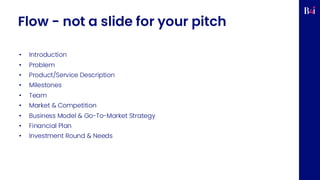
Flow - not a slide for your pitch
• Introduction
• Problem
• Product/Service Description
• Milestones
• Team
• Market & Competition
• Business Model & Go-To-Market Strategy
• Financial Plan
• Investment Round & Needs
Presentation guidelines
• Present in a clear and synthetic way (no more than 20 slides).
• Use big type size (min. 18-20) and write as less as you can, use images &
charts when possible.
• You don’t need a fancy UX, some of the most successful pitch decks were
able to convey concise messages without a strong brand identity (few
examples later).
• Explain clearly what the company does in the first few slides.
• Show why your company is a terrific investment opportunity (milestones
reached/growth/market potential).
• Show a vision. Make the listener-investor believe in you.
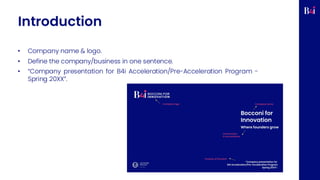
Introduction
• Company name & logo.
• Define the company/business in one sentence.
• “Company presentation for B4i Acceleration/Pre-Acceleration Program -
Spring 20XX”.
Problem
• What problem you’re solving?
• How are your potential customers solving the problem today?
• Include data backing your claims. Sources for market research could be:
Doxa, Statista, Euromonitor, etc.
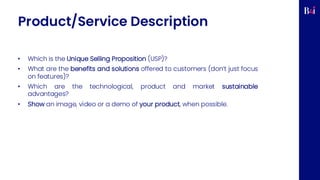
Product/Service Description
• Which is the Unique Selling Proposition (USP)?
• What are the benefits and solutions offered to customers (don’t just focus
on features)?
• Which are the technological, product and market sustainable
advantages?
• Show an image, video or a demo of your product, when possible.
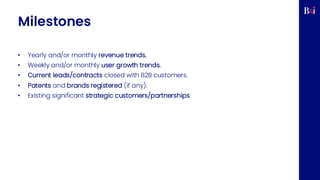
Milestones
• Yearly and/or monthly revenue trends.
• Weekly and/or monthly user growth trends.
• Current leads/contracts closed with B2B customers.
• Patents and brands registered (if any).
• Existing significant strategic customers/partnerships.
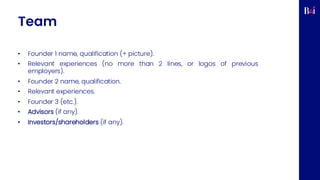
Team
• Founder 1 name, qualification (+ picture).
• Relevant experiences (no more than 2 lines, or logos of previous
employers).
• Founder 2 name, qualification.
• Relevant experiences.
• Founder 3 (etc.).
• Advisors (if any).
• Investors/shareholders (if any).
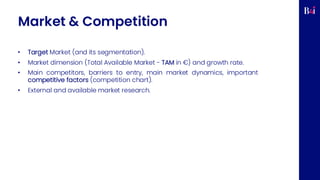
Market & Competition
• Target Market (and its segmentation).
• Market dimension (Total Available Market - TAM in €) and growth rate.
• Main competitors, barriers to entry, main market dynamics, important
competitive factors (competition chart).
• External and available market research.
Business Model &
Go-to-Market Strategy
• How do you make money/acquire customers.
• Go-to-market strategy.
• Strategies about provisions and production (when applicable/relevant).
Financial Plan
• The closer your startup is to product/market fit, the further your plan
should look into the future - with a limit of maximum 3 years.
• Feel free to keep your projections at 1-2 years into the future: what we are
looking for is not a scientifically precise financial forecast, but a sound
reasoning from the entrepreneur who is structuring the plan.
• Make sure to include revenue and EBITDA indicators, as well as a
projection of the most relevant metrics for your business.
• If you’re applying for Pre-Acceleration, it is not mandatory to prepare a
financial plan. We nevertheless recommend starting to think about it, as it
will be a pillar document to support your decisions during the life of your
company.
Investments Round & Needs
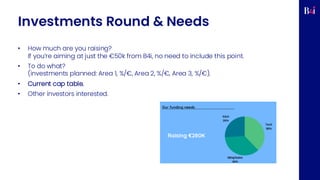
• How much are you raising?
If you’re aiming at just the €50k from B4i, no need to include this point.
• To do what?
(investments planned: Area 1, %/€, Area 2, %/€, Area 3, %/€).
• Current cap table.
• Other investors interested.
Additional sources and
benchmarks for your pitch deck
• Lessons From A Study of Perfect Pitch Decks - Techcrunch
• The Early Pitch Decks Of 15 Startups Before They Became Billion-Dollar
Companies - CBInsights
• Sequoia Capital Pitch Deck Template
• What should be in my fundraising slides?
• https://visme.co/blog/best-pitch-decks/
Got questions?
Email us at infob4i@unibocconi.it
Powered by