How do event loops
 work in Python?
    Saúl Ibarra Corretgé


      FOSDEM 2013
print(self)

• Hi there!

• @saghul

• I work on VoIP and Real Time Communications

• Python and C are my tools
try: sockets
from __future__ import print_function

import socket

server = socket.socket(family=socket.AF_INET, type=socket.SOCK_STREAM)
server.bind(('127.0.0.1', 1234))
server.listen(10)
print("Server listening on: {}".format(server.getsockname()))

client, addr = server.accept()
print("Client connected: {}".format(addr))

while True:
    data = client.recv(4096)
    if not data:
        print("Client has disconnected")
        break
    client.send(data.upper())

server.close()
except Exception:
• We can only handle one client at a time!

• Solutions for handling multiple clients

   • Threads

   • I/O multiplexing

• Check the C10K problem if you haven’t already!

   • http://www.kegel.com/c10k.html
try: sockets + threads
from __future__ import print_function

import socket
import thread

def handle_client(client, addr):
    print("Client connected: {}".format(addr))
    while True:
        data = client.recv(4096)
        if not data:
            print("Client has disconnected")
            break
        client.send(data.upper())

server = socket.socket(family=socket.AF_INET, type=socket.SOCK_STREAM)
server.bind(('127.0.0.1', 1234))
server.listen(10)
print("Server listening on: {}".format(server.getsockname()))

while True:
    client, addr = server.accept()
    thread.start_new_thread(handle_client, (client, addr))
except Exception:
• Threads have overhead

  • Stack size

  • Context switching

• Synchronization

• GIL?

  • Not for I/O!
I/O multiplexing
• Examine and block for I/O in multiple file
  descriptors at the same time

   • Single thread

• A file descriptor is ready if the corresponding I/O
  operation can be performed without blocking

• File descriptor has to be set to be non-blocking
I/O multiplexing (II)

1. Put file descriptors in non-blocking mode

2. Add file descriptors to a I/O multiplexor

3. Block for some time

4. Perform blocking operations on file descriptors
   which are ready
def set_nonblocking
def set_nonblocking(fdobj):
    try:
         setblocking = fdobj.setblocking
    except AttributeError:
         try:
              import fcntl
         except ImportError:
              raise NotImplementedError
         try:
              fd = fdobj.fileno()
         except AttributeError:
              fd = fdobj
         flags = fcntl.fcntl(fd, fcntl.F_GETFL)
         fcntl.fcntl(fd, fcntl.F_SETFL, flags | os.O_NONBLOCK)
    else:
         setblocking(False)
select

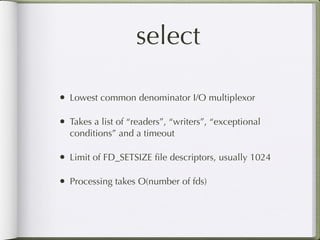
• Lowest common denominator I/O multiplexor

• Takes a list of “readers”, “writers”, “exceptional
  conditions” and a timeout

• Limit of FD_SETSIZE file descriptors, usually 1024

• Processing takes O(number of fds)
epoll

• “A better select”

• No FD_SETSIZE limit!

• Processing takes O(1) time!

• Linux only
Other I/O
         multiplexors
• kqueue

  • Like epoll but for Max OSX and BSD

• poll

  • Like select but without a limit of file descriptors

  • O(number of file descriptors) processing time

  • Very broken on some systems (OSX 10.3-5)
sys.platform == “win32”
  • Windows supports select

     • 64 file descriptors per thread - WAT

  • Starting with Vista WSAPoll (poll) is supported

     • It’s broken - http://daniel.haxx.se/blog/
       2012/10/10/wsapoll-is-broken/

  • IOCP is the good stuff

     • Based on completion, not readiness
edge/level triggering
• Level triggering (the most common)

   • You get notified when the condition is present

• Edge triggering

   • You get notified when the condition happens

• epoll and kqueue support both mechanisms

• IOCP is kind-of edge-triggered epoll
Event loop libraries
            epoll, IOCP on
                           File I/O
           kqueue windows

 libev      YES      NO      libeio

libevent    YES      YES      NO

 libuv      YES      YES      YES
Event loop libraries
        (II)
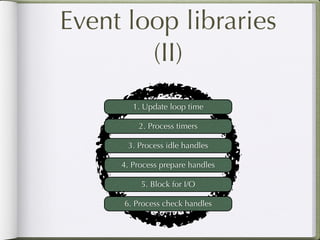
        1. Update loop time

         2. Process timers

      3. Process idle handles

     4. Process prepare handles

          5. Block for I/O

     6. Process check handles
libuv: the power
underneath nodeJS
nodeJS <= 0.4.x

                   node standard library
JavaScript

  C / C++
                      node bindings


              V8           libev       libeio
nodeJS >= 0.6.x

                   node standard library
JavaScript

  C / C++
                      node bindings


              V8                 libuv
libuv
• Originally based on libev + libeio + IOCP

• Now: epoll + kqueue + event ports + IOCP + file I/O

• TCP, UDP, named pipes, TTY

• Nice additions: interface addresses, process title, ...

• Most complete cross platform networking library

• Python bindings - pyuv
import pyuv

• Written in C, wraps everything libuv has to offer

• Python >= 2.6, supports Python 3!

• Works on Windows

• https://github.com/saghul/pyuv
from __future__ import print_function

import signal
import pyuv

def on_read(client, data, error):
    if data is None:
        print("Client read error: {}".format(pyuv.errno.strerror(error)))
        client.close()
        clients.remove(client)
        return
    client.write(data.upper())

def on_connection(server, error):
    client = pyuv.TCP(server.loop)
    server.accept(client)
    clients.append(client)
    client.start_read(on_read)
    print("Client connected: {}".format(client.getpeername()))

def signal_cb(handle, signum):
    [c.close() for c in clients]
    signal_h.close()
    server.close()

clients = []
loop = pyuv.Loop.default_loop()
server = pyuv.TCP(loop)
server.bind(("127.0.0.1", 1234))
server.listen(on_connection)
signal_h = pyuv.Signal(loop)
signal_h.start(signal_cb, signal.SIGINT)
loop.run()
import pyuv

• Experiments in replacing event loops of common
  Python networking frameworks

  • Twisted - https://github.com/saghul/twisted-pyuv

  • Tornado - https://github.com/saghul/tornado-pyuv

  • Gevent - https://github.com/saghul/uvent
import pyuv

• gaffer: application deployment and supervisor

   • https://github.com/benoitc/gaffer

• ts_analyzer: realtime analysis of multicast video
  streams

   • https://github.com/tijmenNL/ts_analyzer
The Python
 async I/O problem
• Each framework uses it’s own event loop
  implementation

• Protocols aren’t reusable

• PEP-3156 to the rescue!

   • For Python >= 3.3

• Reference implementation (Tulip)
  https://code.google.com/p/tulip/
import rose

• PEP-3156 EventLoop implementation using pyuv

• pyuv.Poll: high performance level triggered I/O
  (works on Windows as well!)

   • Uses fairy dust covered unicorns

• https://github.com/saghul/rose
import rose
import signal
from rose import events, protocols

class EchoProtocol(protocols.Protocol):
    def connection_made(self, transport):
        # TODO: Transport should probably expose getsockname/getpeername
        print("Client connected: {}".format(transport._sock.getpeername()))
        self.transport = transport
    def data_received(self, data):
        self.transport.write(data.upper())
    def eof_received(self):
        self.transport.close()
    def connection_lost(self, exc):
        print("Client closed connection")

reactor = events.new_event_loop()
events.set_event_loop(reactor)

reactor.start_serving(EchoProtocol, '127.0.0.1', 1234)
reactor.add_signal_handler(signal.SIGINT, reactor.stop)

reactor.run()
saghul