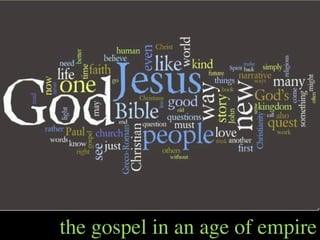
the gospel in an age of empire
From the place where   But doubts and loves
we are right
                           Dig up the world
Flowers will never
grow                   Like a mole, a plow.
In the spring.
                       And a whisper will be
The place where we        heard in the place
are right                  Where the ruined
Is hard and trampled     House once stood.
Like a yard.                    Israeli poet Yehuda Amichai
The Hebrew Scriptures
The Egyptian Empire:
- A place of refuge and enslavement, genocide

The Assyrian Empire: (about 722 bce)
- Destroying the Northern Kingdom, genocide

The Babylonian Empire (about 586 bce)
- Destroying the Southern Kingdom, Exile

The Medo-Persian and Persian Empires (539 bce)
- Religious co-option (Daniel, Ezra, Nehemiah,
Esther)
Intertestamental Period
Greek Empire

Seleucid Empire

Roman Empire
The New Testament

Roman Empire
   Greek Language, Culture, Philosophy

    Roman Politics, Power

The Jewish Wars (67-70 ce)

Christians as “Barbarians”
Christian faith as “the true philosophy” (Athens)
Christianity and Rome:
    Who converts whom?
After John was put in prison, Jesus
 went into Galilee, proclaiming the
                 good news of God.


  The time has come, he said. The
   kingdom of God has come near.
Repent and believe the good news!
                            Mark 1:15
Question 1:
What is the shape of the
biblical narrative?

              (A pre-critical question)
Eden                       Heaven


       Fall                Salvation


              History/
              The fallen
              world                    Hell
Platonic Ideal                  Platonic Ideal


        Fall                    Atonement,
                                purification
        Into
Aristotelian     Aristotelian
       Real
                 Real
                                              Hades
Pax Romana                 Pax Romana

                                  Civilization,
 Rebellion                       development,
       into                        colonialism
 barbarism    Barbarian/          assimilation
              pagan
              world
                               Destruction,
                               defeat
Perfection               Heaven

                         The Gospel of the
                         Gap ...
             Damnation


                             Hell
Is there an
alternative
understanding?
sdrawkcab gnidaer
Rick Warren, Billy Graham, Charles Finney, John Wesley (or Calvin), Luther,
Aquinas, Augustine, Paul, Jesus


reading forwards
Adam, Abraham, Moses, David, Isaiah, John the Baptist, Jesus
Exodus: Liberation & Formation


Genesis: Creation and Reconciliation
Isaiah: Peaceable Kingdom - Justice and
                 Mercy


        Exodus: Liberation & Formation


Genesis: Creation and Reconciliation
G
e
      Isaiah: Peaceable Kingdom - Justice and
n
      Mercy
e
s
i
s


    Exodus: Liberation & Formation
HUMAN DESTRUCTION
  G
  e
         Isaiah: Peaceable Kingdom - Justice and
  n
         Mercy
  e
      HUMAN VIOLENCE
  s
  i
  s   HUMAN EXPLOITATION

       Exodus: Liberation & Formation
HUMAN DESTRUCTION
  G
  e
         Isaiah: Peaceable Kingdom - Justice and
  n
         Mercy
  e
      HUMAN VIOLENCE
  s
  i
  s   HUMAN EXPLOITATION

       Exodus: Liberation & Formation
G
e    Isaiah: Peaceable Kingdom
n
e
s

    Exodus: Liberation
From Everything Must Change ...

The Roman Empire was Jesus’ original habitat and the
dominant social reality in which he lived. Its framing
story demanded absolute submission. The empire
could demand this submission because it could boast
amazing successes: a system of roads and ports to
facilitate commerce, urban planning that featured
unprecedented engineering advances—from
aqueducts to amphitheatres, an economic system that
provided a common currency and a cultural system
that spread Roman values through the Greek
language.
...The Roman Empire promised peace, security,
and equity through domination. The pax Romana
recipe was elegantly simple, as it is for all empires.
Concentrate the power of violence in once source—
the emperor (literally, the king of kings, the supreme
king to whom all regional kings defer and submit).
Decisively crush any and all opposition to the
emperor. Then, unified under the emperor’s supreme
will, the empire will defeat its enemies and punish its
criminals so that all will experience prosperity, equity,
and peace . . .
   All, that is except ...
Slaves and servants ...

Small farmers ... taxes, land acquisition, tenants, landless

Women ... marry by 14, raise 5 children to adulthood

Neighbors ...

Conscriptable men ...
So unless you were a slave, servant, tenant farmer,
woman, or border dweller, you had a great life of
prosperity, security, and equity in the empire. Until, of
course, full-scale wars broke out. Then, it wasn’t good
to be a conscriptable male. But thankfully, the sons of
the wealthy and those in power wouldn’t be
conscripted to go to the front lines. The common
people and their sons would be given that honor.
Obviously, to protect the precious freedom of the
empire’s wealthy and powerful men, there would have
to be taxes—taxes that fell disproportionately on the
non-elite. But these were small prices to pay for the
pleasure of being part of a great and peaceful empire
—a pleasure enjoyed by all except slaves, servants,
tenant farmers, women, border-dwellers, conscriptable
males, and those who were not given tax breaks.
There was one other small price to pay so that
powerful, wealthy men could enjoy the prosperity,
security, and equity of empire: freedom of speech, of
thought, of religion. Of course, all three were
officially celebrated and defended by the empire—
except when they might undermine support for
imperial policy. For example, if people were tempted
to use their free speech to complain about excessive
taxation in the empire, or if their religion came into
conflict with the patriotic ethos of the empire—
perhaps by doubting the supreme, divine authority
given to the emperor—they’d better keep quiet about
it, or they may experience the dark side of the pax
Romana: the cross.
The cross was Rome’s brilliant way of torturing uncooperative
people. Imperial security forces would erect crosses conspicuously
on hillsides near well-traveled roads near major cities of the empire.
By impaling rebels like insects on pins for public view, security
forces would demonstrate both the absolute and fearsome power of
the empire and the complete and pathetic powerlessness of
writhing, gasping, crying would-be insurrectionists. It would just
take one quick glance at a cross, perhaps supporting a naked victim
covered in sweat and blood, feces dripping down his leg, screaming
and moaning and sobbing, and the lesson would be learned. Or
perhaps a second quick glance a few days later, the Roman cross
holding high the rebel’s rotting remains as they were attended to by
scavenging crows, a vulture or two, feral dogs, a cloud of flies, and
maggots.
The quickest glance at a cross would cure almost anyone of the
impulse to shake up the blissful status quo of the pax Romana that
benefited everyone equally—except slaves, servants, tenant
farmers, women, the people of border territories, soldiers, those not
given tax breaks, and those unable to control their dreams of
freedom and impulses for free speech.


         ... How ironic that the cross—the icon of the
 dominating Roman framing story—became the icon
   for the liberating framing story of Jesus. And how
much more ironic if we who believe in Jesus don’t get
                                              the irony.
After John was put in prison, Jesus
 went into Galilee, proclaiming the
                 good news of God.


  The time has come, he said. The
   kingdom of God has come near.
Repent and believe the good news!
                            Mark 1:15
Jesus came with an alternative
  story:
          the good news
   of the kingdom* of God.
     [*reign, commonwealth, dream, dance,
   economy, ecosystem, movement, beloved
                 community, network, etc]
Colossians 1:15-20
Christ is the image of the
God who can’t be seen.

Christ is the image of the
God who can’t be seen.

   The firstborn of all
   creation.
In him all things were created.
     Things in heaven and on
     earth -
     Things visible and invisible -
     Whether thrones or
     dominions, rulers or powers.
Through him all things have
been created.
For him all things have been
created.
And he is before all things.
   All things hold together in
   him.
And he is the head of the
body, the church.
He is the beginning, the
    firstborn from the dead.
So in everything he has the first
place.
    For in him all the fullness -
    The fullness of God -
    Was pleased to dwell.
In Him God was pleased to
reconcile all things
    All things to himself,
    All things on earth,
    all things in heaven,
By making peace through the
blood of his cross.
By making peace through the
blood of his cross.
Christ is the image of the
God who can’t be seen.
Christ is the image of the
God who can’t be seen.
Amen.
Zealots
                                                         Pharisees
                                          Herodians and Sadducees
                                                          Essenes
At first glance, all of this might seem rather remote to us today, although
there has been much talk in recent years about the United States as a new
imperial power. But upon further reflection, it’s clear that these
counternarratives have various counterparts in our world today, maybe
including some of us, or maybe parts of each of us. For example, some
groups call believers to withdraw into isolated subcultures like the Essenes
– with their own TV stations, their own radio stations, their own literature,
their own schools. Others stir people to “take America back for Jesus,”
often using the rhetoric of warfare, recalling the Zealots. Some identify
various scapegoats – liberals and gays have been popular in this role – to
blame for our world’s problems. Others call on believers to support their
president or party without criticism, and to accept the current political
arrangement as the will of God, echoing Herodians and Sadducees.
Empire can be defined in various ways. Duane Clinker offers three
characteristics:
    1. An empire expands beyond normal boundaries, so its national
      interests extend to include military installations abroad, multinational
      corporations owned by the empire’s citizens, and the interests of its
      allies.
    2. An empire normally develops extraordinary military power.
    3. An empire exerts its influence in a variety of ways—through
      economics, culture, religion, education, and politics.

David Korten offers four characteristics of an empire:
   1. Empires embrace the idea of material luxury and excess for the ruling
     classes.
   2. Empires are dedicated to absolute military supremacy.
   3. Empires emphasize the masculine values of violence and domination
     over the feminine values of nurture and cooperation.
   4. Empires create a ceiling for human development and impede
     development beyond their current level.
In light of these kinds of descriptions, the three priorities of
“The National Security Strategy of the United States” have
a rather eerie significance:

   1. Perpetuate US military dominance globally so no
   nation can rival or threaten the US.
   2. Be prepared to engage in preemptive military strikes,
   whenever the US government considers another nation
   to be a threat to the US, its forces or installations
   abroad, or its friends or allies.
   3. Maintain immunity for US citizens from prosecution
   by the International Criminal Court.

   In other words, dominate, intimidate, and refuse to play
by the rules you expect everybody else to play by—a
classic manifesto of the imperial spirit.
two stories ...
two gospels ...   G
                  e    Isaiah: Peaceable Kingdom
                  n
                  e
                  s

                      Exodus: Liberation
After John was put in prison, Jesus
 went into Galilee, proclaiming the
                 good news of God.


  The time has come, he said. The
   kingdom of God has come near.
Repent and believe the good news!
                            Mark 1:15
Acts 16
The gospel of the kingdom/empire of
God confronts a colony of the kingdom/
empire of Caesar.

                                 What happens?
   What does “salvation” or “saved” mean in this
                                       context?
Ivan Illich (Austrian
        former priest,
  philosopher, social
   critic, 1926-2002)
Neither revolution nor reformation
can ultimately change a society,
rather you must tell a new powerful
tale, one so persuasive that it sweeps
away the old myths and becomes the
preferred story …
… one so inclusive that it gathers all the
bits of our past and our present into a
coherent whole, one that even shines
some light into the future so that we can
take the next step…. If you want to
change a society, then you have to tell an
alternative story.
  - attributed to Ivan Illich (Austrian former priest,
              philosopher, social critic, 1926-2002)
Gospel in age of empire