Downloaded 201 times


![GenAI Use Case: Synthetic Data Generation
Synthetic Data Generation
[Generation of data that looks like
real financial data]
● Generate large amounts of
financial data for testing and
QA
● Create realistic training
scenarios for market
simulations
● Generation of “user” data for
checking GDPR compliance
As a QA engineer validating financial system, generate CSV file that contains the following data:
First Name, Last Name, SSN, Date of birth, Credit Card Type, Credit Card Number, Purchase
Amount
Business Value:
Cost-Effectiveness - Reduces Data Collection Costs, Enables Data Augmentation
Privacy and Compliance - Ensures Data Anonymization, Facilitates Secure Testing
Speed and Efficiency - Rapid Prototyping, Scalability, Data Quality and Diversity](https://image.slidesharecdn.com/generativeaiuse-casesforenterprise-part1-230908035225-5b86104b/85/Generative-AI-Use-cases-for-Enterprise-First-Session-12-320.jpg)
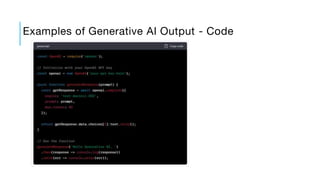
![GenAI Use Case: Code Generation
Code Generation
[Code generation based on specs]
● Coding Assistance
● Spec-to-code
● Adaptable to industry-
specific requirements
● Personalized code generation
based on project need
● Offers real-time code
suggestions
● Acts as a virtual pair
programmer
Generate an example of Python code to list prime numbers that are
less than 1000
Business Value:
Cost-Effectiveness Reduces development time, Lowers costs by automating repetitive tasks
Accelerating Development- Rapid prototyping
Automation and Scalability- Facilitates Automated Testing, Enables Batch Code Generation
# Python code to list prime numbers less than 1000
def is_prime(n):
"""Check if a number is prime."""
if n <= 1:
return False
for i in range(2, int(n ** 0.5) + 1):
if n % i == 0:
return False
return True
# List prime numbers less than 1000
prime_numbers = [n for n in range(2, 1000) if is_prime(n)]
prime_numbers[:10], len(prime_numbers) # Display the first 10 prime numbers and the total count](https://image.slidesharecdn.com/generativeaiuse-casesforenterprise-part1-230908035225-5b86104b/85/Generative-AI-Use-cases-for-Enterprise-First-Session-13-320.jpg)
![GenAI Use Case: Code Quality Check
Code Quality Checks
[Making sure that code does
not have security holes or
potential bugs]
● Automated code reviews
● Code coverage
● Bug detection
● Unit test cases
● Security vulnerability
checks
Find bugs in this function …
Business Value:
Cost-Effectiveness - Reduces development time, Lowers costs by automating repetitive tasks
Accelerating Development- Rapid debugging
Automation and Scalability- Facilitates Automated Testing, Enables Code Testing as a part of deployment pipeline
1. Bug in is_prime Condition: The condition if n < 1: should be if n <= 1:. The function should return False for both
0 and 1, as they are not prime numbers.
2. Bug in for Loop Range: The loop for i in range(10, int(n ** 0.5) + 1): starts from 10, which will not properly
check for the primality of the numbers. The loop should start from 2.
3. Bug in List Comprehension Range: The list comprehension prime_numbers = [n for n in range(0, 10) if
is_prime(n)] starts from 0. It should start from 2, as 0 and 1 are not prime numbers.
4. Bug in Output: The output prime_numbers[:1], len(prime_numbers) only shows the first element of the list and
the length of the list. If you want to show the first 10 elements, it should be prime_numbers[:10].
5. Inconsistent Comment: The comment says "List prime numbers less than 10000," but the code is actually listing
prime numbers less than 10. This can lead to confusion.
6. Performance Issue (Not exactly a bug): The function could be more efficient if it were to stop checking for
divisibility once it finds a divisor.](https://image.slidesharecdn.com/generativeaiuse-casesforenterprise-part1-230908035225-5b86104b/85/Generative-AI-Use-cases-for-Enterprise-First-Session-14-320.jpg)



![GenAI Use Case: Synthetic Data Generation
Synthetic Data Generation
[Generation of data that looks like
real financial data]
● Generate large amounts of
financial data for testing and
QA
● Create realistic training
scenarios for market
simulations
● Generation of “user” data for
checking GDPR compliance
As a QA engineer validating financial system, generate CSV file that contains the following data:
First Name, Last Name, SSN, Date of birth, Credit Card Type, Credit Card Number, Purchase
Amount
Business Value:
Cost-Effectiveness - Reduces Data Collection Costs, Enables Data Augmentation
Privacy and Compliance - Ensures Data Anonymization, Facilitates Secure Testing
Speed and Efficiency - Rapid Prototyping, Scalability, Data Quality and Diversity](/p?url=https%3A%2F%2Fimage.slidesharecdn.com%2Fgenerativeaiuse-casesforenterprise-part1-230908035225-5b86104b%2F85%2FGenerative-AI-Use-cases-for-Enterprise-First-Session-12-320.jpg&__src=https%3A%2F%2Fwww.slideshare.net%2Fslideshow%2Fgenerative-ai-usecases-for-enterprise-first-session%2F260684126&__type=image)
![GenAI Use Case: Code Generation
Code Generation
[Code generation based on specs]
● Coding Assistance
● Spec-to-code
● Adaptable to industry-
specific requirements
● Personalized code generation
based on project need
● Offers real-time code
suggestions
● Acts as a virtual pair
programmer
Generate an example of Python code to list prime numbers that are
less than 1000
Business Value:
Cost-Effectiveness Reduces development time, Lowers costs by automating repetitive tasks
Accelerating Development- Rapid prototyping
Automation and Scalability- Facilitates Automated Testing, Enables Batch Code Generation
# Python code to list prime numbers less than 1000
def is_prime(n):
"""Check if a number is prime."""
if n <= 1:
return False
for i in range(2, int(n ** 0.5) + 1):
if n % i == 0:
return False
return True
# List prime numbers less than 1000
prime_numbers = [n for n in range(2, 1000) if is_prime(n)]
prime_numbers[:10], len(prime_numbers) # Display the first 10 prime numbers and the total count](/p?url=https%3A%2F%2Fimage.slidesharecdn.com%2Fgenerativeaiuse-casesforenterprise-part1-230908035225-5b86104b%2F85%2FGenerative-AI-Use-cases-for-Enterprise-First-Session-13-320.jpg&__src=https%3A%2F%2Fwww.slideshare.net%2Fslideshow%2Fgenerative-ai-usecases-for-enterprise-first-session%2F260684126&__type=image)
![GenAI Use Case: Code Quality Check
Code Quality Checks
[Making sure that code does
not have security holes or
potential bugs]
● Automated code reviews
● Code coverage
● Bug detection
● Unit test cases
● Security vulnerability
checks
Find bugs in this function …
Business Value:
Cost-Effectiveness - Reduces development time, Lowers costs by automating repetitive tasks
Accelerating Development- Rapid debugging
Automation and Scalability- Facilitates Automated Testing, Enables Code Testing as a part of deployment pipeline
1. Bug in is_prime Condition: The condition if n < 1: should be if n <= 1:. The function should return False for both
0 and 1, as they are not prime numbers.
2. Bug in for Loop Range: The loop for i in range(10, int(n ** 0.5) + 1): starts from 10, which will not properly
check for the primality of the numbers. The loop should start from 2.
3. Bug in List Comprehension Range: The list comprehension prime_numbers = [n for n in range(0, 10) if
is_prime(n)] starts from 0. It should start from 2, as 0 and 1 are not prime numbers.
4. Bug in Output: The output prime_numbers[:1], len(prime_numbers) only shows the first element of the list and
the length of the list. If you want to show the first 10 elements, it should be prime_numbers[:10].
5. Inconsistent Comment: The comment says "List prime numbers less than 10000," but the code is actually listing
prime numbers less than 10. This can lead to confusion.
6. Performance Issue (Not exactly a bug): The function could be more efficient if it were to stop checking for
divisibility once it finds a divisor.](/p?url=https%3A%2F%2Fimage.slidesharecdn.com%2Fgenerativeaiuse-casesforenterprise-part1-230908035225-5b86104b%2F85%2FGenerative-AI-Use-cases-for-Enterprise-First-Session-14-320.jpg&__src=https%3A%2F%2Fwww.slideshare.net%2Fslideshow%2Fgenerative-ai-usecases-for-enterprise-first-session%2F260684126&__type=image)


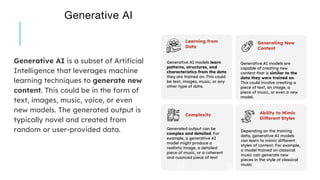
The document discusses generative AI, a subset of artificial intelligence that creates new content from learned patterns, including applications like synthetic data generation, code generation, and code quality checks. It highlights how generative AI can streamline processes, enhance productivity, and raise important compliance and privacy considerations, especially regarding data retention. The document further emphasizes that while AI can assist in various tasks, human oversight and expertise are still crucial.


![[DSC Europe 23] Shahab Anbarjafari - Generative AI: Impact of Responsible AI](https://cdn.slidesharecdn.com/ss_thumbnails/shahabanbarjafariresponsibleai-231128234708-209fc7a4-thumbnail.jpg?width=640&height=640&fit=bounds)


