Fundamentals of Database
   Systems
     By Berhanu Abebe
Chapter 1 - Introduction
•   Computers
•   Purpose of computers
•   Database
•   Benefits of Database
•   Database Vs flat files
•   Users of a Database
•   DBMS
•   Purposes of DBMS
Introduction
• Data
• Information
• Data processing

• What is data for someone may be an
  information to the other and vice versa.
Computers
• An electronic machine that
 Accepts inputs
 Processes them
 Stores the result
 Displays the output
• The main task of a computer is to transform data
  into information.
• The computer can do this by storing the data in a
  database and then by querying the database you
  can get an information out of data.
Database
• Database –
shared collection of logically related data.
Data that is organized and stored in a
  computer and can be searched and
  retrieved by a computer program.
Benefits of Database
• Data can be shared
• Concurrent access of data
• Reduced redundancy
• Quality data can be maintained – constraints,
  data type specifications
• Security measures can be enforced
• Speed will be enhanced ( for searching data
  and …)
• Centralized information control
Why not text files, Spreadsheets
•   Data integrity
•   Redundancy
•   Outdated data
•   Data size
•   Retrieval
•   Searching
•   Filtering
•   Protecting data from unauthorized use
•   Protecting data from becoming corrupt
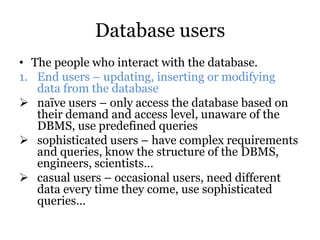
Database users
• The people who interact with the database.
1. End users – updating, inserting or modifying
   data from the database
 naïve users – only access the database based on
   their demand and access level, unaware of the
   DBMS, use predefined queries
 sophisticated users – have complex requirements
   and queries, know the structure of the DBMS,
   engineers, scientists…
 casual users – occasional users, need different
   data every time they come, use sophisticated
   queries…
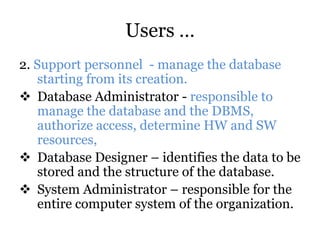
Users …
2. Support personnel - manage the database
    starting from its creation.
 Database Administrator - responsible to
    manage the database and the DBMS,
    authorize access, determine HW and SW
    resources,
 Database Designer – identifies the data to be
    stored and the structure of the database.
 System Administrator – responsible for the
    entire computer system of the organization.
DBMS
• Stands for Database Management System
• A DBMS is a software package for
providing a systematic method for
  creating, updating, storing, retrieving data
  in a database.
controlling data access, enforcing data
  integrity, managing concurrency control,
  and recovery.
Purposes of DBMS
• Concurrency control
• Data processing – creating ,updating,
  modifying….
• Authorization service
• Integrity services
• User interfaces
End


?