facilities Planning the School Media Program Part 3 planning equipment furnishings Facilities, Space  and   Equipment Ren Guray EdTech 203 Prof. Leny Que College of Education University of the Philippines
facilities planning equipment furnishings Facilities, Space  and   Equipment References and Credits Planning the School Media Program Part 3 UST Library System
Planning Approaches Start from scratch Renovate existing one
Start from scratch Consider : - goals and objectives - student population, age,  learning styles -curriculum, methods,  class schedule
Renovate existing one Review: - goals and objectives - location - inventory  - population - traffic pattern - physical lay-out
Facilities space environmental elements
Space - capacity for 20-25% of the  entire student population - or  28 m 2   per student If population is  1000 , there should be about  5600-7000 m 2  total EMC space
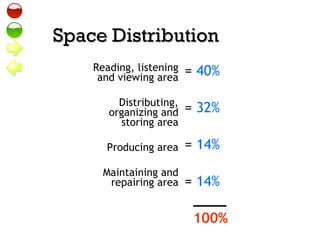
Space Distribution Reading, listening and viewing area Distributing, organizing and storing area Producing area Maintaining and repairing area =  40% =  32% =  14% =  14% ____ 100%
Space Lay-out - must allow easy access  - wide doorways and corridors for traffic
Typical Library Lay-out
Typical EMC Lay-out reading area group activity areas issue desk references repair area workroom production area carrels display door office restroom
Space Reading, Listening and Viewing Distributing, Organizing and Storing Maintaining and Repairing Producing
Provision for individual study small group (class size) large group Reading, Listening and Viewing
Individual study ranges from 1.0 m 2  - 2.2 m 2 low dividers electric outlets carrel and chair Reading, Listening and Viewing
Small Group seating enough for one class approximately 55 m 2 electric outlets adjustable dividers Reading, Listening and Viewing
Large Group maximum seating for 80-100  approximately 70 m 2 electric outlets adjustable dividers Reading, Listening and Viewing
Divided into main area workroom storage Distributing, Organizing and Storing
Main Area circulation  approx. 20% of total area display area  walls and small stands catalogue/OPAC  center/near desk issue desk  near exit Distributing, Organizing and Storing
Workroom acquisition area approx. 14-28 m 2 adequate entrances sink and running water offices approx. 20 m 2 for media specialist and staff Distributing, Organizing and Storing
Storage printed materials  non-print materials  instructional equipment  approx. 46 m 2 better to decentralize equipment distribute to each department or floor Distributing, Organizing and Storing
Services offered graphic preparation duplication printing approx. 56-65 m 2 faculty media preparation area Producing
Provided with sink electrical outlets counter/worktables Area  may be optional because services can be outsourced approx. 56-65 m 2 Maintaining and Repairing
Environmental Elements lighting thermal environment electrical power acoustics color
Lighting optimal lighting condition   fluorescent lighting, general area 400-500 lux 16-19 glare index avoid highly polished surfaces Environmental Elements
Approaches to Stack Lighting Environmental Elements “ Parallel” scheme , where rows of linear fixtures are located directly above the stack aisles “ Perpendicular” scheme , where rows of fixtures run perpendicular to the stacks and stack aisles “ Indirect” scheme , where lighting is aimed upward rather than downward, and is bounced off the ceiling. The resulting light is diffuse and non-directional.
Approaches to Stack Lighting “ Parallel” scheme “ Perpendicular” scheme
Approaches to Stack Lighting “ Indirect” scheme “ Hybrid” scheme
Table Lighting Yellowish lamp for less glare
Thermal Environment cooling and ventilation must not interfere with furniture  nor reduce space compressors must be far to avoid  noise getting in air-conditioning is the most efficient  and economical form of ventilation Environmental Elements
Electrical Power outlets on the wall, floor and ceiling minimum of 4 outlets per small area   must have safety features minimum of 15 ampere outlets circuit brakers Environmental Elements
Acoustics room location far from main roads, cafeteria, gym sound proofing carpeting, fabric space dividers, acoustic materials sound system speakers faces inwards, good quality Environmental Elements
Color age of users children= bright colors (on materials);  mature students= subdued color wall, floor and ceiling light colors, matte finish Environmental Elements
Equipment criteria for purchase commonly used
Criteria for Purchase safety ease of use performance size, weight and design maintenance and service Equipment Purchase
Criteria for Purchase compatibility versatility availability of software and consumables cost need Equipment Purchase
Common equipment presentation  duplication recording data encoding
Presentation equipment projectors  lcd, overhead, slide players  dvd, cd, tape, vhs, mp3 radio television speaker system
Presentation equipment LCD, OHP & slide projectors TV, VCR & DVD/CD player Speaker system
Duplication equipment printers  large format, color, photo scanners copiers  riso, photocopiers laminating machine
Duplication equipment Laser printer & laminating machine Document scanner Photocopier & Riso machine
Recording equipment video and audio recorders  digital, tape Digital cameras  & tripod Audio recorders
Data equipment computers  laptop, PC, mac Personal computer Laptop computer
Furnishings characteristics kinds and specifications
Characteristics - simple construction - rugged and durable - comfortable and safe - eye-pleasing - compact - multi-purpose Furnishings
Kinds carrel/workstations shelving/storage tv/vcr cart tables and chairs issue desk Furnishings
Carrel distribute throughout the EMC contain shelves/panels electric outlets 1 m x 1 m area (36”W x 30”D x 30”H surface 18”H partition panels)
Carrels
Shelving/Storage less than 8 m long 2.4 m ft between 2.5 m away from the furniture 10 m 2  per 1000 volumes Maximum height: elementary =  2.5 m high school = 3.2 m college = 3.7 m
Shelving adjustable standard shelf depth = .22 m maximum width is 1.5 m (oversized books)
TV/VCR Cart about 2 m in height should have rollers, shelves and wire brackets wood or metal frame distributed in each area
Tables and Chairs no sharp edges durable no armrests (chairs) optional table lamps and electric outlets
Issue Desk 1.5 m height or less 0.5 m wide counter adjacent shelves for books serves as display area well-lit signage
Miguel de Benavides Library UST The Library has been in continuous service since the first opening of the  "Colegio de Santo Tomas"  centuries ago. Even wars did not interrupt this service and it has adapted over time. Contents [ hide]
Miguel de Benavides Library UST
Miguel de Benavides Library UST Ecclesiastical Faculties Library Education High School Library Grade School Library  Health Sciences Library  UST High School Library Branch Libraries
Miguel de Benavides Library UST Conference Hall Discussion Rooms Drafting Area Exhibit Area Faculty Area Individual Study Rooms Internet Online Public Access Catalog (OPAC) Package Counter Readers' Café Facilities
Miguel de Benavides Library UST ground floor 109 seating capacity library orientations, seminars  other related activities for a fee  Conference Hall
Miguel de Benavides Library UST Maximum of 6 persons only. The group may stay for a maximum of 2 hours.   Discussion Rooms
Miguel de Benavides Library UST tables and chairs are specially designed for drafting and drawing purposes  Drafting Area
Miguel de Benavides Library UST computers available to UST faculty members for Internet searching and encoding purposes, research works and reports lockers for textbook, thesis and dissertation writers are available upon request. Faculty Area
Miguel de Benavides Library UST individual study, specifically for Graduate School students, foreign students and board reviewees semestral fee Individual Study Rooms
Miguel de Benavides Library UST available at the ground floor and second floor of the library  internet terminals available in the different sections and branch libraries free of charge  Internet Stations
Miguel de Benavides Library UST units installed at the different sections and branch libraries OPAC
Miguel de Benavides Library UST Readers’ Café  ground floor, rear part of the Central Library building  Italian brand "La vazza," hot and cold beverages, cakes, pastries and sandwiches
References De Silva, Rufus and Alison Turriff.  Developing the Secondary School Library Resource Centre . London: Kogan Press, 1993. Gillespie, John T. and Diana L. Spirt.  Creating A School Media Program . New York: Bowler Co, 1973  Smaldino, Sharon, etal.  Instructional Technology and Media for Learning  9 th  Ed. New Jersey: Pearson, 2008. Whitehead, B.M., etal.  Planning for Technology . London: Corwin Press, 2003. Wools, Blanche.  The School Library Media Manager . Colorado: Libraries Unlimited, 1994. http://librisdesign.org/docs/LightingLibraries.pdf http://library.ust.edu.ph/ Photo Credits http://www.computercomforts.com/open_computer_labs/images/Carrel_Group-text-JPG.jpg http://lis.luther.edu/files/images/carrel02.jpg http://www.biz2bizonline.com/texwood/images/oakwood/621248pbssl.jpg http://asset2.vitsoe.com/store/gallery_images/files/168/four_seventy/Vitsoe-shelves-university-library-003.jpg http://www.pinoyexchange.com/forums/showthread.php?t=385338&page=8 http://www.northeaststage.com/images/photos/lighting_pipe_grid.jpg http://library.rice.edu/services/dmc/checkout/equipment/list.htm http://campus.udayton.edu/~tss/classroom_support/forum015.jpg http://www.aaps.k12.mi.us/carpenter.mediacenter/files/media_center.jpg http://apache.afsc.k12.ar.us/highschool/uploads/images/JCioppa/lib12.jpg http://www.law.uconn.edu/system/files/private/lib202_tv_vcr_cart.jpg http://static.flickr.com/140/322387537_92015b23e8_o.jpg)  [email_address]