ProjectProject
Two different fabrics
Research on
Fabric
Manufacturing process
Wash and care labels
Other relevant information
BLACKBERRY’S
FORMAL
BLACK
TROUSER
75% TERYLENE 25%RAYON
Washing instructionsWashing instructions
Machine wash 40˚c
No chlorine bleach
Line dry
Iron up to 40˚c
RayonRayon
Rayon is a oldest man-made redeveloped
cellulose fibre. Rayon is produced from
naturally occurring polymers.
Rayon fibre is a natural-based material made
from the cellulose of wood pulp or cotton
fibre. They are made from reformed or
regenerated cellulose and are identified as
regenerated cellulose fibres.
It is also known as imitation silk or artificial silk
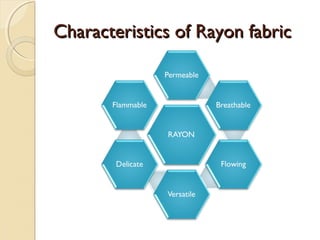
Characteristics of Rayon fabricCharacteristics of Rayon fabric
RayonRayon
 • Rayon is a versatile fibre
 • Rayon is very soft, cool comfortable and very good absorbent
property but could not be able to protect body heat and used in
humid steamy climatic conditions.
 • Rayon fibre has the same comfort property as natural fibres.
 • Rayon can replicate the feel and texture of silk, cotton, linen and
wool.
 • Rayon can easily be dyed in variety of colours
 • Rayon has very lower elastic recovery of any fibre.
Rayon Fibre CharacteristicsRayon Fibre Characteristics
Highly absorbent
Soft and comfortable
Easy to dye
Drapes well
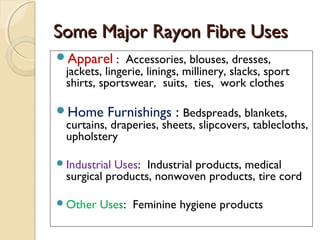
Some Major Rayon Fibre UsesSome Major Rayon Fibre Uses
Apparel : Accessories, blouses, dresses,
jackets, lingerie, linings, millinery, slacks, sport
shirts, sportswear, suits, ties, work clothes
Home Furnishings : Bedspreads, blankets,
curtains, draperies, sheets, slipcovers, tablecloths,
upholstery
Industrial Uses: Industrial products, medical
surgical products, nonwoven products, tire cord
Other Uses: Feminine hygiene products
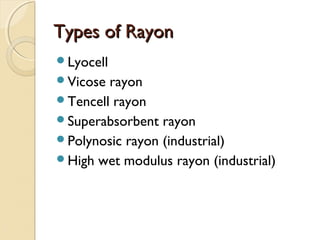
Types of RayonTypes of Rayon
Lyocell
Vicose rayon
Tencell rayon
Superabsorbent rayon
Polynosic rayon (industrial)
High wet modulus rayon (industrial)
PROCESS OF
MANUFACTURING
RAYON (from
cotton linters)
RayonRayon
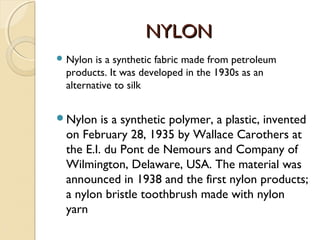
NYLONNYLON
 Nylon is a synthetic fabric made from petroleum
products. It was developed in the 1930s as an
alternative to silk
Nylon is a synthetic polymer, a plastic, invented
on February 28, 1935 by Wallace Carothers at
the E.I. du Pont de Nemours and Company of
Wilmington, Delaware, USA. The material was
announced in 1938 and the first nylon products;
a nylon bristle toothbrush made with nylon
yarn
Zara knit plain
black sweater
Wash care labels
Normal wash do not exceed 30˚c
No bleach
Flat dry
Key features of NylonKey features of Nylon
Nylon fibre based apparelsNylon fibre based apparels
Blouses
 dresses
foundation garments
lingerie
raincoats
ski apparel
windbreakers
swimwear
cycle wear
Properties of nylon fabricsProperties of nylon fabrics
Strength: Nylon has good tenacity and the strength is
not lost with age. Nylon has a high strength to weight
ratio. It is one of the lightest textile fibres is at the same
time also one of the strongest.
Elasticity: Nylon has good elasticity which makes it
much suitable for the apparel purposes. The excellent
elasticity would mean that the nylon materials return to
their original length and shreds the wrinkles or creases.
Resilience: Nylon fabrics have excellent resilience.
Nylon fabrics retain their smooth appearance and the
wrinkles from the usual daily activities can be removed
easily.
Drapability: Fabrics of nylon filament yarn have
excellent draping qualities. The drape of the fabrics
made from nylon can be varied depending on the yarn
size. The light weight sheer fabrics of nylon night gowns
have high-draping quality.
 Cleanliness and Washability: Nylon fabrics are easy
care garments. Nylon fabrics are smooth, non-
absorbent and dry quickly. Dirt doesn’t cling to this
smooth fibre, which can be washed easily or can be
even cleaned by using a damp cloth. Nylon whites are
commonly referred as colour scavengers and should be
washed separately to avoid greying
Care of nylon fabricsCare of nylon fabrics
Effect of Heat: Nylon should always be ironed at low
temperatures. Using hot iron will result in glazing and then
melting of the fabric.
Effect of Bleaches: The nylon fabrics are white and
generally do not require bleaching. The nylon fabrics which
pick up colour or develop greying should be bleached with
oxidising bleaches such as hydrogen peroxide
Wash: Nylon whites are commonly referred as colour
scavengers and should be washed separately to avoid
greying. They easily pick up colour and dirt from the
wash water. Nylons, washed with other fabrics pick up
colour (even from the palest pastels) and develop a
dingy grey appearance that is extremely difficult to
remove……
Thank you
Parmeet kaur
CPT’15