Employee Recognition Program


             Survey Findings
Key Findings

   What are the most important workforce management
    challenges organizations are currently facing?
   What are the key HR challenges organizations expect to
    face in the next three to five years?
   How many organizations currently have an employee
    recognition program?
   What are the most common reasons that organizations
    recognize employees?
   Are employee recognition programs challenging to
    measure?
Do you think that at your organization:

                                                                        Percentage

Organizational charts are an accurate indicator of                      71%
your organization’s leaders and influencers?                            (n= 491)
Annual performance reviews are an accurate                              61%
appraisal for employees’ work?                                          (n = 435)
Employees are rewarded according to their job                           56%
performance?                                                            (n = 406)
Managers or supervisors effectively acknowledge and                     46%
appreciate employees?                                                   (n= 331)
Employees are satisfied with the level of recognition                   31%
they receive for doing a good job at work?                              (n = 223)
Note: Analysis excludes “not sure” response. Percentages above reflect respondents who answered “yes” to the
question.
Does your organisation have an Employee
Recognition Program?


             No, 20

                                Yes   No


                      Yes, 80
The Most Common Reasons Organizations
Recognize Employees
Percentage of organizations that track the
ROI of their employee recognition program

Comparisons by organization staff size:
Larger organizations (2,500 employees and more) are more likely to track the ROI of
their employee recognition programs compared with smaller organizations (2,499
employees and fewer).

  1-99 employees = 10%                                                     Larger organizations > smaller
  100-499 employees = 6%               2,500-24,999 employees = 19%        organizations


  500-2,499 employees = 7%             25,000 and above = 21%
Comparisons by organization sector:
Publicly owned for-profit organizations are more likely to track the ROI of their
employee recognition programs compared with privately owned for-profit and
nonprofit organizations.

  Publicly owned for - profit = 22%   Privately owned for – profit = 10%   Publicly owned for – profit
                                      Non – profit = 7%                    organisation > privately owned for
                                                                           – profit organisation, non profit
                                                                           organisation
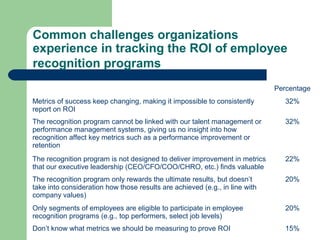
Common challenges organizations
experience in tracking the ROI of employee
recognition programs
                                                                             Percentage
Metrics of success keep changing, making it impossible to consistently          32%
report on ROI
The recognition program cannot be linked with our talent management or          32%
performance management systems, giving us no insight into how
recognition affect key metrics such as a performance improvement or
retention
The recognition program is not designed to deliver improvement in metrics       22%
that our executive leadership (CEO/CFO/COO/CHRO, etc.) finds valuable
The recognition program only rewards the ultimate results, but doesn’t          20%
take into consideration how those results are achieved (e.g., in line with
company values)
Only segments of employees are eligible to participate in employee              20%
recognition programs (e.g., top performers, select job levels)
Don’t know what metrics we should be measuring to prove ROI                     15%
HR challenges organizations anticipate
facing in the next three to five years:

                               Very             Important   Unimportant Very
                               Important                                Unimportant

 Employee Engagement                69%         30%         1%          0%
Employee Retention                  63%         32%         4%          1%
Employee Recruitment                53%         43%         3%          0%

Culture management (i.e.,           51%         45%         4%          0%
managing your
organisation’s corporate
culture)


Note: n = 742. Total may not equal 100% due to rounding
Thank You

Rashmi Rawat
Roll No. 38
PGDSHRM – Contemporary Issues of HR