By – N.G.Palit
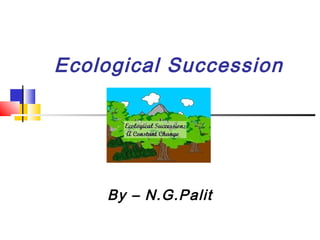
Ecological Succession
What is Ecological
Succession?
ECOLOGICAL SUCCESSION IS:
The observed process of change in the
species structure of an ecological
community over a period of time
What is Ecological Succession?
 Ecosystems are constantly changing.
Ecological succession is a gradual
process of change and replacement of
the types of species in a community.
 Each new community makes it harder
for the previous community to survive.
Types of Ecological
Succession
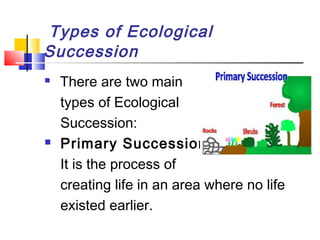
 There are two main
types of Ecological
Succession:
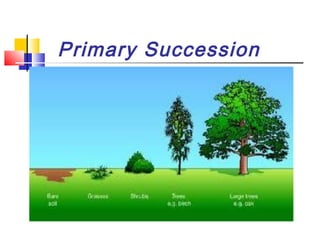
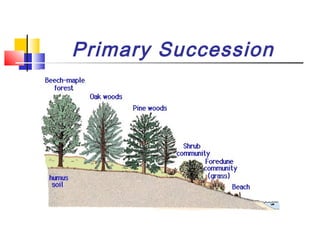
 Primary Succession:
It is the process of
creating life in an area where no life
existed earlier.
Primary Succession
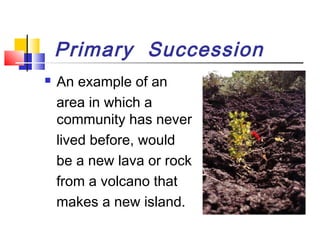
 An example of an
area in which a
community has never
lived before, would
be a new lava or rock
from a volcano that
makes a new island.
Primary Succession
 Begins in a place without any soil, like:
* Sides of volcanoes
* Landslides
* Flooding
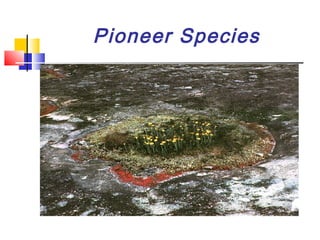
 Starts with the arrival of living things
such as lichens that do not need any
soil to survive.
 They are called Pioneer Species
Pioneer Species
Primary Succession
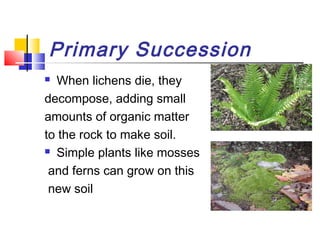
 When lichens die, they
decompose, adding small
amounts of organic matter
to the rock to make soil.
 Simple plants like mosses
and ferns can grow on this
new soil
Primary Succession
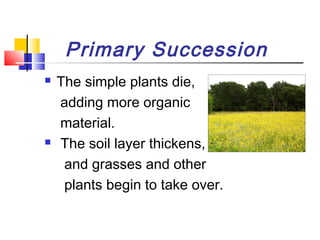
 The simple plants die,
adding more organic
material.
 The soil layer thickens,
and grasses and other
plants begin to take over.
Primary Succession
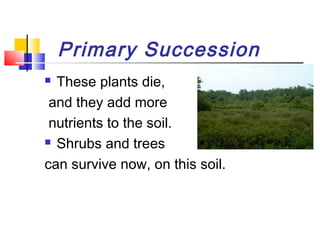
 These plants die,
and they add more
nutrients to the soil.
 Shrubs and trees
can survive now, on this soil.
Primary Succession
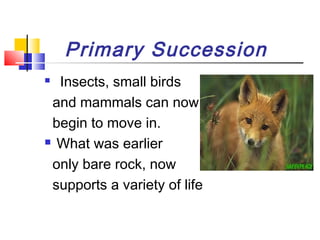
 Insects, small birds
and mammals can now
begin to move in.
 What was earlier
only bare rock, now
supports a variety of life
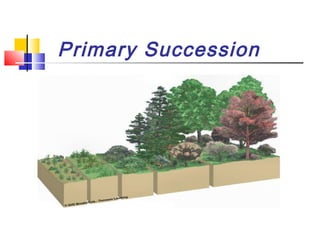
Primary Succession
Primary Succession
Primary Succession
Secondary Succession
 Secondary Succession
is the process of re-stabilization that
follows a disturbance in an area, where
life has formed an ecosystem.
Types of Ecological
Succession
 Secondary Succession occurs on a
surface where an ecosystem has
previously existed. It is the process by
which one community replaces another
community which has been partially or
totally destroyed, might be by natural
process such as floods, earthquake etc.
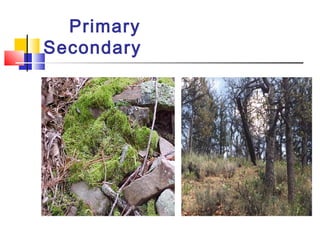
Primary
Secondary
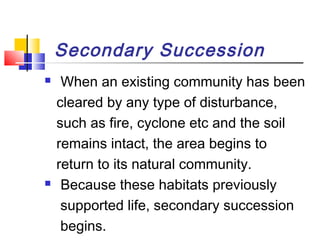
Secondary Succession
 When an existing community has been
cleared by any type of disturbance,
such as fire, cyclone etc and the soil
remains intact, the area begins to
return to its natural community.
 Because these habitats previously
supported life, secondary succession
begins.
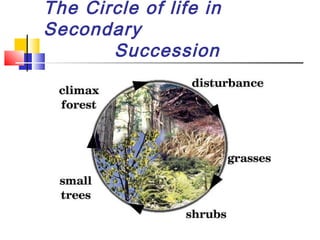
The Circle of life in
Secondary
Succession
Why does Ecological
Succession
Occur?
 Because it is the process of life for
plants and other living organisms.
 Because organisms alter soil structure
and the species communities constantly
change over a period of time.
 Succession will continue until the
environment reaches its final stage –
the Climax Community
Gradual Change from Pioneer
Stages to Climax Community
How Ecological Succession
takes place?
 Succession will
continue until the
environment
reaches it’s final
stage, ----
the Climax Community.
Climax Community
 A climax community is a mature,
stable community that is the final stage
of ecological succession
 This type of community remains the
same through out the time, if it is not
disturbed.
Climax Community
 A stable group of plants and animals
which is the end result of succession
process, does not always mean only
big trees. They could be:
* Cacti in deserts or
* Grasses in fields
These are Climax Communities
Physical Factors
 The two main physical factors that
determine the nature of the community
that develops in an area are:
 1. Temperature
 2. The amount of rainfall.
Threats to Succession
 The grasses that move in
as pioneer species are
often thought as weeds.
 The subsequent growth
of shrubs are considered
undesirable “brush”.
Threats to Succession
 But, without these
intermediate stages,
the disturbed
habitat can’t return
to forest.
How do Humans affect
Ecological succession?
 Clearing the land for garden and
preparing the soil for planting is a type
of major external event that radically
re-structure and disrupt a previously
stabilized ecosystem.
 This disturbance may immediately
begin a process of ecological
succession.
Does Ecological
Succession ever stop?
 Over a long period of time, the climate
conditions of an ecosystem is bound to
change.
 No ecosystem has existed or will
remain unchanged over a
Geological Time Scale
Any Question
Thank You
By –
N.G.Palit
At the End
Please feel free to send your valuable
feedback to me at:
nandapalit@yahoo.co.in
OR
through facebook @nandapalit