UNIT-2
 Singly Linked List
 Doubly Linked List
 Circular Linked List
 Representing Stack with Linked List.
 Representing Queue with Linked List.
In array, elements are stored in consecutive memory locations.
To occupy the adjacent space, block of memory that is required for the array
should be allocated before hand.
Once memory is allocated, it cannot be extended any more. So that array is
called the static data structure.
Wastage of memory is more in arrays.
Array has fixed size
But, Linked list is a dynamic data structure, it is able to grow in size as
needed.
What is Linked List?
 A linked list is a linear collection of homogeneous data elements,
called nodes, where linear order is maintained by means of links or
pointers.
 Each node has two parts:
 The first part contains the data (information of the element) and
 The second part contains the address of the next node (link /next
pointer field) in the list.
 Data part of the link can be an integer,
a character, a String or an object of any kind.
link
data
node
A
Null
B C D
Start
Linked Lists
 Linked list
– Linear collection of self-referential structures, called nodes, connected
by pointer links.
– Accessed via a pointer to the first node of the list.
– Subsequent nodes are accessed via the link-pointer member stored in
each node.
– Link pointer in the last node is set to null to mark the end of list.
– Data stored dynamically – each node is created as necessary.
– Length of a list can increase or decrease.
– Becomes full only when the system has insufficient memory to satisfy
dynamic storage allocation requests.
Types of linked lists
– Singly linked list
• Begins with a pointer to the first node
• Terminates with a null pointer
• Only traversed in one direction
– Circular, singly linked list
• Pointer in the last node points back to the first node
– Doubly linked list
• Two “start pointers”- first element and last element
• Each node has a forward pointer and a backward pointer
• Allows traversals both forwards and backwards
– Circular, doubly linked list
• Forward pointer of the last node points to the first node and
backward pointer of the first node points to the last node
Dynamic Memory Allocation
 Dynamic memory allocation
– Obtain and release memory during execution
• malloc
– Takes number of bytes to allocate
• Use sizeof to determine the size of an object
– Returns pointer of type void *
• A void * pointer may be assigned to any pointer
• If no memory available, returns NULL
– newPtr = malloc( sizeof( struct node ) );
• free
– Deallocates memory allocated by malloc
– Takes a pointer as an argument
– free (newPtr);
Self-Referential Structures
• Self-referential structures
– Structure that contains a pointer to a structure of the same type
– Can be linked together to form useful data structures such as lists,
queues, stacks and trees
– Terminated with a NULL pointer (0)
• Two self-referential structure objects linked together
10
15
NULL pointer (points
to nothing)
Data member
and pointer
Singly linked list operations
Insertion:
• Insertion of a node at the front
• Insertion of a node at any position in the list
• Insertion of a node at the end
Deletion:
• Deletion at front
• Deletion at any position
• Deletion at end
Display:
• Displaying/Traversing the elements of a list
Singly linked lists
Node Structure
struct node
{
int data;
struct node *link;
}*new, *ptr, *header, *ptr1;
Creating a node
new = malloc (sizeof(struct node));
new -> data = 10;
new -> link = NULL;
data link
2000
10
new
2000
NULL
Inserting a node at the beginning
Create a node that is to be inserted
2500
data link
10
new
2500
NULL
Algorithm:
1. Create a new node.
2. if (header = = NULL)
3. new -> link = NULL;
4. header = new;
5. else
6. {
7. new -> link = header;
8. header = new;
9. }
If the list is empty
NULL
header header
If the list is not empty
1200
header
2500
10
new
2500
NULL 1200 1300 1330 1400
NULL
5 5 4 8
1300 1330 1400
Inserting a node at the end
10 1800 20 1200 30 1400 40 NULL
1500 1800 1200
1400
1500
header
50 NULL
2000
Algorithm:
1. new=malloc(sizeof(struct node));
2. ptr = header;
3. while(ptr -> link!= NULL)
4. ptr = ptr -> link;
5. new -> link = NULL;
6. ptr -> link = new;
2000
new
1500
ptr
1800
1200
1400
2000
Inserting a node at the given position
10 1800 20 1200 30 1400 40 NULL
1500
header
50 NULL
2000
2000
new Algorithm:
1. new=malloc(sizeof(struct node));
2. ptr = header;
3. for(i=1;i < pos-1;i++)
4. ptr = ptr -> link;
5. new -> link = ptr -> link;
6. ptr -> link = new;
1500
ptr
1500 1800 1200
1400
Insert position : 3
1800
1200
2000
Deleting a node at the beginning
Algorithm:
1. if (header = = NULL)
2. print “List is Empty”;
3. else
4. {
5. ptr = header;
6. header = header -> link;
7. free(ptr);
8. }
10 1800 20 30 1400 40 NULL
1500 1800 1200
1400
1200
1500
header
1500
ptr
1800
Deleting a node at the end
10 1800 20 1200 30 1400 40 NULL
1500 1800 1200
1400
1500
header
Algorithm:
1. ptr = header;
2. while(ptr -> link != NULL)
3. ptr1=ptr;
4. ptr = ptr -> link;
5. ptr1 -> link = NULL;
6. free(ptr);
1500
ptr
1800
1200
NULL
ptr1 ptr1 ptr1
1400
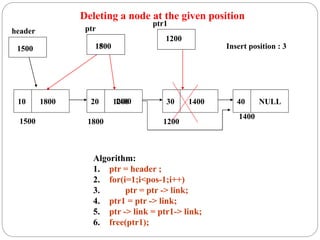
Deleting a node at the given position
10 1800 20 1200 30 1400 40 NULL
1500
header
Algorithm:
1. ptr = header ;
2. for(i=1;i<pos-1;i++)
3. ptr = ptr -> link;
4. ptr1 = ptr -> link;
5. ptr -> link = ptr1-> link;
6. free(ptr1);
1500
ptr
1500 1800 1200
1400
Insert position : 3
1800
ptr1
1200
1400
Traversing an elements of a list
10 1800 20 1200 30 1400 40 NULL
1500 1800 1200 1400
1500
header
Algorithm:
1. if(header = = NULL)
2. print “List is empty”;
3. else
4. for (ptr = header ; ptr != NULL ; ptr = ptr -> link)
5. print “ptr->data”;
ptr
1500
/*Program to implement single linked list*/
#include<stdio.h> #include<malloc.h> #include<conio.h> #include<stdlib.h>
void traverse(); void deletion(); void insertion();
int choice,i,pos,item;
struct node {
int data;
struct node *link;
}*header,*ptr,*ptr1,*new;
void main() {
header=NULL;
ptr=header;
printf("****Menu****n");
printf("n 1.Insertionn 2.Deletionn 3.Traversen 4.Searchn 5.Exitn");
while(1) {
printf("nenter ur choice");
scanf("%d",&choice);
switch(choice) {
case 1: insertion(); break;
case 2: deletion(); break;
case 3: traverse(); break;
case 4: search(); break;
case 5: exit();
default: printf("nwrong choicen");
}/*end of switch*/
}/*end of while*/
}/*end of main*/
void insertion() {
new=malloc(sizeof(struct node));
printf("n enter the item to be insertedn");
scanf("%d",&item);
new->data=item;
if(header = = NULL)
{
new->link=NULL;
header=new;
}/*end of if*/
else
{
printf("nEnter the place to insert the itemn");
printf("1.Startn 2.Middlen 3.Endn");
scanf("%d",&choice);
if(choice = = 1)
{
new->link=header;
header=new;
}
if(choice = = 2)
{
ptr=header;
printf("Enter the position to place an item: ");
scanf("%d",&pos);
for(i=1;i<pos-1;i++)
ptr=ptr->link;
new->link=ptr->link;
ptr->link=new;
}
if(choice = = 3)
{
ptr=header;
while(ptr->link!=NULL)
ptr=ptr->link;
new->link=NULL;
ptr->link=new;
}
}/*end of else*/
}/*end of insertion*/
void deletion()
{
ptr=header;
if(header = = NULL)
{
printf("nThe list is empty");
}
else
{
printf("n1.Start n2.Middle n3.End");
printf("nEnter the place to delete the element from list");
scanf("%d",&choice);
if(choice = = 1)
{
printf("nThe deleted item from the list is -> %d",ptr->data);
header=header->link;
}
if(choice = = 2)
{
printf("nEnter the position to delete the element from the list");
scanf("%d",&pos);
for(i=0;i<pos-1;i++)
{
ptr1=ptr;
ptr=ptr->link;
}
printf("nThe deleted element is ->%d",ptr->data);
ptr1->link=ptr->link;
}
if(choice = = 3)
{
while(ptr->link!=NULL) {
ptr1=ptr;
ptr=ptr->link;
}//while
printf("nThe deleted element from the list is ->%d", ptr->data);
ptr1->link=NULL;
}
}/*end of else*/
}/*end of deletion*/
void traverse()
{
if(header = = NULL)
printf("List is emptyn");
else
{
printf("nThe elements in the list are");
for(ptr=header;ptr!=NULL;ptr=ptr->link)
printf("ntNode at %d is %d",++i,ptr->data);
}
}/*end of traverse*/
 Disadvantage of using an array to implement a stack or queue is the
wastage of space.
 Implementing stacks as linked lists provides a feasibility on the number of
nodes by dynamically growing stacks, as a linked list is a dynamic data
structure.
 The stack can grow or shrink as the program demands it to.
 A variable top always points to top element of the stack.
 top = NULL specifies stack is empty.
Representing Stack with Linked List
10 NULL
1500
1800
1200
1400
20 1400
30 1200
40 1800
50 1500 1100
top
Example:
The following list consists of five cells, each of which holds a data object
and a link to another cell.
A variable, top, holds the address of the first cell in the list.
/* Write a c program to implement stack using linked list */
#include<stdio.h> #include<conio.h> #include<malloc.h> #include<stdlib.h>
int push(); int pop(); int display(); int choice,i,item;
struct node {
int data;
struct node *link;
}*top,*new,*ptr;
main() { top=NULL;
printf("n***Select Menu***n");
while(1) {
printf("n1.Push n2.Pop n3.Display n4.Exitn5.Count");
printf("nnEnter ur choice: ");
scanf("%d",&choice);
switch(choice) {
case 1: push(); break;
case 2: pop(); break;
case 3: display(); break;
case 4: exit(0);
case 5: count(); break;
default: printf("nWrong choice");
}/* end of switch */
}/* end of while */
}/* end of main */
int push()
{
new=malloc(sizeof(struct node));
printf("nEnter the item: ");
scanf("%d",&item);
new->data=item;
if(top = = NULL)
{
new->link=NULL;
}
else
{
new->link=top;
}
top=new;
return;
}/* end of insertion */
int pop()
{
if(top = = NULL)
{
printf("nnStack is empty");
return;
}//if
else
{
printf("nnThe deleted element
is: %d",top->data);
top=top->link;
}
return;
}/* end of pop() */
int display()
{
ptr=top;
if(top = = NULL)
{
printf("nThe list is empty");
return;
}
printf("nThe elements in the stact are: ");
while(ptr!=NULL)
{
printf("n %d",ptr->data);
ptr=ptr->link;
}/* end of while */
return;
}/* end of display() */
int count()
{
int count=1;
ptr=top;
if(top = = NULL)
{
printf("nThe list is empty");
return;
}
while(ptr->link!=NULL)
{
++count;
ptr=ptr->link;
}
printf("nnThe number of elements in
the stack are: %d",count);
return;
}/* end of count */
 New items are added to the end of the list.
 Removing an item from the queue will be done from the front.
 A pictorial representation of a queue being implemented as a linked list
is given below.
 The variables front points to the front item in the queue and rear points
to the last item in the queue.
Representing Queue with Linked List
10 1800 20 1200 30 1400 40 NULL
1500 1800 1200 1400
front rear
/*Write a c program to implement queue using linked list*/
#include<stdio.h> #include<conio.h> #include<malloc.h>
#include<stdlib.h> int choice,i,item;
struct node {
int data;
struct node *link;
}*front,*rear,*new,*ptr;
main() {
front=NULL;
rear=NULL;
printf("nn MENU");
printf("n1.Enqueue n2.Dequeue n3.Display n4.Exit");
while(1) {
printf("nEnter your choice: ");
scanf("%d",&choice);
switch(choice) {
case 1:enqueue(); break;
case 2:dequeue(); break;
case 3:display(); break;
case 4:exit(0);
default:printf("nwrong choice");
}/*end of switch */
}/*end of while */
}/*end of main */
int enqueue()
{
new=malloc(sizeof(struct node));
printf("nenter the item");
scanf("%d",&item);
new->data=item;
new->link=NULL;
if(front==NULL)
{
front=new;
}
else
{
rear->link=new;
}
rear=new;
return;
}/*end of enqueue */
display()
{
if(front==NULL)
printf("nThe list is emtpy");
else
{
for(ptr=front;ptr!=NULL;ptr=ptr->link)
printf(" %d",ptr->data);
}
return;
}/* end of display */
dequeue()
{
if(front==NULL)
printf("nThe list is empty");
else
if(front==rear) /*list has single element*/
{
printf("nThe deleted element is: %d",front->data);
front=rear=NULL;
}
else
{
printf("nThe deleted element is: %d",front->data);
front=front->link;
}
return;
}/*end ofdequeue*/
Doubly linked list
 In a singly linked list one can move from the header node to any node in
one direction only (left-right).
 A doubly linked list is a two-way list because one can move in either
direction. That is, either from left to right or from right to left.
 It maintains two links or pointer. Hence it is called as doubly linked list.
 Where, DATA field - stores the element or data, PREV- contains the
address of its previous node, NEXT- contains the address of its next node.
PREV DATA NEXT
Structure of the node
Doubly linked list operations
Insertion:
• Insertion of a node at the front
• Insertion of a node at any position in the list
• Insertion of a node at the end
Deletion:
• Deletion at front
• Deletion at any position
• Deletion at end
Display:
• Displaying/Traversing the elements of a list
Algorithm:
1. Create a new node
2. Read the item
3. new->data=item
4. ptr= header
5. new->next=ptr;
6. ptr->prev=new;
7. new->prev=NULL;
8. header=new;
20 1000
1010 30 2000
2020 40 NULL
1000
10 2020
2200
1010 2020 1000 2000
50 1010
NULL
2200
new
header
2200
20 1000
1010 30 2000
2020 40 NULL
1000
10 2020
NULL
1010 2020 1000 2000
header
1010
ptr
1010 Before inserting a node at the beginning
After inserting a node at the beginning
50 NULL
NULL
2200 new
1. Create a new node
2. Read the item
3. new->data=item
4. ptr= header
5. while(ptr->next!=NULL)
1. ptr=ptr->next;
6. new->next=NULL;
7. new->prev=ptr;
8. ptr->next=new;
50 NULL
NULL
2200 new
header
20 1000
1010 30 2000
2020 40 NULL
1000
10 2020
NULL
1010 2020 1000 2000
1010 ptr
1010 ptr
new
20 1000
1010 30 2000
2020 40 2200
1000
10 2020
NULL
1010 2020 1000 2000
50 NULL
2000
2200
new
ptr 2000
Before inserting a node at end of a list
After inserting a node
at end of a list
Algorithm:
Insertion of a node at any position in the list
1. create a node new
2. read item
3. new->data=item
4. ptr=header;
5. Read the position where the element is to be inserted
6. for(i=1;i<pos-1;i++)
6.1 ptr=ptr->next;
7. if(ptr->next = = NULL)
7.1 new->next = NULL;
7.2 new->prev=ptr;
7.3 ptr->next=new;
8. else
8.1 ptr1=ptr->next;
8.2 new->next=ptr1;
8.3 ptr1->prev=new;
8.4 new->prev=ptr;
8.5 ptr->next=new;
9. end
Algorithm:
header
20 1000
1010 30 2000
2020 40 NULL
1000
10 2020
NULL
1010 2020 1000 2000
1010 ptr
1010 ptr
50 NULL
NULL
2200 new
Before inserting a node at position 3
header
20 2200
1010 30 2000
2200 40 NULL
1000
10 2020
NULL
1010 2020 1000 2000
1010
ptr
2020 ptr
50 1000
2020
2200 new
ptr
1000 ptr1
After inserting a node at position 3
Algorithm:
1.ptr=header
2.ptr1=ptr->next;
3.header=ptr1;
4.if(ptr1!=NULL)
1.ptr1->prev=NULL;
5. free(ptr);
header
20 1000
1010 30 2000
2020 40 NULL
1000
10 2020
NULL
1010 2020 1000 2000
1010
ptr1
ptr
20 1000
NULL 30 2000
2020 40 NULL
1000
10 2020
NULL
1010 2020 1000 2000
2020
1010
header
Before deleting a node at beginning
After deleting a node at beginning
header
20 1000
1010 30 2000
2020 40 NULL
1000
10 2020
NULL
1010 2020 1000 2000
1010
Algorithm:
1. ptr=header
2. while(ptr->next!=NULL)
1. ptr=ptr->next;
3. end while
4. ptr1=ptr->prev;
5. ptr1->next=NULL;
Before deleting a node at end
ptr
pt1
header
20 1000
1010 30 NULL
2020 40 NULL
1000
10 2020
NULL
1010 2020 1000 2000
1010
2000
1000
After deleting a node at end
Deletion at any position
Algorithm:
1. ptr=header;
2. while(ptr->next!=NULL)
1.for(i=0;i<pos-1;i++)
1. ptr=ptr->next;
2.if(i = = pos-1)
1. break;
3. end while
4. if(ptr = = header)
//if the deleted item is first node
4.1 ptr1=ptr->next;
4.2 ptr1->prev=NULL;
4.3 header=ptr1;
4.4 end if
5.else
5.1 ptr1=ptr->prev;
5.2 ptr2=ptr->next;
5.3 ptr1->next=ptr2;
5.4 ptr2->prev=ptr1;
6. end else
7. end if
header
20 1000
1010 30 2000
2020 40 NULL
1000
10 2020
NULL
1010 2020 1000 2000
1010 ptr
1010 ptr
Before deleting a node at position 3
After deleting a node at position 3
2000
header
20 2000
1010 30 2000
2200 40 NULL
2020
10 2020
NULL
1010 2020 1000 2000
1010
ptr
2020
ptr
1
ptr
1000 ptr2
Displaying elements of a list
Algorithm:
1. ptr=header;
2. if(header = = NULL)
1. printf("The list is emptyn");
3. else
1. print “The elements in farword order: “
2. while(ptr!=NULL)
1. print “ptr->data”;
2. if(ptr->next = = NULL)
1. break;
3. ptr=ptr->next;
3. print “The elements in reverse order: “
4. while(ptr!=header)
1. if(ptr->next = = NULL)
1. print “ptr->data”;
2. else
1. print “ptr->data”;
2. ptr=ptr->prev;
3. print “ptr->data”;
3.end else
4. end else
20 1000
1010 30 2000
2020 40 NULL
1000
10 2020
NULL
1010 2020 1000 2000
header
1010
ptr
1010
Forward Order : 10 20 30 40
Reverse Order : 40 30 20 10
/*Program to implement operations of double linked list*/
#include<stdio.h> #include<conio.h> #include<malloc.h>
void insertion(); void deletion(); void traverse(); int i,pos,item,choice;
struct node {
int data;
struct node *next;
struct node *prev;
}*new,*header,*ptr,*ptr1,*ptr2;
void main() {
header=NULL;
printf(" ***** MENU ****");
printf("n1.Insertion n2.Deletion n3.Traverse n4.Exitn");
while(1) {
printf("nnEnter your choice: ");
scanf("%d",&choice);
switch(choice) {
case 1: insertion(); break;
case 2: deletion(); break;
case 3: traverse(); break;
case 4: exit();
default: printf("nWrong choice");
}/* end of switch */
}/* end of while */
}/* end of main */
void insertion() {
ptr=header;
new=malloc(sizeof(struct node));
printf("nEnter the item to be inserted: ");
scanf("%d",&item);
new->data=item;
if(header==NULL) {
new->prev=NULL;
new->next=NULL;
header=new;
}
else {
printf("nSelect the place:");
printf("n1.Start n2.Middle n3.Endn");
scanf("%d",&choice);
if(choice==1) {
new->next=ptr;
ptr->prev=new;
new->prev=NULL;
header=new;
}/* choice1 */
if(choice==2)
{
printf("nEnter the position to place the new element: ");
scanf("%d",&pos);
for(i=1;i<pos-1;i++)
ptr=ptr->next;
if(ptr->next==NULL)
{
new->next=NULL;
new->prev=ptr;
ptr->next=new;
}
else
{
ptr1=ptr->next;
new->next=ptr1;
ptr1->prev=new;
new->prev=ptr;
ptr->next=new;
}
}/* choice2 */
if(choice==3)
{
while(ptr->next!=NULL)
ptr=ptr->next;
new->next=NULL;
new->prev=ptr;
ptr->next=new;
}
}/* end of else */
}/* end of insertion */
void deletion()
{
ptr=header;
if(header==NULL)
printf("The list is emptyn");
else
{
printf("Select the place:");
printf("n1.Start n2.Middle n3.Endn");
scanf("%d",&choice);
if(choice==1)
{
printf("nThe deleted item is: %d",ptr->data);
ptr1=ptr->next;
header=ptr1;
if(ptr1!=NULL)
ptr1->prev=NULL;
}/* choice1 */
if(choice==2) {
printf("nEnter the position to delete the element: ");
scanf("%d",&pos);
while(ptr->next!=NULL) {
for(i=0;i<pos-1;i++)
ptr=ptr->next;
if(i==pos-1)
break;
}//while
printf("nnThe deleted node is: %d",ptr->data);
if(ptr==header)//deleted item is starting node
{
ptr1=ptr->next;
ptr1->prev=NULL;
header=ptr1;
}//if
else {
ptr1=ptr->prev;
ptr2=ptr->next;
ptr1->next=ptr2;
ptr2->prev=ptr1;
}
}/* choice2 */
}/* end of else */
if(choice==3)
{
while(ptr->next!=NULL)
ptr=ptr->next;
printf("nnThe deleted node is: %d",ptr->data);
ptr1=ptr->prev;
ptr1->next=NULL;
}/* choice3 */
}/*end of deletion */
void traverse(){
ptr=header;
if(header==NULL)
printf("The list is emptyn");
else {
printf("nnThe elements in farword order: ");
while(ptr!=NULL){
printf(" %d",ptr->data);
if(ptr->next==NULL) {
break;
}
ptr=ptr->next;
}/* end of while */
printf("nnThe elements in reverse order: ");
while(ptr!=header) {
if(ptr->next==NULL)
printf(" %d",ptr->data);
else
printf(" %d",ptr->data);
ptr=ptr->prev;
}/* end of while */
printf(" %d",ptr->data);
}/* end of else */
}/* end of traverse() */
Circular linked list
 The linked list where the last node points the header node is called
circular linked list.
Circular singly linked list
Circular doubly linked list
/* Write a c program to implement circular linked list*/
#include<stdio.h> #include<conio.h> #include<malloc.h> #include<stdlib.h>
int choice,i,item;
struct node {
int data;
struct node *link;
}*front,*rear,*new,*ptr1,*ptr;
main() {
front=rear=NULL;
printf("n select menun");
while(1) {
printf("n1.Enqueue n2.Dequeue n3.Display n4.Exit");
printf("nEnter ur choice: ");
scanf("%d",&choice);
switch(choice) {
case 1: enqueue(); break;
case 2: dequeue(); break;
case 3: display(); break;
case 4: exit(0);
default: printf("nWrong choice.");
}/*end of switch*/
}/*end of while*/
}/*end of main*/
int enqueue()
{
new=malloc(sizeof(struct node));
printf("nEnter the item: ");
scanf("%d",&item);
new->data=item;
if(front==NULL)
front=new;
else
rear->link=new;
rear=new;
rear->link=front;
return;
}/*end of enqueue()*/
dequeue()
{
if(front==NULL)
printf("nThe circular list is empty.");
else
if(front==rear)
{
printf("nThe deleted element is: %d",front->data);
front=rear=NULL;
}
else
{
printf("nThe deleted element is: %d",front->data);
front=front->link;
rear->link=front;
}
return;
}/*end of dequeue*/
display()
{
ptr=front;
ptr1=NULL;
if(front==NULL)
printf("nThe circular list is empty.");
else
{
printf("nElements in the list are: ");
while(ptr!=ptr1)
{
printf(" %d",ptr->data);
ptr=ptr->link;
ptr1=front;
}/*end of while*/
return;
}/*end of else*/
}/*end of display*/