TOPIC
DISORDERS OF PITUITARY
GLAND
PRESENTED BY
OM VERMA
ASST.PROFESSOR
RELIANCE INSTITUTE OF NURSING
DISORDERS
OF
PITUITARY GLAND
The pituitary is the "master control gland" -
it makes hormones that affect growth and
the functions of other glands in the body.
With pituitary disorders, you often have too
much or too little of one of your hormones.
Injuries can cause pituitary disorders, but
the most common cause is
a pituitary tumor.
ACCORDING TO LUCLMANN
Pituitary disorders it is a defend as
anMost pituitary adenomas are known as non-
functional adenomas and do not produce
excessive amounts of hormones, while others can
result in hormone overproduction, causing
serious endocrine problems, such as acromegaly
(GH excess), Cushing's syndrome (ACTH excess)
or prolactinoma (prolactin excess).
ACCORDING TO LEWIS
Causes of Disorder of PituitaryGland
Mainly of 2 reasons:
• Hyperactivity
• Hypoactivity
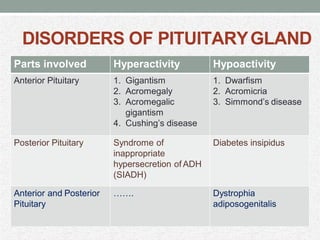
DISORDERS OF PITUITARYGLAND
Parts involved Hyperactivity Hypoactivity
Anterior Pituitary 1. Gigantism
2. Acromegaly
3. Acromegalic
gigantism
4. Cushing’s disease
1. Dwarfism
2. Acromicria
3. Simmond’s disease
Posterior Pituitary Syndrome of
inappropriate
hypersecretion of ADH
(SIADH)
Diabetes insipidus
Anterior and Posterior
Pituitary
……. Dystrophia
adiposogenitalis
HYPERACTIVITY IN PITUITARY
GLAND
ANTERIOR PITUITARY
Gigantism
Acromegaly
Acromegalic gigantism
Cushing’s disease
GIGANTISM
Pituitary disorder characterized by:
• Excess growth of body
• Average height is approximately 7 – 8 feet
Gigantism
is a rare condition that causes abnormal
growth in children. This change is most
notable in terms of height, but girth is affected
as well. It occurs when your child's pituitary
gland makes too much growth hormone,
which is also known as somatotropin.
CAUSES OF GIGANTISM
• Hypersecretion of GH in childhood or in
pre – adult
• Tumor of acidophilic cells of Anterior
pituitary
Carney complex is an inherited condition that
causes noncancerous tumors on connective
tissue, cancerous or noncancerous endocrine
tumors, and spots of darker skin.
Multiple endocrine neoplasia type 1 (MEN1) is
an inherited disorder that causes tumors in the
pituitary gland, pancreas, or parathyroid
glands.
Neurofibromatosis is an inherited disorder that
causes tumors in the nervous system.
Continued…
SIGNS AND SYMPTOMS
• Huge stature : 7 or 8 feet height
• Hyperglycemia , develop glycosuria ,
pituitary diabetes mellitus
• Headache due to tumor of pituitary
Continued…
• Visual disturbances
• Gigantism ends in hypopituitarism
(burning of cells of anterior pituitary )
very large hands and feet
thick toes and fingers
a prominent jaw and forehead
coarse facial features
excessive sweating
severe or recurrent headaches
weakness
insomnia and other sleep disorders
delayed puberty in both boys and girls
irregular menstrual periods in girls
deafness
GIGANTISM DIAGNOSTIC TEST
HISTORY TAKING
PHYSICAL EXAMINATION
BLOOD TEST
If your child’s doctor suspects gigantism, they may
recommend a blood test to measure levels of growth
hormones and insulin-like growth factor 1 (IGF-1),
which is a hormone produced by the liver.
MRI SCAN of the pituitary gland. Doctors use
this scan to find the tumor and see its size and
position.
ORAL GLUCOSE TOLERANCE TEST,
The doctor also may recommend an oral
glucose tolerance test.
During an oral glucose tolerance test, your
child will drink a special beverage containing
glucose, a type of sugar. Blood samples will be
taken before and after your child drinks the
beverage.
In a normal body, growth hormone levels will
drop after eating or drinking glucose. If your
child’s levels remain the same, it means
their body is producing too much growth
hormone.
If the blood tests indicate gigantism, child
will needed.
Medical management
Treatments for gigantism aim to stop or slow your
child’s production of growth hormones.
Medication
In some cases, surgery may not be an option. For
example, if there’s a high risk of injury to a critical
blood vessel or nerve.
Your child’s doctor may recommend medication if
surgery is not an option. This treatment is meant to
either shrink the tumor or stop the production of
excess growth hormone.
doctor may use the drugs octreotide or lanreotide
to prevent the growth hormone’s release. These
drugs mimic another hormone that stops growth
hormone production. They’re usually given as an
injection about once a month.
Bromocriptine and cabergoline are drugs that can
be used to lower growth hormone levels. These are
typically given in pill form. They may be used with
octreotide. Octreotide is a synthetic hormone that,
when injected, can also lower the levels of growth
hormones and IGF-
Gamma knife radiosurgery
Gamma knife radiosurgery is an option if your
child’s doctor believes that a traditional
surgery isn’t possible.
The “gamma knife” is a collection of highly
focused radiation beams. These beams don’t
harm the surrounding tissue, but they’re able
to deliver a powerful dose of radiation at the
point where they combine and hit the tumor.
This dose is enough to destroy the tumor
Gamma knife treatment takes months to
years to be fully effective and to return the
levels of growth hormone to normal. It’s
performed on an outpatient basis
under general anesthetic.
However, since the radiation in this type of
surgery has been linked to obesity, learning
disabilities, and emotional issues in children,
it’s usually used only when other treatment
options don’t work.
Surgery
Removing the tumor is the preferred treatment
for gigantism if it’s the underlying cause.
The surgeon will reach the tumor by making an
incision in your child’s nose. Microscopes or
small cameras may be used to help the surgeon
see the tumor in the gland. In most cases, your
child should be able to return home from the
hospital the day after the surgery.
ACROMEGALY
Anterior pituitary disorder characterized by:
• Enlargement, thickening, and broadening of
bones
• Particularly extremities of the body
Acromegaly is a hormonal disorder that
develops when pituitary gland produces
too much growth hormone during
adulthood. When this happens, your
bones increase in size, including those of
your hands, feet and
face. Acromegaly usually affects middle-
aged adults
Continued…
CAUSES OF ACROMEGALY
• Hypersecretion of GH after fusion of
epiphysis with shaft
of bone
• Adenomatous tumor of anterior pituitary
involving the acidophilic cells.
Continued...
SIGNS AND SYMPTOMS
Striking features are protrusion of :
• Supraorbital ridges
• Broadening of nose
• Thickening of lips
• Thickening and wrinkles formation on forehead
• Lower jaw (prognathism)
Face with these features called as acromegalic or guerilla face
Continued…
Signs and symptoms
• Kyphosis : enlargement of hands and feet with
bowing spine
• Scalp is thickened and thrown into folds
• Overgrowth of body hair
• Visceral organs are enlarged
Continued…
Signs and symptoms
• Thyroid , parathyroid and adrenal glands shows
hyperactivity
• Hyperglycemia and glucosuria
• Hypertension
• Headache
• Visual disturbance – Bitemporal hemianopia
Con…
Common symptoms of acromegaly are:
enlarged bones in the face, feet, and hands
excessive hair growth in women
an enlarged jaw or tongue
a prominent brow
excessive growth spurts, which are more
common in people who’ve had abnormal
growth before adolescence
weight gain
swollen and painful joints that limit
movement
Con….
spaces between the teeth
splayed fingers and toes
a hoarse, deep voice
fatigue
headaches
an inability to sleep
muscle weakness
profuse sweating
body odor
enlarged sebaceous glands, which are glands that
produce oils in the skin
thickened skin
skin tags, which are noncancerous growths
DIAGNOSING ACROMEGALY
BLOOD TESTS
Blood tests can determine if you have too much GH,
but these aren’t always accurate because GH levels
fluctuate throughout the day. Instead, your doctor may
order a glucose tolerance test. This test requires you to
drink 75 to 100 grams of glucose and then have your
GH levels tested. If your body is secreting normal levels
of GH, excess glucose will cause your body to suppress
your GH levels. People who have acromegaly will still
show high GH levels.
INSULIN-LIKE GROWTH FACTOR 1 (IGF-1)
Doctors may also test for a protein called
insulin-like growth factor 1 (IGF-1). Levels
of IGF-1 can show if there is abnormal
growth in the body. IGF-1 testing can also
be used to monitor the progress of other
hormone treatments.
IMAGING STUDIES
X-rays and MRI scans may be ordered to check for
excess bone growth if your doctor suspects you have
acromegaly. Your doctor will also perform a physical
exam, and they may order a sonogram to check the
size of internal organ
After you’re diagnosed with acromegaly, your doctor can
use MRI and CT scans to help them find the pituitary
tumor and determine its size. If they don’t find a tumor on
the pituitary gland, your doctor will look for tumors in the
chest, abdomen, or pelvis that may be causing excess GH
production.
MANAGEMENT OF ACROMEGALY
Treatment for acromegaly is based on your age and
overall health. The goals of treatment are to:
bring GH production levels back to normal
relieve pressure around any growing pituitary tumors
maintain normal pituitary function treat any hormone
deficiencies and improve the symptoms of
acromegaly Several types of treatments may be
needed.
MEDICATION
Medication is another treatment option that’s
often used if surgery isn’t successful in
reducing GH levels, and it can also be used to
shrink large tumors before surgery. These
types of medications are used to regulate or
block GH production:
somatostatin analogs
GH receptor antagonists
dopamine agonists
RADIATION
Radiation may be used to destroy large tumors or
sections of tumor left after surgery or when
medications alone aren’t effective. Radiation can
slowly help to lower GH levels when used along
with medication. A dramatic decrease in GH levels
using this type of treatment may take several
years, with radiation administered in multiple
four- to six-week sessions. Radiation can impair
your fertility. In rare cases, it can lead to vision
loss, brain injury, or secondary tumors.
COMPLICATIONS
If it’s left untreated, acromegaly can cause serious
health problems. It can even become life-threatening.
Some common complications include:
vision loss
a compression of the spinal cord
uterine fibroids in women, which are benign tumors
of the uterus
a reduced release of pituitary hormones, which is
called hypopituitarism
carpal tunnel syndrome
sleep apnea, which is characterized by
sporadic breathing during sleep
precancerous growths, or polyps, on the
lining of the colon
goiter, which is a thyroid gland enlargement
that causes swelling of the neck
type 2 diabetes
arthritis
heart disease, especially an enlarged heart
high blood pressure, or hypertension
Acromegalic Gigantism
Rare disorder
Due to hypersecretion of GH in children,before fusion of
epiphysis with the shaft of bone results in Gigantism
If hyersecretion of GH is continued after the fusion of
epiphysis the symptoms of Acromegaly also appear
CUSHING’S DISEASE
• Rare disease characterized by obesity
Cushing's disease is a serious condition of
an excess of the steroid hormone cortisol in
the blood level caused by a pituitary tumor
secreting adrenocorticotropic hormone
(ACTH). ACTH is a hormone produced by
the normal pituitary gland.
ACCORDING TO LEWIS
Cushing disease is a condition in
which the pituitary gland releases too
much adrenocorticotropic hormone
(ACTH). The pituitary gland is an organ
of the endocrine system.
ACCORDING TO LUCKMANS
ETIOLOGY
• Hypersecretion of glucocorticoids mainly cortisol
• Either pituitary origin or adrenal origin
Cushing’s
disease
Cushing’s
syndrome
Continued…
Pituitary origin
• Increased secretion of ACTH leads to hyperplasia
of adrenal cortex therefore, hypersecretion of
glucocorticoids takes place
• ACTH is increased by
• Tumor in pituitary cells ( basophilic cells)
• Malignant tumor of nonendocrine origin like cancer of
lungs or abdominal viscera
• Hypothalamic disorder causing hypersecretion of
corticotropin releasing hormone
Cushing’s syndrome is caused by an excess of the
hormone cortisol. adrenal glands produce cortisol.
It helps with a number of body’s functions, including:
regulating blood pressure and the cardiovascular system
reducing the immune system’s inflammatory response
converting carbohydrates, fats, and proteins into energy
balancing the effects of insulin
responding to stress
body may produce high levels of cortisol for
a variety of reasons, including:
high stress levels, including stress related to
an acute illness, surgery, injury, or
pregnancy, especially in the final trimester
athletic training
malnutrition
alcoholism
depression, panic disorders, or high levels
of emotional stress
CORTICOSTEROIDS
The most common cause of Cushing’s syndrome
is the use of corticosteroid medications, such
as prednisone, in high doses for a long period.
Healthcare providers can prescribe these to treat
inflammatory diseases, such as lupus, or to
prevent rejection of a transplanted organ.
High doses of injectable steroids for treatment of
back pain can also cause Cushing’s syndrome.
However, lower dose steroids in the form of
inhalants, such as those used for asthma, or
creams, such as those prescribed for eczema,
usually aren’t enough to cause the condition.
TUMORS
Several kinds of tumors can also lead to a higher production of
cortisol. Some of these include:
Pituitary gland tumors. The pituitary gland releases too much
adrenocorticotropic hormone (ACTH), which stimulates cortisol
production in the adrenal glands. This is called Cushing’s disease.
Ectopic tumors. These are tumors outside of the pituitary that
produce ACTH. They usually occur in the lung, pancreas, thyroid,
or thymus gland.
Adrenal gland abnormality or tumor. An adrenal abnormality or
tumor can lead to irregular patterns of cortisol production, which
can cause Cushing’s syndrome.
Familial Cushing’s syndrome. Although Cushing’s syndrome isn’t
typically inherited, it’s possible to have an inherited tendency to
develop tumors of the endocrine glands
SIGNS AND SYMPTOMS
1. Disproportionate distribution of body fat results:
• MOON FACE : Fat accumulation and retention of
water and salt
• Torso : Fat accumulation in chest and abdomen but slim
legs and arms
• BUFFALO HUMP : Fat deposit on the back of neck
and shoulder
• Pot belly : Fat accumulation in upper abdomen
Continued…
2.PURPLE STRIAE
: Reddish purple stripes on abdomen due to
mainly three reasons:
 Stretching of abdominal wall by excess subcutaneous fat
 Rupture of subdermal tissues due to stretching
 Deficiency of collagen fibres due to protein depletion
Continued…
3. Thinning of extremities
4. Thinning of skin and subcutaneous tissues
5. Darkening of skin on neck (aconthosis)
6. Pigmentation of skin
7. Facial redness (facial plethora)
8. Weakening of muscle
Continued…
9. Facial hair growth ( Hirsutism )
10. Bone resorption leads to osteoporosis
11.Hyperglycemia due to gluconeogeneis leads adrenal
diabetes and glycosuria
12. Hypertension
13.Immunosuppression resulting in susceptibility for
infection
14. Poor healing
LABORATORY TESTS, INCLUDING:
24-HOUR URINARY FREE CORTISOL TEST:
For this test, you’ll be asked to collect your urine over a 24-
hour period. The levels of cortisol will then be tested.
Salivary cortisol measurement: In people without Cushing’s syndrome,
cortisol levels drop in the evening. This test measures the level of cortisol in
a saliva sample that’s been collected late at night to see if cortisol levels are
too high.
LOW-DOSE DEXAMETHASONE SUPPRESSION TEST:
For this test, you’ll be given a dose of dexamethasone late in
the evening. Your blood will be tested for cortisol levels in the
morning. Normally, dexamethasone causes cortisol levels to
drop. If you have Cushing’s syndrome, this won’t occur.
DIAGNOSING THE CAUSE OF CUSHING’S SYNDROME
After you receive the diagnosis of Cushing’s syndrome, your
healthcare provider must still determine the cause of the excess
cortisol production.
Tests to help determine the cause may include:
BLOOD ADRENOCORTICOTROPIN HORMONE (ACTH) TEST:
Levels of ACTH in the blood are measured. Low levels of ADTH
and high levels of cortisol could indicate the presence of
a tumor on the adrenal glands.
CORTICOTROPIN-RELEASING HORMONE (CRH)
STIMULATION TEST:
In this test, a shot of CRH is given. This will raise levels of ACTH
and cortisol in people with pituitary tumors.
HIGH-DOSE DEXAMETHASONE SUPPRESSION
TEST: This is the same as the low-dose test, except that a
higher dose of dexamethasone is used. If cortisol levels drop,
you may have a pituitary tumor. If they don’t you may have an
ectopic tumor.
PETROSAL SINUS SAMPLING: Blood is drawn from a vein
near the pituitary and also from a vein far away from the
pituitary. A shot of CRH is given. High levels of ACTH in the
blood near the pituitary can indicate a pituitary tumor. Similar
levels from both samples indicate an ectopic tumor.
IMAGING STUDIES: These can include things like CT and
MRI scans. They’re used to visualize the adrenal and pituitary
glands to look for tumors.
CUSHING’S SYNDROME
TREATMENT
The overall goal of Cushing’s syndrome treatment
is to lower the levels of cortisol in your body. This
can be accomplished in several ways. The
treatment that you receive will depend on what’s
causing your condition.
Your healthcare provider may prescribe a
medication to help manage cortisol levels. Some
medications decrease cortisol production in
the adrenal glands or decrease ACTH production in
the pituitary gland. Other medications block the
effect of cortisol on your tissues.
Examples include:
ketoconazole (Nizoral)
mitotane (Lysodren)
metyrapone (Metopirone)
pasireotide (Signifor)
mifepristone (Korlym, Mifeprex) in
individuals with type 2 diabetes or glucose
intolerance
Disorders of PituitaryGland
Parts involved Hyperactivity Hypoactivity
Anterior Pituitary 1. Gigantism
2. Acromegaly
3. Acromegalic
gigantism
4. Cushing’s disease
1. Dwarfism
2. Acromicria
3. Simmond’s disease
Posterior Pituitary Syndrome of
inappropriate
hypersecretion of ADH
(SIADH)
Diabetes insipidus
Anterior and Posterior
Pituitary
……. Dystrophia
adiposogenitalis
Hypoactivity in Anterior
Pituitary
DWARFISM
• Pituitary disorder in children characterized by
stunted growth
Dwarfism is short stature that results from a
genetic or medical condition. Dwarfism is
generally defined as an adult height of 4 feet
10 inches (147 centimeters) or less. The
average adult height among people
with dwarfism is 4 feet (122 cm).
CAUSE OF DWARFISM
• Reduction in the GH in infancy or early childhood
• Occurs because of following reasons:
Deficiency of GH releasing hormone from
hypothalamus
Deficiency of Somatomedin – C
Atrophy of acidophilic cells in the adenohypophysis
Tumor of chromophobes : nonfunctioning tumor ,
compresses and destroys the normal cells
Panhypopituitarism
Causes of proportionate dwarfism include
metabolic and hormonal disorders such
as growth hormone deficiency.
The most common types of dwarfism,
known as skeletal dysplasias, are genetic.
Skeletal dysplasias are conditions of
abnormal bone growth that cause
disproportionate dwarfism.
Dwarfism Genetics
Skeletal dysplasia is caused by a genetic
mutation. The gene mutation can occur
spontaneously or can be inherited.
Signs and Symptoms
• Stunted skeletal growth
• Maximum height approximately 3 feet
• Head becomes slightly larger in relation of body
• Mental activity is normal without any deformity
• Reproductive system is not affected due to lack of
GH but in Panhypopituitarism puberty is not
obtained due to lack of gonadotropic hormone
A larger head
late development of certain motor skills, such as
sitting up or walking
breathing problems
curvature of the spine
bowed legs
joint stiffness and arthritis
lower back pain or numbness in the legs
crowding of teeth
Types of Dwarfism
• Laron dwarfism
• Psychogenic dwarfism
• Dwarfism in dystrophia adiposogenitalis
Laron Dwarfism
• Genetical disorder
• Called as GH insensitivity
• Occurs due to presence of abnormal GH secretagogue
receptors in liver
• GHS becomes abnormal due to mutation in genes
responsible for receptor
• Doesn’t depend on amount of GH secretion , hormone
can’t stimulate the growth due to abnormal GHS
Psychogenic Dwarfism
• Due to extreme emotional deprivation or stress
• Deficiency of GH
• Also called as psychosocial dwarfism or Stress
dwarfism
DWARFISM DIAGNOSTIC TEST
Some forms of dwarfism are evident in
utero, at birth or during infancy and can be
diagnosed through X-rays and a
physical exam. A diagnosis of
achondroplasia, diastrophic dysplasia, or
spondyloepiphyseal dysplasia can be
confirmed through genetic testing. In some
cases,
prenatal testing is done if there is concern
for specific conditions.
Dwarfism in Dystrophiaadiposogenitalis
• Called as Frohlich syndrome
• Rare childhood disorder
• Characterized by :
oObesity
oGrowth retardation
oRetarded development of genital organs
oAssociated with tumors of hypothalamus –
increased appetite and decrease in
gonadotropin hormone
Dwarfism Treatments
Early diagnosis and treatment can help
prevent or lessen some of the problems
associated with dwarfism. People with
dwarfism related to growth hormone
deficiency can be treated with growth
hormone.
In many cases, people with dwarfism have
orthopaedic or medical complications.
Treatment of those can include:
Insertion of a shunt to drain excess fluid and
relieve pressure on the brain
A TRACHEOTOMY
to improve breathing through small airways
Corrective surgeries for deformities such as
cleft palate, club foot, or bowed legs
Surgery to remove tonsils or adenoids to
improve breathing problems related to large
tonsils, small facial structures, and/or a
small chest
Surgery to widen the spinal canal (the
opening through which the spinal cord
passes) to relieve spinal cord compression
Other treatment may include:
Physical therapy to strengthen muscles and
increase joint range of motion
Back braces to improve curvature of the spine
Placement of draining tubes in the middle ear to
help prevent hearing loss due to repeated ear
infections
Orthodontic treatment to relieve crowding
of teeth caused by a small jaw
Nutritional guidance and exercise to help
prevent obesity, which can aggravate skeletal
problems
ACROMICRIA
• Rare disease in adults characterized by the atrophy of the
extremities of the body
Abnormal smallness of
the head and
extremities.
Causes ofAcromicria
• Deficiency of GH in adults
• Secretion of GH decreases in the following
conditions:
Deficiency of GH releasing hormone
Atrophy of acidophilic cells in the anterior
pituitary
Tumor of chromophobes
Panhypopituitarism
Signs and Symptoms
• Atrophy and thinning of extremities ( major
symptoms )
• Associated with hypothyroidism
• Hyposecretion of adrenocortical hormone
• Person becomes lethargic and obese
• Loss of sexual function
Disorders of PituitaryGland
Parts involved Hyperactivity Hypoactivity
Anterior Pituitary 1. Gigantism
2. Acromegaly
3. Acromegalic
gigantism
4. Cushing’s disease
1. Dwarfism
2. Acromicria
3. Simmond’s disease
Posterior Pituitary Syndrome of
inappropriate
hypersecretion of ADH
(SIADH)
Diabetes insipidus
Anterior and Posterior
Pituitary
……. Dystrophia
adiposogenitalis