DESIGN NOTATION
PRESENTED BY
M.RAMYA.
M.sc (CS&IT),
NADAR SARASWATHI COLLEGE OF ARTS & SCIENCE,
THENI.
INTRODUCTION
• Good notation can clarify the interrelationships and
interaction of interest.
• Three level of design specifications:
 External design specification
 Architectural design specification
 Detailed design specification
• Notation used to specify the external characteristic ,
architectural structure and processing details of a software
system include:
 Dataflow diagram
 Structure charts
 HIPO diagrams
 Procedure specification
 Pseudo code
Structured flow charts
DATA-FLOW DIAGRAMS
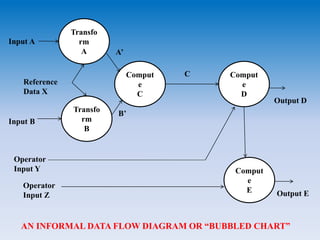
• Dataflow diagrams are directed graphs in which the nodes
specify processing activities and the arcs specify the data items
transmitted between processing nodes.
• Dataflow diagram can be expressed using informal notation
can be used to processing nodes , data sources , data sinks and
data stores.
• Dataflow diagrams are excellent communicating with
customer during requirements and analysis.
• There are also used for representation of external and top level
internal design specifications
Comput
e
C
Comput
e
E
Comput
e
D
Transfo
rm
B
Transfo
rm
A
Input A
Input B
Operator
Input Y
Reference
Data X
Operator
Input Z Output E
Output D
B’
A’
C
AN INFORMAL DATA FLOW DIAGRAM OR “BUBBLED CHART”
STRUCTURED CHARTS
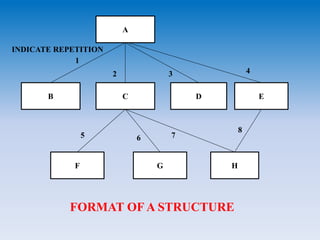
• Structure chats are used to architectural design to document
hierarchical structure , parameters and interconnection in a
system . It differs from a flowchart in two ways:
 Structured chart has know decisions boxes.
 Sequential ordering of tasks
A
ED
H
CB
GF
1
2 3 4
5 6 7
8
INDICATE REPETITION
FORMAT OF A STRUCTURE
HIPO DIAGRAMS
• HIPO diagram(Hierarchy-process-input-output) were
developed at IBM as design representation schemes for top-
down software developed and external documentation aids for
products.
• HIPO diagram contains a visual table of contents, a set of
overview diagram and set detail diagrams , it contains of a tree
structured .
PROCEDURE TEMPLATE
• The format of a procedure interface specification of
architectural design , only information in level 1 need to
supplied . The information on levels 2,3, and 4 can be included
in successive steps.
• It provides initial architectural design , specification of side
effects , exception handling , processing algorithms and data
representation.
PSEUDO CODE NOTATION
• Pseudo code notation can be used in both the architectural
and detailed design phases .
• The designer describes system characteristics using short ,
concise , that are structured by keywords such as If-Then-
Else , While-Do and End.
• Pseudo code can replace flowcharts and reduce the amount
of external documentations required to describe system.
STRUCTURED FLOWCHARTS
• Flowcharts means are specifying and documenting algorithmic
detailed in a software system.
• Flowchart interoperate rectangular boxes for actions ,
diamond shaped boxes for decisions , directed arcs for
interconnections for boxes.
• Single entry , single exit allows hierarchical nesting of
structured flowchart to design in top-down fashion.
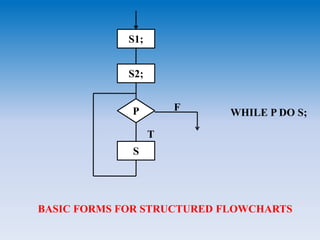
S1;
S2;
P
S
F
T
WHILE P DO S;
BASIC FORMS FOR STRUCTURED FLOWCHARTS
DECISION TABLES
• Decision tables can be used to specify complex decision logic
in a high level software specification.
• There are useful for specifying algorithmic logic during
detailed design.
• Several preprocessor packages are available to translate
decision tables into COBOL.
THANK YOU