Current trends in database
DefinitionData base management system is a system in which “related data”is stored in an “efficient” and “compact” manner. “Efficient”=data which is stored in the DBMS is accessed in                         very quick time “compact”=means that the data which is stored in DBMS                         covers very little space in the computer‘s memory “related data“=the data which is stored in the DBMS                                 is about some particular topic.
A DBMS is a set of software programs that controls the organization, storage, management, and retrieval of data in a database.
The DBMS accepts requests for data from an application program and instructs the operating system to transfer the appropriate data.
In large systems, a DBMS allows users and other software to store and retrieve data in a structured way.
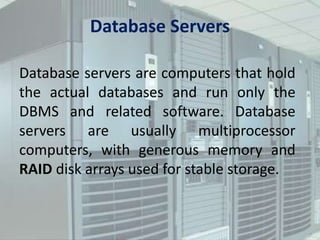
Many DBMS packages provide Fourth-generation programming language (4GLs) and other application development features.Database ServersDatabase servers are computers that hold the actual databases and run only the DBMS and related software. Database servers are usually multiprocessor computers, with generous memory and RAID disk arrays used for stable storage.
History of DBMS1960 – First DBMS by Charles Bachman at GEIBMs Information Management System (IMS)1970 – E.F Codd introduced the RDBMS
1980 – Relational model became popular and accepted as the main database paradigm. SQL, ANSI SQL, etc.
1980 to 1990 – New data models like ODBMS, ORDBMS powerful query languages, etc. Popular vendors are Oracle, SQL Server, IBM DB2, Informix, etc.Why changing trends???Difficulties with RDBMS storage and usage
Demand for data in forms other than just text
Adoption of e-Business causes rise in online DBMS capacity demand.
Growth in e-commerce and enterprise portals….Creates market for open source DBMS.Demand for access through mobile devices….Mobile database suites
What are the current              trends ??Multimedia Databases
Distributed Database
Document-oriented Databases
Mobile & embedded DatabasesMultimedia Databases       Multimedia data typically means digital images audiovideoanimation and graphics       The acquisition, generation, storage and       processing of multimedia data in computers      and transmission over networks have grown      tremendously in the recent past.
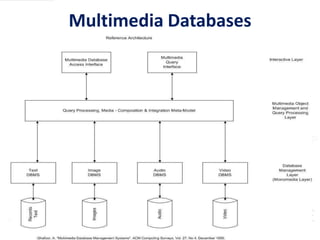
Multimedia DatabasesContents of MMDB Media data - actual data representing images, audio, video that are captured, digitized, processed, compressed and stored. Media format data - Contains information pertaining to the format of the media data after it goes through the acquisition, processing, and encoding phases. E.g. sampling rate, resolution, frame rate, encoding scheme etc.
Multimedia DatabasesContents of MMDB 3.  Media keyword data (content descriptive data ) Contains keyword descriptions, relating to the generation of the media data. E.g., for a video, includes the date, time, place            of recording , person who recorded, scene that       is recorded etc.
Multimedia DatabasesContents of MMDB Media feature data(content dependent data) -        Contains the features derived from the media data. A feature characterizes the media contents. E.g., info about the distribution of colors, the        kinds of textures and the different shapes       present in an image.
Multimedia DatabasesQuerying parametersThe media keyword data and media feature data are used as indices for searching purpose. The media format data is used to present the retrieved information.
Multimedia Databases
Multimedia DatabasesSome Examples Multimedia Search Engine  Multimedia.Lycos.com
Search Engine for Sounds   Findsounds.com
Image Search                        Google.com        e.g. filter image by color
Multimedia DatabasesApplications of Multimedia DatabaseStreaming dataInteractive videoDigital LibrariesImage retrieval
Multimedia Databases1. Streaming dataData stream
Data streaming
Used generally in                    Electronics                   Telecommunications                   Computer architecture. they require        bandwidth, time dependent, no time lag  Source and sink             Multimedia Databases1. Streaming Datamodes of transmission    asynchronous, synchronous, isochronous characteristicstimestrongly periodic, weakly periodic, aperiodicvar. of consecutive packet amountstrongly regular, weekly regular, irregularcontinuityconnected data streams, unconnected data streams
Multimedia Databases2. Interactive videoThe term interactive video usually refers to a technique used to blend interaction and linear film or video.Example
Multimedia DatabasesInteractive video inAdded text with video
Multimedia Databases3. Digital LibrariesCollections are stored in digital formats     (not as print, or other media)The digital content may be stored locally, or accessed remotely via computer networks.
 A digital library is a type of information retrieval system.Example