Design Patterns- Creational
- Sachin Kumar Patidar
Content
1 What are design Patterns
• Definition
• Characteristics
• Benefits
• Categorizing
2 What are Creational Design Patterns
• Singleton Pattern
• Prototype Pattern
• Build Pattern
• Factory Pattern
• Abstract Factory Pattern
What are Design Patterns
Dictionary meaning of Pattern: “A plan, diagram, or model to be followed in
making things”
A software designer or an architect needs to understand more than the
relevant APIs, which includes
• What are the best practices?
• What are the bad practices?
• What are the common recurring problems and proven solutions to these
problems?
• How is code re-factored from a less optimal scenario, or bad practice, to a
better one typically described by a pattern?
What are Design Patterns
Some Definitions of Design Pattern
A design pattern is like a template that can be applied in many different
situations.
Patterns are neither code, nor designs as they must be instantiated and
applied.
•evaluate trade-offs and impact of using a pattern in the system at hand
•make design and implementation decision how best to apply the pattern,
perhaps modify it slightly
•implement the pattern in code and combine it with other patterns
“A design pattern is a general repeatable solution to a commonly
occurring problem in software design. It is a description or template
for how to solve a problem that can be used in many different
situations.”
What are Design Patterns
There are many definitions for a pattern, but all these definitions have a
common theme. Some of the common characteristics of patterns are:
• Patterns are observed through experience.
• Patterns are typically written in a structured format called Template.
• Patterns prevent reinventing the wheel.
• Patterns exist at different levels of abstraction.
• Patterns undergo continuous improvement.
• Patterns are reusable artifacts.
• Patterns can be used together to solve a larger problem.
Design Patterns - Benefit
Benefits of Using Patterns:
•Patterns are a common design vocabulary
• they allow engineers to abstract a problem and talk about that
abstraction in isolation from its implementation.
•Patterns capture design expertise and allow that expertise to be communicated
•Promote design reuse and avoid mistakes
•Improve documentation (less is needed) and understandability (patterns are
described well once)
Design Patterns - Categorizing
Patterns have been captured at many levels of abstraction and in numerous
domains. Numerous categories have been suggested for classifying software
patterns, with some of the most common being
•creational patterns
abstract the object instantiation process
•structural patterns
describe how classes and objects can be combined to form larger Structures
•behavioral patterns
concerned with communication, algorithms and the assignment of
responsibilities between objects
Creational Patterns
This Design pattern is all about class instantiation. Defines the best possible
way in which an object can be instantiated
• Make system independent of how objects are created composed and
represented
• Class-creation:
• use inheritance effectively in the instantiation process
• Object-creation:
• use delegation effectively to get the job done
Creational Patterns
• Factory Method Pattern
Define an interface for creating an object, but let subclasses decide which class
to instantiate.
• Abstract Factory Pattern
Provide an interface for creating families of related or dependent objects
without specifying their concrete classes.
• Builder Pattern
Separate the construction of a complex object from its representation so that
the same construction process can create different representations
• Prototype Pattern
Specify the kinds of objects to create using a prototypical instance, and create
new objects by copying this prototype.
• Singleton Pattern
Ensure a class has only one instance and provide a global point of access to it.
Singleton
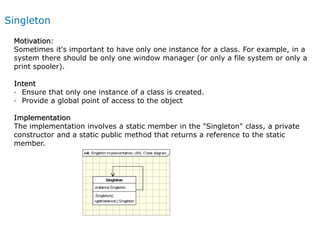
Motivation:
Sometimes it's important to have only one instance for a class. For example, in a
system there should be only one window manager (or only a file system or only a
print spooler).
Intent
• Ensure that only one instance of a class is created.
• Provide a global point of access to the object
Implementation
The implementation involves a static member in the "Singleton" class, a private
constructor and a static public method that returns a reference to the static
member.
Singleton
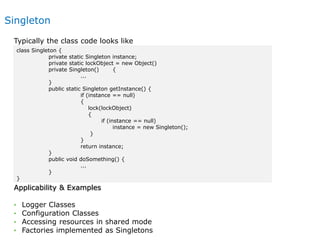
Typically the class code looks like
class Singleton {
private static Singleton instance;
private static lockObject = new Object()
private Singleton() {
...
}
public static Singleton getInstance() {
if (instance == null)
{
lock(lockObject)
{
if (instance == null)
instance = new Singleton();
}
}
return instance;
}
public void doSomething() {
...
}
}
Applicability & Examples
• Logger Classes
• Configuration Classes
• Accessing resources in shared mode
• Factories implemented as Singletons
Prototype
Motivation:
• If the cost of creating a new object is large and creation is resource intensive,
we clone the object.
• We clone the existing object and change the state of the object as needed.
Intent:
• specifying the kind of objects to create using a prototypical instance
• creating new objects by copying this prototype object to avoid creation
Implementation
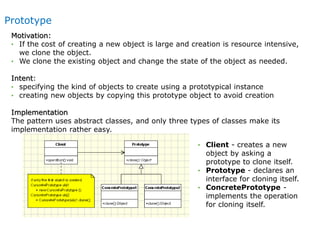
The pattern uses abstract classes, and only three types of classes make its
implementation rather easy.
• Client - creates a new
object by asking a
prototype to clone itself.
• Prototype - declares an
interface for cloning itself.
• ConcretePrototype -
implements the operation
for cloning itself.
Prototype
Typically the class code looks like
public interface Prototype
{
public abstract public interface Prototype Clone( );
}
public class ConcretePrototype : Prototype
{
public override Prototype Clone()
{
//Shallow copy
return (Prototype)this.MemberwiseClone();
}
}
public class Client
{
public static void main( String arg[] )
{
ConcretePrototype obj1= new ConcretePrototype ();
ConcretePrototype obj2 = (ConcretePrototype)obj1.Clone();
}
}
Prototype
Applicability
Use Prototype Pattern when a system should be independent of how its products
are created, composed, and represented.
• Classes to be instantiated are specified at run-time for example, by dynamic
loading
• It is more convenient to copy an existing instance than to create a new one.
• When instances of a class can have one of only a few different combinations of
state.
Examples
• Analysis on a set of data from the database.
Factory
Motivation:
Helps to model an interface for creating an object , which at creation time can let
its subclasses decide which class to instantiate.
Intent:
• creates objects without exposing the instantiation logic to the client.
• refers to the newly created object through a common interface.
• In programmer’s language (very raw form), you can use factory pattern
where you have to create an object of any one of sub-classes depending on
the data provided.
Advantages:
• The use of factories gives the programmer the opportunity to abstract the
specific attributes of an Object into specific subclasses which create them.
• The Factory Pattern promotes loose coupling by eliminating the need to bind
application-specific classes into the code.
Factory
Implementation
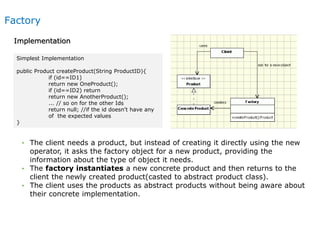
• The client needs a product, but instead of creating it directly using the new
operator, it asks the factory object for a new product, providing the
information about the type of object it needs.
• The factory instantiates a new concrete product and then returns to the
client the newly created product(casted to abstract product class).
• The client uses the products as abstract products without being aware about
their concrete implementation.
Simplest Implementation
public Product createProduct(String ProductID){
if (id==ID1)
return new OneProduct();
if (id==ID2) return
return new AnotherProduct();
... // so on for the other Ids
return null; //if the id doesn't have any
of the expected values
}
Abstract Factory
Motivation:
• This pattern is one level of abstraction higher than factory pattern.
• Abstract Factory is a super-factory which creates other factories
• Provide an interface for creating families of related or dependent objects.
• Factory method takes care of one product where as the abstract factory Pattern
provides a way to encapsulate a family of products.
Intent:
• Provide an interface for creating families of related or dependent objects
without explicitly specifying their classes.
Applicability:
• A system should be independent of how its products are created, composed,
and represented.
• If you want to provide a class library products, and you want to reveal just
their interfaces , not their implementations.
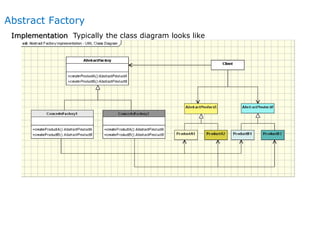
Abstract Factory
Implementation Typically the class diagram looks like
Abstract Factory
Example: We have a requirement where we need to create control library and the
same library supports multiple platforms but the client code should not be
changed if we import from one operating system to the other. The solution is
Builder
Motivation:
Builder, as the name suggests builds complex objects from simple ones step-by-
step. It separates the construction of complex objects from their representation.
Intent:
• Defines an instance for creating an object but letting subclasses decide which
class to instantiate using any of the patterns.
• Refers to the newly created object through a common interface
Advantages:
• Encapsulation: The builder pattern encapsulates the construction process of a
complex object and thereby increases the modularity of an application.
Builder
Implementation
The Builder design pattern uses the Factory Builder pattern to decide which
concrete class to initiate in order to build the desired type of object.
• The Builder class specifies an abstract interface for creating parts of a
Product object.
• The ConcreteBuilder constructs and puts together parts of the product by
implementing the Builder interface. It defines and keeps track of the
representation it creates and provides an interface for saving the product.
• The Director class constructs the complex object using the Builder interface.
• The Product represents the complex object that is being built..
Builder
Applicability:
• Builder patterns is useful in a large system
• Builder patterns fits when different variations of an object may need to be
created and the inheritance into those objects is well-defined.
• the creation algorithm of a complex object is independent from the parts that
actually compose the object
Example:
• User specific UI:
the admin needs to have some buttons enabled,
buttons that needs to be disabled for the common user.
The Builder provides the interface for building form depending on the login
information.
The ConcreteBuilders are the specific forms for each type of user.
The Product is the final form that the application will use in the given case
The Director is the application that, based on the login information, needs a
specific form.
Builder
Comparison
Questions and answers
Thank You