Download to read offline

![Sample Code Snippet
class Base
{
int x=940;
static int percentage=94;
void show(){
System.out.println(“Your score is ”+x);
}
}
class Child extends Base
{
int y=89;
void display(){
System.out.println("My parent's score was "+x); // x is now available here
System.out.println("My parent's score was "+super.x); // x is accessible by super
System.out.println("My parent's score was "+this.x); // x is now available here
System.out.println(“Parent’s percentage can be expressed as ”+percentage+ “,”+Base.percentage+
“,”+Child.percentage+ “,”+super.percentage);
System.out.println(“I’m child with marks “+y);
}
}
class A
{
public static void main(String[] args){
Child ch=new Child();
ch.show(); // show in Base available to Child
ch.display();
}
}
sohamsengupta@yahoo.com 3](https://image.slidesharecdn.com/corejavaday5-141013052128-conversion-gate02/85/Core-java-day5-3-320.jpg)
![When a child-class field has name as that of one in the base class
class Base
{
int x=940;
}
class Child extends Base
{
int x=719;
void show(){
System.out.println("My marks is "+x);
System.out.println("Parent's marks was "+super.x);
}
}// super.x denotes Base-class data. Methods in child class with same name
//can be accessed likewise
class A
{
public static void main(String[] args){
Child ch=new Child();
ch.show();
}
} // keyword “super” cannot be accessed from within static context.
sohamsengupta@yahoo.com 4](https://image.slidesharecdn.com/corejavaday5-141013052128-conversion-gate02/85/Core-java-day5-4-320.jpg)
![Role of Constructors in Inheritance
class Base
{
Base(){
System.out.println("From Base Constructor");
}
}
class Child extends Base
{
Child(){
System.out.println("From Child Constructor");
}
}
class A
{
public static void main(String[] args){
Child ch=new Child();
}
}
When the child class constructor is invoked, the following
steps take place behind the scene…
1. The static blocks and initializers in the Base class
execute when the class is loaded into memory
followed by the same in the Child class
2. Now for each object of Child class, first the non-static
blocks and constructor of base class execute
3. Then those in the child class execute.
FAQ:
1. We are not calling the base-class constructor, then how
come the base-class constructor is invoked?
Answer: See, although the call isn’t explicit, there is an
implicit call to super(), the default/no-arg Base class
Constructor at the very first line in Child().
However, if there is not any no-arg constructor in the base
class it’ll be an error (Onto next slide)
sohamsengupta@yahoo.com 5](https://image.slidesharecdn.com/corejavaday5-141013052128-conversion-gate02/85/Core-java-day5-5-320.jpg)
![super() constructor
class Base
{
Base(int x){
System.out.println("From Base Constructor "+x);
}
}
class Child extends Base
{
Child(){ // Error super() not found; call super(940);
System.out.println("From Child Constructor");
}
}
class A // call to super constructor must be the very 1st line in child constructor
else won’t compile
{
public static void main(String[] args){
Child ch=new Child();
}
}
sohamsengupta@yahoo.com 6](https://image.slidesharecdn.com/corejavaday5-141013052128-conversion-gate02/85/Core-java-day5-6-320.jpg)

![An example of method overriding
sohamsengupta@yahoo.com 8
class Base
{
void show(){
System.out.println("Hello");
}
}
class Child extends Base
{
void show(){
System.out.println("Born!");
}
}
class A
{
public static void main(String[] args){
Base ref=new Base();
ref.show(); // output: Hello
ref=new Child(); // the ref to Base can hold obj of
// Child
//But converse isn't true without explicit type cast.
// type cast may turn out to be fatal
//ClassCastException depending on code
ref.show(); // output: Born! it's because, the
// ref although being a reference of Base, holds
//object of Child
// this is runtime( ? ) polymorphism or dynamic
method dispatch
}
}](https://image.slidesharecdn.com/corejavaday5-141013052128-conversion-gate02/85/Core-java-day5-8-320.jpg)
![static methods can’t be overridden
sohamsengupta@yahoo.com 9
class Base
{
static void show(){
System.out.println("Hello");
}
}
class Child extends Base
{
void show(){
System.out.println("Born!");
}
}
// Error… to avoid: either both should be
static or neither should. Well, let’s make
both static. Now it compiles. But
overriding is not possible. Create an
object of Child and store to a Base’s
reference. Call the method show(). But
Dynamic method dispatch is never seen.
class A
{
public static void main(String[] rt){
Base ref=new Child();
ref.show();
}
}
Output: Hello.
So, static methods are not overridden as
they don’t follow the rule of dynamic
method dispatch](https://image.slidesharecdn.com/corejavaday5-141013052128-conversion-gate02/85/Core-java-day5-9-320.jpg)


![sohamsengupta@yahoo.com 15
class B1
{}
class B2 extends B1
{}
class B3 extends B1
{}
class A
{
public static void main(String[] args){
B1 b1=new B1();
B2 b2=new B2();
B3 b3=new B3();
System.out.println(b1 instanceof B1); // true
System.out.println(b2 instanceof B1); // true
System.out.println(b3 instanceof B1); // true
System.out.println(b1 instanceof B2); // false
b1=new B2();
System.out.println(null instanceof B1);// false
System.out.println(b1 instanceof Object); // true
System.out.println(b1 instanceof B2); // true
// System.out.println(b3 instanceof B2); Error
}}](https://image.slidesharecdn.com/corejavaday5-141013052128-conversion-gate02/85/Core-java-day5-15-320.jpg)


![Sample Code Snippet
class Base
{
int x=940;
static int percentage=94;
void show(){
System.out.println(“Your score is ”+x);
}
}
class Child extends Base
{
int y=89;
void display(){
System.out.println("My parent's score was "+x); // x is now available here
System.out.println("My parent's score was "+super.x); // x is accessible by super
System.out.println("My parent's score was "+this.x); // x is now available here
System.out.println(“Parent’s percentage can be expressed as ”+percentage+ “,”+Base.percentage+
“,”+Child.percentage+ “,”+super.percentage);
System.out.println(“I’m child with marks “+y);
}
}
class A
{
public static void main(String[] args){
Child ch=new Child();
ch.show(); // show in Base available to Child
ch.display();
}
}
sohamsengupta@yahoo.com 3](/p?url=https%3A%2F%2Fimage.slidesharecdn.com%2Fcorejavaday5-141013052128-conversion-gate02%2F85%2FCore-java-day5-3-320.jpg&__src=https%3A%2F%2Fwww.slideshare.net%2Fslideshow%2Fcore-java-day5%2F40192608&__type=image)
![When a child-class field has name as that of one in the base class
class Base
{
int x=940;
}
class Child extends Base
{
int x=719;
void show(){
System.out.println("My marks is "+x);
System.out.println("Parent's marks was "+super.x);
}
}// super.x denotes Base-class data. Methods in child class with same name
//can be accessed likewise
class A
{
public static void main(String[] args){
Child ch=new Child();
ch.show();
}
} // keyword “super” cannot be accessed from within static context.
sohamsengupta@yahoo.com 4](/p?url=https%3A%2F%2Fimage.slidesharecdn.com%2Fcorejavaday5-141013052128-conversion-gate02%2F85%2FCore-java-day5-4-320.jpg&__src=https%3A%2F%2Fwww.slideshare.net%2Fslideshow%2Fcore-java-day5%2F40192608&__type=image)
![Role of Constructors in Inheritance
class Base
{
Base(){
System.out.println("From Base Constructor");
}
}
class Child extends Base
{
Child(){
System.out.println("From Child Constructor");
}
}
class A
{
public static void main(String[] args){
Child ch=new Child();
}
}
When the child class constructor is invoked, the following
steps take place behind the scene…
1. The static blocks and initializers in the Base class
execute when the class is loaded into memory
followed by the same in the Child class
2. Now for each object of Child class, first the non-static
blocks and constructor of base class execute
3. Then those in the child class execute.
FAQ:
1. We are not calling the base-class constructor, then how
come the base-class constructor is invoked?
Answer: See, although the call isn’t explicit, there is an
implicit call to super(), the default/no-arg Base class
Constructor at the very first line in Child().
However, if there is not any no-arg constructor in the base
class it’ll be an error (Onto next slide)
sohamsengupta@yahoo.com 5](/p?url=https%3A%2F%2Fimage.slidesharecdn.com%2Fcorejavaday5-141013052128-conversion-gate02%2F85%2FCore-java-day5-5-320.jpg&__src=https%3A%2F%2Fwww.slideshare.net%2Fslideshow%2Fcore-java-day5%2F40192608&__type=image)
![super() constructor
class Base
{
Base(int x){
System.out.println("From Base Constructor "+x);
}
}
class Child extends Base
{
Child(){ // Error super() not found; call super(940);
System.out.println("From Child Constructor");
}
}
class A // call to super constructor must be the very 1st line in child constructor
else won’t compile
{
public static void main(String[] args){
Child ch=new Child();
}
}
sohamsengupta@yahoo.com 6](/p?url=https%3A%2F%2Fimage.slidesharecdn.com%2Fcorejavaday5-141013052128-conversion-gate02%2F85%2FCore-java-day5-6-320.jpg&__src=https%3A%2F%2Fwww.slideshare.net%2Fslideshow%2Fcore-java-day5%2F40192608&__type=image)

![An example of method overriding
sohamsengupta@yahoo.com 8
class Base
{
void show(){
System.out.println("Hello");
}
}
class Child extends Base
{
void show(){
System.out.println("Born!");
}
}
class A
{
public static void main(String[] args){
Base ref=new Base();
ref.show(); // output: Hello
ref=new Child(); // the ref to Base can hold obj of
// Child
//But converse isn't true without explicit type cast.
// type cast may turn out to be fatal
//ClassCastException depending on code
ref.show(); // output: Born! it's because, the
// ref although being a reference of Base, holds
//object of Child
// this is runtime( ? ) polymorphism or dynamic
method dispatch
}
}](/p?url=https%3A%2F%2Fimage.slidesharecdn.com%2Fcorejavaday5-141013052128-conversion-gate02%2F85%2FCore-java-day5-8-320.jpg&__src=https%3A%2F%2Fwww.slideshare.net%2Fslideshow%2Fcore-java-day5%2F40192608&__type=image)
![static methods can’t be overridden
sohamsengupta@yahoo.com 9
class Base
{
static void show(){
System.out.println("Hello");
}
}
class Child extends Base
{
void show(){
System.out.println("Born!");
}
}
// Error… to avoid: either both should be
static or neither should. Well, let’s make
both static. Now it compiles. But
overriding is not possible. Create an
object of Child and store to a Base’s
reference. Call the method show(). But
Dynamic method dispatch is never seen.
class A
{
public static void main(String[] rt){
Base ref=new Child();
ref.show();
}
}
Output: Hello.
So, static methods are not overridden as
they don’t follow the rule of dynamic
method dispatch](/p?url=https%3A%2F%2Fimage.slidesharecdn.com%2Fcorejavaday5-141013052128-conversion-gate02%2F85%2FCore-java-day5-9-320.jpg&__src=https%3A%2F%2Fwww.slideshare.net%2Fslideshow%2Fcore-java-day5%2F40192608&__type=image)


![sohamsengupta@yahoo.com 15
class B1
{}
class B2 extends B1
{}
class B3 extends B1
{}
class A
{
public static void main(String[] args){
B1 b1=new B1();
B2 b2=new B2();
B3 b3=new B3();
System.out.println(b1 instanceof B1); // true
System.out.println(b2 instanceof B1); // true
System.out.println(b3 instanceof B1); // true
System.out.println(b1 instanceof B2); // false
b1=new B2();
System.out.println(null instanceof B1);// false
System.out.println(b1 instanceof Object); // true
System.out.println(b1 instanceof B2); // true
// System.out.println(b3 instanceof B2); Error
}}](/p?url=https%3A%2F%2Fimage.slidesharecdn.com%2Fcorejavaday5-141013052128-conversion-gate02%2F85%2FCore-java-day5-15-320.jpg&__src=https%3A%2F%2Fwww.slideshare.net%2Fslideshow%2Fcore-java-day5%2F40192608&__type=image)


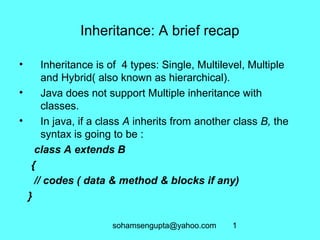
The document provides an overview of inheritance in Java, explaining its four types: single, multilevel, multiple, and hybrid. It discusses the syntax of inheritance, key concepts like superclass and subclass, and the roles of constructors, method overriding, and access modifiers. Additionally, it addresses the reasons behind Java's restriction on multiple inheritance and the distinct mechanisms of overloading versus overriding.


![Internet and Web Technology (CLASS-15) [JAVA Basics] | NIC/NIELIT Web Technol...](https://cdn.slidesharecdn.com/ss_thumbnails/iwtclass-15-200811210151-thumbnail.jpg?width=640&height=640&fit=bounds)


![Internet and Web Technology (CLASS-16) [Basic Elements of Java Program] | NIC...](https://cdn.slidesharecdn.com/ss_thumbnails/iwtclass-16-200811210335-thumbnail.jpg?width=640&height=640&fit=bounds)


