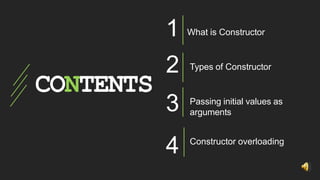
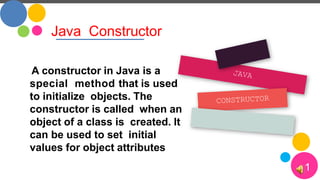
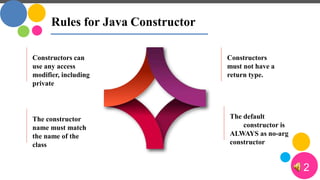
1) A constructor in Java is a special method that is used to initialize objects and is called when an object is created. It can set initial values for object attributes.
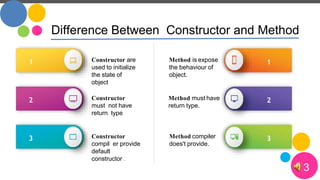
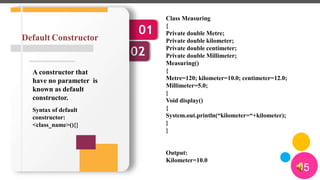
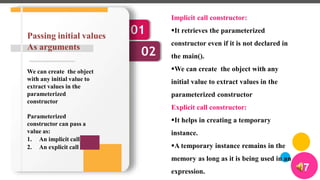
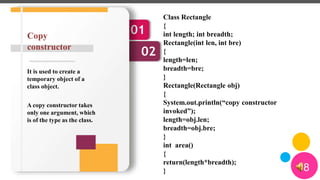
2) There are different types of constructors including default, parameterized, and copy constructors. The default constructor takes no parameters, parameterized constructors take parameters to initialize objects with different values, and copy constructors are used to create a copy of an object.
3) Constructor overloading allows a class to have multiple constructors with the same name but different parameters, allowing objects to be initialized in different ways.

![6
01
02
A constructor that have
parameters is known as
parameterized
constructor.
Parameterized
constructor is used to
provide different values to
the distinct objects
Parameterize
dconstructor
Class Rectangle
{
int length; int breadth;
Rectangle(int len, int bre)
{
length=len;
breadth=bre;
}
}
Class demo
{
Public static void main(String args[])
{
Rectangle r1= new Rectangle(20,10);
System.out.println(“length of rectangle=“
r1.length);
System.out.println(“breadth of
rectangle=“ r1.breadth);
}}](https://image.slidesharecdn.com/constructor-200518062942/85/Constructor-in-java-8-320.jpg)
![9
01
02
It is used to create a
temporary object of a
class object.
A copy constructor takes
only one argument, which
is of the type as the class.
Copy
constructor
Class demo
{
Public static void main(String args[])
{
Rectangle r1= new Rectangle(20,10);
Rectangle r2=new Rectangle(r1);
System.out.println(“area of 1st rectangle=“
r1.area());
System.out.println(“area of 2nd rectangle=“
r2.area());
}}](https://image.slidesharecdn.com/constructor-200518062942/85/Constructor-in-java-11-320.jpg)
![10
01
02
A constructor may be
overloaded, so a single
class may have more
than one constructor, all
of which have the same
name but different
argument lists.
Constructor
overloading
Class overloading
{
int x,
float y;
Overloading()
{x=0;y=0.0;}
Overloading(int a)
{x=a; y=0;}
Overloading(int a, float b)
{x=a; y=b;}
Public static void main(String args[])
{
Overloading ov1=new overloading();
Overloading ov2=new overloading(40);
Overloading ov3=new overloading(10,4.5);
}
}](https://image.slidesharecdn.com/constructor-200518062942/85/Constructor-in-java-12-320.jpg)


![6
01
02
A constructor that have
parameters is known as
parameterized
constructor.
Parameterized
constructor is used to
provide different values to
the distinct objects
Parameterize
dconstructor
Class Rectangle
{
int length; int breadth;
Rectangle(int len, int bre)
{
length=len;
breadth=bre;
}
}
Class demo
{
Public static void main(String args[])
{
Rectangle r1= new Rectangle(20,10);
System.out.println(“length of rectangle=“
r1.length);
System.out.println(“breadth of
rectangle=“ r1.breadth);
}}](/p?url=https%3A%2F%2Fimage.slidesharecdn.com%2Fconstructor-200518062942%2F85%2FConstructor-in-java-8-320.jpg&__src=https%3A%2F%2Fwww.slideshare.net%2Fslideshow%2Fconstructor-in-java-234179054%2F234179054&__type=image)


![9
01
02
It is used to create a
temporary object of a
class object.
A copy constructor takes
only one argument, which
is of the type as the class.
Copy
constructor
Class demo
{
Public static void main(String args[])
{
Rectangle r1= new Rectangle(20,10);
Rectangle r2=new Rectangle(r1);
System.out.println(“area of 1st rectangle=“
r1.area());
System.out.println(“area of 2nd rectangle=“
r2.area());
}}](/p?url=https%3A%2F%2Fimage.slidesharecdn.com%2Fconstructor-200518062942%2F85%2FConstructor-in-java-11-320.jpg&__src=https%3A%2F%2Fwww.slideshare.net%2Fslideshow%2Fconstructor-in-java-234179054%2F234179054&__type=image)
![10
01
02
A constructor may be
overloaded, so a single
class may have more
than one constructor, all
of which have the same
name but different
argument lists.
Constructor
overloading
Class overloading
{
int x,
float y;
Overloading()
{x=0;y=0.0;}
Overloading(int a)
{x=a; y=0;}
Overloading(int a, float b)
{x=a; y=b;}
Public static void main(String args[])
{
Overloading ov1=new overloading();
Overloading ov2=new overloading(40);
Overloading ov3=new overloading(10,4.5);
}
}](/p?url=https%3A%2F%2Fimage.slidesharecdn.com%2Fconstructor-200518062942%2F85%2FConstructor-in-java-12-320.jpg&__src=https%3A%2F%2Fwww.slideshare.net%2Fslideshow%2Fconstructor-in-java-234179054%2F234179054&__type=image)


