Cloud Computing

  Andrew Bourget
   E-Commerce
   Spring 2012
What Is The Cloud?
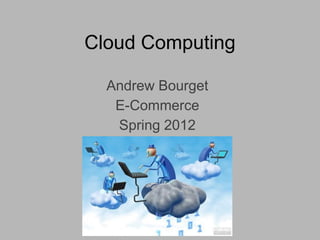
   Cloud Computing is simply the use of
 computer processing or storage available
        externally via the internet.

• http://www.rackspace.com/
  Cloud storage, servers, scalable service
• https://drive.google.com/start#home
  New,Cyncs with Google docs, Storable file on PC
• https://www.dropbox.com/
  File storage, useable with Mobile Apps
Who Discovered the Cloud?
•    "The first high-profile usage of the term "cloud
     computing" must have been Google's Eric Schmidt back
     in 2006 during a search engine strategies conference."
      ~CNET editor Dong Ngo


http://news.cnet.com/8301-17938_105-20069370-1/networking-talk-from-cloud-to-icloud-and-why-you-should-care/

Inside the offices of Compaq Computer, a small group of
technology executives was plotting the future of the Internet
business and calling it “cloud computing.”(1996)
~Antonio Regalado, Technology Review
http://www.thebusinesstechnologyforum.com/2011/10/who-coined-the-term-cloud-computing/


Mobile Computing
Diminishing need for lugging large computers on every
Cloud Companies
                   Cloud Times Top 100 Cloud Companies

Google
Drive.google.com
                                                          DropBox,
                                                         Dropbox.com
Apple,
Icloud.com
Public Cloud VS Private Cloud

    Public clouds:
•   Also known as a shared cloud, such services are provided "as a service"
    over the Internet with little or no control over the underlying technology
    infrastructure. This cloud is appealing to many decision-makers as it
    reduces complexity and long lead times in testing and deploying new
    products. It is generally cheaper, too.

    Private clouds:
•   Also called an internal cloud or enterprise cloud, this also offers activities
    and functions "as a service" but is deployed over a company intranet or
    hosted datacenter. This is private product for a company or organization
    offering advanced security and highly available or fault tolerant solutions not
    possible in a public cloud. In this scenario, the private cloud owner shares
    few, if any, resources with other organizations. Hence, multi-tenancy is not
    an issue.
•   http://www.paypercloud.com/Public-versus-Private-Cloud-Hosting-Comparison.aspx
Contacts
         Public Cloud                    Photos
                                         Documents
                           I-Cloud       Calendar


Private Cloud

          Company X Accounting Program
“The Cloudy Road”

Pros
• Enhanced mobile work
• Lowers computing cost
• Freedom to work anywhere
• Work Actively "backed up"
• Easier collaboration
Cons
•   Enhanced mobile security threat
•   Greater need for IT professionals
•   Compatibility issues
•   Information is located externally, no physical access.
Step one, step two, step three?
•   New Wild Wild West
•   The "night is young" when it comes to cloud computing.
•   New innovation is coming out every single day
•   The true test is will people adapt to new technologies
•   Net Neutrality issues are, and will be coming up as the
    Cloud grows.
Who Needs The Cloud?
• Sales Men
• Advertising
• The on the go business man
Tweeting, Blogging, Ecommerce


      http://lifehacker.com/
Virtualization
•   Cloud Computing we have a good grasp
    on

Virtualization?
I-Cloud