Multi-Cloud
Management
Dr. Neeraj Kumar Pandey
Multi-cloud Management
 “Hybrid cloud might be all the rage today, but the multi-
cloud model — where IT deploys a mix of cloud services
from different providers — is next in line.”
-Simon Freedman
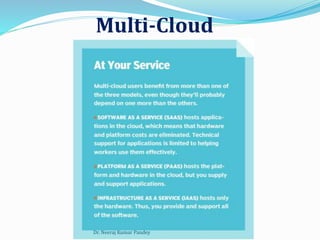
Using clouds from multiple providers can be an
appealing prospect for organizations looking to
capitalize on the strengths of the various computing
models. The added complexity, however,
requires sound strategies for building and managing
multi-cloud environments.
Dr. Neeraj Kumar Pandey
Multi-Cloud
Dr. Neeraj Kumar Pandey
WHAT’S DRIVING YOUR MULTI-CLOUD?
The most important goals for a multi-cloud
user are to avoid unnecessary complexity and
contain costs. While most companies are long-
term multi-cloud candidates, few will balance
their applications and planning across all of
their cloud choices. The first step in effective
multi-cloud planning is to pick the primary
cloud model for your business .
Dr. Neeraj Kumar Pandey
Advantages Of Multi-cloud
 Reduction in Expenditure
 Enhanced Autonomy
 Risk Management
 Customization with Cloud-specific Powers
 Focusing on Business Goals
 Cloud Brokers
 Rigid Choices
 Security
Dr. Neeraj Kumar Pandey
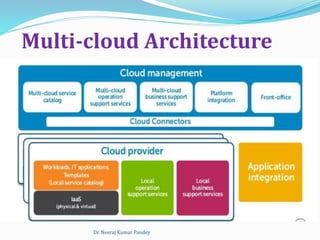
Multi-cloud Architecture
Dr. Neeraj Kumar Pandey
Challenges in managing heterogeneous
clouds
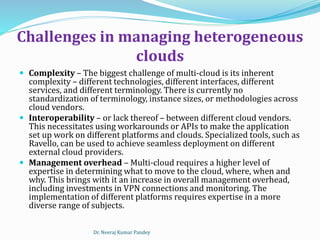
 Complexity – The biggest challenge of multi-cloud is its inherent
complexity – different technologies, different interfaces, different
services, and different terminology. There is currently no
standardization of terminology, instance sizes, or methodologies across
cloud vendors.
 Interoperability – or lack thereof – between different cloud vendors.
This necessitates using workarounds or APIs to make the application
set up work on different platforms and clouds. Specialized tools, such as
Ravello, can be used to achieve seamless deployment on different
external cloud providers.
 Management overhead – Multi-cloud requires a higher level of
expertise in determining what to move to the cloud, where, when and
why. This brings with it an increase in overall management overhead,
including investments in VPN connections and monitoring. The
implementation of different platforms requires expertise in a more
diverse range of subjects.
Dr. Neeraj Kumar Pandey
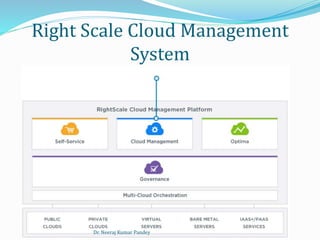
Right Scale Cloud Management
System
Dr. Neeraj Kumar Pandey
Right Scale Cloud Management System
Dr. Neeraj Kumar Pandey
Cloud Management Features List
 Single console for all clouds
 Compute, storage, and
network views
 Resource discovery
 Universal tag management
 Easy-to-deploy agent
 Extensible monitoring
 Customized alerts and
escalations
 Auto-scaling
 Operational scripts
 Standardized templates
 Integrate with Chef, Puppet,
Salt, Ansible
 Docker support
 Hierarchical cloud account
access
 User and group permissions
 Integrate to AD or other
services
 Complete audit trails
 Key management
 Single API
 CLI tool
Dr. Neeraj Kumar Pandey
Right Scale INTEGRATION + DELIVERY
Dr. Neeraj Kumar Pandey
Biz Clouds focused on industry domains: Retail
Dr. Neeraj Kumar Pandey
Biz Clouds focused on industry
domains: Banking and finance
 Card and mobile payment processing -- Visa,
MasterCard, and trusted third parties
 Marketing and customer relationship
management:Cloud providers such as OMI provide market
research and analytics that enable financial services
companies to segment their markets and target their
products so they can grow their customer bases and
product penetration. Salesforce has emerged as a leading
cloud provider for sales and customer relationship
management (CRM) that helps front-line employees,
because of its ability to combine customer intelligence from
all sales and service channels into a 360-degree view of
each customer.
Dr. Neeraj Kumar Pandey
Biz Clouds focused on industry
domains: Banking and finance
 Core banking:Well-established cloud services providers in
this space are Fiserv and Jack Henry & Associates. Both
companies offer a choice of cloud-based core banking
systems.
 Human Resources and talent management:Popular
choices for the cloud in this area include Oracle
HCM (Human Capital Management)
and SAP/SuccessFactors.
 Infrastructure as a Service:First National Technology
Solutions offers IaaS to financial institutions for application
development, testing, disaster recovery, failover, and data
storage. In the risk management area, Amazon Web
Services (AWS) is being used by some large banks to run
portfolio credit risk simulations in as little as 20 minutes.
Dr. Neeraj Kumar Pandey
Biz Clouds focused on industry
domains: Life Sciences
Dr. Neeraj Kumar Pandey
Telecom cloud Providers
 Today, Telecom carriers are facing challenges in many folds,
either in the area of reducing the IT operations cost, rolling
out the new value added services/applications for
customers, migrating to next generation networks
/platforms, or keeping the customer churn controlled. They
actively seek solutions which address the above issues.
“Cloud computing” is one such interesting and upcoming
trend. Cloud computing offers a means of sharing resources
like hardware, software, and data on demand to users.
Telecom carriers will soon embrace cloud computing to
solve some of the above issues and provide business
models like “Infrastructure as a service” or “Pay as you go".
 Ericsson
 HCL
 Dell
Dr. Neeraj Kumar Pandey
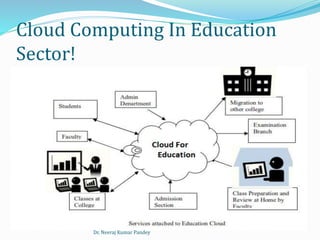
Cloud Computing In Education
Sector!
Dr. Neeraj Kumar Pandey
Selection criteria for cloud deployment
 Polytech – Can the Platform Support Multiple
Languages, Databases and Middleware?
 Polycloud – Can the Provider Run on Multiple
Infrastructures and Support Hybrid Options?
 Complete Application Lifecycle Support – Can the
Platform Deliver a Balance of Automation and
Granular Control?
 Proven – Does the Cloud Provider Have a Strong
Track Record?
 Customer Support - How Involved Does Your
Provider Get?Dr. Neeraj Kumar Pandey