The document outlines fundamental concepts of cloud computing, including roles associated with cloud providers, consumers, and services, as well as delivery and deployment models. Key characteristics of cloud environments, such as on-demand usage, elasticity, and resiliency are also described. Additionally, it distinguishes between various cloud delivery models—Infrastructure-as-a-Service (IaaS), Platform-as-a-Service (PaaS), and Software-as-a-Service (SaaS)—as well as deployment models like public, community, private, and hybrid clouds.

![Contents
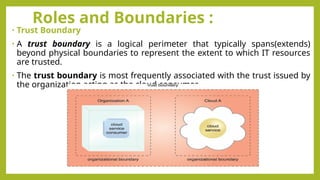
• Roles and Boundaries
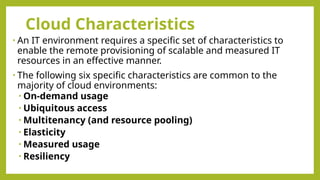
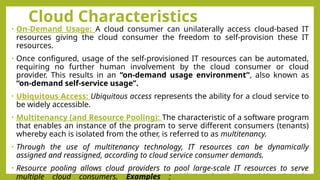
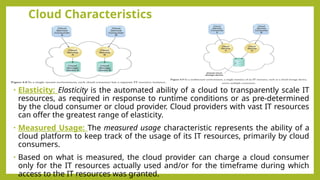
• Cloud Characteristics
• Cloud Delivery Models
• Infrastructure-as-a-Service [IaaS]
• Platform-as-a-Service [PaaS]
• Software-as-a-Service [SaaS]
• Cloud Deployment Models
• Public Clouds
• Community Clouds
• Private Clouds
• Hybrid Clouds](https://image.slidesharecdn.com/chapter-2-cloudcomputing-updated-240921202229-347f3afd/85/Chapter-two-Cloud-Computing-Updated-pptx-3-320.jpg)
![Cloud Delivery Models
• A cloud delivery model represents a specific, pre-packaged
combination of IT resources offered by a cloud provider. Three
common cloud delivery models have become widely established
and formalized:
• Infrastructure-as-a-Service [IaaS]
• Platform-as-a-Service [PaaS]
• Software-as-a-Service [SaaS]](https://image.slidesharecdn.com/chapter-2-cloudcomputing-updated-240921202229-347f3afd/85/Chapter-two-Cloud-Computing-Updated-pptx-17-320.jpg)
![Infrastructure-as-a-Service [IaaS]
• The IaaS delivery model represents a self-contained IT environment
comprised of infrastructure-centric IT resources that can be accessed and
managed via cloud service-based interfaces and tools.
• This environment can include hardware, network, connectivity, operating
systems, and other “raw” IT resources.
• The general purpose of an IaaS environment is to provide cloud consumers
with a high level of control and responsibility over its configuration and
utilization.
• IT resources available through IaaS environments are generally offered as
freshly initialized virtual instances.
• A central and primary IT resource within a typical IaaS environment is the
virtual server. Virtual servers are leased by specifying server hardware
requirements, such as processor capacity, memory, and local storage](https://image.slidesharecdn.com/chapter-2-cloudcomputing-updated-240921202229-347f3afd/85/Chapter-two-Cloud-Computing-Updated-pptx-19-320.jpg)
![Infrastructure-as-a-Service [IaaS]
A cloud consumer is using a virtual server within an IaaS environment. Cloud
consumers are provided with a range of contractual guarantees by the cloud provider,
pertaining to characteristics such as capacity, performance, and availability.](https://image.slidesharecdn.com/chapter-2-cloudcomputing-updated-240921202229-347f3afd/85/Chapter-two-Cloud-Computing-Updated-pptx-20-320.jpg)


![Contents
• Roles and Boundaries
• Cloud Characteristics
• Cloud Delivery Models
• Infrastructure-as-a-Service [IaaS]
• Platform-as-a-Service [PaaS]
• Software-as-a-Service [SaaS]
• Cloud Deployment Models
• Public Clouds
• Community Clouds
• Private Clouds
• Hybrid Clouds](/p?url=https%3A%2F%2Fimage.slidesharecdn.com%2Fchapter-2-cloudcomputing-updated-240921202229-347f3afd%2F85%2FChapter-two-Cloud-Computing-Updated-pptx-3-320.jpg&__src=https%3A%2F%2Fwww.slideshare.net%2Fslideshow%2Fchapter-two-cloud-computing-updated-pptx%2F271939415&__type=image)


![Cloud Delivery Models
• A cloud delivery model represents a specific, pre-packaged
combination of IT resources offered by a cloud provider. Three
common cloud delivery models have become widely established
and formalized:
• Infrastructure-as-a-Service [IaaS]
• Platform-as-a-Service [PaaS]
• Software-as-a-Service [SaaS]](/p?url=https%3A%2F%2Fimage.slidesharecdn.com%2Fchapter-2-cloudcomputing-updated-240921202229-347f3afd%2F85%2FChapter-two-Cloud-Computing-Updated-pptx-17-320.jpg&__src=https%3A%2F%2Fwww.slideshare.net%2Fslideshow%2Fchapter-two-cloud-computing-updated-pptx%2F271939415&__type=image)

![Infrastructure-as-a-Service [IaaS]
• The IaaS delivery model represents a self-contained IT environment
comprised of infrastructure-centric IT resources that can be accessed and
managed via cloud service-based interfaces and tools.
• This environment can include hardware, network, connectivity, operating
systems, and other “raw” IT resources.
• The general purpose of an IaaS environment is to provide cloud consumers
with a high level of control and responsibility over its configuration and
utilization.
• IT resources available through IaaS environments are generally offered as
freshly initialized virtual instances.
• A central and primary IT resource within a typical IaaS environment is the
virtual server. Virtual servers are leased by specifying server hardware
requirements, such as processor capacity, memory, and local storage](/p?url=https%3A%2F%2Fimage.slidesharecdn.com%2Fchapter-2-cloudcomputing-updated-240921202229-347f3afd%2F85%2FChapter-two-Cloud-Computing-Updated-pptx-19-320.jpg&__src=https%3A%2F%2Fwww.slideshare.net%2Fslideshow%2Fchapter-two-cloud-computing-updated-pptx%2F271939415&__type=image)
![Infrastructure-as-a-Service [IaaS]
A cloud consumer is using a virtual server within an IaaS environment. Cloud
consumers are provided with a range of contractual guarantees by the cloud provider,
pertaining to characteristics such as capacity, performance, and availability.](/p?url=https%3A%2F%2Fimage.slidesharecdn.com%2Fchapter-2-cloudcomputing-updated-240921202229-347f3afd%2F85%2FChapter-two-Cloud-Computing-Updated-pptx-20-320.jpg&__src=https%3A%2F%2Fwww.slideshare.net%2Fslideshow%2Fchapter-two-cloud-computing-updated-pptx%2F271939415&__type=image)
![Platform-as-a-Service [PaaS]
• The PaaS delivery model represents a pre-defined “ready-to-use” environment
typically comprised of already deployed and configured IT resources.
• Specifically, PaaS relies on (and is primarily defined by) the usage of a ready-
made environment that establishes a set of pre-packaged products and tools
used to support the entire delivery lifecycle of custom applications.
• Common reasons a cloud consumer would use and invest in a PaaS environment
include:
• The cloud consumer wants to extend on-premise environments into the cloud
for scalability and economic purposes.
• The cloud consumer uses the ready-made environment to entirely substitute an
on-premise environment.
• The cloud consumer wants to become a cloud provider and deploys its own
cloud services to be made available to other external cloud consumers.
• The cloud consumer is granted a lower level of control over the underlying IT
resources that host and provision the platform.](/p?url=https%3A%2F%2Fimage.slidesharecdn.com%2Fchapter-2-cloudcomputing-updated-240921202229-347f3afd%2F85%2FChapter-two-Cloud-Computing-Updated-pptx-21-320.jpg&__src=https%3A%2F%2Fwww.slideshare.net%2Fslideshow%2Fchapter-two-cloud-computing-updated-pptx%2F271939415&__type=image)
![Platform-as-a-Service [PaaS]
• By working within a ready-made platform, the cloud consumer is spared the
administrative burden of setting up and maintaining the bare infrastructure IT
resources provided via the IaaS model.
• Conversely, the cloud consumer is granted a lower level of control over the
underlying IT resources that host and provision the platform
A cloud consumer is accessing a ready-made PaaS environment. The question mark indicates
that the cloud consumer is intentionally shielded from the implementation details of the
platform.](/p?url=https%3A%2F%2Fimage.slidesharecdn.com%2Fchapter-2-cloudcomputing-updated-240921202229-347f3afd%2F85%2FChapter-two-Cloud-Computing-Updated-pptx-22-320.jpg&__src=https%3A%2F%2Fwww.slideshare.net%2Fslideshow%2Fchapter-two-cloud-computing-updated-pptx%2F271939415&__type=image)
![Software-as-a-Service [SaaS]
• A software program positioned as a shared cloud service and
made available as a “product” or generic utility represents the
typical profile of a SaaS offering.
• The SaaS delivery model is typically used to make a reusable
cloud service widely available (often commercially) to a range of
cloud consumers.
• An entire marketplace exists around SaaS products that can be
leased and used for different purposes and via different terms.
• A cloud consumer is generally granted very limited administrative
control over a SaaS implementation.](/p?url=https%3A%2F%2Fimage.slidesharecdn.com%2Fchapter-2-cloudcomputing-updated-240921202229-347f3afd%2F85%2FChapter-two-Cloud-Computing-Updated-pptx-23-320.jpg&__src=https%3A%2F%2Fwww.slideshare.net%2Fslideshow%2Fchapter-two-cloud-computing-updated-pptx%2F271939415&__type=image)
![Software-as-a-Service [SaaS]
The cloud service consumer is given access the cloud service contract, but not to any
underlying IT resources or implementation details.](/p?url=https%3A%2F%2Fimage.slidesharecdn.com%2Fchapter-2-cloudcomputing-updated-240921202229-347f3afd%2F85%2FChapter-two-Cloud-Computing-Updated-pptx-24-320.jpg&__src=https%3A%2F%2Fwww.slideshare.net%2Fslideshow%2Fchapter-two-cloud-computing-updated-pptx%2F271939415&__type=image)


