Software Engineering (3rd ed.), By K.K Aggarwal & Yogesh Singh, Copyright © New Age International Publishers, 2007   1
Software Design

   More creative than analysis

   Problem solving activity

WHAT IS DESIGN

‘HOW’


                         Software design document (SDD)


        Software Engineering (3rd ed.), By K.K Aggarwal & Yogesh Singh, Copyright © New Age International Publishers, 2007   2
Software Design
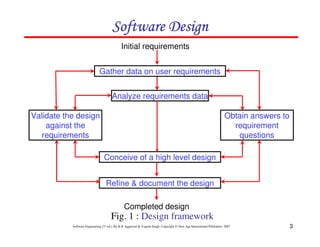
                                              Initial requirements


                              Gather data on user requirements


                                       Analyze requirements data

Validate the design                                                                                                     Obtain answers to
    against the                                                                                                           requirement
   requirements                                                                                                            questions

                                 Conceive of a high level design


                                  Refine & document the design

                                                Completed design
                                      Fig. 1 : Design framework
           Software Engineering (3rd ed.), By K.K Aggarwal & Yogesh Singh, Copyright © New Age International Publishers, 2007               3
Software Design

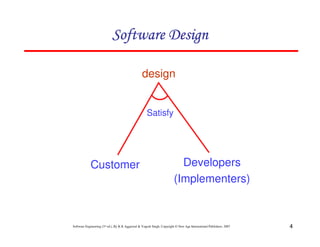
                                                  design


                                                     Satisfy


            Customer                                                       Developers
                                                                         (Implementers)


Software Engineering (3rd ed.), By K.K Aggarwal & Yogesh Singh, Copyright © New Age International Publishers, 2007   4
Software Design
Conceptual Design and Technical Design
                                                                        D
                                                                        e
                                                                        s                                                  How
        What
                                                                        i
     Conceptual                                                         g                                           Technical
       design                                                           n                                            design
                                                                        e
                                                                        r
                                                                        s
                                                A two part design                                                                System
 Customer
                                                    process                                                                      Builders
                           Fig. 2 : A two part design process
            Software Engineering (3rd ed.), By K.K Aggarwal & Yogesh Singh, Copyright © New Age International Publishers, 2007              5
Software Design

Conceptual design answers :
         Where will the data come from ?
         What will happen to data in the system?
         How will the system look to users?
         What choices will be offered to users?
         What is the timings of events?
         How will the reports & screens look like?


          Software Engineering (3rd ed.), By K.K Aggarwal & Yogesh Singh, Copyright © New Age International Publishers, 2007   6
Software Design
Technical design describes :
       Hardware configuration
       Software needs
       Communication interfaces
       I/O of the system
       Software architecture
       Network architecture
       Any other thing that translates the requirements in to a
       solution to the customer’s problem.
         Software Engineering (3rd ed.), By K.K Aggarwal & Yogesh Singh, Copyright © New Age International Publishers, 2007   7
Software Design

The design needs to be
       Correct & complete
       Understandable
       At the right level
       Maintainable


        Software Engineering (3rd ed.), By K.K Aggarwal & Yogesh Singh, Copyright © New Age International Publishers, 2007   8
Software Design


Informal                                                                            More
 design                      Informal                                              formal                                     Finished
 outline                      design                                               design                                      design


 Fig. 3 : The transformation of an informal design to a detailed
                             design.
         Software Engineering (3rd ed.), By K.K Aggarwal & Yogesh Singh, Copyright © New Age International Publishers, 2007              9
Software Design
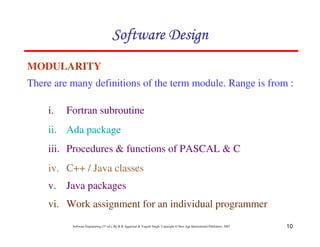
MODULARITY
There are many definitions of the term module. Range is from :

    i.   Fortran subroutine
    ii. Ada package
    iii. Procedures & functions of PASCAL & C
    iv. C++ / Java classes
    v. Java packages
    vi. Work assignment for an individual programmer
          Software Engineering (3rd ed.), By K.K Aggarwal & Yogesh Singh, Copyright © New Age International Publishers, 2007   10
Software Design


All these definitions are correct. A modular
system consist of well defined manageable
units with well defined interfaces among
the units.


       Software Engineering (3rd ed.), By K.K Aggarwal & Yogesh Singh, Copyright © New Age International Publishers, 2007   11
Software Design
Properties :
     i. Well defined subsystem
     ii. Well defined purpose
     iii. Can be separately compiled and stored in a
          library.
     iv. Module can use other modules
     v. Module should be easier to use than to build
     vi. Simpler from outside than from the inside.

         Software Engineering (3rd ed.), By K.K Aggarwal & Yogesh Singh, Copyright © New Age International Publishers, 2007   12
Software Design


Modularity is the single attribute of software that
allows a program to be intellectually manageable.
It enhances design clarity, which in turn eases
implementation,       debugging,        testing,
documenting, and maintenance of software
product.


        Software Engineering (3rd ed.), By K.K Aggarwal & Yogesh Singh, Copyright © New Age International Publishers, 2007   13
Software Design


            Fig. 4 : Modularity and software cost
Software Engineering (3rd ed.), By K.K Aggarwal & Yogesh Singh, Copyright © New Age International Publishers, 2007   14
Software Design
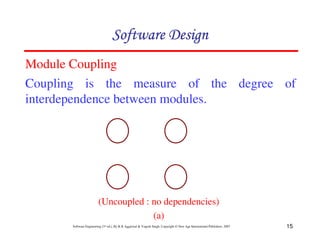
Module Coupling
Coupling is the measure of the degree of
interdependence between modules.


                         (Uncoupled : no dependencies)
                                      (a)
       Software Engineering (3rd ed.), By K.K Aggarwal & Yogesh Singh, Copyright © New Age International Publishers, 2007   15
Software Design


 Loosely coupled:                                                                      Highly coupled:
some dependencies                                                                     many dependencies
       (B)                                                                                                         (C)
                                    Fig. 5 : Module coupling


       Software Engineering (3rd ed.), By K.K Aggarwal & Yogesh Singh, Copyright © New Age International Publishers, 2007   16
Software Design

This can be achieved as:
   Controlling the number of parameters passed
   amongst modules.
   Avoid passing undesired data to calling
   module.
   Maintain parent / child relationship between
   calling & called modules.
   Pass data, not the control information.

        Software Engineering (3rd ed.), By K.K Aggarwal & Yogesh Singh, Copyright © New Age International Publishers, 2007   17
Software Design
Consider the example of editing a student record in a
‘student information system’.
          Edit student                                                                                  Edit student
            record                                                                                        record
Student name,
                                 Student                                                   Student                             Student
  student ID,
                                 record                                                       ID                               record
   address,
                                  EOF                                                                                           EOF
    course
            Retrieve                                                                                   Retrieve
         student record                                                                             student record
   Poor design: Tight Coupling                                                  Good design: Loose Coupling

                                  Fig. 6 : Example of coupling
          Software Engineering (3rd ed.), By K.K Aggarwal & Yogesh Singh, Copyright © New Age International Publishers, 2007             18
Software Design
       Data coupling                                                                                     Best
       Stamp coupling
       Control coupling
       External coupling
       Common coupling
       Content coupling                                                                               Worst
                    Fig. 7 : The types of module coupling

Given two procedures A & B, we can identify number of
ways in which they can be coupled.
         Software Engineering (3rd ed.), By K.K Aggarwal & Yogesh Singh, Copyright © New Age International Publishers, 2007   19
Software Design
Data coupling
The dependency between module A and B is said to be                                                                            data
coupled if their dependency is based on the fact                                                                               they
communicate by only passing of data. Other                                                                                     than
communicating through data, the two modules                                                                                     are
independent.
Stamp coupling
Stamp coupling occurs between module A and B when
complete data structure is passed from one module to another.


          Software Engineering (3rd ed.), By K.K Aggarwal & Yogesh Singh, Copyright © New Age International Publishers, 2007     20
Software Design
Control coupling
Module A and B are said to be control coupled if they
communicate by passing of control information. This is usually
accomplished by means of flags that are set by one module and
reacted upon by the dependent module.

Common coupling
With common coupling, module A and module B have shared
data. Global data areas are commonly found in programming
languages. Making a change to the common data means tracing
back to all the modules which access that data to evaluate the
effect of changes.
           Software Engineering (3rd ed.), By K.K Aggarwal & Yogesh Singh, Copyright © New Age International Publishers, 2007   21
Software Design


         Fig. 8 : Example of common coupling
Software Engineering (3rd ed.), By K.K Aggarwal & Yogesh Singh, Copyright © New Age International Publishers, 2007   22
Software Design

Content coupling
Content coupling occurs when module A changes data of
module B or when control is passed from one module to the
middle of another. In Fig. 9, module B branches into D, even
though D is supposed to be under the control of C.


          Software Engineering (3rd ed.), By K.K Aggarwal & Yogesh Singh, Copyright © New Age International Publishers, 2007   23
Software Design


           Fig. 9 : Example of content coupling
Software Engineering (3rd ed.), By K.K Aggarwal & Yogesh Singh, Copyright © New Age International Publishers, 2007   24
Software Design
Module Cohesion
Cohesion is a measure of the degree to which the
elements of a module are functionally related.


                                                           Module
                                                           strength


    Fig. 10 : Cohesion=Strength of relations within modules
         Software Engineering (3rd ed.), By K.K Aggarwal & Yogesh Singh, Copyright © New Age International Publishers, 2007   25
Software Design

Types of cohesion
       Functional cohesion
       Sequential cohesion

       Procedural cohesion
       Temporal cohesion
       Logical cohesion

       Coincident cohesion


         Software Engineering (3rd ed.), By K.K Aggarwal & Yogesh Singh, Copyright © New Age International Publishers, 2007   26
Software Design

Functional Cohesion                                                                          Best (high)

Sequential Cohesion

Communicational Cohesion

Procedural Cohesion

Temporal Cohesion

Logical Cohesion

Coincidental Cohesion                                                                       Worst (low)


                Fig. 11 : Types of module cohesion
   Software Engineering (3rd ed.), By K.K Aggarwal & Yogesh Singh, Copyright © New Age International Publishers, 2007   27
Software Design

Functional Cohesion
 A and B are part of a single functional task. This is very good
 reason for them to be contained in the same procedure.

Sequential Cohesion
 Module A outputs some data which forms the input to B. This is
 the reason for them to be contained in the same procedure.


          Software Engineering (3rd ed.), By K.K Aggarwal & Yogesh Singh, Copyright © New Age International Publishers, 2007   28
Software Design

Procedural Cohesion
 Procedural Cohesion occurs in modules whose instructions
 although accomplish different tasks yet have been combined
 because there is a specific order in which the tasks are to be
 completed.

Temporal Cohesion
 Module exhibits temporal cohesion when it contains tasks that
 are related by the fact that all tasks must be executed in the
 same time-span.


          Software Engineering (3rd ed.), By K.K Aggarwal & Yogesh Singh, Copyright © New Age International Publishers, 2007   29
Software Design

Logical Cohesion
  Logical cohesion occurs in modules that contain instructions
  that appear to be related because they fall into the same logical
  class of functions.


Coincidental Cohesion
  Coincidental cohesion exists in modules that contain
  instructions that have little or no relationship to one another.


          Software Engineering (3rd ed.), By K.K Aggarwal & Yogesh Singh, Copyright © New Age International Publishers, 2007   30
Software Design
Relationship between Cohesion & Coupling
If the software is not properly modularized, a host of seemingly
trivial enhancement or changes will result into death of the project.
Therefore, a software engineer must design the modules with goal of
high cohesion and low coupling.


                  Fig. 12 : View of cohesion and coupling
            Software Engineering (3rd ed.), By K.K Aggarwal & Yogesh Singh, Copyright © New Age International Publishers, 2007   31
Software Design
STRATEGY OF DESIGN
A good system design strategy is to organize the program modules
in such a way that are easy to develop and latter to, change.
Structured design techniques help developers to deal with the size
and complexity of programs. Analysts create instructions for the
developers about how code should be written and how pieces of
code should fit together to form a program. It is important for two
reasons:
   First, even pre-existing code, if any, needs to be understood,
   organized and pieced together.
   Second, it is still common for the project team to have to write
   some code and produce original programs that support the
   application logic of the system.
           Software Engineering (3rd ed.), By K.K Aggarwal & Yogesh Singh, Copyright © New Age International Publishers, 2007   32
Software Design
Bottom-Up Design
These modules are collected together in the form of a “library”.


                           Fig. 13 : Bottom-up tree structure
            Software Engineering (3rd ed.), By K.K Aggarwal & Yogesh Singh, Copyright © New Age International Publishers, 2007   33
Software Design

Top-Down Design

A top down design approach starts by identifying the major modules
of the system, decomposing them into their lower level modules and
iterating until the desired level of detail is achieved. This is stepwise
refinement; starting from an abstract design, in each step the design
is refined to a more concrete level, until we reach a level where no
more refinement is needed and the design can be implemented
directly.


            Software Engineering (3rd ed.), By K.K Aggarwal & Yogesh Singh, Copyright © New Age International Publishers, 2007   34
Software Design

Hybrid Design
For top-down approach to be effective, some bottom-up approach is
essential for the following reasons:

   To permit common sub modules.

   Near the bottom of the hierarchy, where the intuition is simpler,
   and the need for bottom-up testing is greater, because there are
   more number of modules at low levels than high levels.
   In the use of pre-written library modules, in particular, reuse of
   modules.


           Software Engineering (3rd ed.), By K.K Aggarwal & Yogesh Singh, Copyright © New Age International Publishers, 2007   35
Software Design

FUNCTION ORIENTED DESIGN

Function Oriented design is an approach to software design where
the design is decomposed into a set of interacting units where each
unit has a clearly defined function. Thus, system is designed from
a functional viewpoint.


           Software Engineering (3rd ed.), By K.K Aggarwal & Yogesh Singh, Copyright © New Age International Publishers, 2007   36
Software Design


Software Engineering (3rd ed.), By K.K Aggarwal & Yogesh Singh, Copyright © New Age International Publishers, 2007   37
Software Design

We continue the refinement of each module until we reach the statement
level of our programming language. At that point, we can describe the
structure of our program as a tree of refinement as in design top-down
structure as shown in fig. 14.


                                  Fig. 14 : Top-down structure
            Software Engineering (3rd ed.), By K.K Aggarwal & Yogesh Singh, Copyright © New Age International Publishers, 2007   38
Software Design
If a program is created top-down, the modules become very specialized.
As one can easily see in top down design structure, each module is used
by at most one other module, its parent. For a module, however, we
must require that several other modules as in design reusable structure
as shown in fig. 15.


                          Fig. 15 : Design reusable structure
            Software Engineering (3rd ed.), By K.K Aggarwal & Yogesh Singh, Copyright © New Age International Publishers, 2007   39
Software Design

Design Notations
Design notations are largely meant to be used during the process
of design and are used to represent design or design decisions.
For a function oriented design, the design can be represented
graphically or mathematically by the following:

   Data flow diagrams

    Data Dictionaries
   Structure Charts
    Pseudocode


          Software Engineering (3rd ed.), By K.K Aggarwal & Yogesh Singh, Copyright © New Age International Publishers, 2007   40
Software Design
Structure Chart
It partition a system into block boxes. A black box means that
functionality is known to the user without the knowledge of internal
design.


          Fig. 16 : Hierarchical format of a structure chart
            Software Engineering (3rd ed.), By K.K Aggarwal & Yogesh Singh, Copyright © New Age International Publishers, 2007   41
Software Design


               Fig. 17 : Structure chart notations

Software Engineering (3rd ed.), By K.K Aggarwal & Yogesh Singh, Copyright © New Age International Publishers, 2007   42
Software Design
A structure chart for “update file” is given in fig. 18.


                                               Fig. 18 : Update file
             Software Engineering (3rd ed.), By K.K Aggarwal & Yogesh Singh, Copyright © New Age International Publishers, 2007   43
Software Design
A transaction centered structure describes a system that processes a
number of different types of transactions. It is illustrated in Fig.19.


                   Fig. 19 : Transaction-centered structure

            Software Engineering (3rd ed.), By K.K Aggarwal & Yogesh Singh, Copyright © New Age International Publishers, 2007   44
Software Design
In the above figure the MAIN module controls the system operation
its functions is to:

    invoke the INPUT module to read a transaction;

    determine the kind of transaction and select one of a number
    of transaction modules to process that transaction, and
    output the results of the processing by calling OUTPUT
    module.


          Software Engineering (3rd ed.), By K.K Aggarwal & Yogesh Singh, Copyright © New Age International Publishers, 2007   45
Software Design

Pseudocode
Pseudocode notation can be used in both the preliminary and detailed
design phases.

Using pseudocode, the designer describes system characteristics
using short, concise, English language phrases that are structured by
key words such as It-Then-Else, While-Do, and End.


            Software Engineering (3rd ed.), By K.K Aggarwal & Yogesh Singh, Copyright © New Age International Publishers, 2007   46
Software Design
Functional Procedure Layers
   Function are built in layers, Additional notation is used to
   specify details.
   Level 0
       Function or procedure name
       Relationship to other system components (e.g., part of
       which system, called by which routines, etc.)

       Brief description of the function purpose.

       Author, date


             Software Engineering (3rd ed.), By K.K Aggarwal & Yogesh Singh, Copyright © New Age International Publishers, 2007   47
Software Design
Level 1
    Function Parameters (problem variables, types, purpose,
    etc.)
    Global variables (problem variable, type, purpose,
    sharing information)

    Routines called by the function

    Side effects
    Input/Output Assertions


          Software Engineering (3rd ed.), By K.K Aggarwal & Yogesh Singh, Copyright © New Age International Publishers, 2007   48
Software Design
Level 2
    Local data structures (variable etc.)

    Timing constraints

    Exception handling (conditions, responses, events)

    Any other limitations


Level 3
    Body (structured chart, English pseudo code, decision
    tables, flow charts, etc.)


          Software Engineering (3rd ed.), By K.K Aggarwal & Yogesh Singh, Copyright © New Age International Publishers, 2007   49
Software Design
IEEE Recommended practice for software design
descriptions (IEEE STD 1016-1998)
   Scope
An SDD is a representation of a software system that is used as a medium
for communicating software design information.

   References

   i.   IEEE std 830-1998, IEEE recommended practice for
        software requirements specifications.

   ii. IEEE std 610.12-1990,                                                      IEEE                 glossary                  of   software
       engineering terminology.

            Software Engineering (3rd ed.), By K.K Aggarwal & Yogesh Singh, Copyright © New Age International Publishers, 2007              50
Software Design
 Definitions
i.   Design entity. An element (Component) of a design that is
     structurally and functionally distinct from other elements and
     that is separately named and referenced.

ii. Design View. A subset of design entity attribute information
    that is specifically suited to the needs of a software project
    activity.
iii. Entity attributes. A named property or characteristics of a
     design entity. It provides a statement of fact about the entity.

iv. Software design description (SDD). A representation of a
    software system created to facilitate analysis, planning,
    implementation and decision making.

         Software Engineering (3rd ed.), By K.K Aggarwal & Yogesh Singh, Copyright © New Age International Publishers, 2007   51
Software Design
   Purpose of an SDD
The SDD shows how the software system will be structured to
satisfy the requirements identified in the SRS. It is basically the
translation of requirements into a description of the software
structure, software components, interfaces, and data necessary for
the implementation phase. Hence, SDD becomes the blue print for
the implementation activity.

   Design Description Information Content
       Introduction

       Design entities

       Design entity attributes
           Software Engineering (3rd ed.), By K.K Aggarwal & Yogesh Singh, Copyright © New Age International Publishers, 2007   52
Software Design
The attributes and associated information items are defined in the
following subsections:


 a) Identification                                                                 f)           Dependencies

 b) Type                                                                           g) Interface

 c) Purpose                                                                        h) Resources

 d) Function                                                                        i)           Processing

 e) Subordinates                                                                    j)           Data

           Software Engineering (3rd ed.), By K.K Aggarwal & Yogesh Singh, Copyright © New Age International Publishers, 2007   53
Software Design

   Design Description Organization

Each design description writer may have a different view of what
are considered the essential aspects of a software design. The
organization of SDD is given in table 1. This is one of the possible
ways to organize and format the SDD.

A recommended organization of the SDD into separate design
views to facilitate information access and assimilation is given in
table 2.


           Software Engineering (3rd ed.), By K.K Aggarwal & Yogesh Singh, Copyright © New Age International Publishers, 2007   54
Software Design


                                                                                                                     Cont…
Software Engineering (3rd ed.), By K.K Aggarwal & Yogesh Singh, Copyright © New Age International Publishers, 2007           55
Software Design


                                                                                                               Table 1:
                                                                                                            Organization of
                                                                                                                SDD


Software Engineering (3rd ed.), By K.K Aggarwal & Yogesh Singh, Copyright © New Age International Publishers, 2007            56
Software Design
 Design View                          Scope                                         Entity attribute                                    Example
                                                                                                                                     representation
Decomposition Partition of the system into                                   Identification, type                               Hierarchical
description   design entities                                                purpose, function,                                 decomposition diagram,
                                                                             subordinate                                        natural language

Dependency      Description of relationships                                 Identification, type,  Structure chart, data
description     among entities of system                                     purpose, dependencies, flow diagrams,
                resources                                                    resources              transaction diagrams

Interface       List of everything a                                         Identification,                                    Interface files,
description     designer, developer, tester                                  function, interfaces                               parameter tables
                needs to know to use design
                entities that make up the
                system
Detail          Description of the internal                                  Identification,                                    Flow charts, PDL etc.
description     design details of an entity                                  processing, data


                                               Table 2: Design views
                Software Engineering (3rd ed.), By K.K Aggarwal & Yogesh Singh, Copyright © New Age International Publishers, 2007                    57
Software Design
Object Oriented Design
Object oriented design is the result of focusing attention not on the
function performed by the program, but instead on the data that are
to do manipulated by the program. Thus, it is orthogonal to function
oriented design.
Object Oriented Design begins with an examination of the real
world “things” that are part of the problem to be solved. These
things (which we will call objects) are characterized individually in
terms of their attributes and behavior.


            Software Engineering (3rd ed.), By K.K Aggarwal & Yogesh Singh, Copyright © New Age International Publishers, 2007   58
Software Design
   Basic Concepts
Object Oriented Design is not dependent on any specific
implementation language. Problems are modeled using objects.
Objects have:

      Behavior (they do things)

      State (which changes when they do things)


          Software Engineering (3rd ed.), By K.K Aggarwal & Yogesh Singh, Copyright © New Age International Publishers, 2007   59
Software Design
The various terms related to object design are:

i.   Objects

The word “Object” is used very frequently and conveys different
meaning in different circumstances. Here, meaning is an entity able to
save a state (information) and which offers a number of operations
(behavior) to either examine or affect this state. An object is
characterized by number of operations and a state which remembers
the effect of these operations.


            Software Engineering (3rd ed.), By K.K Aggarwal & Yogesh Singh, Copyright © New Age International Publishers, 2007   60
Software Design
ii.   Messages
Objects communicate by message passing. Messages consist of the
identity of the target object, the name of the requested operation and
any other operation needed to perform the function. Message are often
implemented as procedure or function calls.

iii. Abstraction
In object oriented design, complexity is managed using abstraction.
Abstraction is the elimination of the irrelevant and the amplification of
the essentials.


            Software Engineering (3rd ed.), By K.K Aggarwal & Yogesh Singh, Copyright © New Age International Publishers, 2007   61
Software Design
iv. Class
In any system, there shall be number of objects. Some of the objects
may have common characteristics and we can group the objects
according to these characteristics. This type of grouping is known as a
class. Hence, a class is a set of objects that share a common structure
and a common behavior.
We may define a class “car” and each object that represent a car
becomes an instance of this class. In this class “car”, Indica, Santro,
Maruti, Indigo are instances of this class as shown in fig. 20.

Classes are useful because they act as a blueprint for objects. If we
want a new square we may use the square class and simply fill in the
particular details (i.e. colour and position) fig. 21 shows how can we
represent the square class.
            Software Engineering (3rd ed.), By K.K Aggarwal & Yogesh Singh, Copyright © New Age International Publishers, 2007   62
Software Design


Fig.20: Indica, Santro, Maruti, Indigo are all instances of the class “car”

           Software Engineering (3rd ed.), By K.K Aggarwal & Yogesh Singh, Copyright © New Age International Publishers, 2007   63
Software Design


                             Fig. 21: The square class


Software Engineering (3rd ed.), By K.K Aggarwal & Yogesh Singh, Copyright © New Age International Publishers, 2007   64
Software Design
v.   Attributes
An attributes is a data value held by the objects in a class. The square
class has two attributes: a colour and array of points. Each attributes
has a value for each object instance. The attributes are shown as
second part of the class as shown in fig. 21.

vi. Operations
An operation is a function or transformation that may be applied to or
by objects in a class. In the square class, we have two operations: set
colour() and draw(). All objects in a class share the same operations.
An object “knows” its class, and hence the right implementation of the
operation. Operation are shown in the third part of the class as
indicated in fig. 21.


            Software Engineering (3rd ed.), By K.K Aggarwal & Yogesh Singh, Copyright © New Age International Publishers, 2007   65
Software Design
vii. Inheritance
Imagine that, as well as squares, we have triangle class. Fig. 22 shows
the class for a triangle.


                                       Fig. 22: The triangle class

            Software Engineering (3rd ed.), By K.K Aggarwal & Yogesh Singh, Copyright © New Age International Publishers, 2007   66
Software Design

Now, comparing fig. 21 and 22, we can see that there is some
difference between triangle and squares classes.
For example, at a high level of abstraction, we might want to think of a
picture as made up of shapes and to draw the picture, we draw each
shape in turn. We want to eliminate the irrelevant details: we do not
care that one shape is a square and the other is a triangle as long as
both can draw themselves.
To do this, we consider the important parts out of these classes in to a
new class called Shape. Fig. 23 shows the results.


            Software Engineering (3rd ed.), By K.K Aggarwal & Yogesh Singh, Copyright © New Age International Publishers, 2007   67
Software Design


          Fig. 23: Abstracting common features in a new class
This sort of abstraction is called inheritance. The low level classes
(known as subclasses or derived classes) inherit state and behavior
from this high level class (known as a super class or base class).
            Software Engineering (3rd ed.), By K.K Aggarwal & Yogesh Singh, Copyright © New Age International Publishers, 2007   68
Software Design
viii. Polymorphism
When we abstract just the interface of an operation and leave the
implementation to subclasses it is called a polymorphic operation and
process is called polymorphism.

ix. Encapsulation (Information Hiding)
Encapsulation is also commonly referred to as “Information Hiding”. It
consists of the separation of the external aspects of an object from the
internal implementation details of the object.
x.   Hierarchy
Hierarchy involves organizing something according to some particular
order or rank. It is another mechanism for reducing the complexity of
software by being able to treat and express sub-types in a generic way.
            Software Engineering (3rd ed.), By K.K Aggarwal & Yogesh Singh, Copyright © New Age International Publishers, 2007   69
Software Design


                                       Fig. 24: Hierarchy


Software Engineering (3rd ed.), By K.K Aggarwal & Yogesh Singh, Copyright © New Age International Publishers, 2007   70
Software Design

   Steps to Analyze and Design Object Oriented System

There are various steps in the analysis and design of an object
oriented system and are given in fig. 25


          Software Engineering (3rd ed.), By K.K Aggarwal & Yogesh Singh, Copyright © New Age International Publishers, 2007   71
Software Design


Fig. 25: Steps for analysis & design of object
               oriented system

       Software Engineering (3rd ed.), By K.K Aggarwal & Yogesh Singh, Copyright © New Age International Publishers, 2007   72
Software Design
i.    Create use case model
First step is to identify the actors interacting with the system. We
should then write the use case and draw the use case diagram.

ii.   Draw activity diagram (If required)
Activity Diagram illustrate the dynamic nature of a system by modeling
the flow of control form activity to activity. An activity represents an
operation on some class in the system that results in a change in the
state of the system. Fig. 26 shows the activity diagram processing an
order to deliver some goods.


            Software Engineering (3rd ed.), By K.K Aggarwal & Yogesh Singh, Copyright © New Age International Publishers, 2007   73
Software Design


                                Fig. 26: Activity diagram
Software Engineering (3rd ed.), By K.K Aggarwal & Yogesh Singh, Copyright © New Age International Publishers, 2007   74
Software Design
iii. Draw the interaction diagram
An interaction diagram shows an interaction, consisting of a set of
objects and their relationship, including the messages that may be
dispatched among them. Interaction diagrams address the dynamic
view of a system.
Steps to draws interaction diagrams are as under:
a)   Firstly, we should identify that the objects with respects to every
     use case.
b)   We draw the sequence diagrams for every use case.

d)   We draw the collaboration diagrams for every use case.


           Software Engineering (3rd ed.), By K.K Aggarwal & Yogesh Singh, Copyright © New Age International Publishers, 2007   75
Software Design

The object types used in this analysis model are entity objects,
interface objects and control objects as given in fig. 27.


                                              Fig. 27: Object types


          Software Engineering (3rd ed.), By K.K Aggarwal & Yogesh Singh, Copyright © New Age International Publishers, 2007   76
Software Design
iv. Draw the class diagram

The class diagram shows the relationship amongst classes. There are
four types of relationships in class diagrams.

a)   Association are semantic connection between classes. When
     an association connects two classes, each class can send
     messages to the other in a sequence or a collaboration
     diagram. Associations can be bi-directional or unidirectional.


           Software Engineering (3rd ed.), By K.K Aggarwal & Yogesh Singh, Copyright © New Age International Publishers, 2007   77
Software Design
b)   Dependencies connect two classes. Dependencies are
     always unidirectional and show that one class, depends on the
     definitions in another class.


c)   Aggregations are stronger form of association. An
     aggregation is a relationship between a whole and its parts.


d)   Generalizations are used to show an inheritance relationship
     between two classes.


           Software Engineering (3rd ed.), By K.K Aggarwal & Yogesh Singh, Copyright © New Age International Publishers, 2007   78
Software Design
v.   Design of state chart diagrams
A state chart diagram is used to show the state space of a given class,
the event that cause a transition from one state to another, and the
action that result from a state change. A state transition diagram for a
“book” in the library system is given in fig. 28.


        Fig. 28: Transition chart for “book” in a library system.
            Software Engineering (3rd ed.), By K.K Aggarwal & Yogesh Singh, Copyright © New Age International Publishers, 2007   79
Software Design
vi. Draw component and development diagram
Component diagrams address the static implementation view of a
system they are related to class diagrams in that a component typically
maps to one or more classes, interfaces or collaboration.

Deployment Diagram Captures                                                      relationship                          between   physical
components and the hardware.


           Software Engineering (3rd ed.), By K.K Aggarwal & Yogesh Singh, Copyright © New Age International Publishers, 2007         80
Software Design
A software has to be developed for automating the manual library of a
University. The system should be stand alone in nature. It should be
designed to provide functionality’s as explained below:
Issue of Books:
      A student of any course should be able to get books issued.
      Books from General Section are issued to all but Book bank
      books are issued only for their respective courses.
      A limitation is imposed on the number of books a student can
      issue.
      A maximum of 4 books from Book bank and 3 books from
      General section is issued for 15 days only.The software takes
      the current system date as the date of issue and calculates date
      of return.
            Software Engineering (3rd ed.), By K.K Aggarwal & Yogesh Singh, Copyright © New Age International Publishers, 2007   81
Software Design
       A bar code detector is used to save the student as well as book
       information.
       The due date for return of the book is stamped on the book.
Return of Books:
       Any person can return the issued books.
       The student information is displayed using the bar code
       detector.
       The system displays the student details on whose name the
       books were issued as well as the date of issue and return of the
       book.
       The system operator verifies the duration for the issue.
       The information is saved and the corresponding updating take
       place in the database.
           Software Engineering (3rd ed.), By K.K Aggarwal & Yogesh Singh, Copyright © New Age International Publishers, 2007   82
Software Design
    Query Processing:
       The system should be able to provide information like:
       Availability of a particular book.
       Availability of book of any particular author.
       Number of copies available of the desired book.

 The system should also be able to generate reports regarding the
details of the books available in the library at any given time. The
corresponding printouts for each entry (issue/return) made in the
system should be generated. Security provisions like the ‘login
authenticity should be provided. Each user should have a user id and
a password. Record of the users of the system should be kept in the
log file. Provision should be made for full backup of the system.

            Software Engineering (3rd ed.), By K.K Aggarwal & Yogesh Singh, Copyright © New Age International Publishers, 2007   83
Software Design


Software Engineering (3rd ed.), By K.K Aggarwal & Yogesh Singh, Copyright © New Age International Publishers, 2007   84
Software Design


Software Engineering (3rd ed.), By K.K Aggarwal & Yogesh Singh, Copyright © New Age International Publishers, 2007   85
Software Design


Software Engineering (3rd ed.), By K.K Aggarwal & Yogesh Singh, Copyright © New Age International Publishers, 2007   86
Software Design


Software Engineering (3rd ed.), By K.K Aggarwal & Yogesh Singh, Copyright © New Age International Publishers, 2007   87
Software Design


Software Engineering (3rd ed.), By K.K Aggarwal & Yogesh Singh, Copyright © New Age International Publishers, 2007   88
Software Design


Software Engineering (3rd ed.), By K.K Aggarwal & Yogesh Singh, Copyright © New Age International Publishers, 2007   89
Software Design


Software Engineering (3rd ed.), By K.K Aggarwal & Yogesh Singh, Copyright © New Age International Publishers, 2007   90
Software Design


Software Engineering (3rd ed.), By K.K Aggarwal & Yogesh Singh, Copyright © New Age International Publishers, 2007   91
Software Design


Software Engineering (3rd ed.), By K.K Aggarwal & Yogesh Singh, Copyright © New Age International Publishers, 2007   92
Software Design


Software Engineering (3rd ed.), By K.K Aggarwal & Yogesh Singh, Copyright © New Age International Publishers, 2007   93
Multiple Choice Questions
Note: Choose most appropriate answer of the following questions:
5.1 The most desirable form of coupling is
    (a) Control Coupling                   (b) Data Coupling
    (c) Common Coupling                    (d) Content Coupling
5.2 The worst type of coupling is
    (a) Content coupling                                                           (b) Common coupling
    (c) External coupling                                                          (d) Data coupling
5.3 The most desirable form of cohesion is
    (a) Logical cohesion                   (b) Procedural cohesion
    (c) Functional cohesion                (d) Temporal cohesion
5.4 The worst type of cohesion is
    (a) Temporal cohesion                                                          (b) Coincidental cohesion
    (c) Logical cohesion                                                           (d) Sequential cohesion
5.5 Which one is not a strategy for design?
    (a) Bottom up design                    (b) Top down design
    (c) Embedded design                     (d) Hybrid design
               Software Engineering (3rd ed.), By K.K Aggarwal & Yogesh Singh, Copyright © New Age International Publishers, 2007   94
Multiple Choice Questions
5.6 Temporal cohesion means
     (a) Cohesion between temporary variables
     (b) Cohesion between local variable
     (c) Cohesion with respect to time
     (d) Coincidental cohesion
5.7 Functional cohesion means
     (a) Operations are part of single functional task and are placed in same procedures
     (b) Operations are part of single functional task and are placed in multiple procedures
     (c) Operations are part of multiple tasks
     (d) None of the above
5.8 When two modules refer to the same global data area, they are related as
    (a) External coupled                    (b) Data coupled
    (c) Content coupled                     (d) Common coupled

5.9 The module in which instructions are related through flow of control is
    (a) Temporal cohesion                      (b) Logical cohesion
    (c) Procedural cohesion                    (d) Functional cohesion


                 Software Engineering (3rd ed.), By K.K Aggarwal & Yogesh Singh, Copyright © New Age International Publishers, 2007   95
Multiple Choice Questions
5.10 The relationship of data elements in a module is called
    (a) Coupling                             (b) Cohesion
    (c) Modularity                           (d) None of the above

5.11 A system that does not interact with external environment is called
    (a) Closed system                          (b) Logical system
    (c) Open system                            (d) Hierarchal system

5.12 The extent to which different modules are dependent upon each other is called
    (a) Coupling                             (b) Cohesion
    (c) Modularity                           (d) Stability


               Software Engineering (3rd ed.), By K.K Aggarwal & Yogesh Singh, Copyright © New Age International Publishers, 2007   96
Exercises
5.1 What is design? Describe the difference between conceptual design and
    technical design.
5.2 Discuss the objectives of software design. How do we transform an
    informal design to a detailed design?
5.3 Do we design software when we “write” a program? What makes
    software design different from coding?
5.4 What is modularity? List the important properties of a modular system.
5.5 Define module coupling and explain different types of coupling.
5.6 Define module cohesion and explain different types of cohesion.
5.7 Discuss the objectives of modular software design. What are the effects
    of module coupling and cohesion?
5.8 If a module has logical cohesion, what kind of coupling is this module
   likely to have with others?
5.9 What problems are likely to arise if two modules have high coupling?
              Software Engineering (3rd ed.), By K.K Aggarwal & Yogesh Singh, Copyright © New Age International Publishers, 2007   97
Exercises
5.10 What problems are likely to arise if a module has low cohesion?

5.11 Describe the various strategies of design. Which design strategy is most
    popular and practical?
5.12 If some existing modules are to be re-used in building a new system,
    which design strategy is used and why?
5.13 What is the difference between a flow chart and a structure chart?
5.14 Explain why it is important to use different notations to describe
   software designs.
5.15 List a few well-established function oriented software design
    techniques.
5.16 Define the following terms: Objects, Message, Abstraction, Class,
   Inheritance and Polymorphism.
5.17 What is the relationship between abstract data types and classes?

              Software Engineering (3rd ed.), By K.K Aggarwal & Yogesh Singh, Copyright © New Age International Publishers, 2007   98
Exercises
5.18 Can we have inheritance without polymorphism? Explain.
5.19 Discuss the reasons for improvement using object-oriented design.
5.20 Explain the design guidelines that can be used to produce “good
    quality” classes or reusable classes.
5.21 List the points of a simplified design process.
5.22 Discuss the differences between object oriented and function oriented
   design.
5.23 What documents should be produced on completion of the design
    phase?
5.24 Can a system ever be completely “decoupled”? That is, can the degree
   of coupling be reduced so much that there is no coupling between
   modules?


              Software Engineering (3rd ed.), By K.K Aggarwal & Yogesh Singh, Copyright © New Age International Publishers, 2007   99