A Strategic Tool of Growing Importance for the Next Millennium
 
 
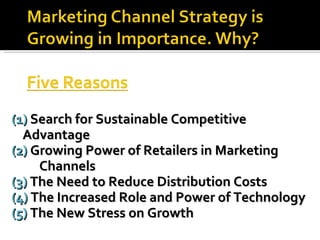
(1)  Search for Sustainable Competitive Advantage (2)  Growing Power of Retailers in Marketing  Channels (3)  The Need to Reduce Distribution Costs (4)  The Increased Role and Power of Technology (5)  The New Stress on Growth
 
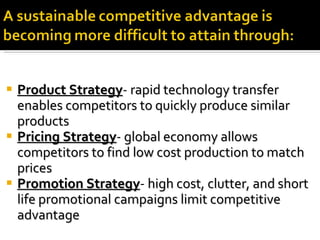
A competitive advantage that cannot be quickly and easily copied by competitors
Product Strategy -  rapid technology transfer enables competitors to quickly produce similar products Pricing Strategy -  global economy allows competitors to find low cost production to match prices Promotion Strategy -  high cost, clutter, and short life promotional campaigns limit competitive advantage
Competitive Advantage Based on
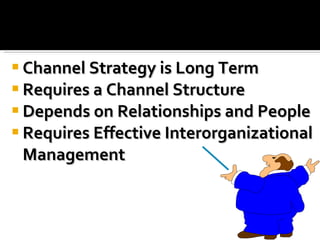
Channel Strategy is Long Term Requires a Channel Structure Depends on Relationships and People Requires Effective Interorganizational  Management
Retailers
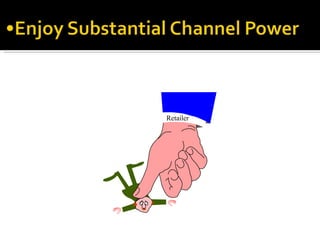
Are Growing Larger Enjoy Substantial Channel Power Act as Buying Agents for Customers Rather than Selling Agents for Suppliers Often Operate on Low Price / Low Margin Model Operate in Saturated Markets and Fight for  Market Share
 
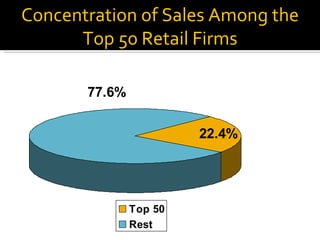
Concentration of Sales Among the Top 50 Retail Firms
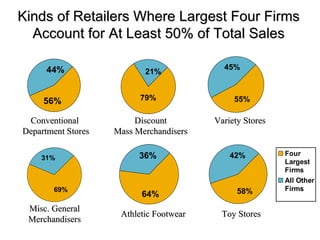
Kinds of Retailers Where Largest Four Firms Account for At Least 50% of Total Sales Conventional  Department Stores Discount Mass Merchandisers Variety Stores Misc. General Merchandisers Athletic Footwear Toy Stores
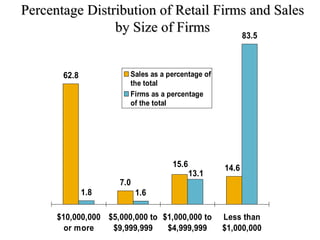
Percentage Distribution of Retail Firms and Sales by Size of Firms
Retailer
Retailers Act as Buying Agents for Customers Rather than as Selling Agents for Suppliers
Retailers Often Operate on Low  Price / Low Margin Model
Retailers Operate in Saturated Markets and Fight for Market Share
Thus, Effective Channel Strategy  for Dealing with  Power Retailers is Crucial
Distribution Costs
Sometimes Distribution Costs  are  Higher  than the Manufacturing  Cost or the Costs of Raw  Materials and Component Parts
Autos  Software   Gasoline   Fax Machines   Packaged Foods Distribution Manufacturing Raw Materials and Components 15% 40% 45% 25% 65% 10% 28% 19% 53% 30% 30% 40% 41% 33% 26%
Disintermediation
 
 
The Internet Wireless Communications B2C and B2B E-Commerce Cell Phones Global Telecommunications Robotics & Automated Warehousing Computerized “Salespeople”
Competition
 
Out Reengineering Restructuring Downsizing Flat Organizations Lean and Mean In  Growth Expansion New Markets Market Share Top Line Revenue
 
Translation By getting channel members to focus on your products to a greater extent than your competitors, you gain market share and  growth
(1)  Search For Competitive Advantage (2)  Growing Size and Power of  Retailers   (3)  Need to Reduce Distribution Costs (4)  Power and Potential of Technology (5)  Stress on Growth Instead of  Downsizing
Marketing Channel Strategy Has Become Critically Important For Most Businesses
 
The broad principles by which a firm expects to achieve its distribution objectives for satisfying its customers
(1)  What role should distribution play in the firm’s  overall objectives and strategies? (2)  What role should distribution play in the marketing mix? (3)  How should the firm’s marketing channels be designed to achieve its distribution objectives? (4)  What kinds of channel members should be selected to meet the firm’s distribution objectives? (5)  How can the marketing channel be managed to implement the firm’s channel design effectively and efficiently on a continuing basis?
C s  = f (P 1 , P 2 , P 3 , P 4 ) where: C s = degree of customer satisfaction P 1 = product strategy P 2 = pricing strategy P 3 = promotional strategy P 4 = place (channel strategy)
Distribution appears to be the most relevant variable for satisfying customers Parity exists among competitors in the other three marketing mix variables High degree of vulnerability exists because of competitors’ neglect of distribution Distribution channel strategy can foster synergies
Dual Distribution Exclusive Dealing Full-Line Forcing Price Differentiation Price Maintenance Refusal to Deal Resale Restrictions Tying Agreements
When Do Customers Buy? Where Do Customers Buy? How Do Customers Buy? Who Buys? Who makes the actual purchase? Who uses the product? Who takes part in the buying decision?
 
 
Supply Chain Management takes a broader perspective by viewing logistics as an integral part of the marketing channel  relationship
A long-term “partnership” among marketing channel participants aimed at reducing inefficiencies, costs, and redundancies in the logistical system in order to provide high levels of customer service
Factor Inventory Management Total Cost Approach Time Horizon Information Sharing and  Monitoring Joint Planning Compatibility of Corporate Philosophies Channel Leadership Sharing of Risks and Rewards Inventory Flow Traditional Logistics System Independent Effort Minimize Firm Costs Short-Term Limited to Needs of Current Transaction Transaction Based Not Relevant Not Needed Each Channel Member on Their Own “ Warehouse” Mentality Storage Safety Stocks Supply Chain Mgmt. System Joint Effort to Reduce Channel Inventories Channel-Wide Cost Efficiencies Long-Term Continuous Effort to Gather and Monitor Ongoing Important for Major Initiatives Required for  Coordination and Focus Risks and Rewards Shared over Long-range “ Distribution Center” Orientation-JIT, Quick  Response, Cross Docking Contrasts Between a Traditional Logistics System and Supply Chain Based System
1.  Order Processing Time 2.  Order Assembly Time 3.  Delivery Time 4.  Inventory Reliability 5.  Order Size Constraints 6.  Consolidation Stipulation 7.  Consistency of Delivery 8.  Frequency of Sales Visits 9.  Ordering Convenience 10.  Order Progress Information 11.  Inventory Backup During Promotion 12.  Invoice Formats 13.  Physical Condition of Goods 14.  Claims Response 15.  Billing Procedures 16.  Average Order Cycle Time 17.  Order Cycle Time Variability 18.  Rush Service 19.  Product Availability 20.  Competent Technical Reps 21.  Equipment Demonstrations 22.  Availability of Literature 23.  Accuracy in Filling Orders 24.  Terms of Sale 25.  Protective Packaging 26.  Degree of Cooperation
 
Continuing and mutually supportive relationship between the manufacturer and its channel members in an effort to provide a more highly motivated team, network, and alliance of channel partners
 
(1)  Recognition of interdependence of channel  members (2)  Close cooperation between channel members (3)  Careful specification of roles, rights, and  responsibilities in the relationship (4)  Coordinated effort focused on common goals (5)  Good communications and trust between  channel members
 
The practice of building long-term relations with key parties - customers, suppliers, distributors- in order to retain their long-term preference and business Because of the importance of channels of distribution, building good relationships in the marketing channel is key to successful relationship marketing
Find Out the Needs and Problems of Channel Members -informal information system (“grapevine”) -research studies of channel members -research studies by outside parties -marketing channel audit -distributor advisory councils
Offer Support to Channel Members that is Consistent with Their Needs and Helps Solve their Problems -cooperative arrangements -partnerships and strategic alliances -distribution programming Provide Leadership to Motivate Channel Members  -use power effectively -recognize causes of conflict -resolve conflicts
Reward Power Coercive Power Legitimate Power Referent Power Expert Power Effective Channel Management Depends  on How Well These Power Bases are  Combined and  Used
Role Incongruities Resource Scarcities Perceptual Divergencies Expectational Differences Decision Domain Disagreements Goal Incompatabilities Communication Difficulties
1.  Growing Emphasis on Marketing Channel  Strategy 2.  More and More Stress on Technology 3.  Focus on Efficiency and Reducing Distribution  Costs 4.  Shortening and Flattening of Distribution  Channels (Disintermediation) 5.  Development of New Types of Intermediaries in Channels (Reintermediation)
6.  Continued Growth in Partnerships and  Alliances (Relationship Marketing) 7.  Increasing Power for Retailers and  Wholesalers (Gatekeepers) 8.  Mergers and Acquisitions to Gain  Distribution Clout 9.  Flexible and Focused Distribution to Match  Micro, Niche, and Database Marketing 10.  Attention to the Behavioral Dimensions of  Distribution to Augment Technology