Name: Panchal Dhrumil Indravadan
Subject: Data Structure
Branch: Computer Engineering (B.E.)
Semester: Third Sem
Year: 2018-19
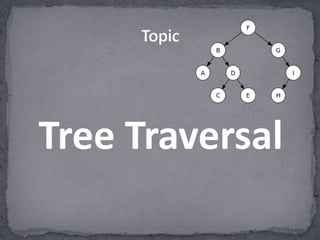
Tree Traversal
 Binary Tree Traversal
 Preorder
 Inorder
 Postorder
 Example
 The most common operations performed on tree
structure is that of traversal. This is a procedure by
which each node in the tree is processed exactly
once in a systematic manner.
 There are three ways of traversing a binary tree.
 1. Preorder Traversal
 2. Inorder Traversal
 3. Postorder Traversal
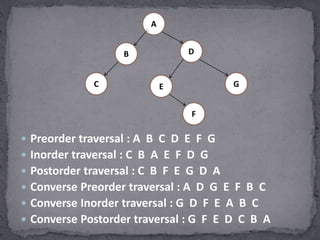
 Preorder traversal : A B C D E F G
 Inorder traversal : C B A E F D G
 Postorder traversal : C B F E G D A
 Converse Preorder traversal : A D G E F B C
 Converse Inorder traversal : G D F E A B C
 Converse Postorder traversal : G F E D C B A
A
B
C
D
E
F
G
 Preorder traversal of a binary tree is defined as follow
 Process the root node
 Traverse the left subtree in preorder
 Traverse the right subtree in preorder
 If particular subtree is empty (i.e., node has no left or
right descendant) the traversal is performed by doing
nothing, In other words, a null subtree is considered to
be fully traversed when it is encountered.
 The preorder traversal of a tree is given by
 A B C D E F G
 The Inorder traversal of a binary tree is given by
following steps,
Traverse the left subtree in Inorder
Process the root node
Traverse the right subtree in Inorder
• The Inorder traversal of a tree is given by
• C B A E F D G
 The postorder traversal is given by
Traverse the left subtree in postorder
Traverse the right subtree in postorder
Process the root node
 The Postorder traversal of a tree is given by
 C B F E G D A
 If we interchange left and right words in the
preceding definitions, we obtain three new traversal
orders which are called
Converse Preorder (A D G E F B C)
Converse Inorder (G D F E A B C)
Converse Postorder (G F E D C B A)
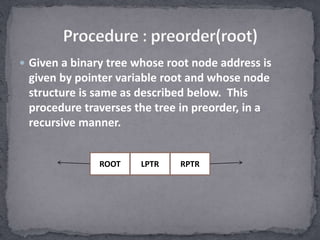
 Given a binary tree whose root node address is
given by pointer variable root and whose node
structure is same as described below. This
procedure traverses the tree in preorder, in a
recursive manner.
ROOT LPTR RPTR
 void preorder (root)
 {
 if (root==NULL)
 return;
 printf (“ %dn ”, root->info);
 preorder ( root-> left);
 preorder ( root-> right);
 }
 Given a binary tree whose root node address is
given by pointer variable “root” and whose node
structure is same as described below. This
procedure traverses the tree in inorder, in a
recursive manner.
LPTR ROOT RPTR
 void inorder (root->left)
 {
 if (root==NULL)
 return;
 inorder ( root);
 printf (“ %dn ”, root->info);
 inorder ( root-> right);
 }
 Given a binary tree whose root node address is
given by pointer variable “root” and whose node
structure is same as described below. This
procedure traverses the tree in postorder, in a
recursive manner.
LPTR RPTR ROOT
 void postorder (root->left)
 {
 if (root==NULL)
 return;
 postorder (root-> right);
 postorder (root);
 printf (“ %dn ”, root->info);
 }
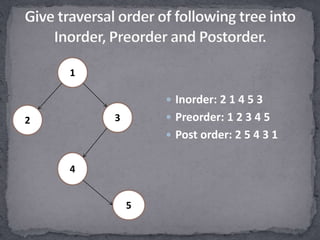
 Inorder: 2 1 4 5 3
 Preorder: 1 2 3 4 5
 Post order: 2 5 4 3 1
1
2 3
4
5
 Inspiration from Prof. Keyur Suthar and Prof.
Rashmin Prajapati
 Notes of DS
 Textbook of DS
 Image from Google images
 Some my own knowledge
#include<stdio.h>
int main()
{
printf(“Thank You”);
return 0;
}