Π’Π»Π°Π΄ΠΈΠΌΠΈΡ€ Илибман  , Cisco Automating Network Security Assessment
What we will cover Traditional approach What ’s new: Automation Case study: Network modeling - Cisco ’s global infrastructure Case study: Zone defense - Scrub down of border PoP ’s Case study: Defending critical assets - Isolating PKI Case study:  β€œSurprise!” Handling new infrastructure Case study: Managing change day to day - The Carnac moment
Today ’s network security audits Typically, network and hosts treated  separately Network: Elbow grease and eye strain Gather configs; print configs; read configs Similar to proof-reading the phone book Hosts: Level 1: Leave the admins to patch Problem:  hope  is not a strategy Level 2: Scan for unpatched systems Problem:  more data  than you can handle Level 3: Drive cleanup based on risk Problem:  prioritization  easier said than done
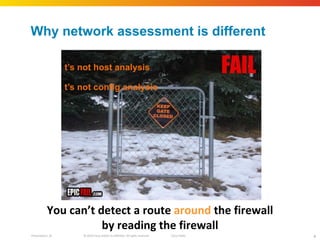
Why network assessment is different It ’s not host analysis It ’s not config analysis You can ’t detect a route  around  the firewall by reading the firewall
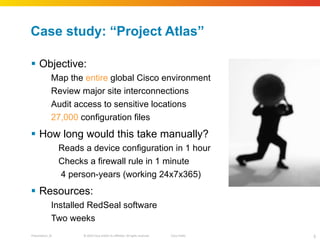
Case study:  β€œProject Atlas” Objective: Map the  entire  global Cisco environment Review major site interconnections Audit access to sensitive locations 27,000  configuration files How long would this take manually? Reads a device configuration in 1 hour Checks a firewall rule in 1 minute 4 person‐years (working 24x7x365) Resources: Installed RedSeal software Two weeks
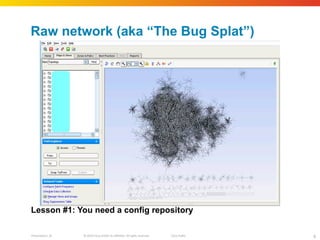
Raw network (aka  β€œThe Bug Splat”) Lesson #1: You need a config repository
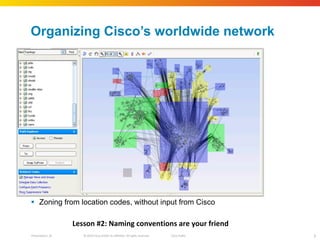
Organizing Cisco ’s worldwide network Zoning from location codes, without input from Cisco Lesson #2: Naming conventions are your friend
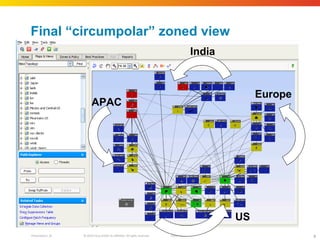
Final  β€œcircumpolar” zoned view US Europe India APAC US
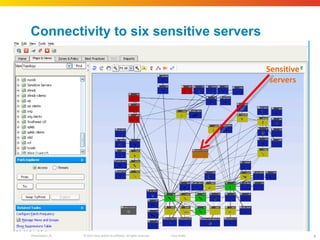
Connectivity to six sensitive servers Sensitive servers
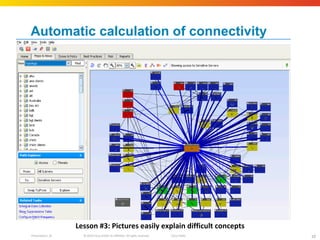
Automatic calculation of connectivity Blue lines show open access paths to sensitive servers Clearly shows the need for segmentation Lesson #3: Pictures easily explain difficult concepts
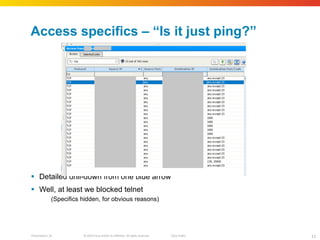
Access specifics –  β€œIs it just ping?” Detailed drill-down from one blue arrow Well, at least we blocked telnet (Specifics hidden, for obvious reasons)
Case Study: Zone defense Cisco has 15 major PoP ’s for external connections Typical manual assessment: 90 days per PoP Target: Build map Record major zones  Internet, DMZ, Inside, Labs, etc Analyze for Best Practice violations Add host vulnerabilities from scans Run penetration test
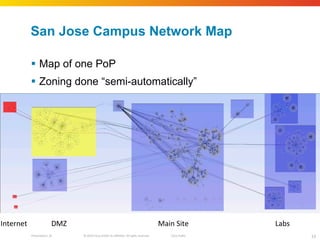
San Jose Campus Network Map Map of one PoP Zoning done  β€œsemi-automatically” Internet DMZ Main Site Labs
Offline penetration testing Next level of analysis is penetration testing Combine  network  map with  host  scans Add access calculation Software automatically evaluates attack paths Identify high risk defensive weaknesses
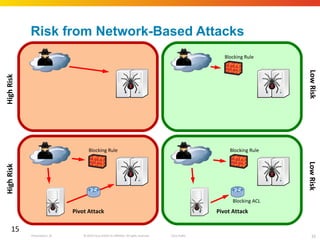
Risk from Network-Based Attacks High Risk Low Risk Blocking Rule Blocking Rule High Risk Low Risk Blocking Rule Pivot Attack Blocking ACL Pivot Attack
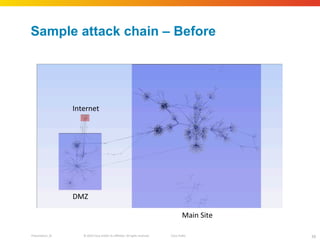
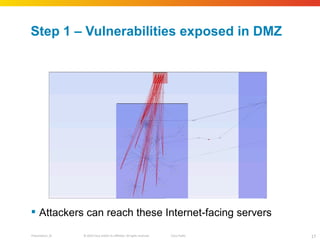
Sample attack chain – Before Internet DMZ Main Site
Step 1 – Vulnerabilities exposed in DMZ Attackers can reach these Internet-facing servers
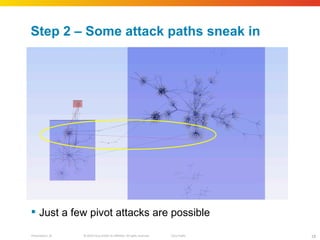
Step 2 – Some attack paths sneak in Just a few pivot attacks are possible
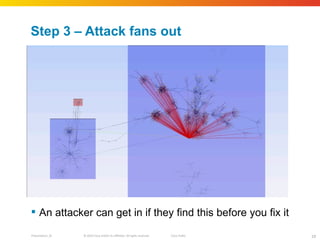
Step 3 – Attack fans out An attacker can get in if they find this before you fix it
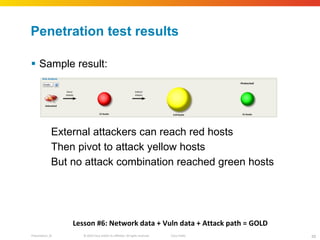
Penetration test results Sample result: External attackers can reach red hosts Then pivot to attack yellow hosts But no attack combination reached green hosts Lesson #6: Network data + Vuln data + Attack path = GOLD
Case Study: Defending critical assets PoP audits work outside in Broad scope, hunting major gaps Problem: lots and lots of access to review Can ’t quickly capture all rules for all incoming access Some assets deserve focused attention For critical assets, work inside out Start from known target Limit scope, increase focus Continuous re-assessment
Distributed public key infrastructure Main site, plus disaster recovery site Building the  β€œcrossbar” was easy – we sampled from Atlas Internet Cert Authority WAN (sample) DR Site Lesson #7: A reference atlas is your friend
Distributed public key infrastructure Access strictly controlled Untrusted 3 rd  party manufacturers need to request certs Only cert admins should have general access Internet Cert Authority Cert Admins WAN to  Extranet DR Site
Investigate unexpected access Note: no flow into primary Only DR site had unexpected Internet access Even that was for limited sources, but still unexpected Lesson #8:  Cruft is so important we mention it twice
Case Study:  β€œSurprise!” Ad hoc network support Sudden addition of complete network to secure M&A, or in this case, short-lived Expo network Requires very rapid assessment Continuous tracking during high visibility phase Until end of expo, or for M&A, integration into normal ops
China Expo Center Topology
Weak Community String
Best Practice Checks Lesson #9: Computers are better at reading phone  books than you are.  Get over it.
Case Study: Managing daily change Business change requests come thick & fast Security teams are asked to approve No standard basis to approve Can ’t position security team as β€œDr No” Need clear, unequivocal reasons when rejecting changes Causes  β€œthe Carnac moment”
RTP Campus Network Map Sensitive servers DMZ Internet Cisco Campus
Client Connection Request Create Network Model Input Vulnerability Data Business need:  Open one Class C network :80 Inside Outside Connection exposes 32 vulnerabilities Downstream Effect? Exposes 7,549 Vulnerabilities
Client Connection Exposure Blue lines show open access paths to sensitive servers Clearly shows the need for segmentation
Acceptable Risk Assessment Outside Inside Access is BLOCKED No hosts vulnerable; nothing Leapfroggable
Automating network audit Before: After: Map the  entire  global network environment Audit access to sensitive locations Correlate access rights and threat risk
ПолСзно ! Π’ΠΈΠ΄Π΅ΠΎΠ·Π°ΠΏΠΈΡΡŒ   ΠΏΡ€Π΅Π·Π΅Π½Ρ‚Π°Ρ†ΠΈΠΈ  http ://www.redseal.net/news-and-events/Cisco-Live-Presentation-6- 2010 The Security Content Automation Protocol (SCAP)  is a method for using specific standards to enable automated vulnerability management, measurement, and policy compliance evaluation http ://scap.nist.gov/ index.html The Security Content Automation Protocol (SCAP) combines a number of open standards that are used to enumerate software flaws and configuration issues related to security.  Cisco Proactive Automation of Change Execution (PACE) http://www.cisco.com/en/US/netsol/ns661/ index.html
Β