Encountering the New Testament 
DAY ONE 
Approaching the New Testament 
Overview 
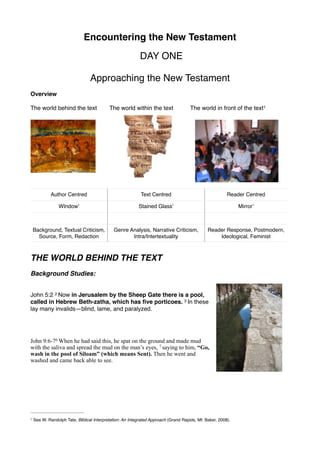
The world behind the text The world within the text The world in front of the text1 
Author Centred Text Centred Reader Centred 
WIndow' Stained Glass’ Mirror’ 
Background, Textual Criticism, 
Source, Form, Redaction 
Genre Analysis, Narrative Criticism, 
Intra/Intertextuality 
THE WORLD BEHIND THE TEXT 
Background Studies: 
Reader Response, Postmodern, 
John 5:2 2 Now in Jerusalem by the Sheep Gate there is a pool, 
called in Hebrew Beth-zatha, which has five porticoes. 3 In these 
lay many invalids—blind, lame, and paralyzed. 
John 9:6-76 When he had said this, he spat on the ground and made mud 
with the saliva and spread the mud on the man’s eyes, 7 saying to him, “Go, 
wash in the pool of Siloam” (which means Sent). Then he went and 
washed and came back able to see. 
Ideological, Feminist 
1 See W. Randolph Tate, Biblical Interpretation: An Integrated Approach (Grand Rapids, MI: Baker, 2008).
“It seemed good to the Greeks of Asia, in the opinion of the high priest Apollonius of 
Menophilus Azanitus: Since providence, which has ordered all things and is deeply 
interested in our life, has set in most perfect order by giving us Augustus, whom she 
filled with virtue that he might benefit humankind, sending him as a savior, both for us 
and for our descendants, that he might end war and arrange all things, and since he, 
Caesar, by his appearance excelled even our anticipations, surpassing all previous 
benefactors, and not even leaving to posterity any hope of surpassing what he has 
done, and since the birthday of the god Augustus was the beginning of the good tidings 
(euangellion) for the world that came by reason of him, which Asia resolved in 
Smyrna.”- Priene Inscription 
Textual Criticism2 
Textual criticism is the field of study whose practitioners examine variant readings in various 
manuscripts in the effort to reconstruct the original wording of a written text. This kind of study is 
needed for texts whose autographs are no longer extant, which is the case for most ancient 
documents and all of the books of the NT.3 
(1) Pastor 
(2) Theologian 
(3) Pietist 
(4) Commentator 
(5) Human (Scribe) 
Image taken from ‘http://www.reclaimingthemind.org/blog/2011/02/2 text-criticism-in-a-nutshell/' 
3 Definition taken from Martin, Ralph P., and Peter H. Davids, eds. Dictionary of the Later New Testament and Its Developments. 
Downers Grove, IL: InterVarsity Press, 1997.
JOHN 5:1-6 
KJV: 
After this there was a feast of the Jews, and 
Jesus went up to Jerusalem. 2 Now there is in 
Jerusalem by the Sheep Gate a pool, which is 
called in Hebrew, Bethesda, having five 
porches. 3 In these lay a great multitude of sick 
people, blind, lame, paralyzed, waiting for the 
moving of the water. 4 For an angel went down 
at a certain time into the pool and stirred up the 
water; then whoever stepped in first, after the 
stirring of the water, was made well of whatever 
disease he had. 5 Now a certain man was there 
who had an infirmity thirty-eight years. 6 When 
Jesus saw him lying there, and knew that he 
already had been in that condition a long time, 
He said to him, “Do you want to be made well?” 
ESV: 
After this there was a feast of the Jews, and 
Jesus went up to Jerusalem. 2 Now there is in 
Jerusalem by the Sheep Gate a pool, in 
Aramaic called Bethesda, which has five roofed 
colonnades. 3 In these lay a multitude of 
invalids—blind, lame, and paralyzed. 5 One 
man was there who had been an invalid for 
thirty-eight years. 6 When Jesus saw him lying 
there and knew that he had already been there 
a long time, he said to him, “Do you want to be 
healed?” 
Source Criticism- A method of biblical study that seeks to determine the literary sources 
behind a final text. 
Luke 1:1-3 
Since many have undertaken to set down an orderly account of the events that have 
been fulfilled among us, 2 just as they were handed on to us by those who from the 
beginning were eyewitnesses and servants of the word, 3 I too decided, after 
investigating everything carefully from the very first, to write an orderly account for 
you, most excellent Theophilus, 4 so that you may know the truth concerning the things 
about which you have been instructed. 
What elements of the process of transmission can you identify here?
Accounts of the temptation of Jesus in the synoptic gospels (syn-optic = same view, as opposed to 
John’s gospel) 
Matthew Mark Luke 
Then Jesus was led up by the Spirit 
into the wilderness to be tempted by 
the devil. 2 He fasted for forty days 
and forty nights, and afterwards he 
was famished. 
12 And the Spirit immediately drove 
him out into the wilderness. 13 He was 
in the wilderness forty days, tempted 
by Satan; and he was with the wild 
beasts; 
Jesus, full of the Holy Spirit, returned 
from the Jordan and was led by the 
Spirit in the wilderness, 2 where for 
forty days he was tempted by the 
devil. He ate nothing at all during 
those days, and when they were over, 
he was famished. 
3 The tempter came and said to him, 
“If you are the Son of God, command 
these stones to become loaves of 
bread.” 4 But he answered, “It is 
written, ‘One does not live by bread 
alone, but by every word that comes 
from the mouth of God.’ ” 
3 The devil said to him, “If you are the 
Son of God, command this stone to 
become a loaf of bread.” 4 Jesus 
answered him, “It is written, ‘One 
does not live by bread alone.’ ” 
5 Then the devil took him to the holy 
city and placed him on the pinnacle of 
the temple, 6 saying to him, “If you are 
the Son of God, throw yourself down; 
for it is written, ‘He will command his 
angels concerning you,’ and ‘On their 
hands they will bear you up, so that 
you will not dash your foot against a 
stone.’ ” 7 Jesus said to him, “Again it 
is written, ‘Do not put the Lord your 
God to the test.’ ” 
8 Again, the devil took him to a very 
high mountain and showed him all the 
kingdoms of the world and their 
splendour; 9 and he said to him, “All 
these I will give you, if you will fall 
down and worship me.” 10 Jesus said 
to him, “Away with you, Satan! for it 
is written, ‘Worship the Lord your 
God, and serve only him.’ ” 
5 Then the devila led him up and 
showed him in an instant all the 
kingdoms of the world. 6 And the devil 
said to him, “To you I will give their 
glory and all this authority; for it has 
been given over to me, and I give it to 
anyone I please. 7 If you, then, will 
worship me, it will all be yours.” 
8 Jesus answered him, “It is written, 
‘Worship the Lord your God, and 
serve only him.’ ” 
9 Then the devil took him to 
Jerusalem, and placed him on the 
pinnacle of the temple, saying to him, 
“If you are the Son of God, throw 
yourself down from here, 10 for it is 
written, ‘He will command his angels 
concerning you, to protect you,’ 11 and 
‘On their hands they will bear you up, 
so that you will not dash your foot 
against a stone.’ ” 12 Jesus answered 
him, “It is said, ‘Do not put the Lord 
your God to the test.’ ” 
11 Then the devil left him, 13 When the devil had finished every 
test, he departed from him until an 
opportune time. 
and suddenly angels came and waited 
on him. 
and the angels waited on him.
Matthew Mark Luke 
Baptism of Jesus Baptism of Jesus Baptism of Jesus 
Jesus is tempted Jesus is tempted Jesus is tempted 
At Nazareth: good news to the poor 
Preaching in Galilee Preaching in Galilee 
Calling of first disciples Calling of first disciples 
Jesus drives out an evil spirit Jesus drives out an evil spirit 
Healing the sick Jesus heals many Jesus heals many 
Calling of first disciples 
Sermon on the mount: beatitudes 
Sermon on the mount: fulfilling the law 
Sermon on the mount: giving, prayer 
and fasting 
Sermon on the mount: do not worry, do 
not judge, asking and seeking 
Sermon on the mount: discipleship and 
obedience 
Healing of a man with leprosy Healing of a man with leprosy Healing of a man with leprosy 
The centurion’s faith 
Jesus heals many 
The cost of following Jesus 
Jesus calms the storm 
Jesus restores two demon possessed 
men 
Jesus forgives the paralysed man Jesus forgives the paralysed man Jesus forgives the paralysed man 
The calling of Matthew The calling of Matthew The calling of Levi 
Jesus questioned about fasting Jesus questioned about fasting Jesus questioned about fasting 
Jesus is Lord of the Sabbath Jesus is Lord of the Sabbath 
Jesus heals on the Sabbath 
Jesus appoints the twelve Jesus appoints the twelve 
Sermon ‘on a level place’: beatitudes 
and woes 
Sermon ‘on a level place’: do not take 
revenge, do not judge 
Sermon ‘on a level place’: discipleship 
and obedience 
The centurion’s faith 
The widow’s son 
Jesus and John the Baptist 
Jesus anointed by the sinful woman 
Jesus is accused by others 
Parables: the sower, the lamp Parables: the sower, the lamp 
Jesus’ mother and brothers 
Parables: the growing seed, the 
mustard seed 
Jesus calms the storm Jesus calms the storm 
The demon possessed man The demon possessed man 
The dead girl and the sick woman The dead girl and the sick woman The dead girl and the sick woman 
A prophet without honour 
Two blind men and a mute man 
The workers are few 
Jesus sends out the twelve Jesus sends out the twelve Jesus sends out the twelve
Form criticism- This approach to biblical study emphasises the way individual stories may have 
been selected, shaped, and even created by the process of transmission. 
1. Logia 
2. Pronouncement 
3. Parables 
4. Speeches 
5. Miracles Stories 
6. Legends 
Mark 2:23-28 
23 One sabbath he was going through the grainfields; and as they made their way his 
disciples began to pluck heads of grain. 24 The Pharisees said to him, “Look, why are 
they doing what is not lawful on the sabbath?” 25 And he said to them, “Have you never 
read what David did when he and his companions were hungry and in need of food? 
26 He entered the house of God, when Abiathar was high priest, and ate the bread of the 
Presence, which it is not lawful for any but the priests to eat, and he gave some to his 
companions.” 27 Then he said to them, “The sabbath was made for humankind, and not 
humankind for the sabbath; 28 so the Son of Man is lord even of the sabbath.” 
Does this passage have a particular format (or ‘form’) we see elsewhere in the gospels? 
Are there reasons you think a this passage would be especially preserved in the life of the early 
church? 
Redaction Criticism: (Redaktionsgeschichte; redaction history). An interpretive method of 
biblical criticism. Attempts to discover how the biblical source material was gathered to form a 
single narrative and express a particular theological point.4 
Barry, John D., and Lazarus Wentz, eds. The Lexham Bible Dictionary. Bellingham, 4 WA: Lexham Press, 2012.
THE WORLD WITHIN THE TEXT 
Literary Criticism- These approaches examine the way in which the authors achieve their effect 
through their writing. For instance, how they use plot and narrative (‘narrative criticism’), or how 
how they use argument, irony and personal appeals (‘rhetorical criticism’). 
Genre- Ancient Biography, Apocalyptic, Letter, Circular Letter 
Narrative 
Intratextuality 
Intertextuality 
Markan Sandwich- Intercalcation 
THE WORLD IN FRONT OF THE TEXT 
Reader Response Approaches 
Reader-response criticism focuses on the readers and the process of reading. This method 
contends that the meaning of a text is created through the interplay of the reader and the 
text. Consequently, to some degree, meaning will differ from one reader to the next. There 
are varying views as to what extent a reader can create the meaning of a passage (in their 
own mind or psych). 
How have given bible passages been interpreted in the past (their ‘reception history’)? 
How do I negotiate, or even create, the meaning of the biblical text as I read it (‘reader response 
criticism’)? For instance, as a white, middle-class UK male, what meanings might I be likely to miss 
or manipulate? Are there ‘privileged’ readings of the Bible that need to be challenged by the 
experience of women (‘feminist criticism’) or the poor (‘liberationist criticism’)? 
Is there any fixed meaning in the text at all (‘deconstructionism’)?
Further Reading 
Introductory 
Moiyse, S., Introduction to Biblical Studies (London: Bloomsbury T & T Clark, 2013). 
Tate, W. Randolph, Biblical Interpretation: An Integrated Approach (Grand Rapids, MI: Baker, 
2008). 
Wenham, David, and Steve Walton, Exploring the New Testament: The Gospels and Acts. Second 
edition. London: SPCK, 2011. Chapters 3, 4 and 5. 
Intermediate 
Aune, David E., The Blackwell Companion to the New Testament (Oxford: Wiley-Blackwell, 2010). 
Advanced 
Bauckham, Richard, Jesus and the Eyewitnesses: The Gospels as Eyewitness Testimony (Grand 
Rapids, MI: Eerdmans, 2006).