
APLASTIC ANAEMIA
ASWATHY.A
ASSISTANT PROFESSOR
DEPARTMENT OF PATHOLOGY

Aplastic Anemia
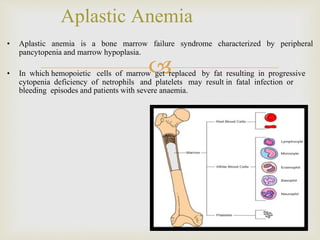
• Aplastic anemia is a bone marrow failure syndrome characterized by peripheral
pancytopenia and marrow hypoplasia.
• In which hemopoietic cells of marrow get replaced by fat resulting in progressive
cytopenia deficiency of netrophils and platelets may result in fatal infection or
bleeding episodes and patients with severe anaemia.

History of Aplastic anaemia
 Paul Ehrlich (1854-1915) described the first case of aplastic anaemia in a pregnant woman
who died of marrow failure in1888 .
 The term “aplastic anaemia” first used by Anatole Chauffard in 1904.
Epidemiology
• Annual incidence in Europe and US - 2 cases per million population, but 4 cases in
Bangkok 6 in Thailand and 14 in Japan.
• No racial predisposition exists in the United States; however, prevalence is increased in
the Far East.
• The male-to-female ratio is approximately 1:1.
• Aplastic anemia occurs in all age groups.
– a small peak in incidence in childhood.
– First peak incidence in people aged 15-25 years, and second peak in people older
than 60 years.

FEATURES
 Pancytopenia
 Recticulocytopenia
 BM hypercellularity
 Depletion of haematopoietic stem cells
 Heart murmur
 Irregular heart beats
 Pale skin ,gums ,nail buds
 Bleeding gums and intestinal bleedings,epitaxis
 Mouth infection
 PNH
 Anemia


CLASSIFICATION
Based on etiology
1)Congenital/Inherited (20%)
 Patients usually have dysmorphic features or physical stigmata. Occasionally,
marrow failure may be the initial presenting feature.
 Fanconi anemia
 Dyskeratosis congenita
 Shwachman -Diamond syndrome
 Familial aplastic anemia
2)Acquired (60%)
a. Idiopathic
b. Drugs
- Cytotoxic drugs - Antibiotics
- Chloramphenicol - Anti-inflammatory
- Anti-convulsant - Sulphonamides
- 2-3 months usually between exposure and the development of aplastic
anemia.
- Psychotropic drugs

c) Physical agents
Ionizing radiation
d) Chemicals agents
Benzene, hemical solvents, DDT, arsenic pesticides, chloramphenicol,
phenylbutazone, and gold,
- 2- 6 months usually between exposure and the development of aplastic anemia. 5
e)Viruses:
 Hepatitis A, B,C,Non-A and Non-B
 Herpes simplex
 EB virus
 Parvovirus: Transient
 Important clinically in patients with hemolytic anemias
 5-10% of cases of AA in the West and 10-20% in the Far East.
 2-3 months between exposure to the virus and the development of AA.
f)Immune: SLE, RA (rheumatoid arthritis)
g)Pregnancy

PATHOGENESIS
Potential mechanisms:
 Absent or defective stem cells (stem cell failure).
 Abnormal marrow micro-environment.
 Inhibition by an abnormal clone of hemopoietic cells.
 Abnormal regulatory cells or factors.
 Immune mediated suppression of hematopoiesis.

CAUSES
1.Failure of production of blood cells
a) bone marrow infiltration
- Acute leukemias
- Hairy cell leukemia
- Multiple myeloma
- Lymphoma
- Myelofibrosis
- Metastatic carcinoma
b) Aplastic anemia
2. Ineffective hematopoesis
- Myelodysplastic syndrome
- Vit.B12 and folate deficiency
3. Increased destruction of blood cells
- Hypersplenism
- Autoimmune disorders
- Paroxysmal nocturnal hemoglobinuria
4. Myelosuppression after irradiation or antiproliferative drugs

LAB DIAGNOSIS
A. Blood count
 Hemoglobin ≤ 10gm/dl
 Platelet count↓
 WBC – decreased
 BT- increased
 ESR- increased
 CT,REDCELL INDICES- normal
B.Peripheral blood smear
 RBC -normocytic/ normochromic no abnormal cells/blasts.
 In initial stages lymphocyte count is normal but as the disease progresses lymophocyte
count increased.
 Thrombocytopenia
 Toxic granules in neutrophil

C)Bone marrow examination
 a) BM aspiration (fluid)
 (b) BM biopsy (tissue)

 Marrow may be aplastic
 Few haematopoietic stem cells
 Lymphocyte and plasma cells – predominant
 Few mast cells
 Iron stores increased
 Hypocellular ,increased fat spaces

D)Other test
 a) Vitamin B12 & folate test
 b) Liver test
 c)Serological – EBV,HIV,Hep etc..
 d)Chromosomal studies
 e) Antinuclear antibody
 f)Coombs test
 g)R-Factor
 h)Hams test
 i) X-ray, CT scan
 j) Ultrasound imaging test

TREATMENT
 1. Stem cell transplant
 2. Immunosuppressant
 3. Blood transfusion
 4. Bone marrow stimulant
 5. Antibiotics & antiviral
 6.Growth hormones
