Download to read offline


![CMPSC-511
Sp2021 5
Exploit/Explore
● Stick to something old (“exploit”) or try something new (“explore”)?
– “Explore” = gather information [e.g., about restaurants], “exploit” = use
information [e.g., re-visit a known restaurant]
● Possible solution: “Win-Stay, Lose-Shift” (1952)
– As long as exploitation pays off, keep exploiting.
– When it does not, try something else.
– Better than random, but not perfect (“shift” in a rush?)](https://image.slidesharecdn.com/algorithms-210416165721/85/Algorithms-5-320.jpg)


![CMPSC-511
Sp2021 11
Bayesian Predictions
● To make a prediction, we need to know prior probabilities (“given
that ...”)
● Copernican Principle: absent any prior knowledge about a process,
we are likely to be in the middle of it.
– It will take the process the same time terminate as it took to begin.
– “The [near] future is the same as the [near] past.”
● Will a 99-y/o live another 99 years?](https://image.slidesharecdn.com/algorithms-210416165721/85/Algorithms-11-320.jpg)


![CMPSC-511
Sp2021 5
Exploit/Explore
● Stick to something old (“exploit”) or try something new (“explore”)?
– “Explore” = gather information [e.g., about restaurants], “exploit” = use
information [e.g., re-visit a known restaurant]
● Possible solution: “Win-Stay, Lose-Shift” (1952)
– As long as exploitation pays off, keep exploiting.
– When it does not, try something else.
– Better than random, but not perfect (“shift” in a rush?)](/p?url=https%3A%2F%2Fimage.slidesharecdn.com%2Falgorithms-210416165721%2F85%2FAlgorithms-5-320.jpg&__src=https%3A%2F%2Fwww.slideshare.net%2Fslideshow%2Falgorithms-246338173%2F246338173&__type=image)


![CMPSC-511
Sp2021 11
Bayesian Predictions
● To make a prediction, we need to know prior probabilities (“given
that ...”)
● Copernican Principle: absent any prior knowledge about a process,
we are likely to be in the middle of it.
– It will take the process the same time terminate as it took to begin.
– “The [near] future is the same as the [near] past.”
● Will a 99-y/o live another 99 years?](/p?url=https%3A%2F%2Fimage.slidesharecdn.com%2Falgorithms-210416165721%2F85%2FAlgorithms-11-320.jpg&__src=https%3A%2F%2Fwww.slideshare.net%2Fslideshow%2Falgorithms-246338173%2F246338173&__type=image)


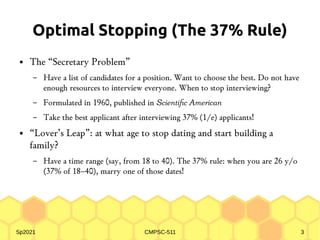
The document discusses various algorithms and decision-making strategies based on the concepts from the book by Brian Christian and Tom Griffiths. Key topics include optimal stopping (the 37% rule), exploit/explore strategies, scheduling techniques, and Bayesian predictions. It emphasizes practical applications of these algorithms in everyday choices, such as dating, parking, and task management.


