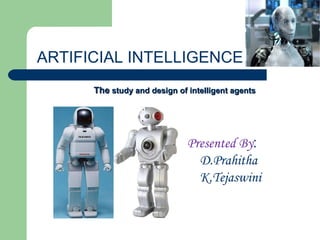
ARTIFICIAL INTELLIGENCE The  study and design of intelligent agents  Presented By : D.Prahitha K.Tejaswini
CONTENTS INTRODUCTION  TO  A.I. EVOLUTION  OF  A.I. IMPORTANCE  OF  A.I. APPLICATIONS  OF  A.I. CONCLUSIONS  ON  A.I.
INTRODUCTION Artificial Intelligence is a branch of Science which deals with helping machines in a human-like fashion.  In short it can be described as: Simple things turn out to be the hardest to automate: *Recognizing a face. *Navigating a busy street. *Understanding what someone  says
HISTORY
SCIENTISIT IN CREATION OF AI In 1956  John McCarthy  regarded as the father of AI, organized a conference to draw the talent and expertise of others interested in machine intelligence.
IMPORTANCE OF AI Why Artificial Intelligence? Computers are well suited to perform mechanical computations.  Unlike humans, computers have trouble understanding specific situations, and adapting to new situations.  Artificial Intelligence aims to improve machine behavior in tackling complex tasks.
ARTIFICIAL INTELLIGENCE APPLICATIONS Robotics Applications Artificial Intelligence Cognitive  science  Applications Natural Interface Applications Visual Perceptions Locomotion Navigation Expert Systems Gaming Medicine Natural Language Speech Recognition Telephone Translators
Robotics is the study of how to design, build, use, and work with robots.  They are used in laboratories, and in situations, which would be dangerous for humans such as cleaning toxic waste or defusing bombs. ROBOTICS
MILITARY Walking through minefields,  deactivating  unexploded bombs To operate in a relatively unstructured, natural environment Replacing human in dangerous, dirty, or dull missions Bear cost to build the robot instead of losing a human life
EXPERT SYSTEMS An  expert system , also known as a  knowledge based  system, is a  computer program  that contains the knowledge and analytical skills of one or more human experts, related to a specific subject. The Expert System Knowledge Base User Workstation Expert Advice User Interface Programs Inference Engine Program Expert System Development Workstation Knowledge Engineering Knowledge Acquisition Program Expert and/or Knowledge Engineer
Game Playing in Artificial Intelligence: Game artificial intelligence   refers to techniques used in computer and video games to produce the illusion of intelligence in the behavior of non-player characters (NPCs)  . Types of Games: Role-Playing Games (RPG) Action Games Sports Games Simulations Adventure Games Puzzle Games
NEW BLOOD TEST SPOTS CANCER:  In one of the biggest advances in cancer research in years, scientists have developed a blood test that can detect cancer with greater than 90% accuracy.  This artificial intelligence --already tested for cancers of the breast, ovary, and lung--could one day be used to detect many types cancer.   MEDICINE
NATURAL LANGUAGE PROCESSING The goal of the Natural Language Processing (NLP) group is to design and build software that will analyze, understand, and generate languages that humans use naturally. HELLO !
The main focus in AI today is getting a computer to recognize, make senses and recreate in what it sees and hears.  Pattern-Recognition-Vision:   Its goal is to get a computer to recognize pictures so that it can recognize objects in its surroundings that would be helpful in robotics.   Pattern-Recognition-Sound: It wants to achieve a similar goal but is a primary concern with companies that want to produce a new means in which a person interacts with a computer by talking. PATTERN RECOGNITION
TELEPHONE TRANSLATORS   A computer intercepts the voice, translates what was said, and synthetically generate the appropriate words to the person on the other line. The translator needs an advanced voice recognition, natural language processing and inferencing to extract what was spoken by the people on phone.
FUTURE OF AI The day is not far when you will just sit back in your cozy little beds and just command your personal Robot's to entirely do your  ruts . He will be a perfect companion for you. Just enjoy the Technology. Here are a few applied innovations that AI promises in  the future and the technologies behind them.
TESTING OF INTELLIGENCE Turing Test Alan Turing, a British mathematician developed a test in 1950 to determine if a program was intelligent:   It has the following features: A human tester was connected to 2 terminals and asked a series of questions.  One of the terminals had another human making the responses and the other used a computer program to make the responses If the human tester could not distinguish between the human responder and the program response then the software was said to be intelligent.
CONS OF ARTIFICIAL INTELLIGENCE Use of AI in warfare (atomic and nuclear  research) is producing huge damage worldwide esp loss of lives and money. Use of AI in trading shares and stocks is creating unfair advantage to companies who do stock trading. They definitely have an edge over common people who buy and sell stocks. Use os AI in some of the autopilot settings caused few airplanes to crash. Also few satellite missions failure is attributed to AI There is also a myth that excessive AI can cause machines take over the world from humans one day in near future.
AI is like a two edged sword, at one end they can solve problems "intelligently" at another end they pose a problem themselves. CONCLUSION
Luger, George F., and William A. Stubblefield.  Artificial Intelligence: Structures and Strategies for Complex Problem Solving .  Redwood City , CA: Benjamin/Cummings Publishing Company, 1993. Artificial Intelligence: A Modern approach by Stuart Russel and Peter Norvig. Published by Prentice Hall,1995,ISBN. BIBILOGRAPHY
 
Queries