London, march 2015
Agile product management
Angel Medinilla
angel.medinilla@proyectalis.com
www.proyectalis.com/en/AngelMedinilla
(Slides, Videos, Newsletter, Books, Blog, LinkedIn, Sketchnotes, Twitter...)
Twitter: @angel_m
(would love some instant feedback!)
<vanity>
www.leanadvantage.co.uk
our Pleasure!
</vanity>
Some logistics
Time shcedule?
Lunch?
Restrooms? water? snakcs?
Pictures?
LAptops, ipads
CHECK: FEEDBACK DOOR, RESOURCES BOARD, KUDOS BOARD, insights board
Free shoulder pain test
- Can you all rise your right (or left) hand?
Who do we have here today?
AVENGERS: ASSEMBLE!
product
metrics
Course structure
Kaizen culture Customer-focused
product definition
Product Development
via build-measure-
learn
Kaizen enablers
agile kaizen intro Metrics & goals
actionable metrics
funnel metrics
product management &
product development
traditional vs. agile
pm process
defining opportunities:
customer, problem, solution
validating your assumptions:
MVE, MVP, MMFS
communicating your vision:
product strategy & scope
defining your product:
structure & stories
managing your backlogusing model canvas to
gather your assumptions
Kaizen events
product
metrics
exercise: what do you want to learn?
Kaizen culture Customer-focused
product definition
Product Development
via build-measure-
learn
Kaizen enablers
agile kaizen intro Metrics & goals
actionable metrics
funnel metrics
product management &
product development
traditional vs. agile
pm process
defining opportunities:
customer, problem, solution
validating your assumptions:
MVE, MVP, MMFS
communicating your vision:
product strategy & scope
defining your product:
structure & stories
managing your backlogusing model canvas to
gather your assumptions
Kaizen events
product
metrics
Course structure
Kaizen culture Customer-focused
product definition
Product Development
via build-measure-
learn
Kaizen enablers
agile kaizen intro Metrics & goals
actionable metrics
funnel metrics
product management &
product development
traditional vs. agile
pm process
defining opportunities:
customer, problem, solution
validating your assumptions:
MVE, MVP, MMFS
communicating your vision:
product strategy & scope
defining your product:
structure & stories
managing your backlogusing model canvas to
gather your assumptions
Kaizen events
Agile kaizen
what’s kaizen
Kaizen / kaikaku
Agile kaizen
kaizen culture
Team / people kaizen
process kaizen
product kaizen
Agile kaizen
Culture: noble cause, values, behaviors, artifacts
story telling
cultural enablers / failure causes
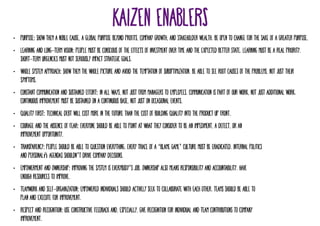
kaizen enablers
• Purpose: show them a noble cause, a global purpose beyond profits, company growth, and stakeholder wealth. Be open to change for the sake of a greater purpose.
• Learning and Long-term vision: people must be conscious of the effects of investment over time and the expected better state. Learning must be a real priority.
Short-term urgencies must not seriously impact strategic goals.
• Whole system approach: Show them the whole picture and avoid the temptation of suboptimization. Be able to see root causes of the problems, not just their
symptoms.
• Constant communication and sustained effort: in all ways, not just from managers to employees. Communication is part of our work, not just additional work.
Continuous improvement must be sustained on a continuous base, not just on occasional events.
• Quality first: technical debt will cost more in the future than the cost of building quality into the product up front.
• Courage and the absence of fear: Everyone should be able to point at what they consider to be an impediment, a defect, or an 

improvement opportunity.
• Transparency: people should be able to question everything. Every trace of a ‘blame game’ culture must be eradicated. Internal politics 

and personalñ agendas shouldn’t drive company decisions.
• Empowerment and ownership: improving the system is everybody’s job. Ownership also means responsibility and accountability. Have 

enough resources to improve.
• Teamwork and self-organization: empowered individuals should actively seek to collaborate with each other. Teams should be able to 

plan and execute for improvement.
• Respect and Recognition: use constructive feedback and, especially, give recognition for individual and team contributions to company 

improvement. 

exercise: kaizen enablers
• Purpose
• Learning and Long-term vision
• Whole system approach
• Constant communication and
sustained effort
• Quality first
•Courage and the absence of fear
• Transparency
• Empowerment and ownership
• Teamwork and self-
organization
•Respect and Recognition
Kaizen events
Different kinds
retrospectives
10 rules for good retrospectives
retrospective canvas
exercise: product retrospective
Things we liked:
maximize
impediments: remove or
reduce
ideas, things to
try
Kudos!
Last retrospective plan:
what we tried, how were
the results
New plan: 4 - 5 things
we are going to try,
detailed as a plan
product
metrics
Course structure
Kaizen culture Customer-focused
product definition
Product Development
via build-measure-
learn
Kaizen enablers
agile kaizen intro Metrics & goals
actionable metrics
funnel metrics
product management &
product development
traditional vs. agile
pm process
defining opportunities:
customer, problem, solution
validating your assumptions:
MVE, MVP, MMFS
communicating your vision:
product strategy & scope
defining your product:
structure & stories
managing your backlogusing model canvas to
gather your assumptions
Kaizen events
EXERCISE: PROduct management
What’s product Management?
HOW DO YOU DECIDE WHAT TO BUILD?
HOW DO YOU KNOW WHEN ARE YOU READY TO START BUILDING?
PROduct management
The “requirements gathering era”
PROduct management
The “requirements gathering era”
PROduct management
The “requirements gathering era”
PROduct management
The “requirements gathering era”
PROduct management
The “requirements gathering era”
PROduct management
The “requirements gathering era”
PROduct management
Faster horses - Product Death Cycle (david j. bland)
Nobody uses
our product
Ask customer
what features
Are missing
Build missing
features
PROduct management
Faster horses - Product Death Cycle (david j. bland)
Nobody uses
our product
Ask customer
what features
Are missing
Build missing
features
Junk garage
syndrome!
PROduct management
PRODUCT MANAGEMENT VS PRODUCT DEVELOPMENT
The visionary myth
PROduct management
faster? more? - MAXIMIZE OUTCOME, NOT OUTPUT
the terrible truth
Too few
features
Too many
features
Magic features Meh...
hate
them
sweet spot
++$$
++t
++Risk
Agile product development
old style project management
closed projects - All or nothing
Agile product development
“Project driven development”
Agile product development
Shared understanding - learn the context
collaboration, communication, conversations
early and frequent delivery of valuable product increments
adapting to change
Continuous improvement
Agile product development
iterative and incremental development
Agile product development
iterative and incremental development
Not “half baked cake”!!
exercise (20 min)
Agile is better / more effective / more efficient than waterfall because...
waterfall is better / more effective / more efficient than Agile because...
Agile product development
client-vendor anti-pattern: from waiters to doctors
Agile product development
cross functional collaboration
COLLABORATIVE WORKSHOPS VS MEETINGS
valuable, feasible, usable
keep conversations happening
Agile product development
the product management / core discovery team

“the three amigos” - triads
Agile product development
the product management / core discovery team

lean startup
the black hole in agility
lean startup
Basically: be sure there’s a market that wants your product, before you build it
Problems users have Problems R&D
team solves
???
lean startup
customer development
build-measure-learn
validated learning
assumptions and pivots
Start with a Vision
“Organize world's information, make it universally accessible”
“Find and discover anything you might want to buy online”
“ (Be) Worldwide Authority on Kids, Families and Fun”
“Be #1 car company in America & one of the great American brands”
“(Find) my iPhone”
“Flirt with people near me”
“File too big for email”
“Put a Man on the moon and back alive before 1970”
“Run your own hospital online”
Vision: verb, target, outcome
“Organize world's information, make it universally accessible”
“Find and discover anything you might want to buy online”
“ (Be) Worldwide Authority on Kids, Families and Fun”
“Be #1 car company in America & one of the great American brands”
“(Find) my iPhone”
“Flirt with people near me”
“File too big for email”
“Put a Man on the moon and back alive before 1970”
“Run your own hospital online”
Vision: make it about your customer
“Organize world's information, make it universally accessible”
“Find and discover anything you might want to buy online”
“ (Be) Worldwide Authority on Kids, Families and Fun”
“Be #1 car company in America & one of the great American brands”
“(Find) my iPhone”
“Flirt with people near me”
“File too big for email”
“Put a Man on the moon and back alive before 1970”
“Run your own hospital online”
Exercise: 20 minutes
craft your company / department / product / project / team / course group’s vision
verb, target, outcome
use words, pictures, metaphors, stories
memorable, relevant, client focused, ambitious, feasible, tangible, time bound...
pm “process”
Capture opportunities (canvas)
select / prioritize opportunities (executive board)
validate opportunities (core discovery team)
schedule opportunities (portfolio management)
deep-define opportunities (inception)
break down opportunities (grooming)
execute opportunities (backlog)
validate opportunities (demo)
pm “process”
pm “process”
Strategy meeting Strategy meeting
Portfolio Management - portfolio review meetings
projects to be launched
vision, goals, priorities…..
Strategy meeting Strategy meeting
Portfolio Management - portfolio review meetings
sprint Planning, grooming, demo
release planning - product review
vision, goals, priorities…..
projects to be launched
Business epics Business epics
storiesstoriesstories stories
Strategy meeting Strategy meeting
Portfolio Management - portfolio review meetings
sprint Planning, grooming, demo
release planning - product review
projects to be launched
vision, goals, priorities…..
Business epics Business epics
storiesstories storiesstories
Opportunies
project-product-problem space
Opportunies
project-product-problem space
*
Opportunies
Dude’s Law
understand customers and users
understand problems and envision solutions
validate completeness
Opportunies
frame ideas through conversations
craft a vision
mile wide, inch deep
PLAN AHEAD (1-2 WEEK FOR 3-5 MONTHS)
opportunity canvas
(C) Jeff Patton - “User story mapping”
Business Model Generation Canvas
(C) alex osterwalder
Partners
Costs Revenues
Activities
Resources
Value Clients
Channels
Relationship
Value proposition canvas
(C) alex osterwalder
Lean canvas
(C) ash maurya
opportunities: Design thinking
Empathize: understand your users
define: frame the problem
Ideation: brainstorm, generate ideas
prototyping: physical form. show, don’t tell
test: validate and refine
opportunities: Design thinking
Empathize: user personas, impact mapping, empathy maps, user journeys, interviews……..
define: research, root cause analysis, journey maps
ideation: brainstorm, reverse, break the pattern, get a rule out, impose constraints...
prototyping: story boards, low.fi prototype...
test: mvp, poll, smoke test
Resource: bootcamp bootleg
EXErcise: opportunity canvas
(C) Jeff Patton - “User story mapping”
product
metrics
Course structure
Kaizen culture Customer-focused
product definition
Product Development
via build-measure-
learn
Kaizen enablers
agile kaizen intro Metrics & goals
actionable metrics
funnel metrics
product management &
product development
traditional vs. agile
pm process
defining opportunities:
customer, problem, solution
validating your assumptions:
MVE, MVP, MMFS
communicating your vision:
product strategy & scope
defining your product:
structure & stories
managing your backlogusing model canvas to
gather your assumptions
Kaizen events
Assumptions!
Core assumptions
customer-problem-solution
elevator pitch
first stage validation
validate vs. confirm
User assumption
User centered design
“the user”
users and customers
Fine grain roles
relationships
user personas
orgzonas
user persona
user persona
Exercise: user persona
assumptions
persona = assumption
you are not your customer
personas: doing it wrong
research and validate - interview, observe……..
keep personas at the center of your conversations
validating your assumptions
pre-MVP validation (TTYFU)
POST-MVP Validation (TTYFU)
iterate your assumptions using a product
Video: nordstrom innovation labs
mve / mvp
minimum is less than minimum
create value Now
what about “all or nothing”?
product is not product - Mve
mvp vs mmfs
mvp vs quality
validation: goal modelling
define key outcomes and results
how can we tell we are successfull?
how would busines change?
define key metrics for each goal
EXERCISE: MVE
SEVILLE’S HOTEL STORY….
PIVOT
Select riskiest assumptions
Run experiment
if wrong: pivot one of your assumptions
celebrate learning: learn, not launch
Some MVES / mvps
- Simple prototype
- HiFi prototype (MockUps)
- Brochure, Slides, Storyboards
- Survey
- Wizard of Oz (Flinstoning, concierge )
- Flash video
- Smoke test / 404
- A/B testing, Sub-set testing
- Batching
- Outsourcing
- Walled garden - Alpha environment
Validation board
mvp problems
- confirmation bias
- false negative
- all or nothing
- visionary complex
- too busy to learn
- needs more quality / features
opportunity —> Product
Validated! Product - market fit
core vision defined
core assumptions tested: customer, PROBLEM, solution..
now, let’s build it!
if the development team has still not been involved, now it’s time!
garrett ux stack
strategy: product vision, concept, main actors, goals, use context...
scope: specific roles and journeys<- first epics
structure: workflows, sitemaps, navigation, tasks
skeleton: UX, interface, user flow, user interaction
surface: look and feel, design
- Why are we here?
- Vision / Pitch
- Product Box
- What it’s NOT
- Meet your neighbours / Project community
- Show the solution
strategy - scope: inception deck
- What doesn’t let us sleep
- Estimate size
- Trade-offs
- How long it’s going to take
Resource “The agile samurai”
Why are we doing this? what are the goals?
who can make it? who can stop it? who can help?
how can we change people’s behavior? how can they help? how can they stop us?
what can we do to reach our goals? what can we deliver?
strategy - scope: impact map
strategy-scope: goal modelling
define key outcomes and results
how can we tell we are successfull?
how would busines change?
define key metrics for each goal
strategy-scope: metrix matrix
management 3.0
add several stakeholder views
add several project dimensions
measure different perspectives
perspective)
dimension) s"ckies'
ac"ons'
evals'
cycle'"me'
views'
1.) Time)
2.) Tools)
3.) People)
4.) Value)
5.) Functionality)
6.) Quality)
7.) Process)
happy'
1. Employee)
2. Team)
3. Organization)
4. Customer)
5. Manager)
6. Supplier)
7. Community)
scope: user personas
scope: user journeys
scope - structure: story boards
structure: story maps
Jeff Patton (httP://slideshare.net/nashjain/user-story-mapping)
Structure: story maps
Remember this slide?
Not “half baked cake”!!
structure: story maps
Jeff Patton (httP://slideshare.net/nashjain/user-story-mapping)
structure: story maps
Jeff Patton (httP://slideshare.net/nashjain/user-story-mapping)
structure: story maps
walking skeleton
end-to-end vs. module-based
good, better, best
see it work - make it better - make it releseable
group stories in themes (release, component, track, activity...)
show progres on map