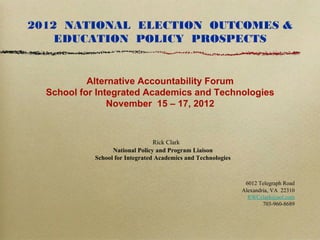
The document summarizes the outcomes of the 2012 national election and prospects for education policy. It notes that the House and Senate outcomes maintained the status quo with small Democratic gains. Cooperation will still be needed between parties. The Department of Education will likely continue supporting common core standards and waiver implementation. Republicans want to limit the federal role while Democrats want to maintain reforms and funding. Reauthorization of ESEA is still pending with no clear path forward. Other issues like sequestration cuts and student loan rates will also need to be addressed. Dropout recovery was rarely discussed and alternative accountability models still face many political hurdles.


![HOUSE AND SENATE EDUCATION COMMITTEE[S]
STATUS
Election virtually maintained existing alignment of House and Senate Committees
House: Education and the Workforce Committee
- 23 Reps to 17 Dems in 112th - maintenance
- Anticipate minimum of 7 new members
- Won’t slow down Committee since mostly Dems
- No change anticipated in House Committee leadership
- Key players : Chairman John Kline (MN), Subcommittee Chair, Duncan Hunter (CA),
Virginia Foxx (NC), Rep. McKeon (CA)
- Extremely partisan leadership in 112th – unprecedented
- Mark-ups on education and workforce bills were triple P – painful, partisan, polarized](https://image.slidesharecdn.com/advocatingclark-121204164707-phpapp02/85/Advocating-clark-6-320.jpg)
![HOUSE AND SENATE EDUCATION COMMITTEE[S]
STATUS
Senate: Health, Education, Pensions, and Labor Committee
- Minimum of 1 or 2 new members
- 12 Dems to 10 Reps in 112th
- Senate leadership and membership expected to undergo some change
- Key players in Senate: Senators Harkin, Enzi, Alexander, and Bingaman [only
Bingaman will be gone – retired]
- New Committee dynamics: Sen Alexander ascending to ranking minority
- did not support bi-partisan Committee bill in 112th
- More respectful, more bi-partisan leadership in the Senate [vs. House]](https://image.slidesharecdn.com/advocatingclark-121204164707-phpapp02/85/Advocating-clark-7-320.jpg)
![US Department of Education
(Expected to )
o Support and incentivize implementation of common core standards
o Continue implementation and oversight of the waivers already granted to 35 states (including DC)
- as funding tightens, waivers will be a primary way of leveraging reform
- Republicans in House Ed Committee challenged waiver authority
- usurpation of power, circumvention of Congress
- Secretary Duncan on of fairly solid legal grounds
- Senate acquiescence : no moves by Democratic leadership to coalesce with House in taking back
authority [price too high]
o Waivers problematic with challenges of monitoring and enforcing implementation
- 2 year renewal review](https://image.slidesharecdn.com/advocatingclark-121204164707-phpapp02/85/Advocating-clark-8-320.jpg)


![ELEMENTARY AND SECONDARY EDUCATION ACT
(NCLB) STATUS
ESEA Reauthorization pending since 2007
Senate and House reported bills in 112 th Congress
Neither achieved floor action
Despite inaction:
- Strong signal of the major metamorphosis, if not
end of the No Child Left Behind Era
new name for ESEA [ESEA]
new priorities for education reform
advanced in House and Senate Committee bills
waiver process flexibility](https://image.slidesharecdn.com/advocatingclark-121204164707-phpapp02/85/Advocating-clark-11-320.jpg)
![OTHER EDUCATION RELATED POLICY ISSUES FOR
LAME DUCK SESSION AND 113th CONGRESS
Sequestration – threat of 8.2 percent cut to federal ed
programs (DOE)
- Formula program grants to the states [key part of state ed
funding]
- Title 1 cuts at 1.3 billion (of 15.7 plus bill)
- Spec Ed cuts at 1 billion (of 12.6 plus bill)
FY 2012 Appropriations – Continuing Resolution thru
March
Pell Grant Funding - $7 billion short-fall
Student loan interest rate increase –– One year extension
at 3.4 %, to double in August to 6.8 %](https://image.slidesharecdn.com/advocatingclark-121204164707-phpapp02/85/Advocating-clark-12-320.jpg)


![TRADITIONAL POLITICAL HURDLES TO
RECOVERY AND ALTERNATIVE ACCOUNTABILITY
(Fiscal) Unattractiveness of tens of thousands of youth back on
education rolls
Lack of policy maker distinction between prevention and recovery
Premium placed on high stakes testing over other ways of measuring
progress
One size fits all policy mentality, e.g., 90 percent graduation rate
[without a distinction for recovery schools]
- Dropout schools have 100 percent concentration of failure of
traditional schools
- Community college success of remedial students at community
0 Non recognition of differences in alternative schools
- Dedicated recovery school serving out-of-school youth, not
same as alternative school for in-school youth](https://image.slidesharecdn.com/advocatingclark-121204164707-phpapp02/85/Advocating-clark-17-320.jpg)
![Preoccupation – understandably - with solving the in-school
at risk student problem, i.e., prevention
o No excuse for uninformed or non attention to alternative
accountability for reengaged youth serving schools
[sympathetic advocacy groups as guilty as policy
makers…some movement among stakeholder groups]
o Non organized status of dropout recovery stakeholders
compared to other education stakeholder groups:
Special ed
English language learners
Technology in schools advocates
Stem education advocates
School Funding advocates
o Mistaken assumption that reforms being put in place with
respect to accountability, and dropout and graduation rates
are pertinent to all schools serving at-risk students](https://image.slidesharecdn.com/advocatingclark-121204164707-phpapp02/85/Advocating-clark-18-320.jpg)

![OTHER POLICY ISSUES
/CHALLENGES/CONSIDERATIONS IN MAKING A
NUANCED CASE FOR RECOVERY AND ALTERNATIVE
ACCOUNTABILITY
Ending seat time requirement – may be declining problem
o Open entry open exit hampered by traditional Carnegie units
o Modifications or waivers a priority condition
Mainstreaming of competency based instruction
Growth model considerations: individual student based, consider
individual enrollment date [not just spring to spring]; also, length of
stay
A graduation rate of 40 percent can represent success for open entry,
open exit school
- National graduation rate for reengaged students averages half of
the above figure (?) – 90 percent goal, even current 75 percent
[fantasyland]
- Secretary Duncan makes no distinction in his 90 percent goal
- work to be done on his blanket statements](https://image.slidesharecdn.com/advocatingclark-121204164707-phpapp02/85/Advocating-clark-20-320.jpg)


![HOUSE AND SENATE EDUCATION COMMITTEE[S]
STATUS
Election virtually maintained existing alignment of House and Senate Committees
House: Education and the Workforce Committee
- 23 Reps to 17 Dems in 112th - maintenance
- Anticipate minimum of 7 new members
- Won’t slow down Committee since mostly Dems
- No change anticipated in House Committee leadership
- Key players : Chairman John Kline (MN), Subcommittee Chair, Duncan Hunter (CA),
Virginia Foxx (NC), Rep. McKeon (CA)
- Extremely partisan leadership in 112th – unprecedented
- Mark-ups on education and workforce bills were triple P – painful, partisan, polarized](/p?url=https%3A%2F%2Fimage.slidesharecdn.com%2Fadvocatingclark-121204164707-phpapp02%2F85%2FAdvocating-clark-6-320.jpg&__src=https%3A%2F%2Fwww.slideshare.net%2Fslideshow%2Fadvocating-clark%2F15491189&__type=image)
![HOUSE AND SENATE EDUCATION COMMITTEE[S]
STATUS
Senate: Health, Education, Pensions, and Labor Committee
- Minimum of 1 or 2 new members
- 12 Dems to 10 Reps in 112th
- Senate leadership and membership expected to undergo some change
- Key players in Senate: Senators Harkin, Enzi, Alexander, and Bingaman [only
Bingaman will be gone – retired]
- New Committee dynamics: Sen Alexander ascending to ranking minority
- did not support bi-partisan Committee bill in 112th
- More respectful, more bi-partisan leadership in the Senate [vs. House]](/p?url=https%3A%2F%2Fimage.slidesharecdn.com%2Fadvocatingclark-121204164707-phpapp02%2F85%2FAdvocating-clark-7-320.jpg&__src=https%3A%2F%2Fwww.slideshare.net%2Fslideshow%2Fadvocating-clark%2F15491189&__type=image)
![US Department of Education
(Expected to )
o Support and incentivize implementation of common core standards
o Continue implementation and oversight of the waivers already granted to 35 states (including DC)
- as funding tightens, waivers will be a primary way of leveraging reform
- Republicans in House Ed Committee challenged waiver authority
- usurpation of power, circumvention of Congress
- Secretary Duncan on of fairly solid legal grounds
- Senate acquiescence : no moves by Democratic leadership to coalesce with House in taking back
authority [price too high]
o Waivers problematic with challenges of monitoring and enforcing implementation
- 2 year renewal review](/p?url=https%3A%2F%2Fimage.slidesharecdn.com%2Fadvocatingclark-121204164707-phpapp02%2F85%2FAdvocating-clark-8-320.jpg&__src=https%3A%2F%2Fwww.slideshare.net%2Fslideshow%2Fadvocating-clark%2F15491189&__type=image)


![ELEMENTARY AND SECONDARY EDUCATION ACT
(NCLB) STATUS
ESEA Reauthorization pending since 2007
Senate and House reported bills in 112 th Congress
Neither achieved floor action
Despite inaction:
- Strong signal of the major metamorphosis, if not
end of the No Child Left Behind Era
new name for ESEA [ESEA]
new priorities for education reform
advanced in House and Senate Committee bills
waiver process flexibility](/p?url=https%3A%2F%2Fimage.slidesharecdn.com%2Fadvocatingclark-121204164707-phpapp02%2F85%2FAdvocating-clark-11-320.jpg&__src=https%3A%2F%2Fwww.slideshare.net%2Fslideshow%2Fadvocating-clark%2F15491189&__type=image)
![OTHER EDUCATION RELATED POLICY ISSUES FOR
LAME DUCK SESSION AND 113th CONGRESS
Sequestration – threat of 8.2 percent cut to federal ed
programs (DOE)
- Formula program grants to the states [key part of state ed
funding]
- Title 1 cuts at 1.3 billion (of 15.7 plus bill)
- Spec Ed cuts at 1 billion (of 12.6 plus bill)
FY 2012 Appropriations – Continuing Resolution thru
March
Pell Grant Funding - $7 billion short-fall
Student loan interest rate increase –– One year extension
at 3.4 %, to double in August to 6.8 %](/p?url=https%3A%2F%2Fimage.slidesharecdn.com%2Fadvocatingclark-121204164707-phpapp02%2F85%2FAdvocating-clark-12-320.jpg&__src=https%3A%2F%2Fwww.slideshare.net%2Fslideshow%2Fadvocating-clark%2F15491189&__type=image)


![TRADITIONAL POLITICAL HURDLES TO
RECOVERY AND ALTERNATIVE ACCOUNTABILITY
(Fiscal) Unattractiveness of tens of thousands of youth back on
education rolls
Lack of policy maker distinction between prevention and recovery
Premium placed on high stakes testing over other ways of measuring
progress
One size fits all policy mentality, e.g., 90 percent graduation rate
[without a distinction for recovery schools]
- Dropout schools have 100 percent concentration of failure of
traditional schools
- Community college success of remedial students at community
0 Non recognition of differences in alternative schools
- Dedicated recovery school serving out-of-school youth, not
same as alternative school for in-school youth](/p?url=https%3A%2F%2Fimage.slidesharecdn.com%2Fadvocatingclark-121204164707-phpapp02%2F85%2FAdvocating-clark-17-320.jpg&__src=https%3A%2F%2Fwww.slideshare.net%2Fslideshow%2Fadvocating-clark%2F15491189&__type=image)
![Preoccupation – understandably - with solving the in-school
at risk student problem, i.e., prevention
o No excuse for uninformed or non attention to alternative
accountability for reengaged youth serving schools
[sympathetic advocacy groups as guilty as policy
makers…some movement among stakeholder groups]
o Non organized status of dropout recovery stakeholders
compared to other education stakeholder groups:
Special ed
English language learners
Technology in schools advocates
Stem education advocates
School Funding advocates
o Mistaken assumption that reforms being put in place with
respect to accountability, and dropout and graduation rates
are pertinent to all schools serving at-risk students](/p?url=https%3A%2F%2Fimage.slidesharecdn.com%2Fadvocatingclark-121204164707-phpapp02%2F85%2FAdvocating-clark-18-320.jpg&__src=https%3A%2F%2Fwww.slideshare.net%2Fslideshow%2Fadvocating-clark%2F15491189&__type=image)

![OTHER POLICY ISSUES
/CHALLENGES/CONSIDERATIONS IN MAKING A
NUANCED CASE FOR RECOVERY AND ALTERNATIVE
ACCOUNTABILITY
Ending seat time requirement – may be declining problem
o Open entry open exit hampered by traditional Carnegie units
o Modifications or waivers a priority condition
Mainstreaming of competency based instruction
Growth model considerations: individual student based, consider
individual enrollment date [not just spring to spring]; also, length of
stay
A graduation rate of 40 percent can represent success for open entry,
open exit school
- National graduation rate for reengaged students averages half of
the above figure (?) – 90 percent goal, even current 75 percent
[fantasyland]
- Secretary Duncan makes no distinction in his 90 percent goal
- work to be done on his blanket statements](/p?url=https%3A%2F%2Fimage.slidesharecdn.com%2Fadvocatingclark-121204164707-phpapp02%2F85%2FAdvocating-clark-20-320.jpg&__src=https%3A%2F%2Fwww.slideshare.net%2Fslideshow%2Fadvocating-clark%2F15491189&__type=image)
![Issues, Challenges, con’t
Dropouts are a special population
o Profile of dropout is very different from in-school youth
o (Examples) Must work, have children, are self-sufficient, don’t
live at home, have limited hours to devote to schooling, don’t
have broadband access where they reside
Dedicated dropout recovery schools [majority to 100 percent] are
unique
- Unique among alternative schools
- often lumped with alternative schools serving in-school
youth
- Serve students already failed by traditional school
- are 100 percent encumbered by reasons for traditional school
failure
O Differentiated, individualized learning essential – not one size fits all
O New graduation rate calculation [NGA, CCSSO] is either not relevant, or
marginally relevant to certain recovery schools
O GED – don’t penalize recovery schools](/p?url=https%3A%2F%2Fimage.slidesharecdn.com%2Fadvocatingclark-121204164707-phpapp02%2F85%2FAdvocating-clark-21-320.jpg&__src=https%3A%2F%2Fwww.slideshare.net%2Fslideshow%2Fadvocating-clark%2F15491189&__type=image)

![- Create personal game plan for continued involvement and contribution
National Level Network Contacts, and Activities, and Messaging Targets
o [Highest priority] Identification of inside supporters in Congress, state houses, education
agencies -- including staff
o Alliance formation and agenda setting with:
- Policy groups in Congress, e.g. Progressive Caucus, Black and Hispanic Caucuses,
Friends of Job Corp
- Executive Branch groups: National Office of Rural Affairs, White House Council on
Community Solutions
- Key, national advocacy groups: Alliance for Excellent Education, America’s Promise
Alliance/Grad Nation, Opportunity Nation, National Youth Employment Coalition, Jobs
for the Future, National Job Corps Association, YouthBuild, American Youth Policy
Forum, Center for Law and Social Policy
- National associations of government officials and policymakers, e.g., National
Governors Association, National Conference of State Legislatures, Council of Chief
State School Officers
o Media Representative outreach: Editorial writers, education writers
o Hearing promotion and participation
o * Identification and liaison with prospective insider advocates [highest priority]](/p?url=https%3A%2F%2Fimage.slidesharecdn.com%2Fadvocatingclark-121204164707-phpapp02%2F85%2FAdvocating-clark-23-320.jpg&__src=https%3A%2F%2Fwww.slideshare.net%2Fslideshow%2Fadvocating-clark%2F15491189&__type=image)


![[GDG-Fremont] Building Multi-Agentic ecosystem using Gemini.pdf](https://cdn.slidesharecdn.com/ss_thumbnails/gdg-fremontbuildingmulti-agenticecosystemusinggemini-260601215542-0431b465-thumbnail.jpg?width=640&height=640&fit=bounds)


