5.2 The present progressive
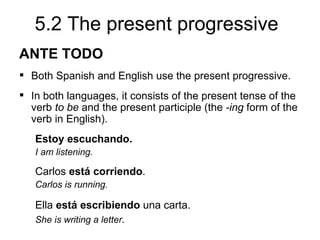
ANTE TODO
 Both Spanish and English use the present progressive.
 In both languages, it consists of the present tense of the
  verb to be and the present participle (the -ing form of the
  verb in English).
   Estoy escuchando.
   I am listening.

   Carlos está corriendo.
   Carlos is running.

   Ella está escribiendo una carta.
   She is writing a letter.
5.2 The present progressive
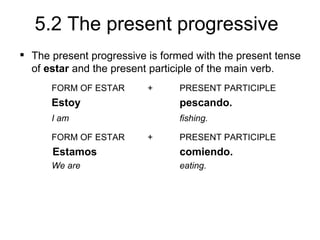
 The present progressive is formed with the present tense
  of estar and the present participle of the main verb.
      FORM OF ESTAR       +      PRESENT PARTICIPLE
      Estoy                      pescando.
      I am                       fishing.

      FORM OF ESTAR       +      PRESENT PARTICIPLE
      Estamos                    comiendo.
      We are                     eating.
5.2 The present progressive
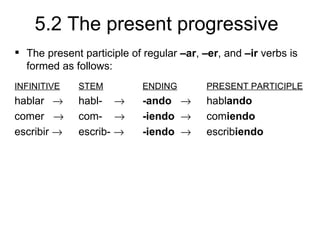
 The present participle of regular –ar, –er, and –ir verbs is
  formed as follows:
INFINITIVE    STEM          ENDING        PRESENT PARTICIPLE
hablar →      habl- →       -ando →       hablando
comer →       com- →        -iendo →      comiendo
escribir →    escrib- →     -iendo →      escribiendo
5.2 The present progressive
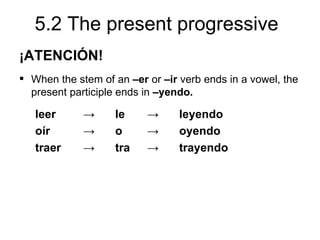
¡ATENCIÓN!
 When the stem of an –er or –ir verb ends in a vowel, the
  present participle ends in –yendo.

   leer      →     le     →      leyendo
   oír       →     o      →      oyendo
   traer     →     tra    →      trayendo
5.2 The present progressive
 Ir, poder, and venir have irregular present participles
  (yendo, pudiendo, viniendo), but these verbs are
  rarely used in the present progressive.
 Several other verbs have irregular present participles
  that you will need to learn.
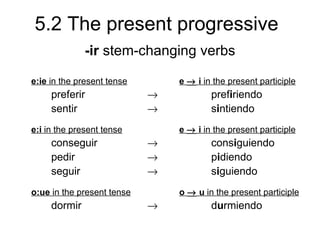
 -Ir stem-changing verbs have a stem change in the
  present participle.
5.2 The present progressive
              -ir stem-changing verbs

e:ie in the present tense       e → i in the present participle
     preferir               →           prefiriendo
     sentir                 →           sintiendo
e:i in the present tense        e → i in the present participle
     conseguir              →           consiguiendo
     pedir                  →           pidiendo
     seguir                 →           siguiendo
o:ue in the present tense       o → u in the present participle
     dormir                 →           durmiendo
5.2 The present progressive
             COMPARE & CONTRAST
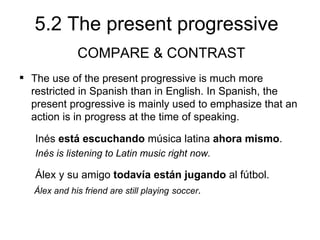
 The use of the present progressive is much more
  restricted in Spanish than in English. In Spanish, the
  present progressive is mainly used to emphasize that an
  action is in progress at the time of speaking.

   Inés está escuchando música latina ahora mismo.
   Inés is listening to Latin music right now.

   Álex y su amigo todavía están jugando al fútbol.
   Álex and his friend are still playing soccer.
5.2 The present progressive
            COMPARE & CONTRAST
 In English, the present progressive is often used to talk
  about situations and actions that occur over an extended
  period of time or in the future. In Spanish, the simple
  present tense is often used instead.

   Javier estudia computación este semestre.
   Javier is studying computer science this semester.

   Inés y Maite salen mañana para los Estados Unidos.
   Inés and Maite are leaving tomorrow for the United States.
5.2 The present progressive
¡INTÉNTALO! Create complete sentences by putting the
verbs in the present progressive.

 1. Mis amigos / descansar en la playa
 2. Nosotros / practicar deportes
 3. Carmen / comer
 4. Nuestro equipo / ganar el partido
 5. Yo / leer el periódico
 6. Él / pensar en comprar una bicicleta
 7. Ustedes / jugar a las cartas
 8. José y Francisco / dormir
 9. Marisa / leer correo electrónico
10. Yo / preparar sándwiches
11. Carlos / tomar fotos
12. ¿dormir / tú?
5.2 The present progressive
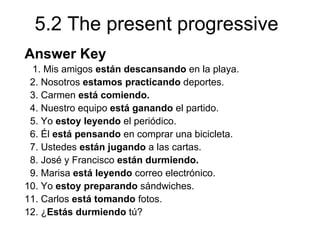
Answer Key
 1. Mis amigos están descansando en la playa.
 2. Nosotros estamos practicando deportes.
 3. Carmen está comiendo.
 4. Nuestro equipo está ganando el partido.
 5. Yo estoy leyendo el periódico.
 6. Él está pensando en comprar una bicicleta.
 7. Ustedes están jugando a las cartas.
 8. José y Francisco están durmiendo.
 9. Marisa está leyendo correo electrónico.
10. Yo estoy preparando sándwiches.
11. Carlos está tomando fotos.
12. ¿Estás durmiendo tú?