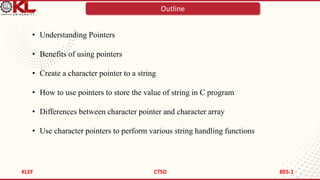
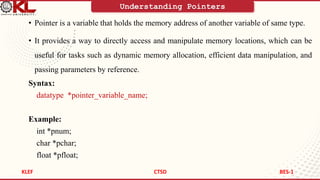
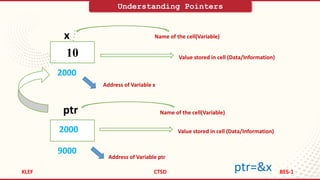
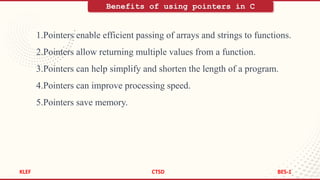
This document provides an overview of character pointers in C. It discusses how character pointers store memory addresses of characters and strings, allowing for dynamic memory allocation and efficient string manipulation. The key topics covered include declaring and initializing character pointers, accessing strings with pointers, the differences between pointers and arrays, and examples of string handling functions like strcpy() that utilize character pointers. The overall aim is to familiarize students with using pointers to work with strings in C.


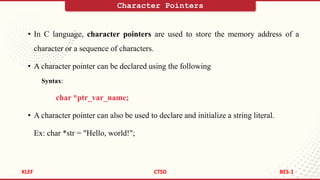
![CREATED BY K. VICTOR BABU
KLEF CTSD BES-1
Initialization of Character Pointer
Variables
A character pointer variables can be initialized in the following ways
1. String Literal Initialization:
char *ptr = "Hello, World!";
2. Array Initialization:
char arr[] = "Hello";
char *ptr = arr;
3. Dynamic Memory Allocation:
char *ptr = (char *)malloc(sizeof(char) * (length + 1));](https://image.slidesharecdn.com/233-characterpointer-231125012748-0ac5a8ec/85/23_3-Character-Pointer-pptx-8-320.jpg)
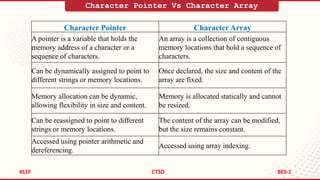
![CREATED BY K. VICTOR BABU
KLEF CTSD BES-1
Character Pointer Vs Character Array
#include <stdio.h>
int main() {
char *str = "Hello, World!";
printf("%sn", str);
str = "New String";
printf("%sn", str);
return 0;
}
#include <stdio.h>
int main() {
char arr[] = "Hello, World!";
printf("%sn", arr);
arr[7] = '-';
printf("%sn", arr);
return 0;
}
Hello, World!
New String
Hello, World!
Hello, -orld!](https://image.slidesharecdn.com/233-characterpointer-231125012748-0ac5a8ec/85/23_3-Character-Pointer-pptx-11-320.jpg)
![CREATED BY K. VICTOR BABU
KLEF CTSD BES-1
String handling using Character Pointer
• Character pointers can be used to manipulate strings and character arrays.
For example, strcpy() function can be used to copy a string from one character
array to another using pointers:
char source[] = "stay focused";
char destination[50];
char *ptr = source;
strcpy(destination, ptr);
printf("%sn", destination);
stay focused](https://image.slidesharecdn.com/233-characterpointer-231125012748-0ac5a8ec/85/23_3-Character-Pointer-pptx-12-320.jpg)


![CREATED BY K. VICTOR BABU
KLEF CTSD BES-1
Initialization of Character Pointer
Variables
A character pointer variables can be initialized in the following ways
1. String Literal Initialization:
char *ptr = "Hello, World!";
2. Array Initialization:
char arr[] = "Hello";
char *ptr = arr;
3. Dynamic Memory Allocation:
char *ptr = (char *)malloc(sizeof(char) * (length + 1));](/p?url=https%3A%2F%2Fimage.slidesharecdn.com%2F233-characterpointer-231125012748-0ac5a8ec%2F85%2F23_3-Character-Pointer-pptx-8-320.jpg&__src=https%3A%2F%2Fwww.slideshare.net%2Fslideshow%2F233character-pointerpptx%2F263874896&__type=image)


![CREATED BY K. VICTOR BABU
KLEF CTSD BES-1
Character Pointer Vs Character Array
#include <stdio.h>
int main() {
char *str = "Hello, World!";
printf("%sn", str);
str = "New String";
printf("%sn", str);
return 0;
}
#include <stdio.h>
int main() {
char arr[] = "Hello, World!";
printf("%sn", arr);
arr[7] = '-';
printf("%sn", arr);
return 0;
}
Hello, World!
New String
Hello, World!
Hello, -orld!](/p?url=https%3A%2F%2Fimage.slidesharecdn.com%2F233-characterpointer-231125012748-0ac5a8ec%2F85%2F23_3-Character-Pointer-pptx-11-320.jpg&__src=https%3A%2F%2Fwww.slideshare.net%2Fslideshow%2F233character-pointerpptx%2F263874896&__type=image)
![CREATED BY K. VICTOR BABU
KLEF CTSD BES-1
String handling using Character Pointer
• Character pointers can be used to manipulate strings and character arrays.
For example, strcpy() function can be used to copy a string from one character
array to another using pointers:
char source[] = "stay focused";
char destination[50];
char *ptr = source;
strcpy(destination, ptr);
printf("%sn", destination);
stay focused](/p?url=https%3A%2F%2Fimage.slidesharecdn.com%2F233-characterpointer-231125012748-0ac5a8ec%2F85%2F23_3-Character-Pointer-pptx-12-320.jpg&__src=https%3A%2F%2Fwww.slideshare.net%2Fslideshow%2F233character-pointerpptx%2F263874896&__type=image)


![C programming & data structure [character strings & string functions]](https://cdn.slidesharecdn.com/ss_thumbnails/cprogrammingdatastructure-characterstringsstringfunctions-150709232537-lva1-app6891-thumbnail.jpg?width=640&height=640&fit=bounds)


