It's a Presentation from THIAGARAJAR  POLYTECHNIC  COLLEGE (Autonomous Institution) Salem - 5
Information Security & Cryptography
Presented & performed by   Ranjith. B Arunachalam. PL COMPUTER ENGINEERING
INFORMATION SECURITY OBJECTIVES OF SECURITY PASSWORD AUDITING DATA SECURITY AUTHENTICATION CRYPTOGRAPHY Encryption and Decryption Public & Private Key Cryptography Digital signatures RSA ALGORITHM DEMONSTRATION CONCLUSION Synopsis
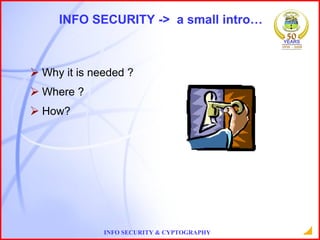
INFO SECURITY ->  a small intro… Why it is needed ? Where ? How?
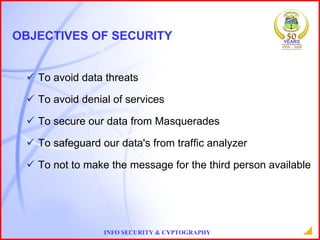
OBJECTIVES OF SECURITY To avoid data threats To avoid denial of services To secure our data from Masquerades To safeguard our data's from traffic analyzer To not to make the message for the third person available
PASSWORD AUDITING Should  not be in uppercases Must have  at least 8 characters Must  include alphabets, numeric keys and special characters Password  should not be the name of the user, dictionary word etc., It  must be updated  at least once a month
DATA SECURITY To monitor the users  ACCESS CONTROLS Systems that are connected in networks must be protected with  FIREWALLS To  protect the integrity and availability of the institution’s information assets
CYPTOGRAPHY -> small intro… KEYWORDS Cryptography Encryption & Decryption Public Key Cryptography Private Key Cryptography Digital Signatures RSA Algorithm
Cryptography  is the science of using  mathematics  to encrypt and decrypt data. Cryptography enables you to store sensitive  information or transmit it across insecure  networks (like the Internet) so that it cannot be  read  by anyone except the intended recipient. Its very usefull to  OUR  Army and Police networks to  transfer confidential datas. Cryptography
ENCRYPTION AND DECRYPTION Encryption  is a technique that converts the original text  into an unreadable text The converted original text is called as  CIPHER TEXT Decryption  technique is used to convert the cipher text  into the original text  Authentication is the verification process which identifies  the password and username Digital signatures  are signed to make the cipher text  into unreadable or unchangeable
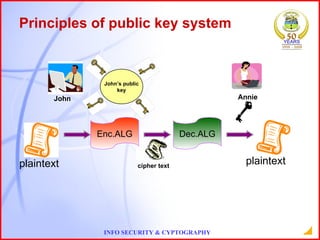
Principles of public key system John’s public key John Annie plaintext cipher text Dec.ALG Enc.ALG plaintext
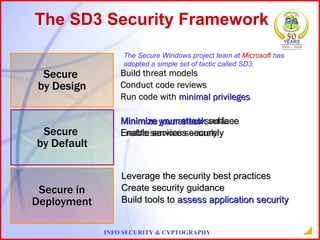
The SD3 Security Framework Secure  by Design Secure  by Default Secure in Deployment Build threat models Conduct code reviews Run code with  minimal privileges Minimize your attack  surface Enable services securely Leverage the security best practices Create security guidance  Build tools to  assess application security The Secure Windows project team at  Microsoft  has adopted a simple set of tactic   called SD3.   Minimize your attack  surface Enable services securely Minimize your attack  surface Enable services securely
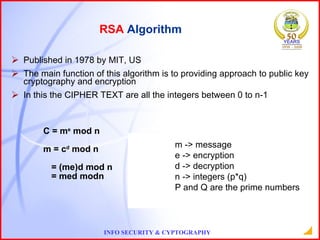
Published in 1978 by MIT, US The main function of this algorithm is to providing approach to public key cryptography and encryption In this the CIPHER TEXT are all the integers between 0 to n-1 C = m e  mod n m = c d  mod n = (me)d mod n = med modn RSA  Algorithm m -> message e -> encryption d -> decryption n -> integers (p*q) P and Q are the prime numbers
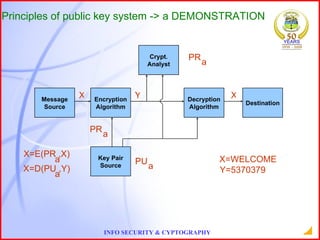
Decryption Algorithm Message Source Encryption Algorithm Destination Crypt. Analyst Key Pair Source X Y X PR a PR a PU a X=E(PR ,X) a X=D(PU ,Y) a X=WELCOME Y=5370379 Principles of public key system -> a DEMONSTRATION
Conclusion
This Paper has been submitted under the guidance of Over headed by M.Saravanan (M.E) – Lecturer (Computer Tech).   PL.Sindhu  B. E  – Lecturer (Computer Tech).   MR.D.ARUL SELVAN M.E., Head Of the Department / Computer Technology
“ Thank You” “ For every lock there is a Key…   It  is better to  KEEP SAFE YOUR LOCK THAN THE KEY”
Bibliography References  CCNA INTRO - Wendell Odom Network Essentials – William Stalings Website www.wikipedia.com www.securitymeasures.com