1
Types of Data Sets
 Record
 Relational records
 Data matrix, e.g., numerical matrix,
crosstabs
 Document data: text documents: term-
frequency vector
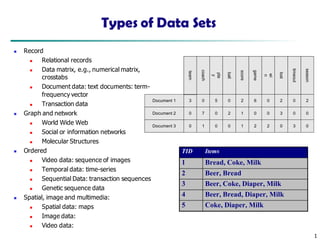
 Transaction data
 Graph and network
 World Wide Web
 Social or information networks
 Molecular Structures
 Ordered
 Video data: sequence of images
 Temporal data: time-series
 Sequential Data: transaction sequences
 Genetic sequence data
 Spatial, image and multimedia:
 Spatial data: maps
 Image data:
 Video data:
Document 1
season
timeout
lost
wi
n
game
score
ball
pla
y
coach
team
Document 2
Document 3
3 0 5 0 2 6 0 2 0 2
0
0
7 0 2 1 0 0 3 0 0
1 0 0 1 2 2 0 3 0
TID Items
1 Bread, Coke, Milk
2 Beer, Bread
3 Beer, Coke, Diaper, Milk
4 Beer, Bread, Diaper, Milk
5 Coke, Diaper, Milk
2
Data Objects
 Data sets are made up of data objects.
 A data object represents an entity.
 Examples:
 sales database: customers, store items, sales
 medical database: patients, treatments
 university database: students, professors, courses
 Also called samples , examples, instances, data points,
objects, tuples.
 Data objects are described by attributes.
 Database rows -> data objects; columns ->attributes.
3
Attributes
 Attribute (or dimensions, features, variables):
a data field, representing a characteristic or feature
of a data object.
 E.g., customer _ID, name, address
 Types:
 Nominal
 Binary
 Numeric: quantitative
 Interval-scaled
 Ratio-scaled
4
Attribute Types
 Nominal: categories, states, or ā€œnames of thingsā€
 Hair_color = {auburn, black, blond, brown, grey, red, white}
 marital status, occupation, ID numbers, zip codes
 Binary
 Nominal attribute with only 2 states (0 and 1)
 Symmetric binary: both outcomes equally important
 e.g., gender
 Asymmetric binary: outcomes not equally important.
 e.g., medical test (positive vs. negative)
 Convention: assign 1 to most important outcome (e.g., HIV
positive)
 Ordinal
 Values have a meaningful order (ranking) but magnitude between
successive values is not known.
 Size = {small, medium, large}, grades, army rankings
5
Numeric Attribute Types
 Quantity (integer or real-valued)
 Interval
 Measured on a scale of equal-sized units
 Values have order
 E.g., temperature in C˚or F˚, calendar dates
 No true zero-point
 Ratio
 Inherent zero-point
 We can speak of values as being an order of
magnitude larger than the unit of measurement
(10 K˚ is twice as high as 5 K˚).
 e.g., temperature in Kelvin, length, counts,
monetary quantities
6
Discrete vs. Continuous Attributes
 Discrete Attribute
 Has only a finite or countably infinite set of values
 E.g., zip codes, profession, or the set of words in a
collection of documents
 Sometimes, represented as integer variables
 Note: Binary attributes are a special case of discrete
attributes
 Continuous Attribute
 Has real numbers as attribute values
 E.g., temperature, height, or weight
 Practically, real values can only be measured and
represented using a finite number of digits
 Continuous attributes are typically represented as
floating-point variables
7
Data Quality: Why Preprocess the Data?
 Measures for data quality: A multidimensional view
 Accuracy: correct or wrong, accurate or not
 Completeness: not recorded, unavailable, …
 Consistency: some modified but some not, dangling, …
 Timeliness: timely update?
 Believability: how trustable the data are correct?
 Interpretability: how easily the data can be
understood?
8
Major Tasks in Data Preprocessing
 Data cleaning
 Fill in missing values, smooth noisy data, identify or remove
outliers, and resolve inconsistencies
 Data integration
 Integration of multiple databases, data cubes, or files
 Data reduction (Reduced representation of the data set that is
much smaller in valumn)
 Dimensionality reduction
 Numerosity reduction
 Data compression
 Data transformation and data discretization
 Normalization (smaller rang i.e.[0.0,1.0]
 Concept hierarchy generation :- raw data values are replaced by
ranges
9
Data Cleaning
 Data in the Real World Is Dirty: Lots of potentially incorrect data,
e.g., instrument faulty, human or computer error, transmission error
 incomplete: lacking attribute values, lacking certain attributes of
interest, or containing only aggregate data
 e.g., Occupation=ā€œ ā€ (missing data)
 noisy: containing noise, errors, or outliers
 e.g., Salary=ā€œāˆ’10ā€ (an error)
 inconsistent: containing discrepancies in codes or names, e.g.,
 Age=ā€œ42ā€, Birthday=ā€œ03/07/2010ā€
 Was rating ā€œ1, 2, 3ā€, now rating ā€œA, B, Cā€
 discrepancy between duplicate records
 Intentional (e.g., disguised missing data)
 Jan. 1 as everyone’s birthday?
10
Incomplete (Missing) Data
 Data is not always available
 E.g., many tuples have no recorded value for several
attributes, such as customer income in sales data
 Missing data may be due to
 equipment malfunction
 inconsistent with other recorded data and thus deleted
 data not entered due to misunderstanding
 certain data may not be considered important at the
time of entry
 not register history or changes of the data
 Missing data may need to be inferred
11
How to Handle Missing Data?
 Ignore the tuple: usually done when class label is missing
(when doing classification)—not effective when the % of
missing values per attribute varies considerably
 Fill in the missing value manually: tedious + infeasible?
 Fill in it automatically with
 a global constant : e.g., ā€œunknownā€, a new class?!
 the attribute mean
 the attribute mean for all samples belonging to the
same class: smarter
 the most probable value: inference-based such as
Bayesian formula or decision tree
12
Noisy Data
 Noise: random error or variance in a measured variable
 Incorrect attribute values may be due to
 faulty data collection instruments
 data entry problems
 data transmission problems
 technology limitation
 inconsistency in naming convention
 Other data problems which require data cleaning
 duplicate records
 incomplete data
 inconsistent data
13
How to Handle Noisy Data?
 Binning
 first sort data and partition into (equal-frequency) bins
 then one can smooth by bin means, smooth by bin
median, smooth by bin boundaries, etc.
How to Handle Noisy Data?
 Regression
 smooth by fitting the data into regression functions
 Clustering
 detect and remove outliers
 Combined computer and human inspection
 detect suspicious values and check by human (e.g.,
deal with possible outliers)
14
15
15
Data Integration
 Data integration:
 Combines data from multiple sources into a coherent store
 Schema integration: e.g., A.cust-id.  B.cust-#
 Integrate metadata from different sources
 Entity identification problem:
 Identify real world entities from multiple data sources, e.g., Bill
Clinton = William Clinton
 Detecting and resolving data value conflicts
 For the same real world entity, attribute values from different
sources are different
 Possible reasons: different representations, different scales, e.g.,
metric vs. British units
16
16
Handling Redundancy in Data Integration
 Redundant data occur often when integration of multiple
databases
 Object identification: The same attribute or object
may have different names in different databases
 Derivable data: One attribute may be a ā€œderivedā€
attribute in another table, e.g., annual revenue
 Redundant attributes may be able to be detected by
correlation analysis and covariance analysis
 Careful integration of the data from multiple sources may
help reduce/avoid redundancies and inconsistencies and
improve mining speed and quality
17
Correlation Analysis (Nominal Data)
 Χ2 (chi-square) test
 The larger the Χ2 value, the more likely the variables are
related
 The cells that contribute the most to the Χ2 value are
those whose actual count is very different from the
expected count
 Correlation does not imply causality
 # of hospitals and # of car-theft in a city are correlated
 Both are causally linked to the third variable: population



Expected
Expected
Observed 2
2 )
(

18
Data Transformation
 A function that maps the entire set of values of a given attribute to a
new set of replacement values s.t. each old value can be identified
with one of the new values
 Methods
 Smoothing: Remove noise from data
 Attribute/feature construction
 New attributes constructed from the given ones
 Aggregation: Summarization, data cube construction
 Normalization: Scaled to fall within a smaller, specified range
 min-max normalization
 z-score normalization
 normalization by decimal scaling
 Discretization: Concept hierarchy climbing
19
Data Preprocessing
 Data Preprocessing: An Overview
 Data Quality
 Major Tasks in Data Preprocessing
 Data Cleaning
 Data Integration
 Data Reduction
 Data Transformation and Data Discretization