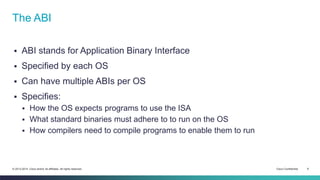
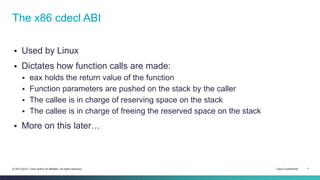
The document provides an introduction to the x86 cdecl ABI and stack management within the context of programming. It explains the roles of the instruction set architecture (ISA), application binary interface (ABI), and details the structure and functioning of the stack, including function calls, stack frames, and the process of unwinding the frame. Additionally, it highlights security implications, particularly concerning buffer overflow vulnerabilities.



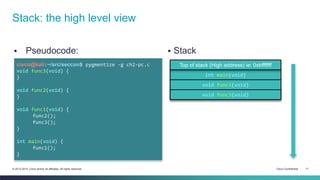
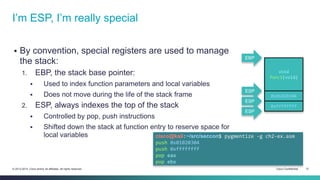

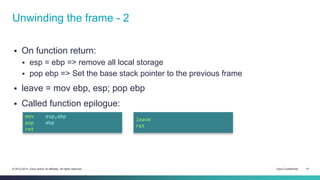
![Example: Winding the stack
Stack
cisco@kali:~/src/seccon$ pygmentize -g ch2-pc.c
void func1(int a) { // 0x080483dc
char c = 'A';
}
int main(void) { // 0x080483e8
func1(0x1234);
}
Top of stack (High address) ie:
0xbfffffff
Saved EIP of main
Saved EBP – (stack frame -1)
0x1234
0x080483e8
EBP=0xbffff6b4
0xbffff6b4
0x00000000
dahtah@kali:~/src/seccon$ objdump -d -j .text -M intel ch2-pc2 | grep 'func1>:'
-A 15
080483dc <func1>:
80483dc: 55 push ebp
80483dd: 89 e5 mov ebp,esp
80483df: 83 ec 10 sub esp,0x10
80483e2: c6 45 ff 41 mov DWORD PTR [ebp-0x4],0x41
80483e6: c9 leave
80483e7: c3 ret
080483e8 <main>:
80483e8: 55 push ebp
80483e9: 89 e5 mov ebp,esp
80483eb: 83 ec 04 sub esp,0x4
80483ee: c7 04 24 34 12 00 00 mov DWORD PTR [esp],0x1234
80483f5: e8 e2 ff ff ff call 80483dc <func1>
80483fa: c9 leave
80483fb: c3 ret
EBP=0xbffff6c4
ESP
0x00000041
0x00000000
0x00000000
0x00000000
© 2013-2014 Cisco and/or its affiliates. All rights reserved. Cisco Confidential 15](https://image.slidesharecdn.com/02-stackframes-141011071523-conversion-gate02/85/02-Introduction-to-the-cdecl-ABI-and-the-x86-stack-15-320.jpg)
![Example: Unwinding the stack
Stack
cisco@kali:~/src/seccon$ pygmentize -g ch2-pc.c
void func1(int a) { // 0x080483dc
char c = 'A';
}
int main(void) { // 0x080483e8
func1(0x1234);
}
Top of stack (High address) ie:
0xbfffffff
Saved EIP of main
Saved EBP – (stack frame -1)
0x1234
0x080483e8
EBP=0xbffff6b4
0xbffff6b4
dahtah@kali:~/src/seccon$ objdump -d -j .text -M intel ch2-pc2 | grep 'func1>:'
-A 15
080483dc <func1>:
80483dc: 55 push ebp
80483dd: 89 e5 mov ebp,esp
80483df: 83 ec 10 sub esp,0x10
80483e2: c6 45 ff 41 mov DWORD PTR [ebp-0x4],0x41
80483e6: c9 leave
80483e7: c3 ret
080483e8 <main>:
80483e8: 55 push ebp
80483e9: 89 e5 mov ebp,esp
80483eb: 83 ec 04 sub esp,0x4
80483ee: c7 04 24 34 12 00 00 mov DWORD PTR [esp],0x1234
80483f5: e8 e2 ff ff ff call 80483dc <func1>
80483fa: c9 leave
80483fb: c3 ret
ESP
ESP
EBP=0xbffff6c4
ESP
ESP
0x00000041
0x00000000
0x00000000
0x00000000
© 2013-2014 Cisco and/or its affiliates. All rights reserved. Cisco Confidential 16](https://image.slidesharecdn.com/02-stackframes-141011071523-conversion-gate02/85/02-Introduction-to-the-cdecl-ABI-and-the-x86-stack-16-320.jpg)

![When I get to rest
Compile the following program:
cisco@kali:~/src/seccon$ pygmentize -g ch2.c
#include <stdio.h>
int callee(int a, int b, int c) {
char local_buf[0x20] = {0x01};
unsigned int local_int = 0xffffffff;
return 0x12345678;
}
int main(int argc, char **argv) {
int ret = callee(0x1, 0x2, 0x3);
return 0;
}
Disassemble it
Understand the objdump output
Draw out the stack movement on paper
Fire up gdb and set a breakpoint on callee
entry and exit. Inspect the stack. Follow ebp,
esp.
Make sure you understand the output from
“info frame”. Get the output manually
Overwrite callee’s saved EIP. What happens
when callee exits?
Add a function called by callee. Follow the
stack
cisco@kali:~/src/seccon$ objdump -d -j .text -M intel
ch2 | grep 'callee>:' -A 40
© 2013-2014 Cisco and/or its affiliates. All rights reserved. Cisco Confidential 18](https://image.slidesharecdn.com/02-stackframes-141011071523-conversion-gate02/85/02-Introduction-to-the-cdecl-ABI-and-the-x86-stack-18-320.jpg)


![Example: Winding the stack
Stack
cisco@kali:~/src/seccon$ pygmentize -g ch2-pc.c
void func1(int a) { // 0x080483dc
char c = 'A';
}
int main(void) { // 0x080483e8
func1(0x1234);
}
Top of stack (High address) ie:
0xbfffffff
Saved EIP of main
Saved EBP – (stack frame -1)
0x1234
0x080483e8
EBP=0xbffff6b4
0xbffff6b4
0x00000000
dahtah@kali:~/src/seccon$ objdump -d -j .text -M intel ch2-pc2 | grep 'func1>:'
-A 15
080483dc <func1>:
80483dc: 55 push ebp
80483dd: 89 e5 mov ebp,esp
80483df: 83 ec 10 sub esp,0x10
80483e2: c6 45 ff 41 mov DWORD PTR [ebp-0x4],0x41
80483e6: c9 leave
80483e7: c3 ret
080483e8 <main>:
80483e8: 55 push ebp
80483e9: 89 e5 mov ebp,esp
80483eb: 83 ec 04 sub esp,0x4
80483ee: c7 04 24 34 12 00 00 mov DWORD PTR [esp],0x1234
80483f5: e8 e2 ff ff ff call 80483dc <func1>
80483fa: c9 leave
80483fb: c3 ret
EBP=0xbffff6c4
ESP
0x00000041
0x00000000
0x00000000
0x00000000
© 2013-2014 Cisco and/or its affiliates. All rights reserved. Cisco Confidential 15](/p?url=https%3A%2F%2Fimage.slidesharecdn.com%2F02-stackframes-141011071523-conversion-gate02%2F85%2F02-Introduction-to-the-cdecl-ABI-and-the-x86-stack-15-320.jpg&__src=https%3A%2F%2Fwww.slideshare.net%2Fslideshow%2F02-stack-frames%2F40142697&__type=image)
![Example: Unwinding the stack
Stack
cisco@kali:~/src/seccon$ pygmentize -g ch2-pc.c
void func1(int a) { // 0x080483dc
char c = 'A';
}
int main(void) { // 0x080483e8
func1(0x1234);
}
Top of stack (High address) ie:
0xbfffffff
Saved EIP of main
Saved EBP – (stack frame -1)
0x1234
0x080483e8
EBP=0xbffff6b4
0xbffff6b4
dahtah@kali:~/src/seccon$ objdump -d -j .text -M intel ch2-pc2 | grep 'func1>:'
-A 15
080483dc <func1>:
80483dc: 55 push ebp
80483dd: 89 e5 mov ebp,esp
80483df: 83 ec 10 sub esp,0x10
80483e2: c6 45 ff 41 mov DWORD PTR [ebp-0x4],0x41
80483e6: c9 leave
80483e7: c3 ret
080483e8 <main>:
80483e8: 55 push ebp
80483e9: 89 e5 mov ebp,esp
80483eb: 83 ec 04 sub esp,0x4
80483ee: c7 04 24 34 12 00 00 mov DWORD PTR [esp],0x1234
80483f5: e8 e2 ff ff ff call 80483dc <func1>
80483fa: c9 leave
80483fb: c3 ret
ESP
ESP
EBP=0xbffff6c4
ESP
ESP
0x00000041
0x00000000
0x00000000
0x00000000
© 2013-2014 Cisco and/or its affiliates. All rights reserved. Cisco Confidential 16](/p?url=https%3A%2F%2Fimage.slidesharecdn.com%2F02-stackframes-141011071523-conversion-gate02%2F85%2F02-Introduction-to-the-cdecl-ABI-and-the-x86-stack-16-320.jpg&__src=https%3A%2F%2Fwww.slideshare.net%2Fslideshow%2F02-stack-frames%2F40142697&__type=image)

![When I get to rest
Compile the following program:
cisco@kali:~/src/seccon$ pygmentize -g ch2.c
#include <stdio.h>
int callee(int a, int b, int c) {
char local_buf[0x20] = {0x01};
unsigned int local_int = 0xffffffff;
return 0x12345678;
}
int main(int argc, char **argv) {
int ret = callee(0x1, 0x2, 0x3);
return 0;
}
Disassemble it
Understand the objdump output
Draw out the stack movement on paper
Fire up gdb and set a breakpoint on callee
entry and exit. Inspect the stack. Follow ebp,
esp.
Make sure you understand the output from
“info frame”. Get the output manually
Overwrite callee’s saved EIP. What happens
when callee exits?
Add a function called by callee. Follow the
stack
cisco@kali:~/src/seccon$ objdump -d -j .text -M intel
ch2 | grep 'callee>:' -A 40
© 2013-2014 Cisco and/or its affiliates. All rights reserved. Cisco Confidential 18](/p?url=https%3A%2F%2Fimage.slidesharecdn.com%2F02-stackframes-141011071523-conversion-gate02%2F85%2F02-Introduction-to-the-cdecl-ABI-and-the-x86-stack-18-320.jpg&__src=https%3A%2F%2Fwww.slideshare.net%2Fslideshow%2F02-stack-frames%2F40142697&__type=image)


![[嵌入式系統] MCS-51 實驗 - 使用 IAR (3)](https://cdn.slidesharecdn.com/ss_thumbnails/mcs51iarpart3-150613071723-lva1-app6892-thumbnail.jpg?width=640&height=640&fit=bounds)


![[2012 CodeEngn Conference 06] pwn3r - Secuinside 2012 CTF 예선 문제풀이](https://cdn.slidesharecdn.com/ss_thumbnails/20126thcodeengnpwn3rsecuinside2012ctf-130525233500-phpapp02-thumbnail.jpg?width=640&height=640&fit=bounds)
![[ZigBee 嵌入式系統] ZigBee 應用實作 - 使用 TI Z-Stack Firmware](https://cdn.slidesharecdn.com/ss_thumbnails/zigbeeappimplementation-150613072040-lva1-app6891-thumbnail.jpg?width=640&height=640&fit=bounds)
![[嵌入式系統] MCS-51 實驗 - 使用 IAR (2)](https://cdn.slidesharecdn.com/ss_thumbnails/mcs51iarpart2-150613071717-lva1-app6891-thumbnail.jpg?width=640&height=640&fit=bounds)


![Ilfak Guilfanov - Decompiler internals: Microcode [rooted2018]](https://cdn.slidesharecdn.com/ss_thumbnails/ilfak-keynote-180312223906-thumbnail.jpg?width=640&height=640&fit=bounds)


