Steel Staircase Design Calculations
Uploaded by
bishwaram gosainSteel Staircase Design Calculations
Uploaded by
bishwaram gosain- Steel Stair Framing Design
- Platform Header and Support
- Materials and Execution
- Structural Calculations
Common questions
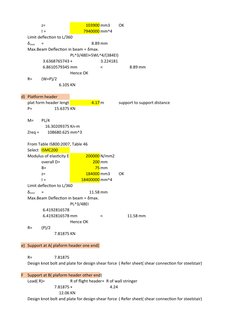
Powered by AIAssuming uniform load distribution in the design of flight headers simplifies calculations by allowing the total load to be treated as a single equivalent force acting at mid-span . This assumption impacts the determination of bending moments (M=WL^2/8+PL/4) and influences the required section modulus (Z_req = 77120 mm^3) and deflection calculations. While this assumption aids in simplifying complex loading scenarios, it may overlook non-uniform real-life scenarios, like uneven weight distribution due to dynamic loading, thereby potentially underestimating localized stress concentrations . Designers must confirm these assumptions align with expected operational conditions, considering possible deviations that could necessitate design adjustments to maintain safety and compliance with IS800:2007 standards .
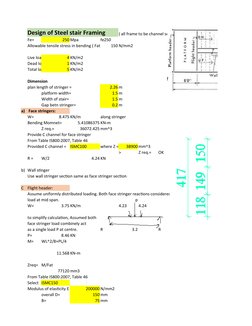
The safety margins for bending in the face stringer design are calculated by comparing the actual section modulus provided (Z = 38900 mm^3) against the required section modulus (Z_req = 36072.425 mm^3). The provided modulus exceeds the required one, indicating an adequate safety margin for bending . For deflection, the calculated deflection (6.861 mm) is compared against the permissible deflection limit (L/360 = 8.89 mm), and the actual deflection is less than this limit, indicating an adequate safety margin . These safety margins are compliant with IS800:2007 standards, ensuring that both bending stress and deflection criteria are met, contributing to the reliable performance of the structure under prescribed loads .
When selecting channel sections for steel stair framing based on the IS800:2007 standard, key considerations include ensuring that the provided channel section's sectional modulus (Z) is greater than or equal to the required Z (Z_req) as determined through calculations based on bending moments and acceptable stress limits (Fat 150 N/mm2). Additionally, it involves verifying that deflections under load are within permissible limits (L/360) to ensure structural stability . The load combinations, including live load (4 KN/m2) and dead load (1 KN/m2), contribute to calculating the total load, influencing the moments and Z requirements . Finally, selecting appropriate channel sections involves choosing from ISMC sections, ensuring the chosen section meets these requirements while considering standardized properties such as modulus of elasticity and cross-sectional dimensions .
The design of a platform header for a steel stair involves considerations of greater bending moments compared to wall stringers due to longer spans and larger loads . This results in a higher required section modulus (Z_req=108680.625 mm3) and selection of a more robust channel section, such as ISMC200 . The deflection limits (L/360) must be adhered to, requiring diligence in ensuring that the structural integrity is maintained under the anticipated load conditions (P=15.6375 KN). In contrast, wall stringers use the same channel section as face stringers and handle different load distributions, often acting as beams supported by walls with smaller spans and bending moments . These differences have structural implications, requiring careful coordination in load distribution and ensuring each component supports its specific expected load without overloading or excessive deflection .
The L/360 deflection criterion is a common standard used to limit deflection in structural elements to ensure comfort and aesthetic appeal . However, in steel staircase design, this criterion might not adequately address scenarios involving dynamic loads, such as vibration or sudden impacts that can occur with high foot traffic or environmental influences (e.g., seismic activities). In such cases, deflection limits might need to be more stringent to prevent serviceability issues and preserve structural integrity under such conditions . Furthermore, in more flexible structural configurations or in designs involving longer spans, additional considerations beyond L/360 may be necessary to avoid perceptible movement, ensuring the lifespan and safety of the staircase structure .
Deflection calculations are significant in platform header design for steel stairs as they ensure structural elements will accommodate anticipated service loads without exceeding accepted deflection limits, such as L/360 . This involves determining the maximum expected deflection due to applied loads and comparing it with the permissible limit, calculated based on the span length (11.58 mm for a platform header). Adequate deflection management is crucial for avoiding structural degradation over time, preventing undue stress at connections, and maintaining user comfort and safety by minimizing visible movement or oscillations in the structure . These calculations play a vital role in planning and validating structural systems to meet operational needs and longevity criteria .
Using C channels for face and wall stringers offers benefits such as ease of installation, due to their shape and lighter weight compared to other types of beams. These channels can effectively distribute the loads and withstand bending when appropriately sized according to IS800:2007 standards . However, challenges include ensuring adequate lateral stability, as C channels may not support torsion as effectively as I-beams, and they require careful consideration of load distribution and connection design to prevent buckling or twisting . Additionally, C channels might limit architectural flexibility in terms of aesthetics and spatial constraints compared to other beam options .
Live loads (4 KN/m2) and dead loads (1 KN/m2) substantially influence the structural design of steel stair framing by determining the total load (5 KN/m2) that the stair components need to support. These loads directly affect the bending moment calculations, which determine the required section modulus (Z_req) for each element, such as stringers and the platform header . The combination of these loads influences the choice of channel sections, requiring designs that can support these stresses while maintaining compliance with deflection limits (e.g., L/360). In essence, accurate load analysis ensures that the structure can support operational demands without structural failure or excessive deflection, maintaining safety standards as stipulated in IS800:2007 .
Calculated required section modulus values (Z_req) are crucial in influencing the choice of channel sections for various components in steel stair design. For example, face stringers with Z_req = 36072.425 mm^3 should have a channel section that exceeds this requirement, such as ISMC100 (Z = 38900 mm^3). Similarly, platform headers with a higher Z_req = 108680.625 mm^3 require larger sections like ISMC200 to ensure they meet strength requirements under calculated bending moments (e.g., M=PL/4). These values provide a quantitative basis to ensure each section can withstand respective loads and stresses while adhering to deflection limitations, thus ensuring structural reliability and adherence to IS800:2007 .
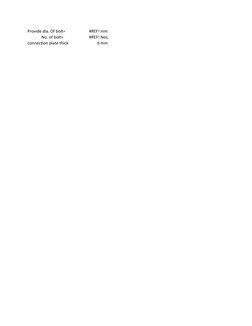
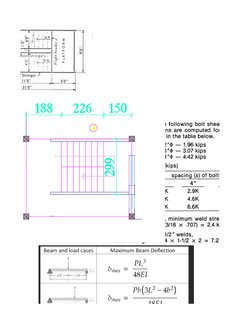
The choice of bolt diameter and number for shear connections in steel stair framing is heavily influenced by the design shear forces at connection points, such as those at supports A and B on platform headers, where particular forces (e.g., R=7.81875 KN) must be accounted for . Factors include the anticipated tension and shear forces at these joints, the material properties and thickness of the connection plate (e.g., 6 mm thickness), and compliance with applicable standards for steel construction . Additionally, structural integrity and load transfer efficiency are critical, necessitating bolts that can accommodate both statically exerted forces and dynamic influences such as vibrational loads and potential impact stresses without failure .