0% found this document useful (0 votes)
204 views8 pages

To Kill a Mockingbird: Part One Questions

The document provides study questions for the first 11 chapters of the novel "To Kill a Mockingbird" by Harper Lee. The questions cover key details about the characters, setting, and events that occur. They also ask students to define vocabulary words used in the text and analyze themes around racism, courage, and moral justice.

Uploaded by

Selim Aboulazm
Copyright
© All Rights Reserved
We take content rights seriously. If you suspect this is your content, claim it here.
Available Formats
Download as PDF, TXT or read online on Scribd
0% found this document useful (0 votes)
204 views8 pages

To Kill a Mockingbird: Part One Questions

The document provides study questions for the first 11 chapters of the novel "To Kill a Mockingbird" by Harper Lee. The questions cover key details about the characters, setting, and events that occur. They also ask students to define vocabulary words used in the text and analyze themes around racism, courage, and moral justice.

Uploaded by

Selim Aboulazm
Copyright
© All Rights Reserved
We take content rights seriously. If you suspect this is your content, claim it here.
Available Formats
Download as PDF, TXT or read online on Scribd
  • Chapter 1
  • Chapter 2
  • Chapter 3
  • Chapter 4
  • Chapter 5
  • Chapter 6
  • Chapter 7
  • Chapter 8
  • Chapter 9
  • Chapter 10
  • Chapter 11

To Kill A Mockingbird:

Part One
Study Questions

Chapter
1

1. What do you learn in this chapter about Maycomb, Atticus Finch and his family?

2. What do you learn about Dill's character?

3. What, briefly, has happened to Arthur “Boo” Radley.

4. Why does the Radley place fascinate Scout, Jem and Dill?

5. What happened to Scout and Jem’s mother?

6. What do you notice about the narrative voice and viewpoint in the novel?

7. Find and define the following words: (page numbers may vary)

a. Assuaged-

b. Dictum-

c. Taciturn-

d. Beadle-

1
Chapter 2

8. Why is Scout so looking forward to starting school?

9. Why does Jem not want anything to do with Scout at school? Is his behavior typical of

an older child?

10. What is important to know about the Cunninghams?

11. What do you think of Miss Caroline Fisher as a teacher? Can you find qualities which

would make her good or not so good at her job?

12. Find and define the following:

a. Illicitly-

b. Sojourn-

2
Chapter 3

13. Who is Calpurnia? What is her place in the Finch household?

14. What is Walter Cunningham like? What does his behaviour during lunch suggest about

his home life?

15. What do you think of the way Atticus treats Walter?

16. Does Scout learn anything from Walter's visit? What do you think this is?

17. Atticus says that you never really understand a person “until you climb into his skin and

walk around in it”. What does this mean? Is it an easy thing for Scout to learn?

18. What do you learn in this chapter about the Ewells?

19. . Find and define the following words: (page numbers will vary)

a. Persevere-

b. Contentious-

c. Diminutive-

3
Chapter 4

20. What does Scout think of current fashions in education?

21. What superstitions do the children have in connection with the Radley house?

22. Why do the children make Boo's story into a game?

23. What do they do in this game? Do you think the game is an accurate version of what

happens in the Radleys' home?

24. What might be the cause of the laughter from inside the house?

25. Find and define: scuppernongs.

Chapter 5

26. Describe Miss Maudie Atkinson. How typical is she of Maycomb's women? What do the

children think of her?

27. What does Miss Maudie tell Scout about Boo? How does this compare with what Scout

already believes?

28. Scout claims that “Dill could tell the biggest ones ” (lies) she ever heard. Why might Dill

have told such lies?

29. What reasons does Atticus give for the children not to play the Boo Radley game? Do

you think he is right? Why?

30. Find and define the following:

a. Benevolence-

b. Placidly-

4
Chapter 6

31. Why does Scout disapprove of Jem's and Dill's plan of looking in at one of the Radleys'

windows?

32. What does Mr. Nathan Radley know about the intruders in his garden? Why does

Miss Stephanie refer to a “negro” over whose head Mr. Nathan has fired?

33. Why does Dill's explanation of Jem's state of dress almost land him in trouble?

5
Chapter 7

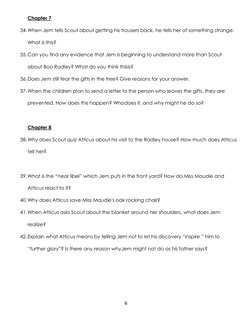
34. When Jem tells Scout about getting his trousers back, he tells her of something strange.

What is this?

35. Can you find any evidence that Jem is beginning to understand more than Scout

about Boo Radley? What do you think this is?

36. Does Jem still fear the gifts in the tree? Give reasons for your answer.

37. When the children plan to send a letter to the person who leaves the gifts, they are

prevented. How does this happen? Who does it, and why might he do so?

Chapter 8

38. Why does Scout quiz Atticus about his visit to the Radley house? How much does Atticus

tell her?

39. What is the “near libel” which Jem puts in the front yard? How do Miss Maudie and

Atticus react to it?

40. Why does Atticus save Miss Maudie's oak rocking chair?

41. When Atticus asks Scout about the blanket around her shoulders, what does Jem

realize?

42. Explain what Atticus means by telling Jem not to let his discovery “inspire ” him to

“further glory”? Is there any reason why Jem might not do as his father says?

6
Chapter 9

43. How well does Atticus feel he should defend Tom Robinson? Is it usual for (white)

lawyers to do their best for black clients in Alabama at this time?

44. Scout and Jem have “mixed feelings” about Christmas? What are these feelings and

why?

45. Uncle Jack Finch tells Scout that she is growing out of her pants. What does this mean

and why might he say it?

46. When Francis talks to Scout he reveals an unpleasant feature of Aunt Alexandra. What is

this?

47. Does Scout learn anything from overhearing Atticus's conversation with Uncle Jack?

What might this be?

48. Read the final sentence of this chapter. Explain in your own words what it means

and why it might be important in the story.

Chapter 10

49. Scout says that “Atticus was feeble”. Do you think that this is her view as she tells the

story or her view when she was younger? Does she still think this after the events

recorded in this chapter?

50. In this chapter Atticus tells his children that “it's a sin to kill a mockingbird”. What reason

does he give for saying this?

51. Why does Heck Tate not want to shoot Tim Johnson?

7
52. Near the end of this chapter Atticus cuts off Heck Tate as he is speaking to Jem. What

might Heck have been about to say,and why would Atticus want to stop him from

saying it?

53. Jem and Scout have different views about telling people at school how well Atticus

can shoot. Explain this difference. Which view is closer to your own?

54. Find and define:

a. inconspicuous-

Chapter 11

55. How does Atticus advise Jem to react to Mrs. Dubose's taunts?

56. What does Mrs. Dubose say about the children's mother? How does Jem feel about this?

57. What request does Mrs. Dubose make of Jem? Is this a fair punishment for his “crime”?

58. Explain in your own words what Atticus thinks of insults like “nigger-lover”. How far do you

agree with him?

59. Why, in Atticus's view, was Mrs. Dubose “a great lady”?

60. Atticus says that Mrs. Dubose is a model of real courage rather than “a man with a

gun in his hand”. What does he mean? Do you think he is right?

61. Chapters ten and eleven are the last two chapters in the first part of the book. Explain

why Harper Lee chooses to end the first part here.

62. Find and define the following:

a. Reconnaissance-

b. Undulate-

c. Cantankerous-

d. Propensities-

Common questions

Powered by AI

Atticus Finch is portrayed as embodying moral courage, primarily shown through his defense of Tom Robinson in a racially prejudiced society. Atticus believes in justice and equality, demonstrated when he tells Scout and Jem that it's a sin to kill a mockingbird because they don't harm anyone and only provide enjoyment with their song . This symbolizes the importance of protecting innocence and supporting the oppressed. He also advises Jem to react with calmness to Mrs. Dubose's taunts, emphasizing understanding over retaliation . Atticus's view that true courage is fighting a losing battle but persisting regardless is epitomized in his respect for Mrs. Dubose, who battled a morphine addiction . Through these examples, Lee uses Atticus to show that moral courage involves upholding one's principles even in the face of adversity or unpopularity.

Initially, Jem and Scout perceive their father rather simplistically, viewing him as feeble and unremarkable in comparison to other fathers who engage in more traditionally masculine activities . However, their perceptions evolve significantly after witnessing his unexpected sharpshooting skills when Tim Johnson, a rabid dog, threatens the community . This incident challenges their previous notions and prompts a deeper respect for Atticus's hidden talents. Furthermore, as they watch Atticus steadfastly defend Tom Robinson, despite widespread societal prejudice, Jem and Scout come to appreciate his moral strength and integrity . Through these experiences, the children learn to value their father's principles and recognize his true courage, reflecting their maturation over the course of the novel.

The Radley house is a powerful symbol of fear and mystery within 'To Kill a Mockingbird'. For much of the novel, it embodies the unknown and the children's superstitions, driven by the societal rumors surrounding Boo Radley . It fascinates and terrifies them, leading to imaginative games and daring acts such as trying to catch a glimpse of Boo through the windows . Over time, as the children learn more about Boo through indirect interactions like the gifts in the knothole, their perception shifts from fear to empathy, mirroring their emotional and moral growth. The house thus symbolizes not only the children's fear of the unknown but also their journey towards understanding and acceptance, highlighting the novel's theme of overcoming prejudice.

Harper Lee uses natural events like the rare snowfall and Miss Maudie's house fire as symbolic devices to reflect the broader themes of transformation and disruption in 'To Kill a Mockingbird'. These events coincide with periods of emotional and social change for the characters, particularly the Finch children. The unexpected snowfall highlights the theme of out-of-placeness and foreshadows the social upheaval to come with Tom Robinson's trial . Miss Maudie's resilience following the fire, choosing to see it as an opportunity to rebuild her house, mirrors the attitudes of change and adaptation that are central to the narrative. These natural phenomena emphasize the rigidity and eventual change in Maycomb's social fabric, paralleling the children's evolving understanding of their world.

The gifts found in the knothole of the Radley tree by Scout and Jem serve as a silent communication channel and a bridge of friendship from Boo Radley, reflecting an underlying theme of understanding and connection. Each gift, from chewing gum to carved soap figures, symbolizes Boo's desire for friendship and his awareness of the children as individuals . This subtle interaction challenges the children's initial perception of Boo as a 'malevolent phantom' and slowly humanizes him, fostering curiosity and sympathy. This evolving understanding emphasizes the novel's broader themes of empathy, kindness, and the breaking down of unfounded fears about those who are different.

Dill serves as a symbol of imagination and childhood innocence. His fanciful tales and keen interest in Boo Radley spark the children's adventures and games, bringing a sense of wonder and mystery to their everyday lives . Dill's creativity and storytelling reflect the boundless imagination characteristic of childhood, contrasting sharply with the reality of the adult world around them. He also represents vulnerability, particularly through his reaction to the trial of Tom Robinson, where he becomes emotionally distraught at the injustice he witnesses. This reaction emphasizes his innocence and highlights the harsh truths the children have yet to fully grasp, functioning as a powerful commentary on lost innocence and the awakening to societal ills.

Atticus's advice to 'climb into someone else's skin' is central to teaching Scout empathy and understanding. This concept encourages seeing the world from others' perspectives. Throughout the novel, Scout encounters situations where she applies this lesson, such as understanding Walter Cunningham's actions at school and later the prejudices faced by Tom Robinson . Atticus's approach fosters a broader understanding of societal complexities and human behavior, encouraging Scout to develop compassion and reject prejudice. This empathetic perspective ultimately shapes her moral growth and helps dilute the stark divisions she observes in Maycomb society.

Harper Lee addresses the concept of true courage through Mrs. Dubose by illustrating her battle with a morphine addiction as an act of bravery. Atticus tells Jem that real courage is shown by a person who maintains their principles and fights despite knowing they may not win, contrasting this with the superficial perception of courage as physical prowess or aggression . Mrs. Dubose's determination to overcome her addiction before her death, even when she could have lived out her days without pain through continued use, serves to exemplify this inner strength. Her story becomes a lesson for Jem on the essence of character and fortitude, challenging him to broaden his understanding of what it means to be truly courageous.

Calpurnia plays a crucial role as the Finch family's housekeeper and a maternal figure to Scout and Jem. She bridges the racial divide of the time, providing the children with insight into both the black and white communities. As an African American woman, Calpurnia teaches Scout about respect and empathy, offering a unique perspective on racial dynamics . Through her, Scout begins to understand the complexity of identity and prejudice. When Calpurnia takes the children to her black church, they experience different social norms and witness firsthand the racial segregation affecting the community, which broadens their worldview and fosters greater sensitivity to racial issues.

The themes of social justice and racial inequality are central to Atticus Finch's defense of Tom Robinson in 'To Kill a Mockingbird'. Atticus stands as a beacon of morality in a society riddled with racial prejudice, committed to providing Tom with the best defense possible despite the inevitable biases of the court and town . His defense challenges the deep-seated racism entrenched in Maycomb and seeks to highlight the fundamental injustice faced by black individuals. Atticus's determination to maintain his integrity and fight for equality, even in a losing battle, underscores the novel's critique of racial injustice. This determination is reflected in his remarks about understanding others, teaching his children empathy, and confronting racism directly. Thus, the trial becomes a microcosm of the broader racial tensions in the American South, making a poignant statement on fairness and human rights.

1 


Chapter
1 
 
 
To Kill A Mockingbird:  
Part One 
Study Questions
1. What do you learn in this chapter about
2 
 
Chapter 2 
8. Why is Scout so looking forward to starting school? 
9. Why does Jem not want anything to do with Scout at
3 
 
Chapter 3 
13. Who is Calpurnia? What is her place in the Finch household? 
14. What is Walter Cunningham like? What doe
4 
 
 
Chapter 4 
20. What does Scout think of current fashions in education? 
21. What superstitions do the children have in
5 
 
Chapter 6 
31. Why does Scout disapprove of Jem's and Dill's plan of looking in at one of the Radleys' 
windows? 
32. Wh
6 
 
Chapter 7 
34. When Jem tells Scout about getting his trousers back, he tells her of something strange. 
What is this?
7 
 
Chapter 9 
43. How well does Atticus feel he should defend Tom Robinson? Is it usual for (white) 
lawyers to do their be
8 
 
52. Near the end of this chapter Atticus cuts off Heck Tate as he is speaking to Jem. What 
might Heck have been about t

You might also like