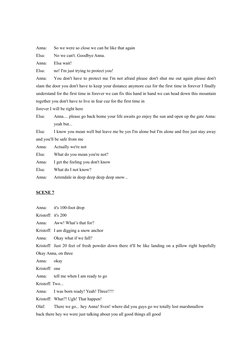
Frozen Musical Script Excerpt
Uploaded by
KingvalkyrieFrozen Musical Script Excerpt
Uploaded by
Kingvalkyrie- Scene 1
- Scene 2
- Scene 3
- Scene 4
- Scene 5
- Scene 6
- Scene 7
Common questions
Powered by AIHumor serves to lighten the mood and build camaraderie among the characters. Olaf's naive comments and Kristoff's sarcastic retorts provide comic relief amid tension, such as Olaf's misunderstanding of summer and Kristoff's teasing of Anna's quick romance decisions . The humor reflects the growing bond between them, with Olaf providing innocence and Kristoff grounding the conversations with reality .
Anna's determination is depicted through her unwavering desire to reconnect with Elsa and solve problems through personal resolve, shown by her focus on reaching Elsa despite challenges . Conversely, Kristoff's pragmatism is evident in his cautiousness and reliance on practical solutions, such as digging a snow anchor and warning Anna about the dangers of the mountain . Their dynamics highlight the balance between action-oriented courage and thoughtful caution.
Elsa exhibits a more defensive and isolationist leadership style, deciding to avoid confrontation with her fears by distancing herself, inadvertently causing Arendelle's plight . Anna, however, leads with an inclusive and conflict-resolution approach, seeking direct communication to resolve the crisis . Elsa's style results in unintended harm due to her lack of communication, while Anna's proactive approach aims to collaborate for peace and understanding, showing the importance of open dialogue in leadership.
The setting plays a pivotal role in illustrating themes of isolation and acceptance. Elsa's ice palace symbolizes her self-imposed seclusion and desire for freedom without societal judgment . In contrast, the harsh, snow-covered landscape reflects the consequences of her fear and lack of control, juxtaposing the idea of internal freedom with external chaos . The settings underscore the characters' struggles and the need for reconciliation and understanding.
The script subverts traditional fairy tale tropes through humor, particularly in Olaf's naivety and Kristoff's cynical remarks on romance. Olaf's misconceptions about the nature of summer humorously undercut the usual association of eternal winters with coldhearted villains, bringing warmth and innocence instead . Kristoff mocks Anna's belief in "true love" at first sight, poking fun at the cliché of instantaneous romantic destinies . These elements challenge standard tropes by highlighting practicality and self-awareness.
Olaf represents childlike innocence and optimism, embodying themes of warmth and connection amidst adversity. His creation by Elsa links past to present, reminding her of happier times with Anna . Olaf's desire for things like summer humorously contrasts his snowman nature, symbolizing hope and the possibility of change . He advances the plot by helping guide Anna to Elsa, indicating the importance of bonds in overcoming emotional and physical obstacles.
Elsa's relationship with her powers is central to her character development. Her fear of harming others due to her uncontrolled powers leads her to isolate herself, as seen when she insists on staying away for Anna's safety . Elsa chooses isolation and attempts to protect Anna through distance, reflecting her internal struggle between her powers and her identity. This influences her decision to stay in the ice palace, as she believes she can be herself without risk to others .
The script portrays fear of the unknown through Elsa's hesitation and self-isolation. Her fear of her uncontrollable powers leads to isolation and a lack of awareness about the outside world's consequences, like Arendelle's endless winter . Kristoff shows skepticism about Anna's impulsive actions, stemming from his practical experience, while Anna's lack of fear in seeking Elsa illustrates her faith in love and connection despite uncertainty . This contrast highlights different reactions to fear and unknown outcomes.
The interaction on the mountainside showcases trust developments as Anna insists on meeting Elsa despite Kristoff's doubts. Kristoff's warnings and guidance indicate his growing protective instincts and pragmatism, while Anna's insistence reflects her personal growth in courage . This dynamic shows that trust is built through shared challenges and willingness to rely on each other despite their different approaches.
Environmental obstacles, such as snowstorms and treacherous terrain, serve as catalysts for character interaction and development. They force collaboration between Anna and Kristoff, revealing their strengths and differences in approach; Kristoff's survival instincts and Anna's determination come to the forefront . These settings compel them to rely on one another, fostering trust and partnership incrementally as they overcome natural challenges, thereby shaping their relationship and individual growth.