100%(3)100% found this document useful (3 votes)
205 views29 pagesAircraft Profile 262 Republic p47 N Thunderbolt
P-47 Thunderbolt.
Uploaded by
Cesar CarpoCopyright
© All Rights Reserved
We take content rights seriously. If you suspect this is your content, claim it here.
Available Formats
Download as PDF or read online on Scribd
100%(3)100% found this document useful (3 votes)
205 views29 pagesAircraft Profile 262 Republic p47 N Thunderbolt
P-47 Thunderbolt.
Uploaded by
Cesar CarpoCopyright
© All Rights Reserved
We take content rights seriously. If you suspect this is your content, claim it here.
Available Formats
Download as PDF or read online on Scribd
- Republic P-47N Thunderbolt
- Variants and Technical Specifications
- Operational History
- Paint Schemes and Identification
- Specifications and Performance Data
- Index and Additional Resources
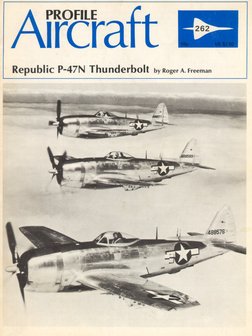
AitCcratt
Republic P-47N Thunderbolt by roger A. Freeman
Editorially
speaking...
No. 30
AUTHORS DO TRY. Especially authors of Proffes Mining for
fhe acts, Right up tothe very lat minutes, Sometimes tere
tre "Creumstances Beyond Qur Contre”. 50 the Editor
‘ecommodates
But then, lke the sad story of The-ish-That-Got-Away
happy story, fabemse, there comes atime when the Editor
yl "Too late
in fact there was a ease ony the other day. "ignore this
wrote the Author traveling hopefully, “io late, bur some o
Republic's tals Thunderbots were distinguished by deep
‘low painted cowlings and ais, Other a afc was advised
{o keep clear of thew easly recognized test aircraft which
might be engage in special measured ight run
Ten ut often for rying ‘CHARLES W. CAIN
ABOUT THE AUTHOR
No. 262: Republic PA7N Thunderbolt
Roger A Freeman was bor raised! and now farm Beals
ast Anglia. World War Two, young Freeman was Bterally
{stones throw away from the genuine article. Needless (0
Say they were P47 Thanderboks ofthe Mh Ai Force.
Roger Freeman writes on the USAAF/USAP wah such
authority that he has gained adricing recogntion among,
“dscerning Americanthstorans—natleattor hs massive tome
{YOUR NEXT AIRCRAFT PROFILE No, 263
No. 262: Dornier Do 235 variants
Here's a foretaste of the good t
Lelebwe’s satisfyingly iustrated frst Protie The baby C8 9
miele! was a Do 235 test vehicle and the 135-patented
Kaan Jona 10 figheer-bomber (oviow) wil surprise many:
No. 243 Pre coming soo"!
vxavuns
Now available
completely d
revolutionary swing ng,
{hroseater that serves it
both the Tactical ana
Strategic Air Command
the USAE respectively in
Tactical ighter and Bor
‘arcs Mediu) Wings,
"Author Kutt Micka
provides an exhau sive
Sedywerthy ofthis
imnprtsive etal, Colour
ntwote by 6 Trt, depicts
Ft subsvarante A. 8c,
Eand Fang 8-1,
Sire Merten" Mcdonald, He povinw Pre Wes
Nov bie! ng 87C Fone
z rorxer
Profile Finder No. 3 ee eens Oy, ‘Hine drawings, with cross 50
Thststhe third ee Profle Nox 2604260 ffourpare | 88/3 8200 fDr' CTripiane) coe anes
seer ena ues pahed tom cite | 86/2 BO0a Monorlanes (Eindecker) sa lt sical Lid 13 96 Se
2 toe cea adore ae ped onde Corea Spread enue rom eciee
‘inside back cover of this Prose. ‘ehay Send 3p/26c S.A.£. for their full price list
eIvReL Bata Areca trons
te como Hott
Bile ob Mote (Salamenden
errr ye Orein and Puriedor Oo) | HA uemns 1611 (eam
By Country of Origin and Period of U Figo cama e218 Une Se
() ececWorkiwart 1814-18 eee Japan (“Aid code names)
@) GuesPom- waa . es open Hetee 2arn2 coms Bix (va) & Yokomta Dav
Centie Joweees ove al Yokosuka
@ pankergipiancastanicley 177/8 0m) Ju52 Series (Ju52/3m) (Judy) Carrier bombers
(@) ockmPost WW. 19606-1970 Tee Some lueraset suas em KAWANISH
We riecaee Gani ihmos 3 Bona} 239/11 coma Four-otor Hing bow
1 51/7—Prle No, 181 tbe foundin 21110 come tye7 Baran (Sula) HokMave so ax
toueivoune? ea env
aya come Iwona 213/10 come Kyuly: Shien Shien AL
320) Sous ibeehign rghor Aiur Roc Geos)
ia Moncolshes(Bleches) os
Pee ScehoLAND) 05/5 como thite teons( Nick)
a fuessenscnr? MG S205 "eco ent Sone ss
2 eiGse Ce emt 1
Germany | ie Sons Tetowrts tion | 250 como ABhitgne Sonczoeve
ae fo Gum nut *fowpiene)
1276 acaags bm ZN comsteemo(oayFighters) — | 19078 como AsNeszuo Sen Hamo'*)
in mecedoy ors eriiowekersntar) Hehe Coma taaMereeo Son (2a
Belt cms the tesecmet ena etes
"ARADO Jer/7) mo tMozt0(at0 Series ae PU eens
215/10 come Areata 3Sile Soc timeaee (Serwslbey Sane
AVIATIR (oa 8. Anat Stormvoge 20/9 coms GAM Bety © (&Ohka Bomb
erg Auto Hangs) pear eae)
BucKER 442. wscopbill 17/8 oma GAN Sey #6 6-597
Pa ioeio einen tile Boctoxh eox MED oper)
bonwien "PHONIX (see AUSTRIA. aaa Kicas (Dinah)
eufeeeee ieee RONAN aie coun RA
POLAND (LEG) © ate -
zavouee aan 199/7 wcooteintwatechy Ways) Ska Reaseleyabima (Oscar®)
11 como 38hia came Katsnon Cie)
FOCKE-WULF SIEMENS-SCHUCKERT 70/3 mo Ki-84 Hayate (Frank’*)
ah poor 804 woootbiten Koosinae
Beja 105 "R180 Oya 1s2Series Der Bay (ey) (ae ACH
33/6 cont Fw200 Condor 273 oaco UAE Famingo Bans
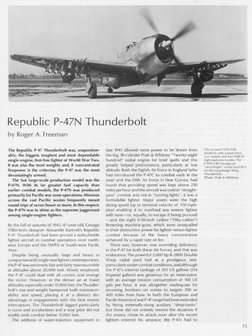
Republic P-47N Thunderbolt
by Roger A. Freeman
The Republic P-47 Thunderbolt was, unquestion-
ably, the biggest, toughest and most dependable
single-engine, first-line fighter of World War Two.
tt was also the most weighty and, it concentrated
firepower is the criterion, the P-47 was the most
devastatingly armed.
The last large-scale production model was the
P-47N. With its far greater fuel capacity than
earlier combat models, the P-47N was produced
primarily for Pacific war zone operations. Missions
across the vast Pacific wastes frequently meant
round trips of seven hours or more. In this respect,
the P-47N was to shine as the supreme juggernaut
among single-engine fighters.
By the F
Tifls}-born designer Alexander Kartveli's Republic
P-47 Thunderbolt had been proved a redoubtable
fighter aircraft in combat operations over north
west Europe and the SWPA or South-west Pacific
Area,
Despite being unusually large and heavy in
comparisonwith single-seat fighter contemporaries,
theP-47 was extremely fast and fairly manoeuvrable
at altitudes above 20,000 feet. Wisely employed,
the P-47 could duel with all comers and emerge
the victor. However, in the denser air at lower
altitudes, especially under 15,000 feet, the Thunder-
bolt’s size and weight hampered both manoeuvr-
ability and speed, placing i at a distinct dis-
advantage in engagements with the best enemy
interceptors, The Thunderbolt lagged particularly
in turns and acceleration and a wise pilot did not
readily seek combat below 15,000 feet
The addition of wate
all or autumn of 1943, 47-year-old, Georgia
injection equipment in
late 1943 allowed more power to be drawn from
the big 18-cylinder Prat & Whitney “Twenty-eight
hundred’ radial engine for brief spels and this
greatly helped performance, particularly at low
altitude. Both the Eighth Air Force in England (who
had introduced the P-47C to combat early in the
year) and the Fith Air Force in New Guinea, had
found that providing speed was kept above 250
miles per hour and the aircraft was used in "straight-
pase" combat and not in “turning-ights’, it was a
formidable fighter. Major assets were the high
diving speed (up to terminal velocity of 550 mph-
plus) enabling it to overhaul any enemy fighter
with ease—or, equally to escape if being pursued
—and the eight 0-50-inch calibre (Fifty-caliber’)
Browning machine-guns, which were unequalled
in their destructive power for ighter-versus-ighter
combat because of the heavy concentration
achieved by a rapid rate of fire.
There was, however, one overriding deficiency
in the P-47 for both these Air Forces, and that was
endurance. The powerlul ,000 hp R-2800 Double
Wasp radial used fuel at a prodigious rate
particularly under combat conditions, and although
the P-47's internal tankage of 305 US gallons (254
Imperial gallons) was generous for an interceptor,
with an average mission consumption of 100 US
gals per hour, it was altogether inadequate for
bombers on sorties to targets 300 or
400 miles from base. in both the European and
Pacific theatres of war -47rangehad been extended
by fitting [Link] “drop-tanks”
but these did not entirely resolve the situation. ff
the enemy chose to attack soon after the escort
fighters entered his airspace, the P-47s had. to
3
jettison theirdrop-tanksin ordertoattain maximum
Speed and manoeuvrability in combat. This actios
seriously depleted fuel supplies and effect
prevented the Thunderbolts from continuing the
x dealing with their antagonists
The manufacturers, Republic Aviation Corpor
ation of Farmingdale, Long, Island, New York, were
appropriate United States Army
pressed by the
Air Forces agencies to build greater endurance
into the Thunderbolt. Republic engineering rep
resentatives, with Fifth and Eighth Air Force fighter
Br
Farmingdale.
P-47 become
studies team at Republic
The two fuel tanks in the P-47's fusela
situated around the aircraft's centre-of-gravity
the main tank of 205 US gallons capacity being
placed forward and below the instrument panel
ps in the field, forwarded similar views to
endurance of the
with the design
‘a. major priority
firewall. Republic engineers found that space was
available to allow this tank to be increased in size,
and redesign enabled an extra 65 US gals to be
accommodated. The new tank was introduced on
the Farmingdale production-line with the P-47D-
5-RA which began reaching operational units
the early winter of 1943. Welcome as this ext
gallonage was, & still did not enhance the opera:
tional employment of the Thunderbolt, to any
The problems of adding stil
further internal tankage were explored throughout
the winter of 1943-44. For example, it was evident
that no more 1 fuel could be found in the
fuselage without a major redesign, Similarly, there
‘was also no place in the wing where fuel cells
could be squeezed-—unless the wing were to be
enlarged. Design studies eventually produced a
marked degree
solution that would not only double the aircraft's
range but, also, would confine essential new
engineering mainly to one major component—
thus causing minimum disruption of continuing
production.
Basically, the inner section of each wing was
len
Four small, interconnected, fuel cells with a total
capacity of 100 US gals were placed in this root
area between the main undercarriage and the
age. Ths kept the additional fuel weight
around the centre-of-gravity so that light charac-
Id not be adversely affected, The
jun compartment of the
inner wing, section remained largely unchanged
although the undercarriage tread was increased
sthened by some 1 inches at the root end.
oto. Harold Martin
by 24inches, To reduce the span, the characteristic-
ally Kartveli-curved wing tips which distinguished
earlier Thunderbolts were deleted and a “clipped”
fairing substituted, Even so, the overall span was
still (© be some 1B inches greater than with the
original P-47 wing,
Known as the “Long-Range Wing’, the new
structure was first tested on the experimental
model XP-47K (AAF serial: 42-8702), This particular
aircraft, the last P-47D-5-RE from the Farmingdale
production line was the fit Thunderbolt to be
‘modified in the summer of 1943 to take 2 360!
vision “bubble” hood to improve the pilot's all
round visibility. This canopy was eventually intro-
duced into production on late-block P-47Ds. After
the successful completion of these experiments,
the XP-47K was selected for reworking with the
Long-Range Wing since it had already been
planned that a production aircraft with the new
wing would also feature the bubble canopy. At
the time this project was initiated, no production
47s with a bubble hood were yet available,
The XP-47K with the Long-Range Wing was
tested during the spring of 1944. While being
declared satisfactory for operations at all normal
flight altitudes, the increase in gross weight had
a telling effect on performance, despite being
fitted with a R-2800-59 incorporating water
injection. However, for production versions the
uprated R-2800-57 "C’-seriesengine was projected.
This engine could produce 2,800 hp at maximum
output (brief periods only) compared with 2,300
hp for the R-2800-59 “B"-series!
Similar to the “B"-series Double Wasp, the "C’
incorporated a number of changes and improve-
jents to provide greater power and increased
ngine speed without increases in cylinder dis
placement or weight. In fact, it was slightly lighter
than the “B'-series models. The US Navy had
originally ordered and funded the “C” engine.
Better cooling provided by additional cylinder fin
‘area—in conjunction with other refinements—
permitted the use of a higher maximum manifold-
pressure, namely 72 inches Hg (boost) with water
injection as against the “B’-series’ 64 inches Hg
with water
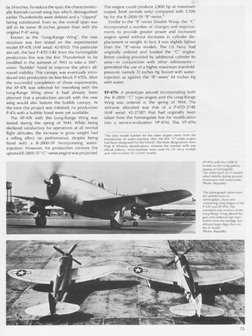
XP-47N: A prototype aircraft incorporating both
the R-2800 “C” type engine and the Long-Range
‘Wing was ordered in the spring of 1044. The
airframe allocated was that of a P-47D-27-RE
(AF serial: 42-27387) that had originally been
taken from the Farmingdale li
into a service-evaluation YP-47M. This YP.
for modification
the older engine stems fo the
the USAAF. The eter designations were
Prats & Whey sdenficationy, whereas the number suf was
‘fica riltayeverrnimier were used for US Navy model
service-test designation version of the P-47D was
fitted with the R-2800 °C" engine. Apart from the
‘C engine and Long-Range Wing the XP-47N
featured a number of other changes, notably
automatic engine control devices to ease the
pilot’s monitoring lot on long-range flights. The
Unilever Control system coupled the
controls for throttle, boost (turbosupercharger!
and_ propeller-pitct
them, subject to the prevailing altitude and the
power setting of the lever. Work on the prototype
Power
and automatically. varied
took only 56 days to complete.
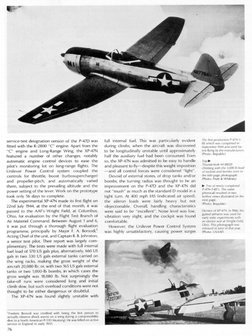
The experimental XP-47N made its first flight on
2and July 1944, at the end of that month, it was
passed to the AAPs:Wright Field, at Columbus,
‘Ohio, for evaluation by the Flight Test Branch of
Air Materiel Command, Between August 1 and 6,
it was put through a thorough fight evaluation
programme, principally by Major F. A. Borsodi
Acting Chief of the unit, and Captain R.B. Johnston,
a senior test pilot. Their report was largely com:
plimentary. The tests were made with full internal
fuel load of 570 US gals plus, alternatively, 660 US
gals in two. 330 US gals external tanks carried on
the wing racks, making the gross weight of the
aircraft 20,080 Ib; or, with two 165 US gals external
tanks oF two 7,000-Ib bombs, in which cases the
gross weight was 18,080 Ib, Not surprisingly the
take-off runs were considered long and initial
climb slow, but such overload conditions were not
thought to be either dangerous or doubttul
The XP-47N was found slightly unstable with
full internal fuel. This was particularly evident
during climbs, when the aircraft was discovered
to be longitudinally unstable until approximately
half the auxiliary fuel had been consumed, Even
s0, the XP-47N was admitted to be easy to handle
and pleasant to fly—despite this weight imposition
—and all control forces were considered “tk
Devoid of external stores, of drop tanks and/or
bombs, the turning radius was thought to be an
improvement on the P-47D and the XP-47N did
as much as the standard D model
tight tum. At 400 mph IAS (indicated air speed,
the aileron loads were fairy heavy but not
objectionable. Overall, b
excellent
idling. characteristics
were said to be Noise level was low,
ion very slight, and the cockpit was found
comfortable.
However, the Unilever Power Control System
was highly unsa causing power surges
. a
fon
in climbs, propeller over-speeding and undue
pe slight movement of the
ever. Because of this erratic behaviour both
‘Wright Field test pilots disconnected the system
bolore effecting land!
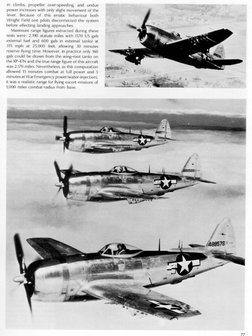
Maximum range figures extra
tests were: 2,190 statute miles with (570 US gals
315 mph at
reserve flying
approaches
600 gals in external tanks) at
00 feet, allowing 30 minutes
me. However, in practice only 160
gals could be drawn from the win
the XP-47N and the true range fi
\was 2,170 miles. Nevertheless, as this computation
allowed 15 minutes combat at full power and 5
minutes at War Eme
it was a realistic range for fying escort missions of
re ofthis airerait
fency power|water-injection)
1,000 miles combat-radius from base,
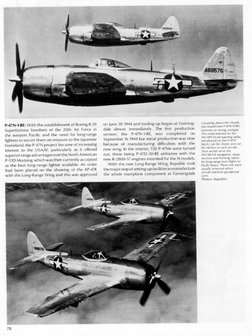
P-47N-ERE: With the establishment of Boeing B-29
Superfortress bombers of the 20th Air Force in
the westem Pacific and the need for long-range
fighters to escort ther on missions to the Japanese
homeland, the P-47N project became of increasing
interest to the USAAF, particularly as it offered
superior range advantages overthe North American
P-51D Mustang, which was then currently accepted
as the best Jong-range fighter available. An order
had been placed on the showing of the XP-47K
«with the Long-Range Wing and this was approved
fon June 30 1944 and tooli
dale almost immediately. The first production
version, the P-47N-TRE, was co
September 16 1944 but initial production was slow
because of manufacturing difficulties with the
m, 130 P-47Ms were turned
30-RE airframes with the
up began at Farming
npleted on
new wing. In the inte
out, these being P-4
new R-2800-57 engines intended for the N models.
With the new Long-Range Wing, Republic took
the majorstep of setting-up facilities to manufacture
whereas wing production for P-47Ds had beer
sub-contracted. A new wing shop was created
and this, inevitably, involved a sl put-per
man-hour problem until production was running
smoothly. To begin with, to tum out the first 50
P-47N wings (less accessories! absorbed 8,600
man-hours per set; while the average inclusive
total man-hours required for each of this frst 50
P-47N-1-REs completed was 25,439. This contrasts
icantly with the rates six months later, wher
production was in full swing. Manufacture o
wing-sets was then taking 1900 man-hours—a
reduction of 78 per cent, and, equally effectively
the time requirement for a complete aircraft had
been cut to 7,236 man-hours
The P-47N-J-RE incorporated a number of
refinements in the light of trials with the pro
lier troublesome experience
Because of the ¢
with the Unilever his uni
‘was not installed, The wing tanks were rates
168 US gals capacity but were shaped so that all
fuel could be withdrawn. Apart from the new
Long-Range Wing and “C" engine, the P-47N--R
differed from the last P-47D-30-RE in the following,
respects. AGeneralElectric CH-Sturbosupercharger
provided greater carburettor ai pressure with only
a small increase in displacement and weight. An
electrical regulator for the “turbo” provided more
constant carburettor air pressure at vary
altitudes. kt was actuated by a sensing tube in the
ks. A manifold-pressure switch auto-
on if the boost
exhaust st
matically introduced water-injec
control was advanced to a point where detonation
would occur without water, and thus guarding
against abuse of the engine. Automatic heat
‘controls—thetmal sensitive units operating electric
tors and hydraulic systems—took care of
engine cow! flaps and inter-cooler radiator doors.
‘Cockpit heating was also automatically controlled.
he frst 550 P-A7N-T-RES had
left the Farmingdale lines, several changes
oved and incorporated on the next 550
airframes, which had N-5-RE block numbers. Mast
of the changes involved combat equipment. Five
zero-length, rocket-launchers to carry a missile
each were installed under each wing, Provision
was made for the quick removal of wing tank
racks to cater for short-duration, tactical missions.
A tal warning radar (AN/APS-13), homing radic
(SCR-522) and minor changes to the VHF set were
‘other items involved. A vacuum tapping was
fitted in the cockpit for a pilot wearing a Berger
sed with
G-Suit” and the rudder pedals were re
better adjustment to suit individual measurements,
AC
nneral Electric G-1 auto-pilot unit permitted
to counter pilot-fatigue or
long-distance missions. A final provision was
catapault attachment with a view to launching
P-47Ns from aircraft-catriers to facilitate speedy
jelivery to forward bases on Paciic islands.
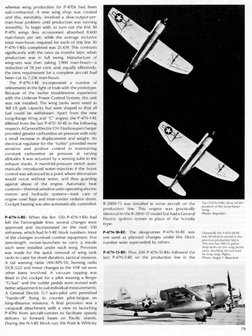
During the N-5-RE block run, the Pratt & Whitney
R-280¢
3 was installed in som
n the
his engine was practically
identical to the R-2800-57 mode! but hs
Electric
type
P-47N-10-RE:
not used as plar
number were superseded by others
P-ATN-
PAIN-5-RE
The designat
stem in place of
ned chat
RE: Thus 200 P-47N-15-REs f
nthe production
aGe
2S)
intilla
spring of 1945, Aircraft in the new ‘N-15-RE block
had a more reliable and neater bomb rack—the
S-THin preference to the earlier B-10 rack, an
improved gyroscopic gunsight,
the pilot’s seat. The overspeed warning light and
tachometer were no longer installed with the
instrumentation. Additionally, although provision
was stil made for the General Electric G-1 auto
pilot. it was not included because of shortage of
Supplies from the manufacturers
nd arm rests on
P-47N-20-RE: The auto-pilot was also missing from
the next block, namely 200 P-47N-20-REs, which
featured a change of radio, an emergency fuel
system—in case normal pumps failed—and a
different make of manifold-pressure switch for the:
automatic injection of water, Also there was
provision for individual pressurizing of the drop.
tanks, which permitted the combat option of
mixed loads of bombs and fuel tanks.
Both R-2600-73 and -77 model engines were
installed on late production P-47Ns, the main
difference being the magneto, the Scintila type
used on the -57 having been re-introduced on the
7.
PAA7NAS-RA: From the outset of the USAAF
acceptance of the P-47N, plans were laid for all
Thunderbolt. production lines to embrace this
model eventually, However, the Evansville plant
in Indiana continued manufacturing P-47Ds until
thespring of 1945 and did not begin to manufacture
P-47N models until July, when the first P-47N-15-RAs
‘were assembled. This model was complementary
to the P-47N-20-RE, with the exception of a revised
cockpit floor with smooth rudder pedal track which
was introduced on the 77th aircraft of this block.
By this time hostilities had ceased and drastic cuts
in aircraft orders were forthcoming. Production at
Evansville was tailed-off during September 1945
80
and only 149 examples of the P-47N we’
by that plant
recompleted
PA47N-25-RE: The last Thunderbolt block from
Farmingdale was the P-47N-25-RE. This model had
the revised cockpit flooring ofthe late P-47N-15-RAs
and several other changes. These involved a
redesigned tailwheel linkage, reinforced aileron
and flaps—to withstand rocket blastat launching
auxiliary cockpit ventilation, and Automatic Engine
Controls AEC). The normal P-47 control quadrant
situated on the left side of the cockpit—consisted
‘of four levers for operating boost, throttle
propeller pitch, and mixture control. There hac
been several attempts at providing sequential
‘operation of these long-range, bomber-escort
controls to relieve the pilot of the complex task
of juggling with the individual levers. Faulty
‘manipulation could, in extreme circumstances,
lead to a “detonated” engine. The Unilever Power
Control system as installed on the XP-47N had
proved disappointing and was discontinued. AEC
was not such an ambitious device, coupling only
the throttle and turbosupercharger regulator but
in such a way that the carburettor butterfies had
to be fully open before the “turbo” was brought
into operation. A single lever (Power Lever) now
combined the functions of the former boost and
throttle levers. With the General Electric G-1 supply
position now improved P-47N-25-REs, the autor
pilot was fitted again. From aircraft AAP serial
‘44-89304 onwards thewingtiplights were relocated
to give hemispheric visibility
Production at Farmingdale was terminated in
October 1945 with the completion of 167 P-47N-
25-REs. The last aircraft was, however, not delivered
until the end of the year. A grand total of 15,683
P-47s ofall madels had been manufactured in four
years, The highest total for any American fighter
aircraft of World War Two, Spare parts amounted
re Ma
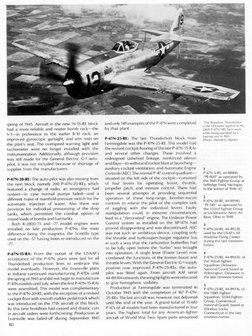
PLaIN-S-RE, 44-88800
F-B00” as operated! by
the 56th Fighter Croup at
Selfridge Feld, Mich
in the winter of 1846
2
P-ATN-20-RE, 44-89160,
FF-40” as operated by
the 332nd Fighter Group,
at Lockboure Ary A
Base, Ohio in 198,
a
PHAIN-2O-RE 44-09238,
used by the USAF’ All
Weather Flying Center
during the late nineteen
fories
4
PoATN-25-RE, 44-09430, of
the 12nd Fighter
Squadron, Delaware
National Guard based at
Wilmington, Delaware in
the late nineteen-forties,
3
PrAPN-25-RE, 44-09316, of,
the Tih Fighter
Squadion, 103d Fighter
Group, Connecticut
National Guard, based at
Windsor Locks,
Connecticut n the late
. oan ‘i
— Je i:
to approximately anather 3,000 P-47
for nearly 6,000 N models wer
the end of hostilities
its. Orders
ancelled after
The P-47 in service
Although the first P-47N--RE was completed in
September 1944, production of this model did not
really get under way until December, with the
USAAF's first sizeable acceptances in January 1945,
The early examples were issued to the 413th
#14th and 507th Fighter Groups, all of which had
been formed in October 1944 for the express
purpose of providing an escort-ighter force for
Very Heavy Bomberst
missions in the Pacific war zones.
While the P-47N had been desig
long-range requirements of Pacific theatres, it was
the intention to re-equip the sole remaining P-47
escort group in Europe—the 56th Fighter Group:
with this model. However, the first shipment of
47N-5-REs did not arrive in England until April
1945, and when hostilities ceased in early May
he few examples known to have been assembled
2t Speke, near the port of Liverpool, were promptly
shipped out the USA?
Asa first step in establishinga foree of long-range:
Thunderbolts in the westem Pacific, it was planned
convert the experienced 318th Fighter Group.
from the P-47D to the P-47N,
47 unit in the central Pacific area, had entered
combat in june during the campaign to
capture the principal islands of the Marianas chain
so that bases could be constructed to enable
B-29 Superfortresses to carry out bombing raids
fon the Japanese hame islands some 1,500 miles
distant. On completion of the
support by ground forces on Saipan, Tinian and
his group, the only
Guam, the P-47Ds of the 318th’s three squad
were chiefly involved in flying defensive patrols.
In March and April 1945, plots of the 318th were
flown by transports to Hawai, where P-47Ns had
py ship and were being assembled. After
familiarization fights over Hawaii, the new Thunder-
bolts were flown by stages across the Pacific for
4,100 miles to the recently captured island of le
Shima, afew miles of the western coast of Okinawa
in the Ryukyu chain, and only 325 miles from the
rpearest point on the Japanese mainland
the United States were soon to follow the 318th.
The 413th Group left its Noth C
field early in April 1945 wit
three groups specially trained on P-47Ns in
the pilots proceeding
Republic P-47N-15-RE Thunderbolt (US Ait Force serial: 4489051, asi appeared
in May 1951 when assigned to the W7th Fighter Squadron, 1th Fighter Croup,
Pennsylvania Air National Guard, and based at Pitsburgh, Lieutenant Edward |
Bollen was the usual plot and the aircraft was named “Eadie Mae” ater his wife
1. Britain'T. Hadler © Profe Publications tic
to Hawaii, where they collected P-47Ns and flew
them to le Shima, However, while on route they
were detained on Saipan and received a baptism
of fire when ordered to undertake two ground
strafing missions to the Truk Islands. The 413th
Group sas established on le Shima by mid-May
and the 507th Group arrived a month later and
went on its first operation on July 1
Mei
B-29 had changed, with many attacks on Japan
being carried out in darkness. This meant that
there was less call for long-range escort and the
three P-47N groups on le Shima were directed
‘mainly to long-range strafing and bombing attacks,
the targets being airfields and communication
systems in Japanese occupied territories in China
and Korea as well as the enemy homeland.
The 4ath Fighter Group began its movement
to the Pacific in May 1945 along a similar route
but its destination was Iwo Jima. This. toughly
defended island wastaken at great loss of American
and Japanese lives for the express. purpose of
establishing an advanced USAAF airbase ap-
proximately half-way between Japan and the
B-29 bases in the Marianas, lwo was 660 miles
from the nearest point on Kyushu, the southern
island of Japan, and 900 miles east of le Shima,
home of the other three P-47N groups. Three North
American P-51 Mustang groups were already
nwhile, the mode of employment of the
‘established on Iwo Jima but the 414th was to be
the only Thunderbolt group operating from the
island and, for that matter, the last fighter forma-
tion sent to the 20th Air Force for escort and
support duties. Had the war against Japan
continued into the autumn and winter of 1945,
it was planned to re-equip a number of fighter
‘groups redeployed from Europe with the P-47N,
but by August 1945 it was evident that they would
not be needed,
Part of the 414th Fighter Group spent a short
period on Guam during its movement to lwo Jima
and while there flew its first combat operation, a
ground attack mission to the Truk Islands on July
13, Operations from wo began later in the month
with missions to attack Japanese ground forces
still holding out on neighbouring islands. In August
the group undertook missions to Japan which
involved double the distance of that which the
sister groups in le Shima were flying. Specially
assigned 8-29 navigation “pathlinders” led. the
Thunderbolts to and from Japan; even so, not
every fighter could rendezvous on
return journey. It was indeed a daunting prospect
for the pilot who had to find his own way back
600 miles to a small island in a vast ocean, On
return from the Group's first operation over
Kyushu on August 8, in support of B-29s bombing
Yawata, the fuel supplies of several Thunderbolts
for the
er 2,000 a ake
‘Photo: USAAR
1d to bale out in the
ling beneath the
mission flight lanes.
Lieutenant Robert Dunnavant, piloting a 437th
Fighter Squadron P-47N, spent the astonishing
period of 8 hours 45 minutes in the ait, His air-
craft's fuel tanks were so
eventually reached Iwo, that h
reach his base at North Field
small US Navy airstrip he located on the coast.
The operations conducted by the four P-#7
groups during the su of 1945 were pre
dominantly ground-attack with the main objectives
being airfields, railways, shipping. and radar installa
pleted when he
dared not try t
instead at a
tions. Bombs were often carried when the objec
tives were within 500 miles of base, and drop
tanks were not required
The 318th Group was the only formation to see
considerable air combat with the P-47N,
primatily o its participation in air op
Kyushu during May and June 1945,
was considerable Ja directed
against American forces in the Ryukyu lands.
Between May 24 and June 22, the 318th claimed
13 Japanese aircraft shot down, By contrast
en there
7
during the previous 2
central Pacific area Hawai, Midway, Makin and
Saipan) only 48. “destroyed!
allowed and the majority of these while lying
Lockheed P-38) Lighenings. The fst enemy aircratt
shot down by a P-47N was a Japanese recon-
nnaissance aircraft encountered by Lieutenant
Wiliam Spencer on May 24. On the next day, a
formation of 318th Group aircraft was despatched
to bomb a target in Kyushu but the mission was
abandoned because of bad weather. Turning back,
the 318th chanced upon a Japanese air attack on
US shipping at Ryukyu Islands anchorages. Jettison-
ing their bombs, the Thunderbolts joined other
USAAF and USN fighters in interceptions.
During approximately four hours in the combat
area and for an expenditure of 34,558 rounds of
050-in calibre ammunition and 15,550 US gals of
fuel, the 318th destroyed no fewer than 34 enemy
aircraft without loss, Lieutenant Richard H. Ander
son alone accounted for five single-engine fighters
in one enemy formation he and his wingman
attacked,
‘On May 28 another 1 “kills” were credited plus
four “probables” during offensive patrols over
Kyushu and again a pilot, Captain John E. Vogt
formerly with the 56th Group in England—had
brought down five Onthis occasion three squadron
formations (consisting of two fights of four
aircraft each) were despatched at intervals during
the day, a tactic tried with success on other
‘An unusual combat occurred on June 6 when a
flight of P-47Ns patrolling at 21,000 feet over
Kysuhu were intercepted by seven Mitsubishi
‘AGM Zero-Sen ("Zeke") carrierborne fighters. The
leader of the flight, Captain Judge Wolte, was
carrying ground-attack rockets on his aircraft, but
instead of jettisoning these he decided to aim
them at an enemy aircraft that was making a
head-on approach, To the amazement of Captain
Wolfe the rockets scored a direct hit, destroying
the “Zeke”. Another 13 Japanese aircraft were
shot down on June 8 during a Japanese attempt
to attack airfields on le Shima. Two days later, on
years of operations in the
an escort and support mission for US. Navy
Consolidated PBAY photographic aircraft (USN
‘version of B-24 Liberator) lying over Kyushu ports
35 P-4INs of the 318th met’an estimated 130
Japanese fighters. Eight of the P-a7s not assigned
to close-escort engaged some of the enemy and
destroyed 7. Also on June 10, another 36th
formation—led by Major John Hussey—obtained
four more victories to bring the 318th’s score with
the P-47N to 102. Incidentally, Hussey was credited
with bringing down the Group's 100th Japanese
aircraft. Only one Thunderbolt had been lost on
operations during this successful month, This
occurred when a pilot failed to recover from a
steep dive initiated to attack a Japanese aircrat
‘ying low over the sea.
The 413th Group joined the 318th on operations
in the middle of June 1945, and the third group,
the 507th, made its debut at the beginning of
July. Encounters with enemy aircraft were now
comparatively few and not until August 8 did
the P-A7Ns experience stif opposition again, This
was the accasion of their only escort for a major
8-29 Superfortress strike at a Japanese target
Some 400 B-2%s despatched to bomb
Yawata, a large sted building complex in Kyushu
A force of 151 PA7Ns of the three le Shima
based groups gave target suppor, fying below
and ahead ofthe bombers to meet any interceptors
sent up to challenge the raid. The raid provided
some of the fiercest air battles to take place over
Kyushu and an estimated 60 Japanese fighters of
many types were involved. In numerous combats
1B were claimed for the loss of five P-47Ns, four of
whose pilots baled out over the sea. Most of the
action involved the 507th Group which had an
even more successful mission on August 13 while
fying a long-range sweep over Korea. In tis final
action involving P-47Ns, the 507th made claims of
20 enemy fighters for the loss of one of is own,
aircraft
The 414th Group was only in action from Iwo
Jima for three weeks before the end of the war and
during this period it met little enemy air opposition
The sole claim was a reconnaissance aitcratt that
Afith aspect of
Lieutenant E | Boller’s
PHATN-IS-RE "Fade Mac
depicted on two eather
colour pages
Tal Markings used by the
twelve PAN squadrons
‘perating in the westery
Pacific inthe summer of
1945, Squadrons within
leach Group are presented
in vertical Columns
A Cae Chie ste on he
Thunderbok obese
ne he
two of the 414th
47N pilots caught while on
patrol
toth
of aircraft shot down in air fights, because of the
speed and confused nature of most combats.
Even allowing for some over-statement of the true
figure, the record of the P-47N units during their
brief period of combat is stil remarkable. This
success is due primarily to good fighting tactics
and well trained pilots; attributes which wer
rarely true of their Japanese veteran-depleted
opponents during the
The main Japanese fighters adversaries were the
ast few months of hostilities,
Imperial Army's Nakajima Ki-#4 (Toja”), and the
imperial Navy's Mitsubishi AGM Zero-Sen "Zeke
Each was only half the weight of a P-47N and could
boast tactical advantages of superior p
in climb, in acceleration and in manoeuvrabil
particularly at altitudes below 20,04
‘most encounters took place.
t where
the USAAF
had long practised the “civin echnique ¢
attacking Japanese aircraft and avoided “turning
hts
in which the enemy aircraft would almost be
sure to gain the advai
A straight-through,
diving-pass—using the m 4 the dive to
‘zoom” climb away to a position from which the
nanoeuvre could be repeated—was the technique
that obtained most P-47N “kills”. The P-47N had a
formidable firepower and a very short burst from
the eight 050-in,
ufficient to explode the Japanese fighte
aibee Brownings was usually
with its
vulnerable fuel system. The American pilots also
had the advantage of the then, new, “gyto!
‘omputing gunsight which gave remarkable ac
‘uracy in’ deflection shooting, and the Berger
'GSuit” which reduced the “black-out” effects
of gravitation pull during violent manoeuvres,
By comparison, most Japanese fighter types had to
pay the price for their light construction, Whereas
the P-47N, like earlier Thunderbolts, could
often did absorb considerable battle damage and
still bring theie wea
pilots back safely to base.
Alter VJ-Day
Once peace came to the western Pacific
remained in the area for
summer of 1946.
The three groups on le Sh
Okinawa
and the 318th was disp
ate in 19
eventually inactivated. The 413th 2
ndured until the summer of 1946 wher
were inactivated. The lone Fighter Group on lwo
Jima, the 444th, was moved to Luzon, in the
Philippines, in December 1945 but survived in
activation only until the following summer. The
Dist Fie! veteran of the Pacific Theatre
feted from P-51 Must
m in April 1946, but its existe
id the formation was inactivated
lowing October. Thereafter, P-47N-
mnits of the USAAF later
to the USA. The elite 56th
Michigan had a mixed
Pt North Amer
elore going over to
Lockheed P-80 Shooting Star jets.
Two regular Air Force groups remained w
Thunderbolt, the 14th at Dow Field, Maine
332nd at Lockbourne, Ohio, the latter being the
all-Neg ip. One of the 332nd!s three s
rons, the 99th, had operated P-47Ns with the 477th
Composite Group prior to the 332nd's reactivation
However, with a more enlightened
in July 19
ial policy this seg
disbanded in July 1949. The 4th Group also
relinquished its Thunderbolts that year, converting
to Republic F-84 Thunders.
not the end of the F-47N! in r
advent
se the
You might also like
- Aircraft Profile 035 - Curtiss p40 Tomahawk100% (4)Aircraft Profile 035 - Curtiss p40 Tomahawk12 pages
- Warpaint Special 1 Republic P-47 Thunderbolt.100% (10)Warpaint Special 1 Republic P-47 Thunderbolt.92 pages
- Classic Archives eBay Purchase Confirmation100% (4)Classic Archives eBay Purchase Confirmation13 pages
- (Aircraft Profile 213) - Kawanishi Kyofu, Shiden and Shiden Kai Variants PDF83% (6)(Aircraft Profile 213) - Kawanishi Kyofu, Shiden and Shiden Kai Variants PDF23 pages
- Messerschmitt Me 262: WWII Jet Fighter HistoryNo ratings yetMesserschmitt Me 262: WWII Jet Fighter History37 pages
- Monografie Lotnicze 031. Me 262 Schwalbe Cz.2100% (1)Monografie Lotnicze 031. Me 262 Schwalbe Cz.2107 pages
- Bf 109 Gustav: Wilde Sau Tactics ExplainedNo ratings yetBf 109 Gustav: Wilde Sau Tactics Explained21 pages
- Profile Publications - Aircraft Profile - 197 - Hawker Tempest I-VI100% (3)Profile Publications - Aircraft Profile - 197 - Hawker Tempest I-VI16 pages
- Modeller's Guide To Focke-Wulf FW 190 Variants Part I100% (1)Modeller's Guide To Focke-Wulf FW 190 Variants Part I22 pages
- (Crowood Press) (Aviation Series) Vickers-Armstrongs Wellington100% (5)(Crowood Press) (Aviation Series) Vickers-Armstrongs Wellington189 pages
- Camouflage and Markings 20 - Douglas A-20 Havoc71% (7)Camouflage and Markings 20 - Douglas A-20 Havoc24 pages
- (Aircraft Profile 045) - Curtiss Army Hawks PDF100% (3)(Aircraft Profile 045) - Curtiss Army Hawks PDF12 pages
- (Aircraft Profile 210) - Mitsubishi G4M Betty PDF75% (8)(Aircraft Profile 210) - Mitsubishi G4M Betty PDF20 pages
- Fdocuments - in Aerodata International 07 Handley Page Halifax100% (6)Fdocuments - in Aerodata International 07 Handley Page Halifax26 pages
- North American P-51D in Detail (Revisited) - Fuselages100% (1)North American P-51D in Detail (Revisited) - Fuselages10 pages
- (Aviation) - (Air Research) - Combat Units of The Regia Aeronautica Italian100% (1)(Aviation) - (Air Research) - Combat Units of The Regia Aeronautica Italian26 pages
- Camouflage & Markings - 02 - N. A. Mustang100% (3)Camouflage & Markings - 02 - N. A. Mustang24 pages
- Camouflage & Markings - 07 - Bristol Blenheim100% (4)Camouflage & Markings - 07 - Bristol Blenheim24 pages
- (Profile Publications) (Aircraft Profile 059) North American B-25A To G 'Mitchell'100% (3)(Profile Publications) (Aircraft Profile 059) North American B-25A To G 'Mitchell'12 pages
- Modeller's Guide To Early P-51 Mustang Variants100% (4)Modeller's Guide To Early P-51 Mustang Variants10 pages
- Camouflage & Markings of IJN Fighters ModelArt Second Edition100% (4)Camouflage & Markings of IJN Fighters ModelArt Second Edition30 pages
- Junkers 187 Collection by Classic Archives100% (2)Junkers 187 Collection by Classic Archives13 pages
- (Aircraft Profile 060) - Douglas Skyraider PDF100% (2)(Aircraft Profile 060) - Douglas Skyraider PDF12 pages
- Kookaburra Tech. Public. S01 08 - Republic P-47 Thunderbolt Described Part 1100% (12)Kookaburra Tech. Public. S01 08 - Republic P-47 Thunderbolt Described Part 128 pages
- (Aviation) - Dai-Nippon Kaiga Co - 1995 - Aero Detail 14 - Republic P-47 Thunderbolt100% (8)(Aviation) - Dai-Nippon Kaiga Co - 1995 - Aero Detail 14 - Republic P-47 Thunderbolt70 pages
- Camouflage and Markings 16 P 51 F 6 Mustang PDF100% (5)Camouflage and Markings 16 P 51 F 6 Mustang PDF24 pages
- Aircraft Profile 100 North American P 51b C Mustan PDF100% (2)Aircraft Profile 100 North American P 51b C Mustan PDF12 pages