



Water and sewer services are essential, but billing them accurately requires clean customer data, reliable meter readings, and a system that can apply complex rate rules consistently. Software for water utilities helps utilities manage customer accounts, run billing cycles, post payments, and reduce manual work, while improving customer experience with online payments and self-service.
Sewer and water billing systems can eliminate many manual, paper-based processes, offering a better experience for customers while providing many other benefits. Let’s take a closer look at sewer and water management software and how it can impact utility businesses.
Water utility billing software helps teams run billing cycles faster by automating billing runs, notices, payments, and account history. The best water billing systems reduce billing errors, improve collections, and give customers self-service options like online bill pay, autopay, and account access.
Water and sewer billing software is typically built on a customer information system (CIS) that centralizes account data, rate structures, billing history, and payment posting. In practice, most utilities evaluating utility billing programs are looking for one system that handles billing runs, collections, customer service workflows, and reporting without manual re-entry.
It facilitates processes like billing and payment collection through a self-service portal for customers and various backend resources for utility companies. Some of the functions you’ll find in sewer and water utility software include:
Your water utilities software should adapt to your current and future needs. For example, your software provider might tailor the solution to your needs and workflow. As technology changes, a provider should also offer ongoing support, such as security updates.
Utility bill software is a broad term that can apply to electric, gas, refuse, or water. Water billing software is designed to handle water-specific complexity like tiered usage rates, seasonal rules, sewer billing logic, and high-bill exceptions, without spreadsheets or manual calculations.
You may see several terms used interchangeably when comparing solutions:
If you’re comparing vendors, the safest approach is to evaluate the platform as water utility billing software first, then confirm operational modules (portal, notices, service orders) based on your needs. If you’re evaluating utility bill software, confirm it is purpose-built for water and sewer rate complexity (tiered rates, minimums, and adjustments) and not a generic invoicing tool.
Delivering these services can be complex, and sewer and water billing systems unlock benefits throughout the process, from enrolling new customers to improving on-time payment rates. With the ever-present need to work efficiently and stay up-to-date on technology demands, a utility company’s software for water sewer billing management system plays a significant role in staying competitive.
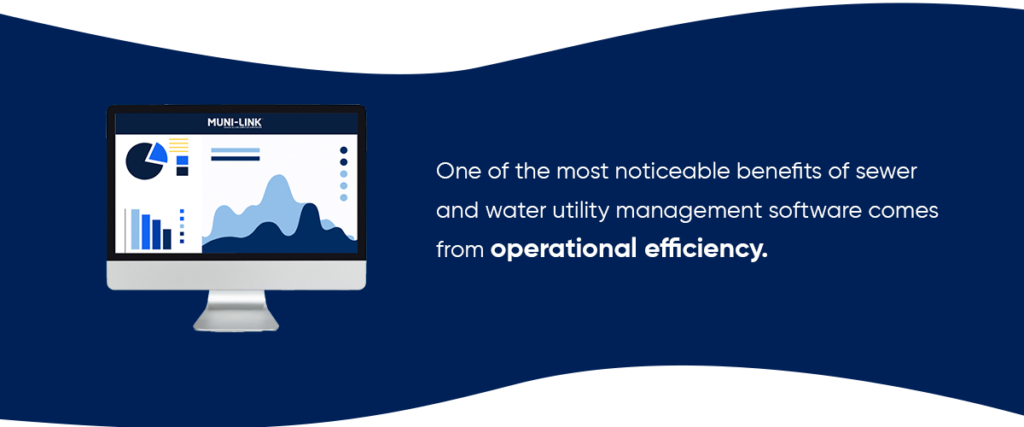
One of the most noticeable benefits of sewer and water utility management software comes from operational efficiency. It can streamline your workflow in many ways, such as automating tasks like invoicing customers and reading meters. Automation and integrations reduce manual data entry, which can boost accuracy and help you avoid costly or time-consuming errors from slow and unreliable paper-based systems. Many utilities start this search by looking for utility bill software, but the best results come from choosing purpose-built water utility billing software that handles tiered rates, sewer logic, and audit-ready billing history.
If your water and sewer utility software also offers a customer portal, it can reduce your team’s workload. Rather than calling one of your employees, users can take action online. A portal also helps water utility software deliver an exceptional customer experience. Today’s residents expect simple, 24/7 account management and flexible payment options. A water billing system allows utility providers to offer this modern experience and boost customer engagement.
These benefits are among the most valuable, but depending on its features, billing software can also help in areas like accounting, compliance and data security.
Importance of Customer Engagement
Conventional utility billing practices come with their share of challenges. A water system’s utility billing services can address these problems through different features and resources. Some common challenges include:
Billing depends on many kinds of data, from the customer’s name to the reading from their meter. Manually typing information can lead to human error and discrepancies. For example, an employee could mistype information in a document or misread a meter.
With the help of seamless integrations and automation, water bill management systems can significantly improve accuracy by eliminating these opportunities for errors.
Utility companies often face cash flow issues due to slow billing processes or cumbersome payment collection options. Sewer and water billing systems help streamline cash flow with efficient workflows and flexible bill management for customers. The easier it is for customers to pay their bills, the less time you need to spend chasing down payments.
Several teams contribute to water and sewer billing, such as operations, customer service and maintenance crews. Your sewer and water utility software can connect these teams and your customers to give everyone access to the most updated information.
Some examples include:
To support communication, look for a solution that integrates water and wastewater billing software with other systems, like asset management software, geographic information system (GIS) data, accounting software and meter-reading systems.
About a third of consumers would stop working with a business that failed to protect their sensitive information. Good security is a must-have, and traditional billing systems — such as those that use disconnected software solutions or store information on-site — could put customer data at risk.
A cloud-based water and wastewater billing solution can significantly improve security, especially if it uses security best practices. This approach leaves data handling to trusted cybersecurity professionals rather than in-house teams, which are often spread thin.
Before you commit to a new system, confirm the software supports:
Utility providers have unique workflows and needs, so we developed the Muni-Link billing solution with the help of municipal authorities. The result is a comprehensive system to streamline sewer and water billing with accuracy and speed. Our cloud-based software-as-a-service (SaaS) model means you can access Muni-Link from anywhere you have an Internet connection.
Some notable features of Muni-Link include:
With a rounded selection of resources and capabilities, our water and wastewater software offers benefits throughout each stage of the process. Save time and money with purpose-built tools for sewer and water services.

Whether you need to manage a vast customer base or implement small water utility billing software for a growing town, Muni-Link can help. We’ll work with you during the switch to tailor our software to your workflow and ensure your team can make the most of it. Request a demo to see our software in action.