This project contains a golang implementation of Swagger 2.0 (aka OpenAPI 2.0). It provide tools to work with swagger specifications.
Swagger is a simple yet powerful representation of your RESTful API.
-
2026-05-28 : v0.34.0 ships!
- major refactoring actions: the repo has been split in smaller chunks, easier to understand:
- code examples have moved to
go-swagger/examples, with a CI to automate code regeneration codescan`` (the part that underpinsswagger generate spec) has moved as a standalone librarygo-openapi/codescan`. This library has been heavily refactored to prepare more significant improvements. The current version gets a few quirks already fixed.diff(the implement ofswagger diff) has joinedgo-openapi/analysis- package
generatorhas been refactored to expose internal utilities (template repo, funcmaps, etc) as packages.
- code examples have moved to
- Generated code now requires
go-openapi/runtimev0.32.x benefits from many bug fixes and here too a rechunking of the code. - Generated code now requires
go-openapi/swagv0.26+ and directly imports all sub-modules. - Many long-awaited improvements on the generated client.
- Feel free to join on Discord - Our Slack channel will be discontinued next month.
- major refactoring actions: the repo has been split in smaller chunks, easier to understand:
-
2026-03-16 : v0.33.2 is out
- upgraded requirement to
go1.25 - bug fix release
- changes in our release workflow:
- releases and tags are signed
- all released artifacts are now signed. Signatures may be checked against
.sigartifacts. - deb and rpm packages are available on a new package name
go-swaggerinstead ofswagger - docker images now embarks a go installation (required to generate code)
- binary releases now ship as tarballs. See the updated installation instructions
- for convenience, plain binaries with the pre-existing OS/arch naming convention has been maintained for now
- removed dependencies:
- mongodb driver (NOT BREAKING: see also https://github.com/go-openapi/strfmt#announcements for support of drivers updates)
mailru/easyjson: not longer imported by default. See https://github.com/go-openapi/swag?tab=readme-ov-file#dependencies to enactmailru/easyjsonexplicitly.
- upgraded requirement to
-
2026-03-16 : new community chat on discord
- a new discord community channel is available to be notified of changes and support users
- our venerable Slack channel remains open, and will be eventually discontinued on 2026-06-30
- (for go-openapi libraries we'll stop Slack on 2026-03-31).
You may join the discord community by clicking the invite link on the discord badge (also above).
Or join our Slack channel: 

go-swagger brings to the go community a complete suite of fully-featured, high-performance, API components to work with a Swagger API: server, client and data model.
- Generates a server from a swagger specification
- Generates a client from a swagger specification
- Generates a CLI (command line tool) from a swagger specification (alpha stage)
- Supports most features offered by jsonschema and swagger, including polymorphism
- Generates a swagger specification from annotated go code
- Additional tools to work with a swagger spec
- Great customization features, with vendor extensions and customizable templates
Our focus with code generation is to produce idiomatic, fast go code, which plays nice with golint, go vet etc.
This project supports OpenAPI 2.0. At this moment it does not support OpenAPI 3.x.
go-swagger is now feature complete and has stabilized its API.
Most features and building blocks are now in a stable state, with a rich set of CI tests.
The go-openapi community actively continues bringing fixes and enhancements to this code base.
There is still much room for improvement: contributors and PR's are welcome. You may also get in touch with maintainers on our slack channel.
go install github.com/go-swagger/go-swagger/cmd/swagger@latestgo-swagger is also available as binary or docker releases as well as from source: more details.
Try go-swagger in a free online workspace using Gitpod:

go-swagger turns an OpenAPI 2.0 specification into source code. Treat a specification like any other untrusted input: if you obtained it from a remote or untrusted location, review its contents before generating code from it.
The generator never executes the spec, and the generated code runs only when you build and import it. We have hardened the generators against an adversarial spec that tries to inject unwanted Go into the artifacts it produces — identifiers, struct tags, doc comments and CLI string literals are sanitized or escaped — which substantially reduces the exposure. It is not, however, a substitute for reviewing what you generate. In particular:
- Remote
$refs. A spec may reference other documents, possibly over the network. Those references are resolved and folded into the generated code, so inspect any external reference you do not control. - The
x-go-typeextension. By design, this extension lets the spec choose the Go type for a field — including an arbitrary imported package. That capability cannot easily be safeguarded: a spec usingx-go-typecan make your generated code import and depend on a package of its choosing. Always review specs that rely on it.
When in doubt, generate into a scratch directory, read the diff, and only then wire it into your build.
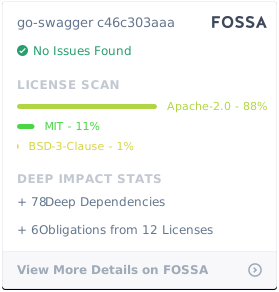
The toolkit itself is licensed under an Apache Software License 2.0: SPDX-License-Identifier: Apache-2.0.
Just like swagger, this does not cover code generated by the toolkit. That code is entirely yours to license however you see fit.