My RSS feeds include a short plain text description of each post in the <description> element within each <item>.
These aren't rendered by the current pretty-feed-v3.xsl file.
I've added something like this, between the item title and Published date:
<p class="mb-0">
<xsl:choose>
<xsl:when test="string-length(description) > 200">
<xsl:value-of select="substring(description, 0, 200)" />…
</xsl:when>
<xsl:otherwise>
<xsl:value-of select="description" />
</xsl:otherwise>
</xsl:choose>
</p>This displays the entire <description> if it's 200 characters or fewer, otherwise displays the first 200 characters followed by an ellipsis. (200 is just arbitrary.) e.g.:
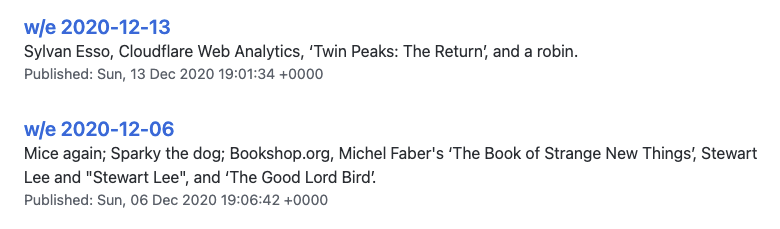
But I think some people have the entire HTML blog post within <description>, between <![CDATA[ and ]]>. This might be problematic if it's truncated mid-tag, or between opening and closing tags? Or maybe the HTML itself would be visible?
AFAIK there isn't a way to detect if the description starts with ![CDATA[ or not, so I'm not sure if this idea can be reliably generalised.
But, given I know my feeds only have a brief plaintext description, I've gone with the above.
My RSS feeds include a short plain text description of each post in the
<description>element within each<item>.These aren't rendered by the current
pretty-feed-v3.xslfile.I've added something like this, between the item title and Published date:
This displays the entire
<description>if it's 200 characters or fewer, otherwise displays the first 200 characters followed by an ellipsis. (200 is just arbitrary.) e.g.:But I think some people have the entire HTML blog post within
<description>, between<![CDATA[and]]>. This might be problematic if it's truncated mid-tag, or between opening and closing tags? Or maybe the HTML itself would be visible?AFAIK there isn't a way to detect if the description starts with
![CDATA[or not, so I'm not sure if this idea can be reliably generalised.But, given I know my feeds only have a brief plaintext description, I've gone with the above.